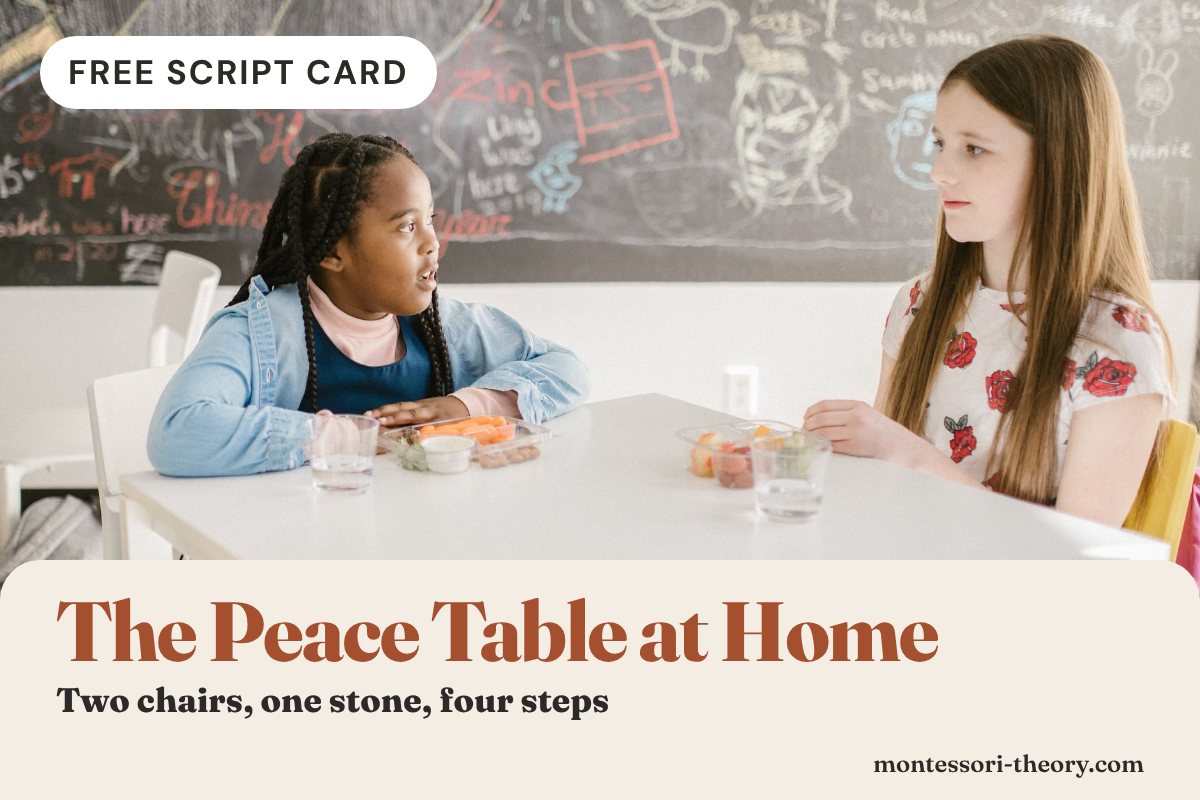
A peace table is a small, calm spot where two children sit down after a conflict and talk it through, taking turns holding an object. At home it needs two chairs, one object and a four-step script. Here’s how to set it up, what to say as the adult, and when to step in instead.
It’s one of the tools of Montessori positive discipline. There’s a free printable script card below.
The Peace Table in Four Steps
- Calm first. Only when both children are calm enough to talk.
- “I feel… when you…” The child holding the object says how they feel.
- “You feel… because…” The other child repeats what they heard.
- Find a fix. Both suggest a solution, then go back to play.
What a Peace Table Is
In many Montessori classrooms, a peace table is a quiet corner with two chairs and a “peace object,” often a stone, a shell or a flower. Children in a conflict go there, take turns holding the object and speak only while they hold it. They stay until both have been heard and they agree on a solution.
It grew out of Maria Montessori’s belief that peace is something children learn through daily practice. She wrote about it in Education and Peace (1949). The peace table turns that idea into a concrete routine children can use without an adult deciding who was right.
How to Set It up at Home
- Two seats. Two small chairs, two cushions or the bottom stair. A table is nice but optional.
- One object. A smooth stone, a shell, a small wooden heart. Something calming to hold that’s only used here.
- A script card. The four steps with pictures for children who don’t read yet. Print ours below.
- A calm place. Away from the TV and the main traffic, but not hidden. A corner of the living room works well.
Introduce it on a calm day, not during a fight. Role-play with stuffed animals. “Bear is sad because Bunny took the ball. Let’s help them use the peace table.”
The Four Steps
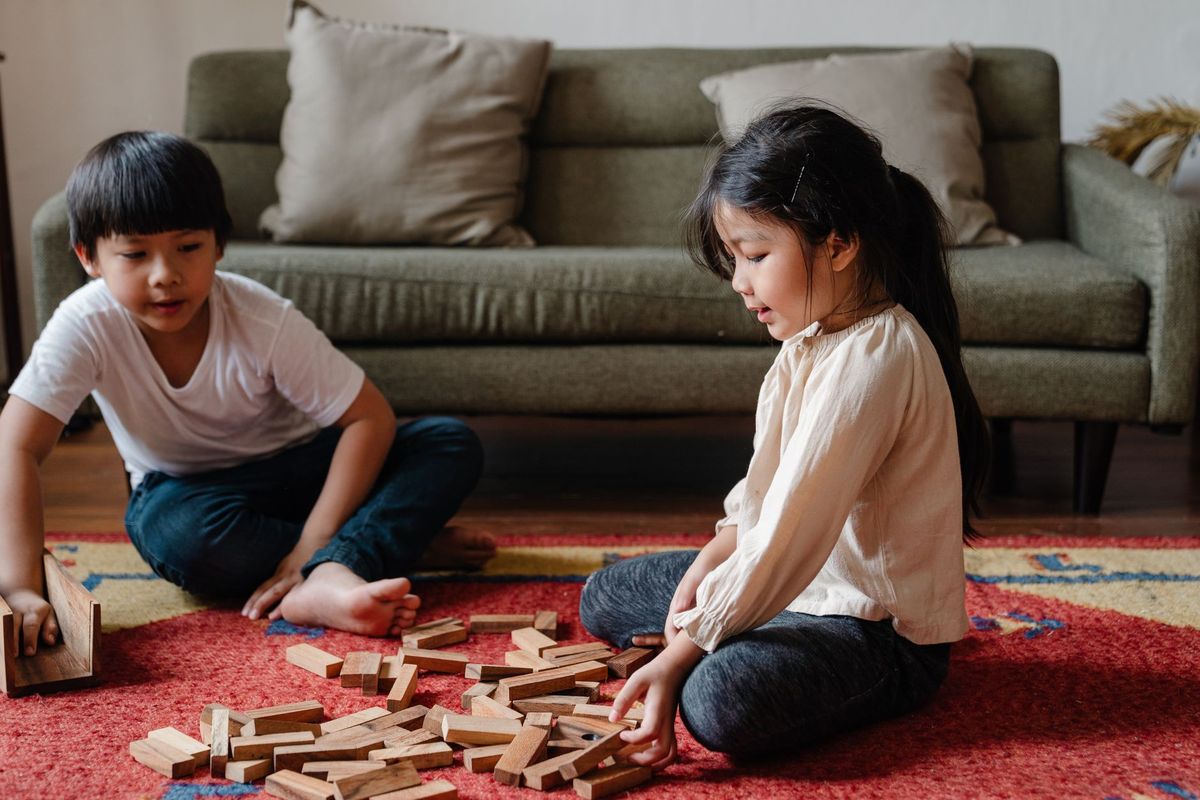
- “I feel… when you…” The first child holds the object. “I feel mad when you knock my tower over.”
- “I want…” Still holding it. “I want you to ask before you touch it.”
- “You feel… because…” The object passes over. The other child repeats what they heard, then shares their side. “You feel mad because I knocked it. I wanted to play too.”
- “How about we…?” Together they find a fix, like building a second tower or taking turns. Then a handshake, a hug or a high five, and back to play.
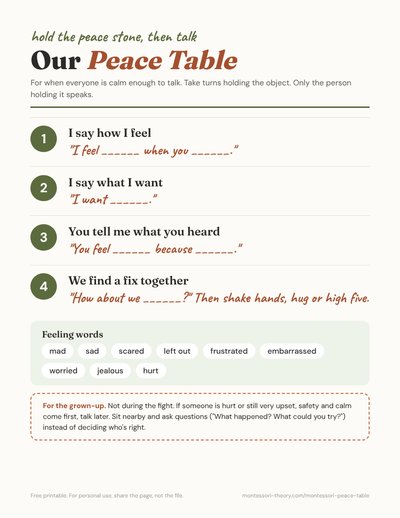
Our Peace Table Script Card
One page for the wall next to your peace table. The four steps, sentence starters, feeling words and a reminder for the grown-up.
What You Say as the Adult
Your job is to coach, not to judge. Sit nearby, help with words when they get stuck and keep the turns fair. Over time, step further back.
- “What happened? Tell your brother, not me.”
- “How did that feel? Here are some feeling words.”
- “What did you hear her say?”
- “What could you try now?”
- “You worked that out yourselves. That was hard.”
Avoid deciding who’s guilty or forcing an apology. A forced “sorry” teaches the words, not the repair. When children find the fix themselves, they’re more likely to stick to it.
Siblings of Different Ages
A peace table works best from about 3½ or 4, when children can use simple sentences about feelings. With a younger sibling, adapt it.
- Toddler and preschooler. You speak for the toddler. “Your sister feels sad. She wanted the blue car.” The older child still practices the steps.
- Big age gap. Protect the older child’s work so fewer fights start. A high shelf or a table the toddler can’t reach for projects in progress.
- Same-age siblings. Expect more fights about fairness. Remind them that fair doesn’t always mean the same.
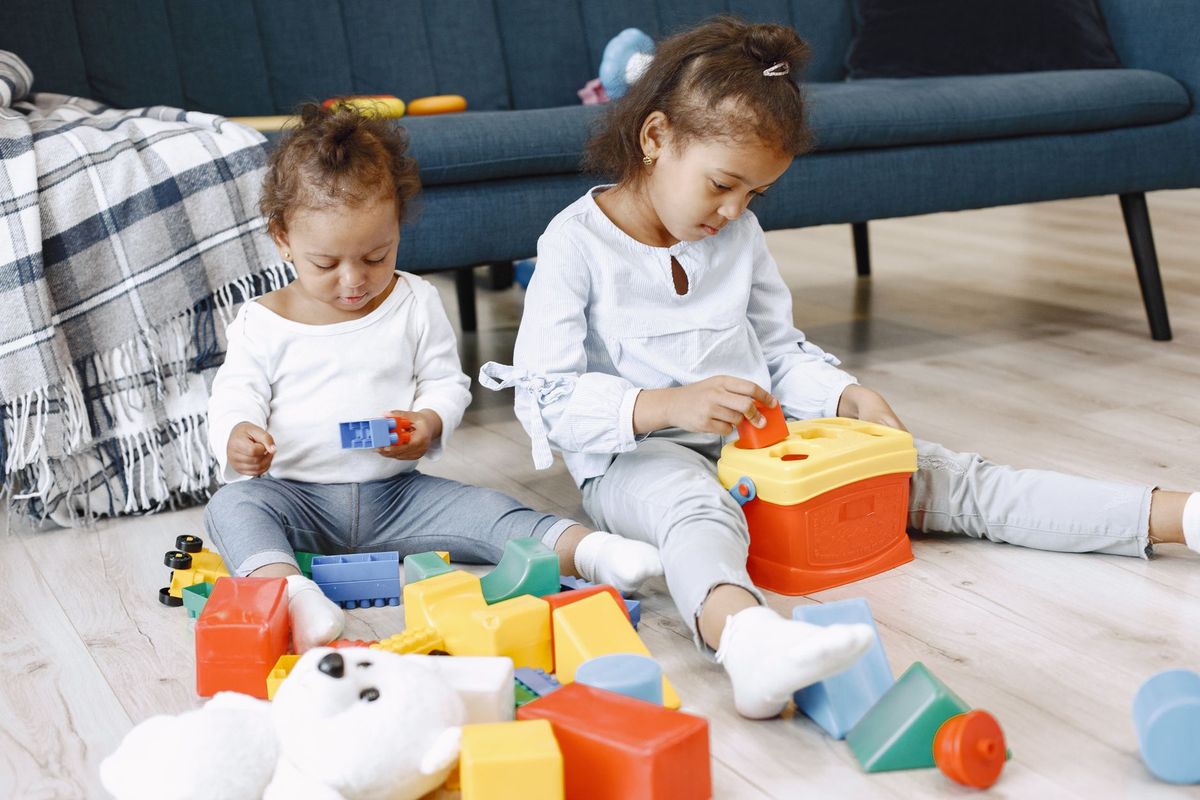
The American Academy of Pediatrics suggests staying out of minor sibling arguments when you can, setting clear ground rules like “no hitting,” and praising children when they solve problems themselves. The peace table gives them a way to do exactly that.
When Not to Use It
Safety first, talk later. If someone is hurt, being hit or still too upset to speak, separate the children and comfort the hurt child first. “I won’t let you hit. Let’s check on your brother.” The peace table comes later, once everyone is calm, sometimes an hour later. Never use it as a punishment or a place to be sent.
Peace Table vs Calm-Down Corner
| Question | Peace table | Calm-down corner |
|---|---|---|
| Who uses it | Two children together | One child alone |
| When | After a conflict, once calm | When a child feels overwhelmed |
| Goal | Talk it through and find a solution | Calm the body and feelings |
| What’s there | Two seats, a peace object, a script | Cushions, books, a breathing card, a soft toy |
Many families have both. A child often needs a few minutes in a calm spot before they’re ready for the peace table.
Questions Parents Ask
What Is a Peace Table in Montessori?
A quiet spot where two children resolve a conflict by taking turns speaking while holding an object, then agreeing on a solution, with little adult involvement.
What Do You Put on a Peace Table?
A peace object like a stone or shell, a script card with the steps, and sometimes a small plant or a sand timer. Keep it simple.
At What Age Can Children Use a Peace Table?
Usually from about 3½ or 4 with help. Older preschoolers and elementary children often use it on their own.
Does a Peace Table Work for Siblings?
Yes, especially for repeated fights over toys and space. You coach at first, then step back as they learn the steps.
Go Deeper
- Montessori positive discipline
- How to stop yelling at your kids
- How to get kids to listen
- Maria Montessori quotes
The Everyday Montessori Preschooler
Book 3 of the Montessori for Real Life series, for ages 3 to 6. Friends, siblings and playdates, hitting and meltdowns, and a peace table you can start this week. Coming December 8, 2026.
Launch price $6.99 $4.99 Kindle · $14.99 $12.99 paperback
Sources
- Montessori, M. Education and Peace (1949).
- American Academy of Pediatrics, HealthyChildren.org, Sibling Rivalry.
- American Montessori Society, Research Library, peace education.
- Photos from Pexels (free licence).