
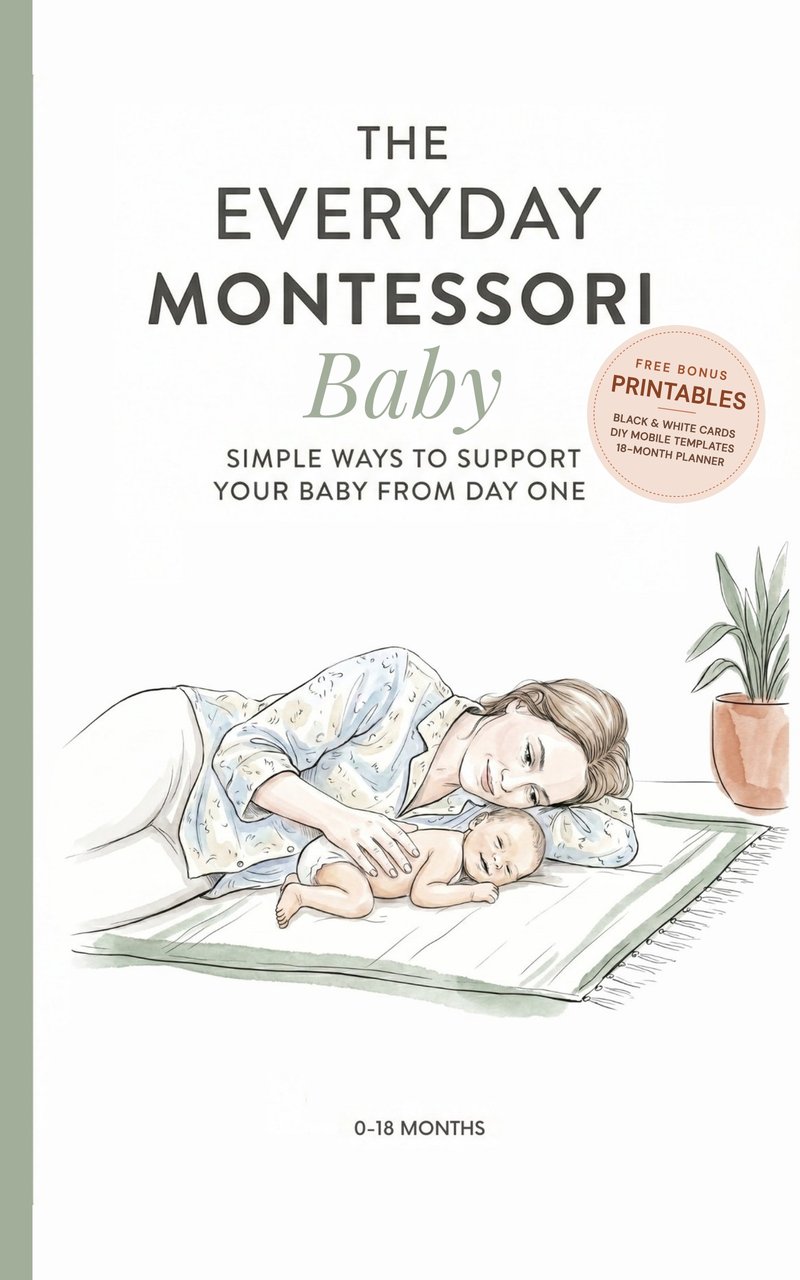
Montessori for Real Life · Book 1 · 0 to 18 months
The Everyday
Montessori Baby
Montessori for the home you actually live in. What your baby is working on at each stage, and simple things to do today with what you already have.
- Four age-by-age modules, from the first weeks to 18 months
- A sample day and simple activities for every stage
- Straight answers on sleep, pacifiers, screens, daycare and milestones
- No special furniture, no big budget, no prior knowledge needed
Free first chapter
The first weeks,
landing together.
Module 1 of the book, lightly condensed for the web. Read it on this page, or download the PDF to keep on your phone. No email needed.
In this chapter
- The period of symbiosis, and why you can’t spoil a newborn
- What your baby is already working on, week by week
- A day with a six-week-old, and the space they actually need
- Safe sleep basics and 5 simple activities for 0 to 3 months
13 pages, A5 format, cover included.
Inside the book
Everything age by age,
so you start where you are.
Go straight to the module that matches your baby right now. No need to read from the beginning.
The First Weeks, Landing Together (0 to 3 months)
The period of symbiosis, a day with your newborn, preparing their space, safe sleep, the first visual mobiles and tummy time.
Start here
A Different Way of Seeing Your Baby
What Montessori actually is, three ideas to hold on to, three things to try today. Plus 7 Montessori myths that keep parents stuck.
3 to 6 months
The World Opens Up
Month by month, a day with a 4-month-old, the next mobiles, evolving their space, activities and the hard questions.
6 to 9 months
The Explorer on the Move
The movement sequence, first foods the Montessori way, and preparing the space for a baby who crawls.
9 to 18 months
Toward Independence
Walking on their timeline, limits, the first “no” and the first big feelings, real independence day to day.
Reference
Preparing the Home, Practical and Real
The yes space, room by room, the floor bed done safely, a starter kit by age and an easy toy rotation system.
Reference
The Montessori Parent, Your Inner Work
Observation in five steps, repair when you lose it, staying calm, working with a partner or grandparents.
Reference
The Real Questions, Straight Answers
Montessori vs. real life, sleep, development worries, and the questions nobody asks out loud.
From chapter 1
Where you are right now as a parent
“This module won’t ask you to feel sure of yourself. It asks you to show up and pay attention. For now, that’s enough.“
The period of symbiosis
“This isn’t the time to push independence. Floor time and activities are coming, and they rest on the safety you build now. You can’t spoil a newborn.“
Activities for 0 to 3 months
“In Montessori, a newborn ‘activity’ is something your baby does themselves. You prepare the space, place them in it and step back.“
How the book works
Short, practical,
built for interrupted reading.
Each module follows the same pattern, so you always know where to look.
In every module
“If you only have 5 minutes”, the one thing to do today
A “Common mistake” and how to fix it without guilt
“You’re doing fine if…”, for the days that feel messy
“The Hard Questions”, crying, sleep regressions, separation anxiety, biting
Also in the book
Checklists, observation and rotation logs
A one-page note for grandparents and caregivers
Safe sleep and first foods in line with pediatric guidance, with when to call your pediatrician
Three printables, high-contrast cards, DIY mobile templates, an 18-month planner (see them here)
Free chapter · Module 1 of 7
Read it here,
no email needed.
The first weeks with your newborn. What your baby is working on, a sample day, safe sleep and five simple activities, in about 10 minutes of reading.
This is the first module of The Everyday Montessori Baby, a practical Montessori guide from birth to 18 months, lightly condensed for the web. Read it here, free, no email needed.
0 – 3 months
Module one
The First Weeks
Landing Together
Your baby has just made the biggest journey of their life. These weeks are about arriving. Milestones can wait.
“I have no idea what I’m doing, and I’m terrified of getting it wrong.”
Almost every new parent feels this, and it says nothing about how good a parent you are. This module won’t ask you to feel sure of yourself. It asks you to show up and pay attention. For now, that’s enough.
Montessori’s answer to this period is gentleness and unhurried presence, with nothing to achieve. Their whole job right now is to get their bearings, to learn that the world is safe, that you’re reliable, and that their body makes sense.
Everything in this module serves that one goal.
The Period of Symbiosis
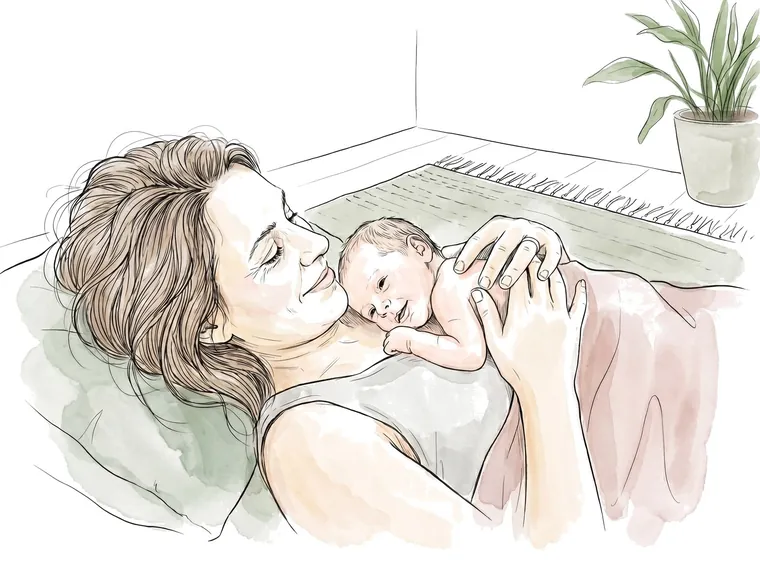
Montessori educators call the first six to eight weeks the period of symbiosis. Your baby and their main caregiver depend on each other so closely that they almost work as one unit.
Your baby needs your smell, your heartbeat, your voice and your warmth. They already know you, since they’ve been hearing your voice for months.
This isn’t the time to push independence. Floor time and activities are coming, and they rest on the safety you build now. You can’t spoil a newborn. Hold your baby, carry them in a wrap if it helps.
What Your Baby Is Already Working On
Newborns “don’t do anything”? In fact, this is some of the most intense learning of their life.
- Your voice, recognized from birth
- Faces best at 8 to 12 inches (20 to 30 cm), about the distance to yours during a feed
- Your smell, especially your milk
- Different cries for hunger, tiredness and overload
- Looking away when they need a break
- Going still and alert when something interests them
- Coos and first smiles, from about six weeks
- Basic trust in the world
- The foundations of language and face recognition
- The ability to calm down, with your help
- A map of their own body
- Predictable responses to their signals
- Slow handling, announced in words
- Time to look at your face up close
- Calm and quiet as much as stimulation
A rough timeline
A Day With Your Newborn
A newborn’s day has no fixed schedule, and it shouldn’t. Here’s one cycle with a six-week-old. It repeats, with variations, all day long.
Feeding frequency and awake time vary a lot from one baby, and one week, to the next.
Preparing Their Space
The Montessori newborn environment rests on one principle, beauty and simplicity over quantity and stimulation. Your baby’s nervous system is brand new. It needs calm, order and one interesting thing at a time.
What your baby actually needs
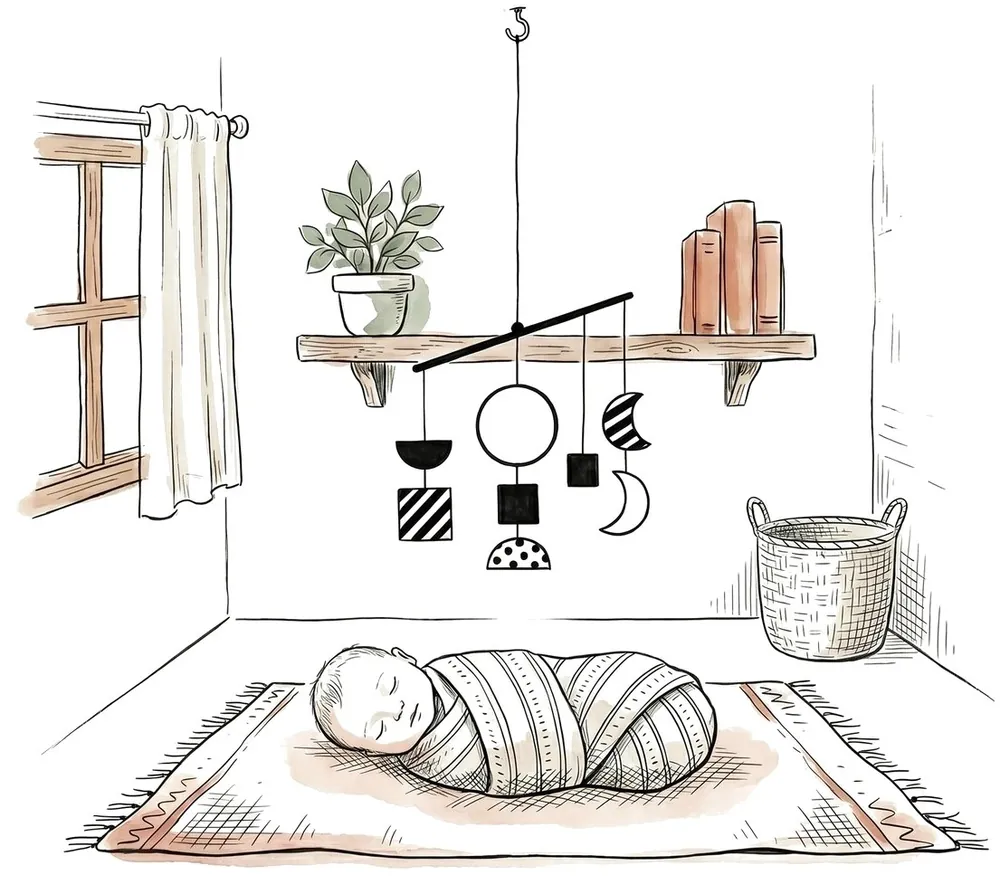
A firm, flat surface where your baby can lie and move freely while awake, like a folded blanket or a simple mat. All movement starts here.
A shatterproof mirror placed horizontally along the mat. Your baby sees their own movements in it, which helps build a sense of their own body.
Hung above the play mat, never over the crib, 8 to 12 inches (20 to 30 cm) from their face. One at a time is plenty.
A crib or bassinet that meets current safety standards, in your room. The same place every time builds trust.
What you can safely skip
Fine for short breaks. Used all day, they replace the floor time your baby’s body needs.
One well-chosen object beats ten scattered around.
Hands are one of your baby’s main reference points. If the room is warm enough, leave their hands free.
- Always put your baby down on their back, for naps and at night.
- Use a firm, flat surface that isn’t inclined, with a fitted sheet and nothing else. No pillow, no loose blanket, no bumper, no stuffed animal.
- For the first six months, the recommendation is in your room, on a separate surface, like a crib or bassinet near your bed.
- Never sleep with your baby on a couch or armchair. These are the most dangerous places of all.
- Avoid overheating and smoke exposure. A sleep sack is safer than a blanket.
- Swings, car seats and baby carriers aren’t meant for sleep. If your baby falls asleep in one, move them to their bed as soon as you can.
Recommendations change and situations vary. Talk them through with your pediatrician.
Activities for 0–3 Months
In Montessori, a newborn “activity” is something your baby does themselves. You prepare the space, place them in it and step back.
Hold your baby close, about 8 to 12 inches from your face, or lean over them. Look them in the eye. Stick out your tongue, then wait and see what happens. Talk slowly, leave pauses and let them answer.
This is the groundwork for language. If you only do one thing from this module, make it this.
Lay your baby on their back on a firm mat, lightly dressed so their arms and legs move freely. Sit nearby and watch. Every kick, every turn of the head is practice.
Start with five to ten minutes when they’re calm and alert. Rolling, crawling and sitting all start here.
Montessori uses a sequence of mobiles matched to your baby’s developing vision. The first is the Munari, black and white geometric shapes with one clear sphere, moving slowly in the air. Around five to six weeks comes the Octahedron, three shiny shapes in primary colors that catch the light. The next ones are in Module 2.
Hang the mobile over the play mat, put your baby underneath and watch. Don’t shake it or point at it. They’ll find it.
Put your baby on their tummy on your chest or on the mat, for short periods while they’re awake and you’re watching. It builds the neck and back strength they’ll need to sit and crawl.
Early on, two or three minutes a few times a day is enough.
Diaper changes, baths, feeds and getting dressed aren’t interruptions to your baby’s development. In Montessori, they’re at the center of it. Slow down and announce each step, and your baby learns that their body belongs to them and that the world is predictable.
Pick one care routine today and do it at half your usual speed, announcing each step. Watch your baby’s face the whole time. What changes when you slow down?
The Hard Questions
“My baby cries all the time and I can’t work out why. What am I doing wrong?”
Probably nothing. In the first weeks, crying is your baby’s only reliable way to communicate, and you’re both still learning the code. Check the basics, hunger, discomfort, tiredness or too much going on. Sometimes your baby just needs to be held. Crying often peaks around six weeks and then eases.
Call your pediatrician if the crying comes with a fever, refusal to feed, unusual drowsiness, or if it sounds different from usual. And if you feel close to breaking point, put your baby down safely in their crib, step out of the room for a few minutes and call someone. It happens to plenty of parents, and asking for help is the right move.
“I don’t feel the bond I expected. Is something wrong with me?”
Bonding doesn’t always arrive as a rush of love at birth. For many parents it builds slowly, over weeks or months. If you’re caring for your baby and responding to them, even on the hard days, bonding is happening.
If you feel persistently empty, anxious or sad, or if dark thoughts come up, talk to your doctor or midwife soon. Postpartum depression is common and it can be treated. You deserve support too.
Put your baby on the mat, on their back, for ten minutes. No bouncer, no arms, lightly dressed. Sit beside them and just watch.
That’s it. You’ve done Montessori today.
“I put a toy in their hand while they were just looking at it.”
When your baby is staring at something, they’re concentrating. Put something in their hand and the discovery is over. Wait, and let them get there.
- Your baby cries and you try to respond, even when you don’t know why
- You managed a few minutes on the mat today, even if it felt awkward
- You talked to your baby today, even just narrating the kitchen
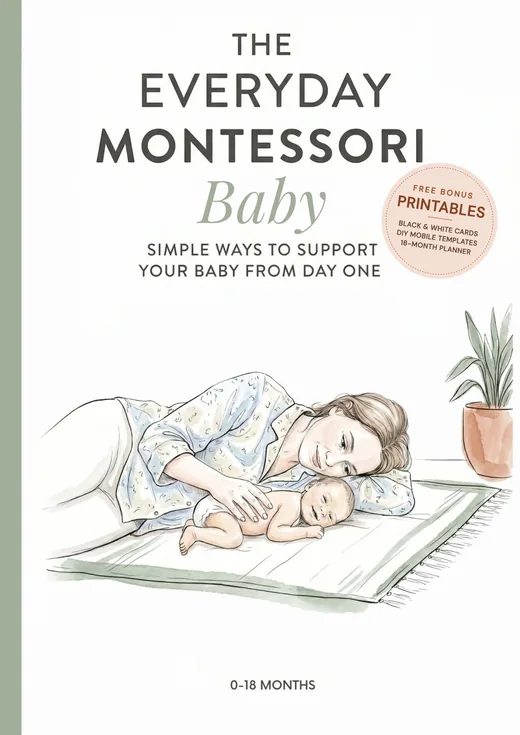
The rest of the first 18 months, one stage at a time
This chapter covers the first three months, condensed for the web. The full book follows your baby all the way to 18 months.
- 7 Montessori myths that keep parents stuck
- 3 to 6 months, 6 to 9 months and 9 to 18 months, each with a sample day, activities and straight answers
- Preparing your home room by room, the floor bed done safely, and a starter kit by age
- Your inner work as a parent, and the questions other books avoid
- Printables to download, with high-contrast cards, DIY mobile templates and an 18-month planner
The free printables for the book are on the baby printables page.
Book 1 of Montessori for Real Life
Keep going,
one stage at a time.
Kindle and paperback (5.83 × 8.27 in). The next stage, from 18 months to 3 years, is covered in The Everyday Montessori Toddler.
Already have the book? Your printables are on this page. Comparing with Simone Davies’ books? See our side-by-side comparison.