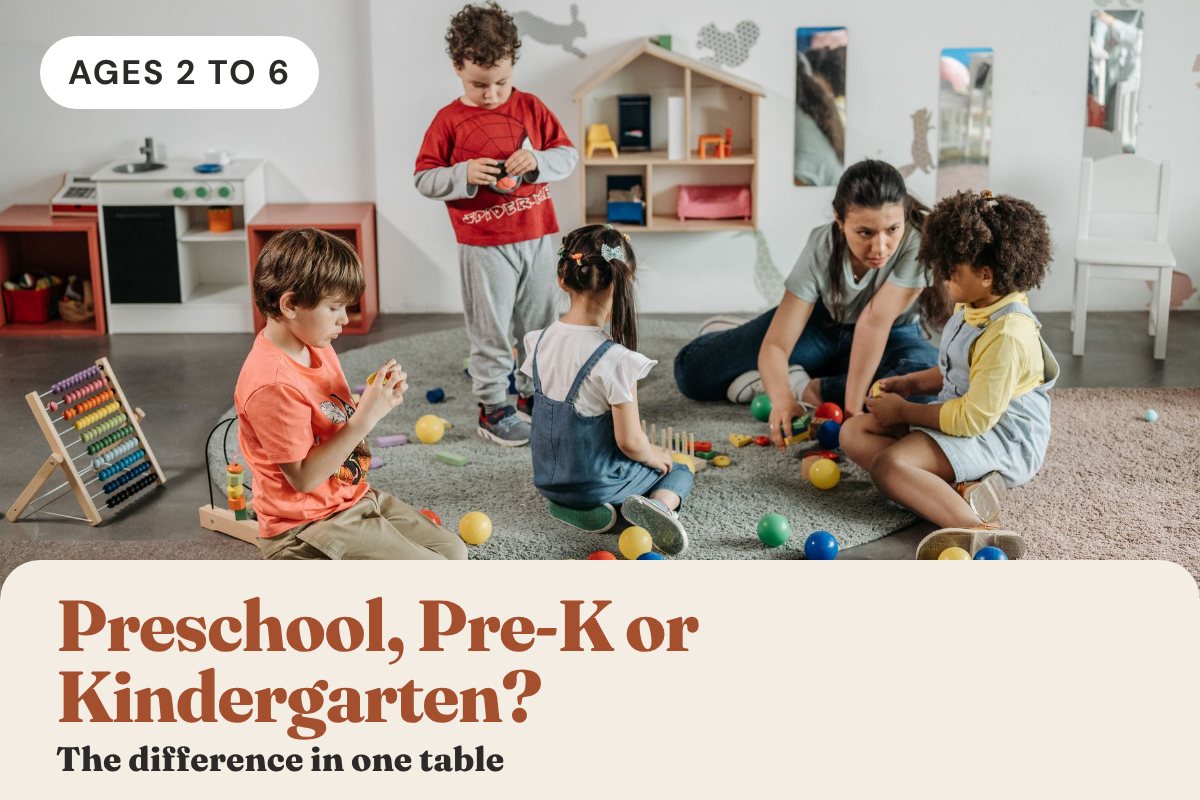
Preschool usually covers ages 2 to 5, pre-K is the year before kindergarten, and kindergarten is the first year of elementary school, usually at 5. The names overlap, and states use them differently. This guide puts them side by side, explains K4 and TK, and shows where a Montessori classroom fits.
For how Montessori schools work in general, see the Montessori school approach.
| Program | Usual ages | Main purpose | Required? | Who pays |
|---|---|---|---|---|
| Preschool | About 2½ to 5 | Play, routines, social skills, early language and numbers | No | Usually families, sometimes public or Head Start |
| Pre-K (also K4, TK) | 4, the year before kindergarten | Getting ready for kindergarten | No | Often free when state-funded, otherwise families |
| Kindergarten | About 5 to 6 | First year of elementary school, reading and math begin | In 17 states and DC | Free in public schools |
| Montessori Children’s House | About 3 to 6, mixed ages | A three-year cycle, the last year is the kindergarten year | No | Usually families, some public Montessori programs |
What Preschool Is
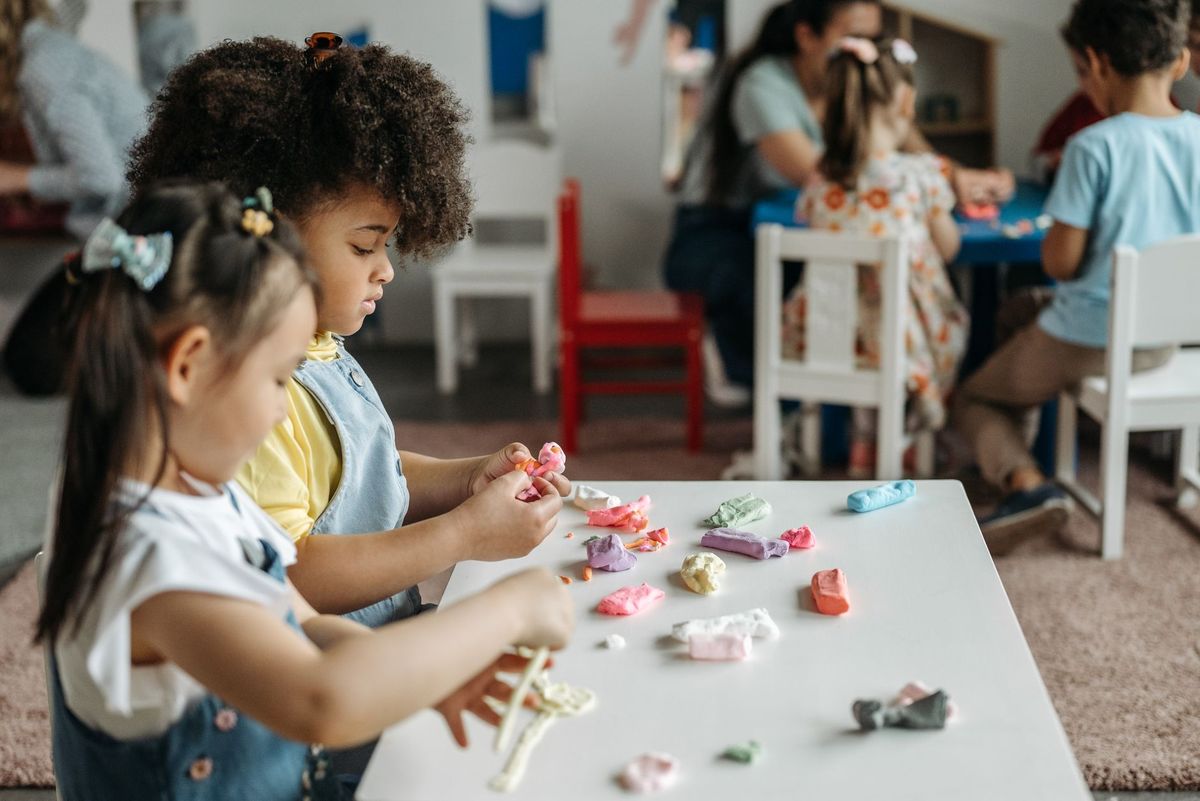
Preschool is the broad name for group programs before kindergarten. Children usually start between 2½ and 4. Programs can be half day or full day, two to five days a week, in a church, a center, a home or a school.
The focus is learning through play and routine. Separating from parents, taking turns, following simple group rules, listening to stories, early counting and lots of movement. Quality and philosophy vary a lot between programs, even under the same name.
Head Start is the federal preschool program for children from low-income families, mostly ages 3 and 4. Early Head Start serves infants and toddlers.
What Pre-K Is (and K4, TK and Public Pre-K)
Pre-K means pre-kindergarten, the year just before kindergarten, usually at age 4. It is often more structured than a younger preschool class, with more time on letters, numbers and school routines.
- K4. Another name for pre-K used in some states and private schools, meaning kindergarten for 4-year-olds. Kindergarten itself is then called K5.
- TK (transitional kindergarten). A public pre-kindergarten year in some states. In California, TK is now open to every child who turns 4 by September 1.
- Public or state pre-K. State-funded programs, sometimes free for all 4-year-olds, sometimes based on income. According to NIEER, 37% of 4-year-olds were enrolled in state-funded preschool in 2023 to 2024.
So “is there a difference between pre-K and preschool?” Yes, usually. Pre-K is a specific year, while preschool is the whole family of programs before kindergarten. Many centers simply call their oldest class “pre-K.”
What Kindergarten Is
Kindergarten is the first year of elementary school, usually for children who turn 5 before a cutoff date set by each state. It is free in public schools, and most states require districts to offer it.
Attendance is a different matter. According to the Education Commission of the States, 17 states and the District of Columbia require children to attend kindergarten. Elsewhere, families can wait and start school in first grade. Many choose kindergarten anyway, since it is now where formal reading and math start. If you are weighing a later start, see what kids really need before kindergarten.
Where a Montessori 3 to 6 Class Fits
Montessori doesn’t follow the preschool, pre-K, kindergarten split. Children from about 3 to 6 share one classroom, often called the Children’s House or Primary, and stay with the same teacher for three years.
- First year (about 3). Practical life, sensorial work, settling into the group.
- Second year (about 4). Letters and sounds, numbers, longer concentration.
- Third year (about 5). The kindergarten year. Children often read, write and work with larger numbers, and they lead the younger ones.
That third year is why many Montessori schools ask families to commit through kindergarten. It’s when the earlier work comes together. Some states fund public Montessori programs, so the kindergarten year can be free there. More in Montessori kindergarten.
Does My Child Need Preschool?
Preschool is not required. Many children do well starting school at kindergarten, especially if they already spend time with other children and adults outside the family.
What preschool offers is practice. Group routines, waiting, sharing an adult’s attention, and separating from you. If your child stays home, you can build the same skills with library story times, playgroups, classes and plenty of real jobs at home.
A simple way to decide. Think about what your child needs most this year. Time with other kids? A predictable routine? Time for you to work? A program that fits that need, at a cost you can sustain, is a better choice than the “best” program on paper.
Questions to Ask Any Program
- How long are children free to choose their activities? Look for long stretches of play or work, not constant transitions.
- How many children per adult, and how long have the teachers stayed? Low turnover is a good sign.
- What happens when a child cries at drop-off or hits? Listen for calm, specific answers.
- How much time is spent outside?
- For Montessori schools, are the lead teachers AMI or AMS trained, and are the classes mixed-age? Our checklist for authentic Montessori schools helps.
Questions Parents Ask
Is Preschool the Same as Kindergarten?
No. Preschool comes before kindergarten and is optional. Kindergarten is the first year of elementary school, usually at 5, and is free in public schools.
What Age Is Preschool vs pre-K?
Preschool usually starts between 2½ and 4. Pre-K is the year before kindergarten, typically at 4.
What Is K4 in School?
K4 means kindergarten for 4-year-olds. It is another name for pre-K, followed by K5, which is regular kindergarten.
Is pre-K Required?
No state requires pre-K. Some offer it free to every 4-year-old, others only to families who qualify.
Is Preschool Important?
Good preschool can help with social skills and school routines, but it isn’t the only path. A warm home with other children around, books, conversation and real jobs builds the same foundations.
Go Deeper
- How Montessori schools work
- Montessori kindergarten, the third year
- Montessori school costs and access
- What is Montessori?
The Everyday Montessori Preschooler
Book 3 of the Montessori for Real Life series, for ages 3 to 6. Choosing and starting school, the after-school crash, letters and numbers at home, with simple steps for real families. Coming December 8, 2026.
Sources
- Education Commission of the States, 50-State Comparison, State K-3 Policies.
- National Institute for Early Education Research, The State of Preschool 2024.
- Office of Head Start, Head Start Programs.
- Children Now, Transitional Kindergarten 101 (California TK eligibility).
- American Montessori Society, 5 Core Components of Montessori Education.
- Photos from Pexels (free licence).