
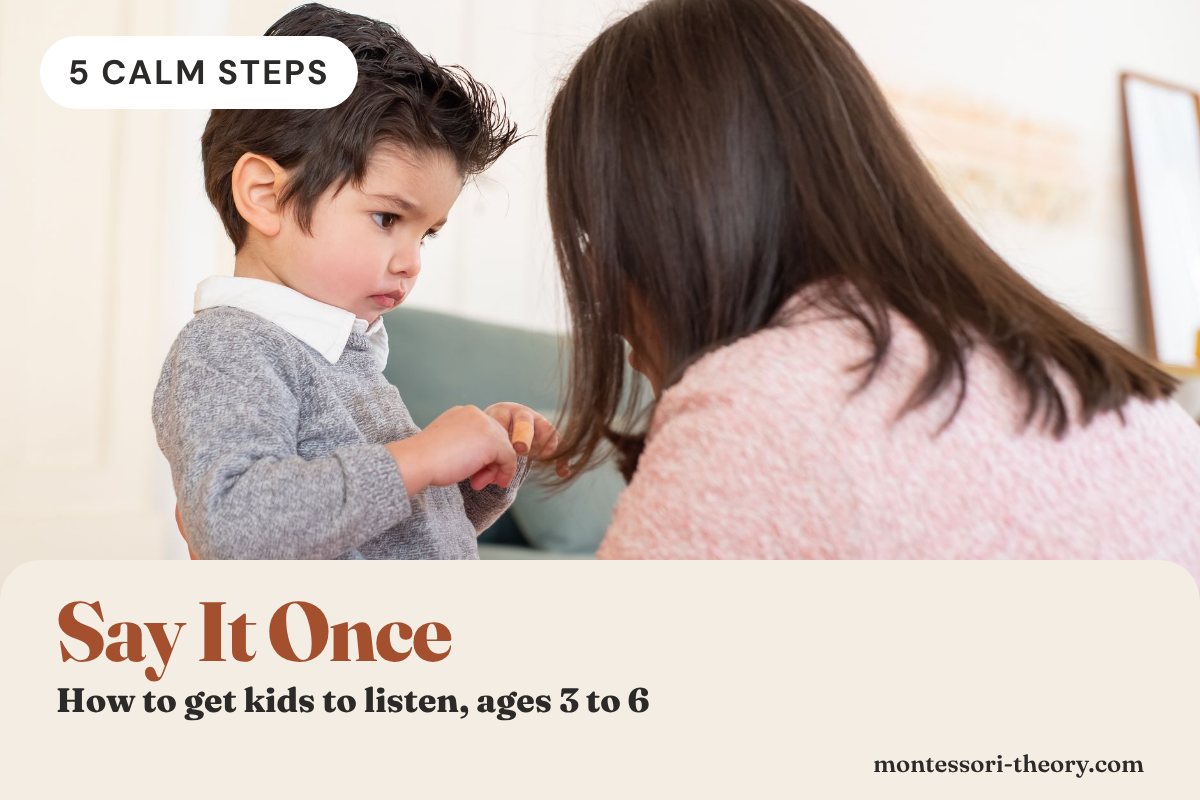
Kids listen better when you go to them, say it once, warn before a switch, offer a choice about how, and follow through calmly with your body, not your voice. Those five steps work for most children from 3 to 6. This guide adds what to do when you must leave on time, and when it’s worth checking more.
The steps build on Montessori positive discipline. Calm limits, respect and no shouting matches.
The five steps
- Go to them. Get close, get low, wait for eye contact.
- Say it once. One short instruction, in a normal voice.
- Warn before the switch. “Two more turns, then shoes.”
- Give a choice about how. “Hop or tiptoe to the door?”
- Follow through. If nothing happens, calmly help with your hands.
Why Kids Don’t Listen at 3 to 6
Most “not listening” isn’t defiance. A preschooler deep in play really may not register a voice from the next room. Shifting attention from a fun task to a boring one is a skill that is still developing, and it collapses when children are tired, hungry or overwhelmed.
Instructions also pile up. Shoes, hands, coat, hurry, not that, careful. When everything is said ten times, nothing stands out. Children learn that the first nine times don’t matter.
And at 4 and 5, “no” is a way of testing independence. That’s healthy, even when it’s exhausting. The goal isn’t instant obedience. It’s a child who hears you, knows you mean it, and has a way to cooperate without losing face.
The 5 Steps, With What to Say
1. Go to Them
Walk over, crouch to their level and put a hand on their shoulder or wait until they look up. Calling from the kitchen trains children to tune you out. Nemours pediatric experts give the same advice. Go to your child’s space and get on their level.
You can say, “Hey, I need your ears for a second.”
2. Say It Once
One instruction, short and specific, in a normal voice. Say what to do, not what to stop. “Feet on the floor” works better than “Stop jumping.” “Be careful” doesn’t tell a child what to do.
You can say, “Shoes on, please.” Then wait about ten seconds. Silence gives the words time to land.
3. Warn Before the Switch
Transitions are the hardest moments. A warning lets your child finish in their head before they finish with their hands. Make it concrete, since young children can’t track minutes.
You can say, “Two more slides, then we go.” Or “When the timer rings, it’s bath time.” A visual timer or a picture routine (see our day schedule at home) does the reminding for you.
4. Give a Choice About How
The task isn’t optional, but the way of doing it can be. A choice gives your child a bit of control, which is often what the “no” was about.
You can say, “Do you want to put on your boots or your sneakers?” “Will you carry your bag or should I?” “Hop like a frog or tiptoe like a cat to the car?” Offer only choices you’re happy with.
5. Follow Through With Your Hands, Not Your Voice
If nothing happens after one instruction and a short wait, don’t repeat it louder. Calmly help. Take their hand and walk to the door, or put the first shoe on together. Follow-through is how children learn that your words mean something.
You can say, “I see it’s hard to stop. I’ll help you.” Then do it, kindly and without a lecture. The American Academy of Pediatrics recommends exactly this kind of calm, consistent follow-through over yelling or punishment.

When You Have to Leave on Time
Some mornings there is no room for choices and timers. Plan for those mornings the night before, not at 8:10.
- Prepare the night before. Clothes laid out, bag by the door, shoes in one spot.
- Use one routine card. Pictures of the four morning steps, so you point instead of talk.
- Front-load the fun. “Shoes first, then you can carry the key to the car.”
- Have a fallback. If it’s time and nothing is working, carry the shoes and put them on in the car. It isn’t failure. It’s choosing the battle.
The Hard Questions
“They Only Listen When I Yell.”
Short answer. Yelling works because it finally comes with action. The fix is to move the action earlier, before the yell.
Try this. After one calm instruction and ten seconds of silence, go straight to step 5. Within a few days, your calm voice starts to carry the same weight.
If you’ve already tried that. Count your instructions for one afternoon. Many parents are surprised by the number. Drop anything that isn’t safety or truly necessary, and keep calm follow-through for what’s left.
With a baby around. You can’t always get up. Use a signal you agreed on together, like a hand on your head for “come here,” and keep the baby in a carrier for the follow-through moments.
“My 4 Year Old Is so Defiant.”
Short answer. At 4, “no” is often about control, not about the task. Give control in small, safe doses.
Try this. Offer more choices about how and when, give real jobs, and name what you see. “You want to decide. You can decide which cup.”
If you’ve already tried that. Look at sleep, hunger and the hour of the day. Defiance that spikes at the same time daily is often a tiredness problem dressed as a behavior problem.
For you. If you’ve been yelling more than you want to, you’re not alone and nothing is broken. Repair is part of the plan. “I yelled. I’m sorry. I’ll try again.” Then start the five steps the next time, not the next perfect day.
Normal, Watch, Ask
Normal
- Ignoring you while absorbed in play
- Saying no, then doing it anyway
- Listening better at school than at home
- Worse listening when tired or hungry
Watch for a few weeks
- Seems not to hear you, even when close and face to face
- Rarely follows simple instructions anywhere, not just at home
- Frequent intense meltdowns that don’t ease with calm routines
Questions Parents Ask
Why Won’t My Child Listen Until I Yell?
Because yelling usually comes right before you act. Your child has learned that the calm requests can wait. Say it once, then follow through calmly, and the calm voice starts to work.
How Do I Get My Child to Listen the First Time?
Go to them, make eye contact, give one short instruction, wait ten seconds, then help them do it. Consistency matters more than the exact words.
Why Is My 4 Year Old so Defiant?
At 4, children push for independence and test limits. Offer choices about how, give real responsibilities, and keep limits calm and consistent.
Should I Use Time-Outs?
The AAP lists short time-outs as one option for young children, used calmly. Many Montessori families prefer a “time-in” or a calm-down spot, staying close until the child is ready to try again.
How Do I Get My Kindergartener to Listen?
The same five steps work, with more responsibility. Agree on a morning routine together, write or draw it, and let your child check their own steps.
Go Deeper
- Montessori positive discipline
- Freedom within limits
- Montessori parenting in five habits
- A Montessori day schedule at home
The Everyday Montessori Preschooler
Book 3 of the Montessori for Real Life series, for ages 3 to 6. Not listening, meltdowns, the after-school crash, letters, numbers and starting school, with simple steps for real homes. Coming December 8, 2026.
Sources
- American Academy of Pediatrics, HealthyChildren.org, Disciplining Your Child.
- Sege, R. D. and Siegel, B. S. (2018). Effective Discipline to Raise Healthy Children. Pediatrics, 142(6), e20183112. doi:10.1542/peds.2018-3112.
- Nemours, How to Get Kids to Listen Without Yelling.
- American Academy of Pediatrics, Bright Futures periodicity schedule (hearing screening).
- Centers for Disease Control and Prevention, Learn the Signs. Act Early. Milestones by 4 years and by 5 years.
- Photos from Pexels (free licence).