If you search for Maria Montessori quotes, you will find the same forty lines recycled across hundreds of pages. Some are real. Several are misattributed. A few are completely invented. No book, no lecture, no source. And almost none of them tell you what to actually do with the insight.
This article does things differently. Every quote here is sourced to the specific book or lecture it came from. The ones that cannot be verified are flagged clearly. And each one is followed by what it actually means for a parent or caregiver in a child’s daily life, because a quote on a Pinterest board does nothing unless it changes something.
A note on fake quotes
Dozens of quotes widely attributed to Maria Montessori online have no verified source. “The child is not a vase to be filled, but a spring to be allowed to gush forth” does not appear in any of her books or lectures. “Help me to do it myself” is from the Reggio Emilia educator Loris Malaguzzi. “It is not enough to know what to do: the child must feel it” has no traceable origin. These circulate on Instagram and Pinterest endlessly. We have not included them here.
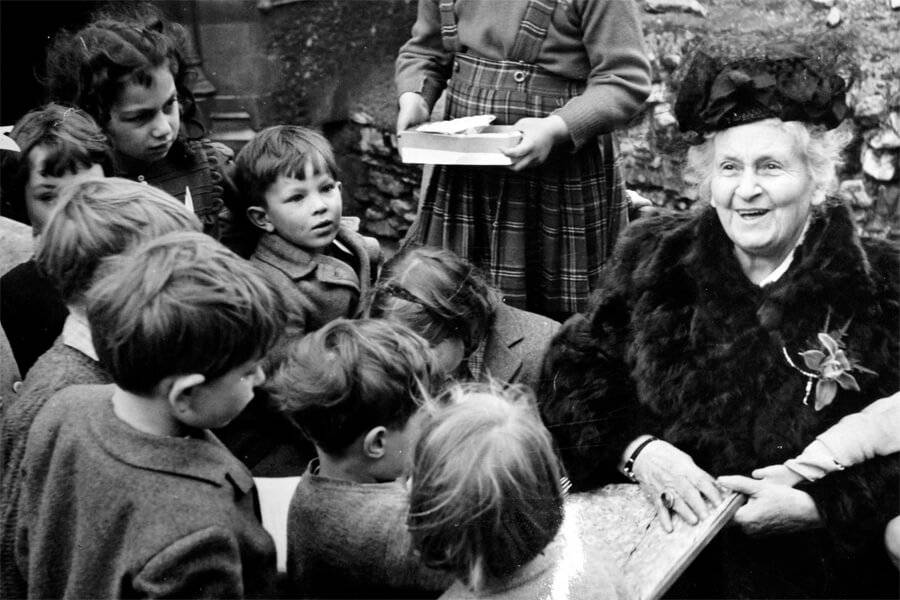
Maria Montessori (1870–1952) spent her life observing children, the foundation of everything she wrote.
On the Child’s Inner Work
Montessori’s most radical insight was that children are not passive recipients of education. They are, in her words, already working, building themselves from the inside out. These quotes capture that core idea.
“The essence of independence is to be able to do something for one’s self. Adults work to finish a task, but the child works in order to grow, and is working to create the adult, the person that is to be. Such experience is not just play: it is work he must do in order to grow up.”
Source: The Absorbent Mind (1949), Chapter 9
What this means in practice
When a toddler spends ten minutes trying to put on their shoes, they are not wasting time. They are building the neural pathways that will make them capable. The frustration is the work. Intervening to speed things up removes the growth, not just the inconvenience.
“The first essential for the child’s development is concentration. The child who concentrates is immensely happy.”
Source: The Absorbent Mind (1949), Chapter 22
What this means in practice
A child deeply absorbed in stacking cups, sorting objects, or filling and emptying a container is not playing around. They have found the thing their developing brain needs right now. Interrupting that concentration to show them “a better way” or to move on to the next activity breaks something real. Protect the concentration first.
“Our care of the child should be governed, not by the desire to make him learn things, but by the endeavour always to keep burning within him that light which is called intelligence.”
Source: The Discovery of the Child (1948), Chapter 4
What this means in practice
The goal is not an output: a skill, a fact, a behavior, but a state: curiosity kept alive. An adult who forces a child to sit and practice something they are not ready for, or who over-explains and over-corrects, risks extinguishing that curiosity long before any skill is gained. The first job is to not put the fire out.
On the Role of the Adult
One of the most consistent themes in Montessori’s writing is the redefinition of the adult’s role. Not teacher. Not authority. Not even guide in the conventional sense. Something quieter and harder.
“The greatest sign of success for a teacher is to be able to say, ‘The children are now working as if I did not exist.'”
Source: The Absorbent Mind (1949), Chapter 27
What this means in practice
This quote is often quoted as inspiration but its implication is regularly missed: a child who cannot work without the adult’s constant presence, validation, or instruction is a signal that something in the environment or the adult’s behaviour is creating dependency. The question to ask is not “how do I help more?” but “what have I set up that is preventing the child from working alone?”
“Never help a child with a task at which he feels he can succeed.”
Source: The Montessori Method (1909), attributed throughout
What this means in practice
The key word is “feels.” Not “can”: “feels he can.” A child who is struggling but still engaged, still trying, still not calling for help, is in the exact zone where growth happens. The adult’s instinct to step in and resolve the difficulty is understandable but often counterproductive. Watch first. Help only when asked, or when the child is clearly stuck beyond their current capacity.
“Do not tell them how to do it. Show them how to do it and do not say a word. If you tell them, they will watch your lips move. If you show them, they will want to do it themselves.”
Source: The Discovery of the Child (1948); also referenced in training materials based on her 1938 lectures
What this means in practice
This describes the Montessori lesson format exactly: slow, silent demonstration. When an adult narrates every step aloud, the child processes the language rather than the action. When an adult demonstrates slowly and silently, the child watches the hands, internalises the movement, and then wants to replicate it. Try folding a cloth slowly in front of a toddler without saying a word, and see what happens.
On Freedom and Its Limits
Montessori is often misread as advocating for unlimited freedom. Her actual position was more precise and more demanding. Freedom, in her framework, is not the absence of structure. It is freedom within boundaries that have been carefully prepared.
“To let the child do as he likes when he has not yet developed any powers of control is to betray the idea of freedom.”
Source: The Montessori Method (1912 English edition), Chapter 5
What this means in practice
A toddler given unlimited choices before they have developed the ability to self-regulate is not being liberated: they are being overwhelmed. Montessori’s freedom is graduated: freedom to choose between two things, then three; freedom to move within a prepared space; freedom to select work from a limited, intentional shelf. Structure comes first. Freedom expands as the child’s capacity grows.
“To give a child liberty is not to abandon him to himself.”
Source: The Discovery of the Child (1948), Chapter 5
What this means in practice
Giving a child freedom means preparing the environment so carefully that the child can navigate it safely and independently, and then being present as an observer. It does not mean stepping back entirely. The adult who has prepared the space, anticipated needs, and remains available is still completely engaged. Freedom is not withdrawal. It is trust backed by preparation.
“Free the child’s potential, and you will transform him into the world.”
Source: Widely attributed; original context traced to her 1946 London Lectures
What this means in practice
Montessori’s view of the child was genuinely utopian: she believed that the way adults treated children in their earliest years would shape not just individual people but civilization itself. This was not rhetoric. She was writing in the aftermath of two world wars and believed the roots of violence lay in how children were educated. Freeing potential was, for her, a political act.
On the Prepared Environment
Montessori’s method did not centre on the teacher or the lesson plan. It centred on the environment. If the space is right, she believed, the child will learn without being taught.
“The environment itself will teach the child, if every error he makes is manifest to him, without the intervention of a parent or teacher, who should remain a quiet observer of all that happens.”
Source: The Discovery of the Child (1948), Chapter 7
What this means in practice
This is the concept of “control of error”: Montessori materials are designed so the child can see for themselves when something has gone wrong without needing an adult to point it out. A puzzle that does not fit. A knobbed cylinder that is too wide for its hole. A balance that tips when unevenly loaded. The feedback is built in. The adult does not need to correct: the material already has.
“To assist a child we must provide him with an environment which will enable him to develop freely.”
Source: To Educate the Human Potential (1948), opening chapters
What this means in practice
The word “assist” is key. Assisting a child does not mean teaching or directing. It means removing obstacles and providing conditions. Low shelves so the child can reach their materials independently. Child-sized furniture so they are not permanently dependent on an adult’s height. Real tools that work rather than plastic toys that simulate working. The environment does the assisting, not the adult.
On Education and Its Real Purpose
Montessori had a wider view of education than most. For her, the classroom was not preparation for school. It was preparation for life, for citizenship, and ultimately for peace.
“The education of even a small child does not aim at preparing him for school, but for life.”
Source: To Educate the Human Potential (1948), Chapter 1
What this means in practice
Every time we rush a child through childhood to reach the next academic milestone, we are making a choice about what education is for. Montessori’s answer was life: the ability to observe, to make decisions, to work with others, to persist, to think. These things are not built by flashcards. They are built by three-hour work periods, meaningful choices, and being taken seriously as a person.
“Establishing lasting peace is the work of education; all politics can do is keep us out of war.”
Source: Education and Peace (1949 English edition), Chapter 1; also in her 1936 address to the Sixth International Montessori Congress
Context worth knowing
Montessori was nominated for the Nobel Peace Prize three times (1949, 1950, 1951). This was not honorary: she had spent her career arguing that the way adults treated children in the first years of life was the deepest root of conflict between peoples. Her peace work and her educational work were the same work, seen from different angles.
“Education is a natural process carried out by the child and is not acquired by listening to words, but by experiences in the environment.”
Source: Education for a New World (1946), Chapter 1
What this means in practice
This one sentence dismantles the traditional model of education. Talking at children, explaining concepts before they have had the physical experience, is inefficient at best. A child who has poured water from a pitcher a hundred times understands volume in a way no explanation can produce. The body learns first. The language follows.
On Infancy and the Absorbent Mind
Montessori’s understanding of early infancy was ahead of its time. Many of her insights about the first three years: the critical periods, the absorbent nature of the infant mind, the importance of the early environment, anticipate what neuroscience has since confirmed.
“Many years of direct experience with children have convinced me profoundly that prenatal life and the period from birth to the age of three years establish the basis for the human personality.”
Source: Understanding the Human Being, p. 164
What this means in practice
This was a controversial claim when Montessori made it. Modern neuroscience supports it: the brain forms more neural connections in the first three years than at any other time in life, and the quality of early attachment, sensory experience, and language exposure shapes cognitive architecture in ways that are difficult to reverse. Montessori understood this from observation, decades before the imaging technology that proved it.
“Little children, from the moment they are weaned, are making their way toward independence.”
Source: The Absorbent Mind (1949), Chapter 8
What this means in practice
Independence is not a toddler phase or a school-age achievement. It begins, in Montessori’s reading, the moment the child leaves the most intimate form of dependency. Every developmental step: rolling, sitting, standing, walking, speaking: each step is the child moving further into their own agency. The adult’s job is to not stand in the way of that journey, and to have already prepared the path.
The Most Misattributed Quote
Disputed / Unverifiable
“The child is not a vase to be filled, but a spring to be allowed to gush forth.”
This quote appears in thousands of articles and social media posts attributed to Maria Montessori. It does not appear in any of her verified books, transcribed lectures, or documented correspondence. A similar metaphor appears in works by other educators of the same period, but the specific phrasing here has no traceable origin. The sentiment is consistent with her thinking, but consistency is not attribution. We cannot confirm she said it.
Misattributed (belongs to someone else)
“Help me to do it myself.”
This is the most commonly misattributed Montessori quote in circulation. It originates with Loris Malaguzzi, the founder of the Reggio Emilia approach, a different educational philosophy, developed in northern Italy, influenced by but distinct from Montessori. The full Malaguzzi line is: “What we want is for children to be able to say: I can do it myself.” It appears in discussions of the Reggio approach, not in any Montessori text.
What to Do with a Quote
Montessori quotes are worth reading not to feel inspired but to be challenged. The most useful thing you can do with any of the lines above is to ask: what am I currently doing that contradicts this? Where am I intervening when I should be observing? Where am I explaining when I should be demonstrating? Where have I not prepared the environment well enough, and so the child needs me for things they should be able to do alone?
The answers are where the actual Montessori practice lives. Not in the quotes themselves, but in the habits they interrupt.
Frequently Asked Questions
What books did Maria Montessori write?+
Her main works in English include The Montessori Method (1909, translated 1912), The Absorbent Mind (1949), The Discovery of the Child (1948), Education for a New World (1946), To Educate the Human Potential (1948), and Education and Peace (1932, translated 1949). The 1946 London Lectures, transcribed and published posthumously, are also a valuable primary source and the origin of several frequently quoted passages.
Was Montessori nominated for the Nobel Peace Prize?+
Yes. Maria Montessori was nominated for the Nobel Peace Prize three times: in 1949, 1950, and 1951. The nominations recognized her lifelong argument that peace could only be secured through a transformation of how children are raised and educated. She died in May 1952, a year after her final nomination. The Nobel Peace Prize is not awarded posthumously.
How do I know if a Montessori quote is real?+
Look for a source: a book title, a chapter, or a lecture reference. If a quote appears with only “Maria Montessori” and no other context, it may be real or it may not be. The most reliable sources for verified quotes are montessori150.org (which sources each quote to its primary text), the American Montessori Society (amshq.org), and direct searches within her published books using Google Books. If a quote cannot be found in any of these sources, approach it with caution.
What is the most famous Montessori quote?+
By frequency of citation, the most widely shared verified quote is: “The greatest sign of success for a teacher is to be able to say, ‘The children are now working as if I did not exist.'” It is sourced to The Absorbent Mind (1949) and captures the core of her philosophy in a single sentence: the goal of the adult is to become unnecessary.
Primary Sources
Montessori, M. (1949). The Absorbent Mind. Clio Press. (Italian original: La Mente del Bambino)
Montessori, M. (1948). The Discovery of the Child. Ballantine Books. (Revised edition of The Montessori Method, 1909)
Montessori, M. (1946). Education for a New World. Kalakshetra Press.
Montessori, M. (1948). To Educate the Human Potential. Kalakshetra Press.
Montessori, M. (1949). Education and Peace. Regnery. (Lectures originally delivered 1932–1936)
Montessori, M. (2012). The 1946 London Lectures. Ed. A. Haines. Montessori-Pierson Publishing Company.
Montessori 150 Project. Verified quote archive with primary source references. montessori150.org →