
You don’t yell because you’re a bad parent. You yell at the same few moments, usually when you’re out of fuel. Find your two yelling hours, change those hours, use a 10-second reset, and repair when it happens anyway.
This plan fits with Montessori positive discipline. Calm limits, held without volume. There’s a free fridge printable at the end.
The plan in five lines
- Track one week. Most yelling happens in two or three predictable moments.
- Change those hours. Prepare the night before, feed everyone earlier, ask less.
- Use the 10-second reset. Say it out loud, calm your body, then one sentence close up.
- Hold limits with your hands, not your voice. Follow through calmly instead of repeating louder.
- Repair every time. “I yelled. That wasn’t okay. I’m sorry.” Repair matters more than perfection.
Why You Yell (It’s Overload, Not Character)
Yelling usually happens when demand is high and fuel is low. Think of four gauges. Sleep, food, time alone, and help from another adult. When two or three are empty, a spilled cup at 6 p.m. feels very different from the same cup at 10 a.m.
Preschoolers also push buttons by design. They dawdle, test limits and say no, because that’s how they practice independence. Put a tired adult and a 4-year-old testing limits in the same hallway at 8:10, and volume rises.
None of this makes yelling okay, and you probably know that already. It means the fix is mostly practical. Change the moments, refill the gauges, and have a plan for the ten seconds before.
Find Your Yelling Hours
For one week, jot down each time you yell. The day, the time, what was happening, and what you needed in that moment. No judging, just data. The printable below has a ready-made tracker.
- Mostly mornings. Prepare the night before and add 15 minutes.
- Mostly 5 to 7 p.m. Eat earlier or simpler, bring a snack to pickup, ask less in the first hour home.
- Mostly bedtime. Start earlier, use a picture routine and the same words every night.
- Everywhere, every day. You may be running on empty. See the Ask box below.
The 10-Second Reset
- Say it out loud. “I’m getting too angry. I need a minute.” Naming it slows you down and shows your child what to do with anger.
- Calm your body first. Breathe out slowly, longer than you breathe in. Put cold water on your hands. Plant your feet. Step back if your child is safe.
- One sentence, close up. Walk over, get to their level, say it once, quietly. Then help with your hands, not your voice.
What You’re Doing Now vs What to Try
| Situation | What usually happens | What to try | What to say |
|---|---|---|---|
| Shoes at 8:10 | Shouting from the kitchen, ten repeats | Go to them, one sentence, shoes in a bag if needed | “Shoes on. I’ll help you with the first one.” |
| Not listening during play | Yelling across the room | Touch, eye contact, a warning, a choice about how | “Two more turns, then bath. Hop or tiptoe?” |
| Siblings fighting | Yelling at both | Safety first, go to the hurt child, talk it through later | “I won’t let you hit. Let’s check on your sister.” |
| Bedtime stalling | “GO TO BED!” at 9 p.m. | Picture routine, one bedtime pass, same words nightly | “It’s sleep time. I love you. See you in the morning.” |
| Mess everywhere | Yelling at the end of the day | Fewer toys out, tidy together at set times with a song | “Clean-up song. You do the blocks, I’ll do the books.” |
| After-school meltdown | Yelling back | Snack, few words, no demands for an hour | “You had a long day. Snack first, talk later.” |
Hold the Limit Without Raising Your Voice
Many parents yell because the calm voice “doesn’t work.” Usually it’s because calm requests aren’t followed by action, so children wait for the loud one. Move the action earlier.
Go to your child, say it once, wait a few seconds, then follow through calmly. Take their hand, turn off the screen, start the first shoe together. The step-by-step version is in how to get kids to listen.
After You Yell, the Repair
You will still yell sometimes. Every parent does. What protects your relationship is what comes next.
A repair script. “I yelled at you. That wasn’t okay. I was upset about the shoes, but yelling isn’t how I want to talk to you. I’m sorry.” Then a hug, if they want one.
Skip “but you made me.” Your child’s behavior can still have a consequence, but the apology stays clean. Repair teaches children that people who love each other can mess up, take responsibility and reconnect.
Change the Two Hardest Hours
- The morning rush. Clothes laid out, bags by the door, breakfast simple, and a 15-minute buffer.
- The 5 to 7 p.m. crash. A snack at pickup, dinner earlier or simpler, and a calm first hour home.
- Lower the bar. On hard days, cereal for dinner and skipped bath are fine. Fewer battles mean fewer yells.
- Tag in. If another adult is home, agree on a signal that means “take over for ten minutes.”
With a baby around? Put the baby somewhere safe, like a crib or play yard, before you deal with the older child. A safe baby buys you the calm minute you need.
Normal, Watch, Ask
Normal
- Yelling now and then, especially when tired
- Feeling guilty afterwards
- More yelling during a stressful period, then less
Watch
- Yelling most days, at most moments
- Feeling irritable or empty most of the time
- Your child seems afraid of you, not just upset
Ask for help
- You feel low or hopeless most days. Talk to your doctor or a mental health professional.
- You’re afraid of what you might do. Call or text 988 (US) right away.
- The Childhelp hotline (1-800-422-4453) also supports parents who feel overwhelmed.
Free Printable, Before I Yell
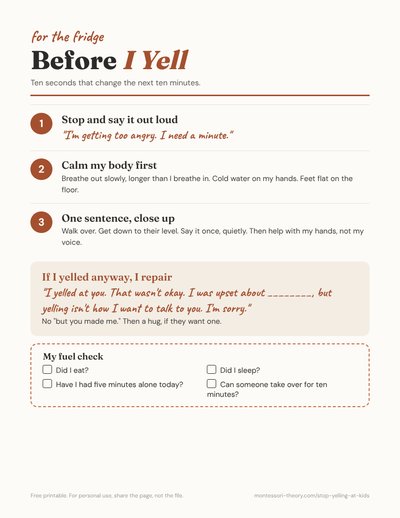
Before I Yell + My Yelling Hours
Two pages. The 10-second reset and repair script for the fridge, and a 7-day tracker to find your yelling hours.
Questions Parents Ask
Is Yelling at Kids Harmful?
Most parents yell sometimes, and repair limits the damage. The American Academy of Pediatrics warns that harsh verbal discipline, like shaming, humiliating or frequent yelling, doesn’t improve behavior over time and is linked to stress and later problems. Aim for less, and repair.
How Do I Stop Yelling When I’m so Angry?
Name it out loud, calm your body with a long exhale and cold water, and step back if your child is safe. Then come back with one quiet sentence.
What Do I Do After I Yelled at My Child?
Apologize simply, without blaming your child, and reconnect. “I yelled. That wasn’t okay. I’m sorry.” Then move on.
Why Do I Yell at My Kids so Much?
Usually because of low fuel at predictable times, too many instructions and calm requests that aren’t followed through. Track a week to see your pattern.
Go Deeper
The Everyday Montessori Preschooler
Book 3 of the Montessori for Real Life series, for ages 3 to 6. Not listening, meltdowns, losing your temper and repairing, the after-school crash and starting school. Coming December 8, 2026.
Sources
- Sege, R. D. and Siegel, B. S. (2018). Effective Discipline to Raise Healthy Children. Pediatrics, 142(6), e20183112. doi:10.1542/peds.2018-3112.
- American Academy of Pediatrics, HealthyChildren.org, AAP Updates Policy on Corporal Punishment (2018).
- American Academy of Pediatrics, HealthyChildren.org, Disciplining Your Child.
- 988 Suicide and Crisis Lifeline and Childhelp National Child Abuse Hotline.
- Photos from Pexels (free licence).