

Between 10 and 24 months, most children go from two naps to one, usually somewhere between 12 and 18 months. A 16-month-old typically naps once for 1½ to 3 hours, and total sleep for toddlers is 11 to 14 hours a day, naps included. Below is the month-by-month table, how to handle the switch, and when to ask your pediatrician.
Quick answer
- 10 to 12 months. Two naps, about 2 to 3 hours of daytime sleep in total.
- 12 to 18 months. The move from two naps to one. Most children manage one nap by 18 months.
- 18 to 24 months. One nap after lunch, usually 1½ to 3 hours.
- Total sleep from 1 to 2 years. 11 to 14 hours per 24 hours, naps included (AASM).
- These are typical ranges, not targets. Your child’s mood and night sleep matter more than the clock.
Toddler Nap Schedule by Month
Find your child’s age in the table. Wake windows are the usual time awake between sleeps. Bedtimes assume a morning wake-up around 6:30 to 7:30.
| Age | Naps | Typical nap length | Wake windows | Bedtime |
|---|---|---|---|---|
| 10 months | 2 | 1 to 1½ hours each | 3 to 4 hours | 6:30 to 7:30 p.m. |
| 11 months | 2 | 1 to 1½ hours each | 3 to 4 hours | 6:30 to 7:30 p.m. |
| 12 months | 2 (a few drop to 1) | 1 to 1½ hours each | 3 to 4 hours | 6:30 to 7:30 p.m. |
| 13 months | 2 | 1 to 1½ hours each | 3½ to 4½ hours | 6:30 to 7:30 p.m. |
| 14 months | 2, some start the switch | 2 to 3 hours in total | 3½ to 4½ hours | 6:30 to 7:30 p.m. |
| 15 months | 1 or 2 | 2 to 3 hours in total | 4 to 5 hours | 6:30 to 7:30 p.m. (earlier on one-nap days) |
| 16 months | 1 for most | 1½ to 3 hours | 4½ to 5½ hours | 6:30 to 7:30 p.m. |
| 17 months | 1 | 1½ to 3 hours | 5 to 5½ hours | 6:30 to 7:30 p.m. |
| 18 months | 1 | 1½ to 3 hours | 5 to 6 hours | 7 to 8 p.m. |
| 19 months | 1 | 1½ to 2½ hours | 5 to 6 hours | 7 to 8 p.m. |
| 20 months | 1 | 1½ to 2½ hours | 5 to 6 hours | 7 to 8 p.m. |
| 21 months | 1 | 1½ to 2½ hours | 5 to 6 hours | 7 to 8 p.m. |
| 22 months | 1 | 1 to 2½ hours | 5 to 6 hours | 7 to 8 p.m. |
| 23 months | 1 | 1 to 2½ hours | 5 to 6 hours | 7 to 8 p.m. |
| 24 months | 1 | 1 to 2½ hours | 5 to 6 hours | 7 to 8 p.m. |
The American Academy of Sleep Medicine recommends 12 to 16 hours per 24 hours for babies 4 to 12 months and 11 to 14 hours for children 1 to 2 years, naps included. The AAP endorses these ranges.
How Much Sleep a Toddler Needs
Count the whole day. A 20-month-old who sleeps 11 hours at night and naps for 2 hours gets 13 hours, right in the recommended range. A shorter nap is fine if night sleep is longer, and the reverse.
The best signs are on your child, not on the clock. A rested toddler wakes mostly happy, plays well and falls asleep without a long battle. Rubbing eyes, clumsiness, clinginess and meltdowns late in a wake window usually mean the window is too long.
Switching From Two Naps to One
Most children drop the morning nap between 12 and 18 months. It’s rarely a clean switch. Expect a few weeks of mixed days.
Signs Your Toddler Is Ready
- Fights the morning nap. Plays or chats in bed for a long time, most days, for two weeks or more.
- Short or skipped afternoon nap. The morning nap pushes the second one too late.
- Early waking or long bedtime battles. Too much daytime sleep for their age.
How to Make the Switch
- Push the morning nap later. Move it by 15 to 30 minutes every few days, toward 11:30 or noon.
- Feed lunch first. An early lunch around 11 makes a midday nap easier.
- Use an earlier bedtime. On one-nap days, bring bedtime forward by 30 to 60 minutes for a few weeks.
- Allow a rescue nap. On rough days, a short morning rest or a car nap is fine. The transition isn’t a test.
A Montessori touch that helps here is a predictable, short routine before each sleep. The same three steps every time, like curtains, book, sleep sack. Your child learns what comes next and can take part, closing the curtains or choosing the book.

Where Your Toddler Naps
For babies under 12 months, the AAP’s safe sleep rules apply to naps too. On their back, on a firm flat surface in a crib or bassinet, with nothing else in it.
After the first birthday, many Montessori families move to a floor bed. If you do, make the whole room safe. Anchor furniture to the wall, cover outlets, secure cords and use a gate at the door. See our guide to the Montessori floor bed for toddlers and the crib to bed transition.
Normal, Watch, Ask
Normal
- Nap length that varies day to day
- A few weeks of messy days during the 2-to-1 switch
- Shorter naps during teething, illness or travel
Watch
- Very sleepy during the day despite enough sleep
- Long night wakings for weeks
- Bedtime battles every night
Ask your pediatrician
- Loud snoring, gasping or pauses in breathing during sleep
- Total sleep far outside 11 to 14 hours for weeks
- Sleep problems along with feeding, growth or development worries
Questions Parents Ask
How Long Should a 16 Month Old Nap?
Usually one nap of 1½ to 3 hours after lunch. Some 16-month-olds still take two shorter naps, which is normal during the transition.
How Many Naps Should a 12 Month Old Take?
Most take two naps, morning and early afternoon, for about 2 to 3 hours in total. A few switch to one nap early.
How Many Naps Should a 15 Month Old Take?
One or two. Fifteen months is a common age for the switch, so many children alternate between one-nap and two-nap days.
How Long Should a 20 Month Old Nap?
Typically one nap of 1½ to 2½ hours, starting around noon to 1 p.m.
What Time Should a 16 Month Old Go to Bed?
Usually between 6:30 and 7:30 p.m. Go earlier on days with a short nap.
How Much Sleep Does a 22 Month Old Need?
11 to 14 hours in 24 hours, including the nap, according to the AASM.
Go Deeper
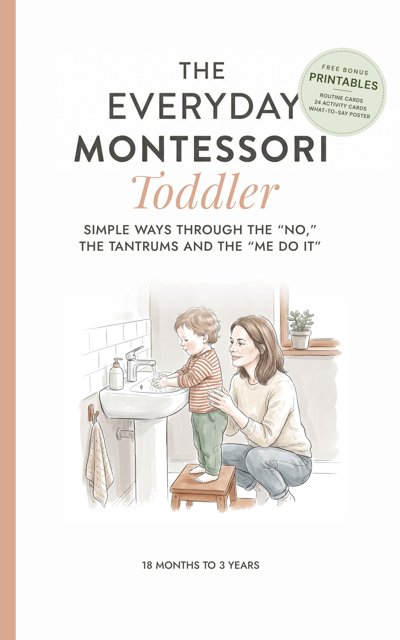
The Everyday Montessori Toddler
Book 2 of the Montessori for Real Life series, for 18 months to 3 years. Sleep, routines, tantrums and “me do it,” with simple steps for real homes. Out November 17, 2026.
Sources
- Paruthi, S. et al. (2016). Recommended Amount of Sleep for Pediatric Populations, a consensus statement of the American Academy of Sleep Medicine. Journal of Clinical Sleep Medicine, 12(6), 785–786. doi:10.5664/jcsm.5866.
- American Academy of Pediatrics, HealthyChildren.org, Healthy Sleep Habits, How Many Hours Does Your Child Need?
- Moon RY et al. Sleep-Related Infant Deaths: Updated 2022 Recommendations for Reducing Infant Deaths in the Sleep Environment. Pediatrics 2022;150(1):e2022057990.
- U.S. Consumer Product Safety Commission, Anchor It (furniture tip-over prevention).
- Photos from Pexels (free licence).