
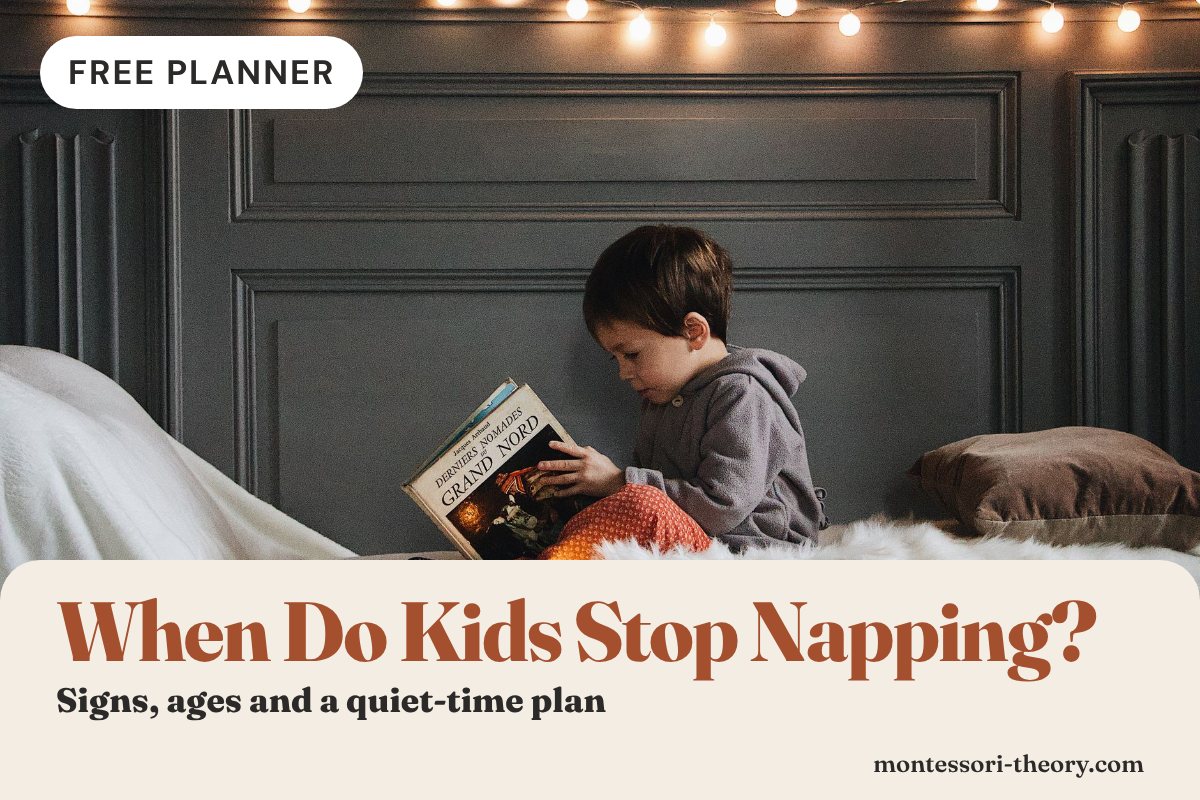
Most children stop napping somewhere between 3 and 5, and a few stop earlier. The hard part is the in-between months, when a nap ruins bedtime and no nap ruins the evening. Here’s how to tell where your child is, a two-schedule plan for that phase, and how quiet time keeps a break in your day.
It fits into a simple Montessori day rhythm at home.
Quick Answer
- Usual age. Most children drop their last nap between 3 and 5.
- Total sleep. 11 to 14 hours a day at 1 to 2 years and 10 to 13 hours at 3 to 5, naps included (AASM).
- Main sign. Nap days lead to late bedtimes, and no-nap days go fine.
- In-between months. Alternate nap and no-nap days, with an earlier bedtime on no-nap days.
- Keep a quiet hour. Rest without sleep, so your child recharges and you get a break.
When Do Kids Stop Napping?
There’s no single right age. Most toddlers take one nap after about 18 months. Somewhere between 3 and 5, that nap gets shorter, harder to start and finally disappears. Some children are done at 2½, others still nap happily at 5.
What matters is total sleep over 24 hours. The American Academy of Sleep Medicine recommends 10 to 13 hours a day for children 3 to 5, including naps. A 4-year-old who sleeps 11½ hours at night is in the range without a nap. A 3-year-old who sleeps 10 hours at night probably still needs one.
Signs Your Child Is Ready to Drop the Nap
| What you see | Ready to drop it | Not ready yet |
|---|---|---|
| Falling asleep at nap time | Takes 30 minutes or more, or doesn’t sleep at all | Falls asleep quickly most days |
| Bedtime on nap days | Awake and chatty until 9 p.m. | Normal bedtime |
| Late afternoon on no-nap days | Tired but fine, happy evening | Meltdowns, falls asleep in the car or at dinner |
| Night sleep | Long, solid nights | Short nights, early waking |
Look for these signs most days for at least two weeks, not after one bad nap. Illness, travel and growth spurts can throw off a week or two.
The In-Between Months, a Two-Schedule Plan
Many families go through a phase where neither option works perfectly. Using two schedules, and choosing each morning, makes it easier.
| Time | Nap day | No-nap day |
|---|---|---|
| Wake-up | 7:00 a.m. | 7:00 a.m. |
| Lunch | 11:45 a.m. | 11:45 a.m. |
| Early afternoon | Nap from about 1:00, wake by 2:30 | Quiet time from about 1:00 to 2:00 |
| Late afternoon | Outdoor play, snack | Calm play, early snack, no car rides if possible |
| Bedtime | About 7:30 to 8:00 p.m. | About 6:30 to 7:00 p.m. |
- Cap the nap. Wake your child by about 2:30 or 3 so bedtime doesn’t slide.
- Move bedtime earlier on no-nap days. 30 to 60 minutes earlier for a few weeks.
- Alternate. Nap every other day, or nap only after busy mornings.
- Track two weeks. Use the planner below to see the pattern instead of guessing.
Quiet Time Instead of a Nap
Dropping the nap doesn’t have to mean losing the rest. Quiet time is an hour in a calm spot where your child rests their body, and sleeps if they need to.
- Same place, same time. Their room or a cozy corner, right after lunch.
- A quiet-time box. Books, a puzzle, a few blocks, crayons, a soft toy, used only at this time.
- A visible end. A timer or a toddler clock that changes color, so your child doesn’t need to ask.
- Start short. 20 minutes, then add 5 minutes every few days, up to about an hour.
- Same simple rules. Stay in the quiet spot, play quietly, sleep if your body is tired.
In Montessori terms, it’s a protected work period for one. The child chooses calm activities, and you get a real break.
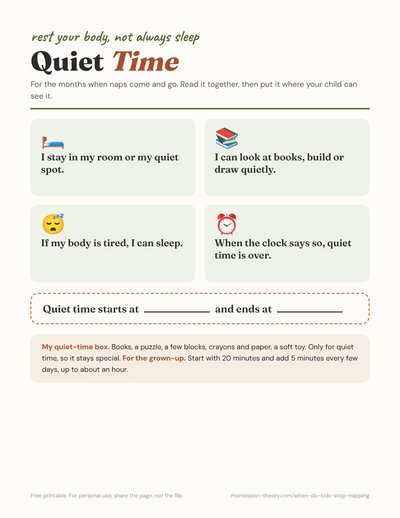
Quiet Time Card + Nap Transition Planner
Two pages. Picture rules for quiet time with a start and end time, and a 2-week tracker to see if your child is ready to drop the nap.
When Preschool Still Requires a Nap
Many preschools and child care centers have a rest time for all children. If your child no longer needs the nap, a school nap can push bedtime late.
- Talk to the teacher. Ask if your child can rest with a book instead of sleeping, or be woken after 30 to 45 minutes.
- Adjust bedtime by day. Later on school-nap days, earlier on home days.
- Protect the morning. Keep wake-up time the same, even after a late night.
Do Kids Nap in Kindergarten?
Most full-day kindergartens in the US have no nap time, though some have a short rest. Ask your school what the afternoon looks like.
If your child still naps at 5, start shifting two to three months before school. Use quiet time instead of sleep on most days, move bedtime earlier, and expect a tired first few weeks. A calm first hour after school helps, see after-school restraint collapse. For the rest of the skills list, read what kids need before kindergarten.
With a Baby or Siblings
Line up the older child’s quiet time with the baby’s nap. One quiet hour for everyone is much easier than two separate ones. If they share a room, use a different quiet spot for the older child, like a reading corner in the living room.
Normal, Watch, Ask
Normal
- Stopping naps at 3, or still napping at 5
- Messy weeks during the switch
- Napping again during illness
Watch
- Very sleepy during the day despite 10 hours or more at night
- Bedtime battles every night for weeks
- Frequent night waking
Ask your pediatrician
- Loud snoring most nights, gasping or pauses in breathing
- Extreme daytime sleepiness or falling asleep at unusual times
- Sleep problems with behavior or attention worries
Questions Parents Ask
At What Age Do Kids Stop Napping?
Most children stop napping between 3 and 5. Some stop earlier, around 2½, and some keep a short nap until 5 or later.
Is It Normal for a 3 Year Old to Stop Napping?
Yes, if they sleep enough at night and are mostly fine in the late afternoon. Keep a quiet time and an earlier bedtime.
Should I Force My Child to Nap?
No. You can’t make a child sleep, but you can offer rest. Quiet time with a clear start and end works better than a nap battle.
Do Kindergartners Take Naps?
Usually not in full-day kindergarten in the US, though some programs offer a short rest. Ask your school.
What Is Quiet Time?
A daily rest period, often an hour after lunch, when a child who no longer naps plays quietly alone and can sleep if needed.
Go Deeper
The Everyday Montessori Preschooler
Book 3 of the Montessori for Real Life series, for ages 3 to 6. Straight answers on sleep, screens and the hard questions, with simple steps for real homes. Coming December 8, 2026.
Pre-order on AmazonSources
- Paruthi, S. et al. (2016). Recommended Amount of Sleep for Pediatric Populations, a consensus statement of the American Academy of Sleep Medicine. Journal of Clinical Sleep Medicine, 12(6), 785-786. doi:10.5664/jcsm.5866.
- American Academy of Sleep Medicine, Recharge With Sleep, Pediatric Sleep Recommendations.
- American Academy of Pediatrics, HealthyChildren.org, Healthy Sleep Habits, How Many Hours Does Your Child Need?
- Marcus, C. L. et al. (2012). Diagnosis and Management of Childhood Obstructive Sleep Apnea Syndrome. Pediatrics, 130(3), 576-584. doi:10.1542/peds.2012-1671.
- Photos from Pexels (free licence).