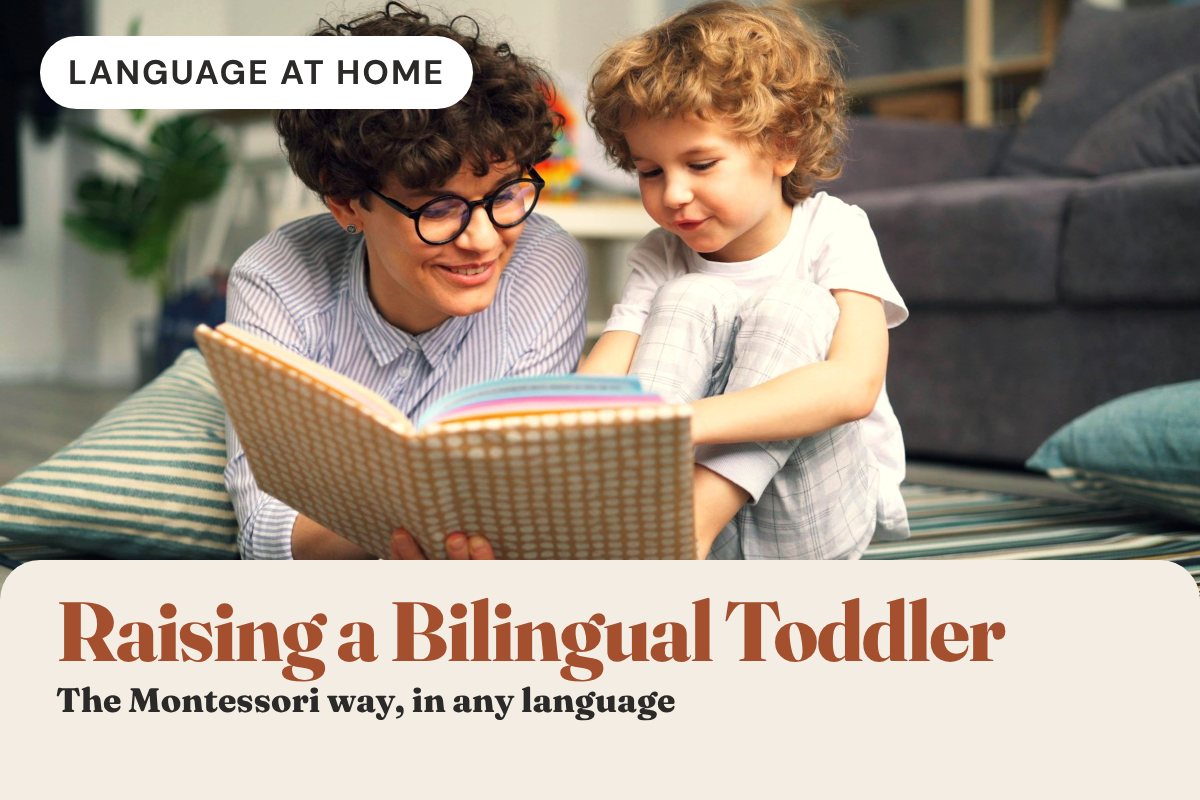
Raising a bilingual toddler the Montessori way comes down to real language from real people, every day. Each language gets its own person, place or time, you talk through ordinary routines, and you trust the absorbent mind. Two languages do not cause speech delay, and mixing words is a normal stage.
At a Glance
- Any pair works. English with Spanish, French, Mandarin, Arabic, Portuguese, Hindi or any language your family speaks.
- Same milestones. First words around 12 months and two-word phrases around 24 months, counting both languages together.
- Mixing is normal. “Más milk” is a toddler using every word they own.
- People beat screens. Children learn a language from someone who talks with them, not from an app or a show.
- Materials are optional. A basket of real objects and books in each language go a long way.
Why Montessori and Two Languages Fit so Well
Maria Montessori described the young child as having an absorbent mind. From birth to about 6, children take in the language around them without lessons, the same way they learn to walk. She called this the sensitive period for language, and it is the reason a toddler can pick up the accent of a grandparent that adults struggle with for years.
A second language fits naturally into that period. The Montessori principles you may already use at home work for any language.
- Follow the child. Talk about what holds their attention right now, in the language of the moment.
- Real words for real things. Name the whisk, the sparrow and the colander, in both languages.
- A prepared environment. Books, songs and objects for each language at the child’s height.
- Independence. Everyday routines like dressing, cooking and tidying give hundreds of chances to hear and use words.
Montessori classrooms around the world already run in two languages, often with one adult speaking each. Families can borrow the same idea at home.
Which Languages? Any Pair Works
There is no best second language for a toddler. The best one is the language someone around them speaks warmly and often. In the United States, Spanish is by far the most common language spoken at home after English, followed by Chinese and Tagalog, according to the Census Bureau. Many families also raise children in French, Vietnamese, Arabic, Korean, Portuguese, Russian or Hindi.
A few things change from one language to another, and they are worth knowing.
- English and Spanish. Spanish spelling is very regular, so letter sounds in Spanish are easy to learn later. Some sounds differ between the two, like the Spanish rolled r or the j that sounds close to an English h.
- English and French. French has nasal vowels and sounds that English lacks. Toddlers hear and copy them far more easily than adults, so songs and rhymes in French are a gift at this age.
- English and Mandarin. Mandarin uses tones to change meaning. Babies who hear tones from early on pick them up without effort, which is a strong reason to start young.
- A language you are still learning. You can still offer it through songs, books, a sitter or a weekly playgroup. Keep the warm, everyday talk in the language you speak best.
The American Academy of Pediatrics advises parents to use the language they are most comfortable with. A child gains more from rich, natural talk in a parent’s first language than from stiff talk in a language the parent barely knows.
Choose a Simple Family Plan
Children sort two languages best when each one has a clear place in their day. Pick the plan that matches your family, and keep it flexible.
- One parent, one language. Each parent speaks their own language to the child. A Spanish-speaking mother and an English-speaking father is a classic example.
- Home language at home. Everyone speaks the family language at home, and the child gets English at daycare, school and in the community.
- Time and place. One language at breakfast and bath, or on weekends, or at grandma’s house.
- A trusted helper. A sitter, a grandparent on video calls or a weekly playgroup brings in a language the parents do not speak at home.
The plan matters less than steady, daily exposure from people who care about the child. Most children get much more of the language of school and the community, so the home language often needs extra protection.
What Bilingual Development Looks Like by Age
Bilingual children reach their milestones in the same age range as children who hear one language. The difference is that their words are spread across two languages, so count them together.
Birth to 12 Months
Babies listen to every sound and start babbling in the rhythm of the languages they hear. Talk, sing and narrate in your language. Face-to-face chats and lap songs are the whole curriculum at this age.
12 to 24 Months
First words usually come around 12 months. A child may say “agua” to one parent and “water” to the other, or only know some words in one language. Both are normal. Around 24 months, two-word phrases appear, sometimes with one word from each language.
2 to 3 Years
Vocabulary grows fast. Mixing languages in one sentence, called code-switching, is very common and shows a child using everything they know. Many children start to notice who speaks what and answer in the matching language.
3 to 6 Years
Children separate the two languages more clearly and can switch on purpose. Many start to prefer the language of school. This is the moment to keep the home language alive with books, stories, visits and songs. Reading and writing in two languages usually starts with the language of school, then the other follows.
A quiet phase is common. A child who starts hearing a new language at daycare or school often goes quiet in it for a few weeks or months. They are listening and storing words. Keep talking to them and do not press them to speak.
Everyday Ways to Use Two Languages at Home
You do not need lessons or special time. Daily life is full of language.
- Narrate routines. “Primero los calcetines, luego los zapatos.” Dressing, cooking and bath time repeat every day, which is exactly what toddlers need.
- Sing the same songs. Lullabies, clapping games and cleanup songs in each language. Pause before the last word and let your child fill it in.
- Read every day in both languages. A small basket of books in each language, rotated every couple of weeks. Libraries often have bilingual shelves.
- Cook together. Name the ingredients, the tools and the actions. Stir, pour, mix, revolver, verser.
- Take a naming walk. Point to the dog, the bus and the tree, and wait for your child to answer.
- Call family. Video calls with grandparents are short and full of real reasons to speak the family language.
- Play with friends. A playgroup or a family friend who speaks the language gives children a reason to use it.
For more ideas sorted by age, our activity finder has dozens of simple language activities you can do in any language.
Montessori Materials That Help (and How to Do Without)
Montessori language materials work in any language. None of them is required, and each has a free homemade version.
- An object basket. Five or six real objects, like a cup, a spoon, a sock and a toy animal. Each parent names them in their own language. Free, and the best first material there is.
- Three-part cards. A picture card, a label card and a control card. Make one set per language with photos printed at home, and keep a different color border for each language so the child sees which set they are using.
- The three-period lesson. “This is a pomme. Show me the pomme. What is this?” It works with any word in any language. See our guide to the three-period lesson.
- Sandpaper letters. From about 3, children trace letters while saying their sound. Each language has its own sounds, so introduce letters in one language first, usually the language of school, and add the other once the first is solid. Our guide to sandpaper letters shows how they work.
- The movable alphabet. Children build words from loose letters before they can write them. Use it in one language at a time. More in our movable alphabet guide.
- A small book shelf. Front-facing, with three or four books in each language. Realistic pictures work best for toddlers.
If you skip every material, you lose very little. Talking, reading and singing every day in each language matters far more than any set of cards.
Common Worries Parents Have
- “Two languages will confuse my child.” Mixing words or grammar from both languages is normal and does not mean a child is confused, the AAP notes.
- “My child will talk later.” Bilingual children reach milestones in the same age range. Counted in one language only, their vocabulary can look smaller, so count both.
- “My child answers me in English.” Very common once school starts. Keep speaking your language warmly, read together and plan time with other speakers. Avoid turning it into a battle.
- “Is it too late?” It is never too late to add a language. Starting early simply makes accents and sounds come more easily.
When to Talk to Your Pediatrician
Learning two languages does not cause speech or language problems. A bilingual child can still have a delay, and when there is one, it shows up in every language the child uses. Talk to your pediatrician if your child:
- is not babbling sounds like “mamama” or “bababa” by about 9 months,
- is not trying to say a few words, in any language, by 18 months,
- is not putting two words together, in any mix of languages, by 2 years,
- loses words or skills they had before.
Ask for an evaluation that looks at both languages, ideally with a speech-language pathologist who speaks your home language. In the US, early intervention services are free to evaluate children under 3.
Keep the home language, even with a delay. The AAP explains that children with speech and language disorders can learn more than one language, and that parents should not stop using their heritage language. If someone tells you to switch to English only, ask for a second opinion.
Questions Parents Ask
Does a Bilingual Toddler Talk Later?
No. Bilingual children say their first words and phrases in the same age range as other children. Their words are spread across two languages, so count both together.
Is It Bad If My Toddler Mixes Two Languages?
No. Mixing words from both languages in one sentence is a normal stage. It shows your child is using every word they know.
What Is the Best Way to Raise a Bilingual Child at Home?
Give each language a clear place, such as one parent per language or the home language at home, and use it every day in real routines, songs and books.
Can I Teach My Child a Language I Don’t Speak Well?
Yes, through songs, books, a sitter, a playgroup or family calls. Keep your everyday talk in the language you speak best.
Do Montessori Schools Teach Two Languages?
Many do, often with one teacher for each language in the same classroom. Ask the school how many hours a day each language is used.
Want to see how children move from sounds to reading? Read how Montessori teaches reading, which works the same way in each language.
Sources
- American Academy of Pediatrics, HealthyChildren.org, Young Children Learning Multiple Languages, Parent FAQs.
- American Speech-Language-Hearing Association, Learning More Than One Language.
- Centers for Disease Control and Prevention, Milestones by Age.
- U.S. Census Bureau, Language Spoken at Home, American Community Survey 2018 to 2022.
- Montessori, M. The Absorbent Mind (1949), on the sensitive period for language.