
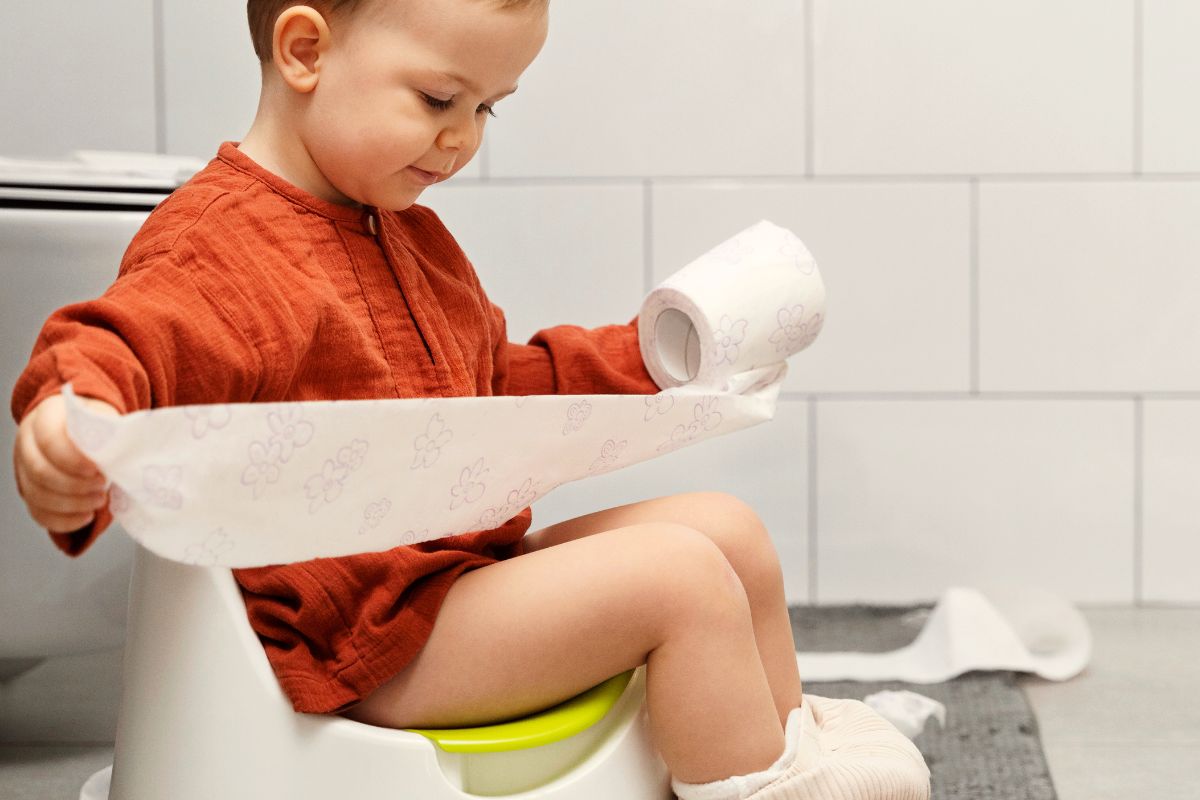
A relative once told me my 20-month-old was “behind” on potty training. He was not behind. He was not trained yet. The Montessori approach treats that as an important difference, not a technicality. Learning happens inside the child, on their own timeline, not on a schedule imposed from outside.
This guide gets straight to what to actually do. How to test if your child is ready, how to set up the bathroom, what to say and do every day, and exactly what to do when something goes wrong. Enough context to understand why each step matters, without the padding.
Step 1: Test Readiness Before You Start
Researchers followed hundreds of children over time. Most girls were dry in the daytime by around 32 months, most boys by around 35 months, but it varied enormously from child to child, and that is completely normal. Another study found something surprising. Starting too early makes the whole process take longer, not shorter. So testing first is not extra caution. It is simply what works best.
Run these three tests over a few days before deciding to start.
Test 1: The dry diaper check
Check the diaper every 30 minutes for a morning.
It stays dry for 2 hours or more at least once. That means the bladder can hold enough to make training realistic.
Test 2: The two-step instruction check
Ask your child to “pick up the ball and bring it to me.”
They do both steps without you repeating it. A bathroom trip is a multi-step routine too, walk there, sit, wait, wipe, wash hands. This confirms they can follow a sequence.
Test 3: The interest check
Leave a small potty in the bathroom for a week, with zero mention of it.
Your child sits on it, touches it, or asks about it on their own at least once. Interest you had to prompt does not count here.
All 3 pass? Move to Step 2 below. Only 1 or 2 pass? Wait 3 to 4 weeks and retest, no pressure in the meantime, the window simply has not opened yet. Just had a house move, new sibling, or illness? Wait until that settles before testing at all, since stress alone can mask genuine readiness.
Step 2: Set Up the Bathroom

Once your child passes the tests above, the environment needs to make independence physically possible, not just encouraged in theory. A child who has to ask an adult for help at every step is not really doing it independently, no matter how ready their body is. This is a one-afternoon job, not a shopping list to spread over weeks.
Skip pull-ups. They are absorbent enough to feel like a diaper, which removes the wetness sensation the child needs to feel to connect cause and effect. Go straight to real cotton underwear. If the idea of accidents on the floor makes you want to delay, that is worth noticing. It usually means you are not ready to start yet, even if your child is.
Step 3: The Daily Routine, Word for Word

There is no special “day one.” The routine below is what you do every day, starting the day the environment is ready. It works because it is repeated identically, not because anything dramatic happens on the first try.
At these 4 moments every day, say this exact sentence
“It’s time to use the potty”
Say it, do not ask it. “Do you want to try?” is an open question, and the answer to an open question is almost always no. State it plainly, at these moments, after waking up, after meals, before going outside, before the bath. These are the natural windows when the body is likely to need to go.
1
Walk with your child to the potty. Do not carry them; getting there is part of the task they are learning.
2
Sit them down. Stay in the room, but do not stare or narrate the whole time. Quiet company, not supervision.
3
Wait 1 to 3 minutes. If nothing happens, that is a completely normal outcome, most attempts in the first two weeks will look like this.
4
Move on either way. No sticker, no clapping. If something happened: “You did it, you’re all done,” said in the same plain tone you would use for anything else.
Nothing else changes for the first two weeks. Repetition, not intensity, is what builds the connection between the bodily sensation and the routine.
If This Happens, Do This
Almost every problem that comes up falls into one of these six situations. Find yours and follow the response, rather than improvising in the moment.
A Visual Routine Card, Not a Reward Chart
A simple picture sequence of the steps, pants down, sit, wipe, pants up, flush, wash hands, helps a child remember the routine without you prompting every single step. This is a reference card, not a sticker chart. No tracking, no ticks, no celebration for completion, just a visual aid for a multi-step sequence a young child is still learning to hold in their head.

A photo of your own child doing each step is often more meaningful to them than a generic illustration.
Boys: Sitting First, Standing Later
Boys sit for everything at first, both pee and poop, ideally with a potty that has a front splashguard. Learning one new skill at a time is the whole logic here. Aiming while standing is a second skill layered on top of the first, and adding it too early is a common reason boys specifically end up frustrated. Once daytime dryness sitting down is solid, usually weeks or months later, standing tends to emerge on its own from watching other males. You do not need to teach it directly. When your son shows interest, a step stool at the toilet and calm modeling are enough.
Does Montessori School Require Potty Training?
It genuinely varies by school. Children’s House programmes, which usually start around age 2.5 to 3, tend to expect children out of diapers or close to it, since the mixed-age classroom is built around independent bathroom use as part of daily life. Toddler communities, roughly birth to 2.5, generally do not require it, since children that age are not developmentally there yet in the first place. Confirm directly with the specific school you are considering, since policies differ even within the same network of schools.
Want A Full Parent Guide In Book Form?
Parents Ask Most Often
My child is 3 and still in diapers. Should I worry?+
If none of the 3 readiness tests pass at all, mention it to your pediatrician at the next visit. If they pass but your child is resisting, that points to timing or stress rather than a developmental problem. Most children finish daytime training by 36 to 42 months. Past 48 months with genuinely zero progress is worth a doctor’s visit.
Can I start at nursery before starting at home?+
Better to start both at the same time. Underwear at nursery but diapers at home sends a confusing message about what is expected and where. Talk to the nursery team and agree on a shared start date before beginning either location.
What is actually different from regular potty training?+
No reward chart, no punishment for accidents, no fixed number of days to complete it in. You test readiness and prepare the environment properly. From that point on, the child sets the actual pace, and your job is to stay consistent rather than push toward a deadline.
The Short Version
Test readiness before you start. Prepare the bathroom so your child can manage independently. Offer the potty at the same 4 moments every day, calmly, without asking. Handle accidents and refusals the same way every time, without drama in either direction.
There is no way to rush this, and trying tends to slow it down instead. Prepare the conditions well, then trust your child to do the rest on their own timeline.
Sources
Schum, T.R. et al. (2002). Sequential acquisition of toilet-training skills. Pediatrics, 109(3), e48.
Blum, N.J. et al. (2003). Relationship between age at initiation of toilet training and duration of training. Pediatrics, 111(4), 810-814.