
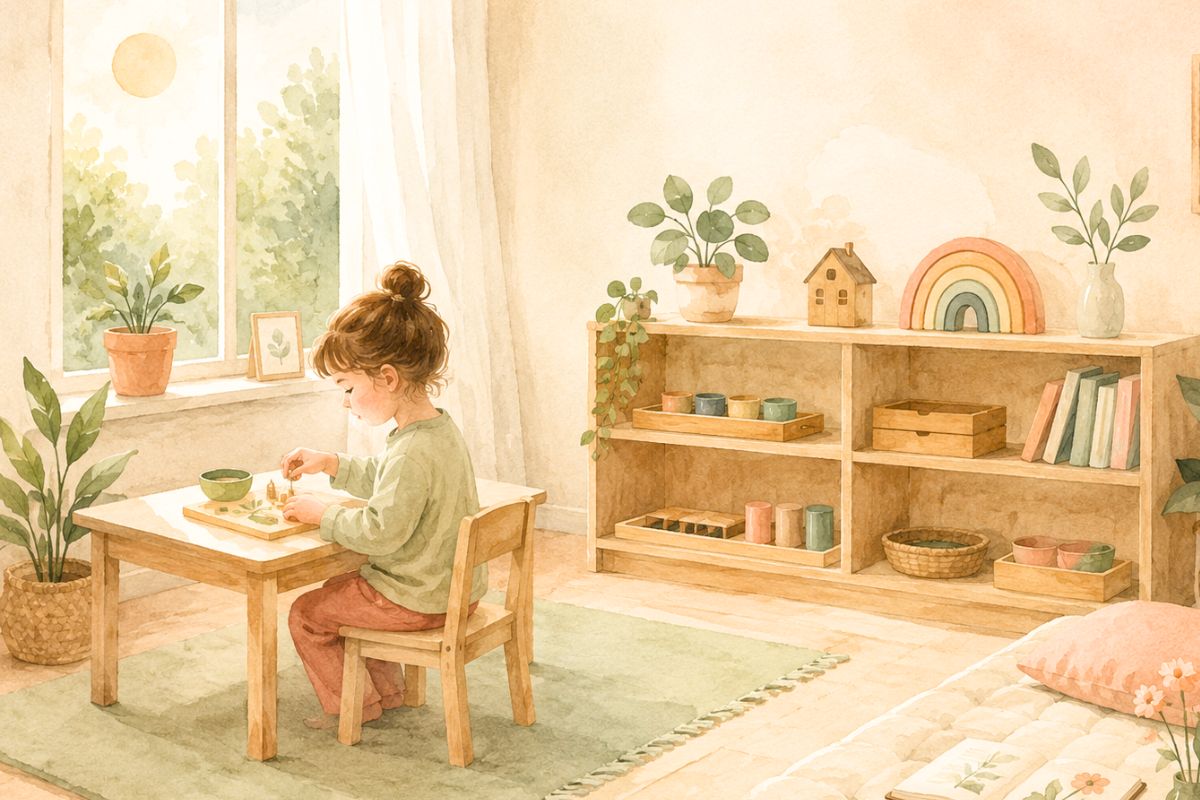
Somewhere online there is a photo of a Montessori homeschool room with fifty labeled activities, color-coded bins, and a laminated hourly schedule taped to the wall. Most parents see it and think the same thing. “I don’t have that. I’m not doing this right.”
Real Montessori families describe their day differently. Not a schedule, a rhythm, followed loosely, repeating similar patterns without ever being identical two days running. Below are two real example rhythms, one for toddlers and one for preschool and kindergarten age children, with rough times attached so you have an actual picture to start from.
Rhythm, Not Schedule
Maria Montessori observed that children benefit from work periods of around three hours, uninterrupted, to move through the full arc of choosing an activity, concentrating on it, and returning it. That is the one piece of structure worth borrowing directly. Everything else in a real Montessori home stays loose on purpose.
The difference in practice
A schedule says breakfast is at 8:00 and work time starts at 8:30. A rhythm says breakfast happens after waking and getting dressed, and work time starts once breakfast is cleared away, whatever time that turns out to be. The order stays the same. The clock does not matter.
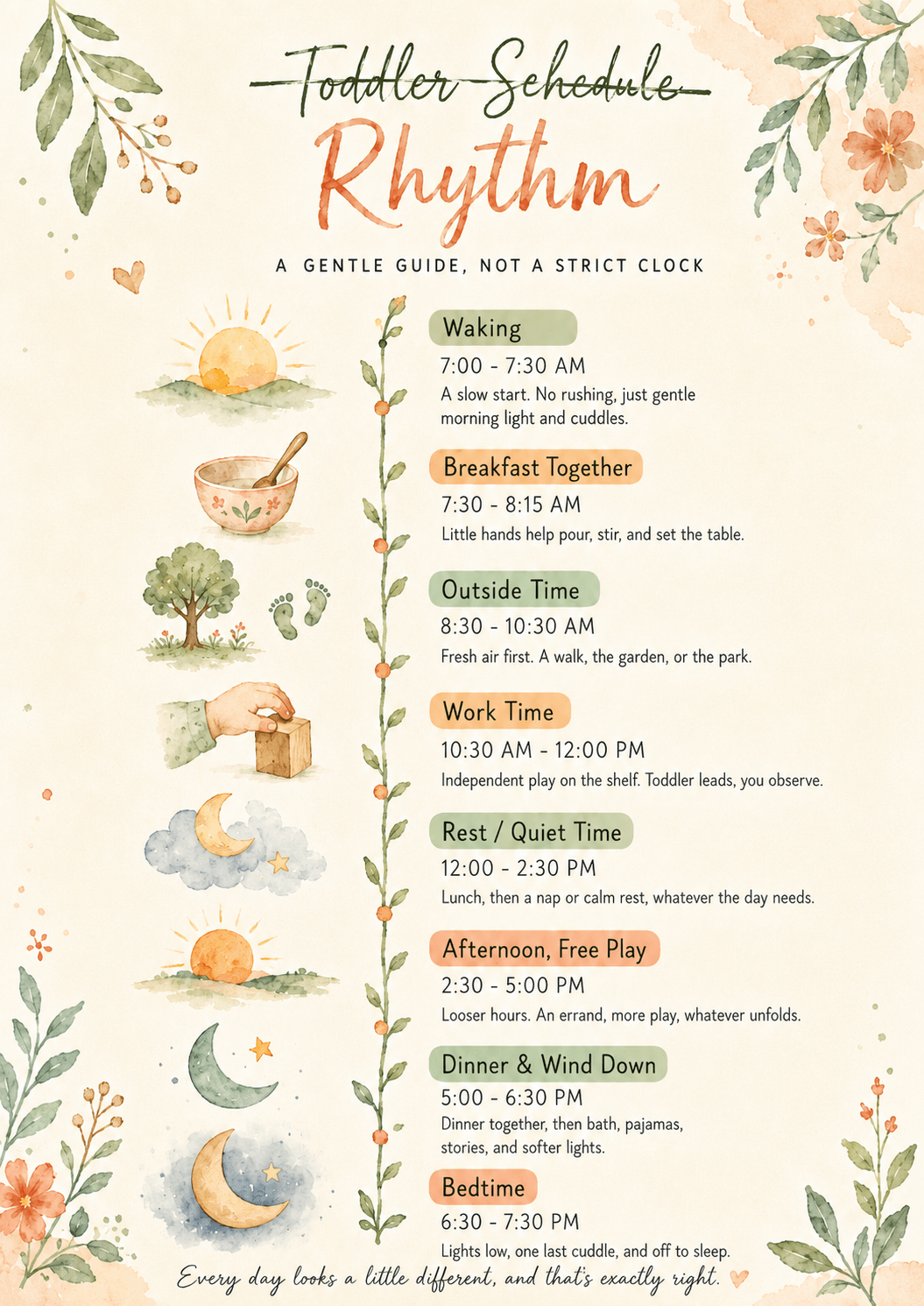
A Real Toddler Rhythm (18 Months to 3 Years)
Toddlers need far more repetition and far less formal structure than people expect. Most of the day is ordinary life, done together, slowly.
Quiet wake-up, a book looked at alone in bed, then getting dressed together.
Toddler helps prepare something simple, pouring cereal, spreading butter, at a low table if possible.
An outing most mornings, a walk, the park, a class, or a playdate. An hour or two, weather and mood depending.
Back home, independent shelf time. The toddler chooses, you observe more than direct.
Lunch, then a nap or quiet rest depending on age.
Looser structure, more free play, an errand, time outside again if the morning was indoors.
A Real Preschool and Kindergarten Rhythm (4 to 6 Years)
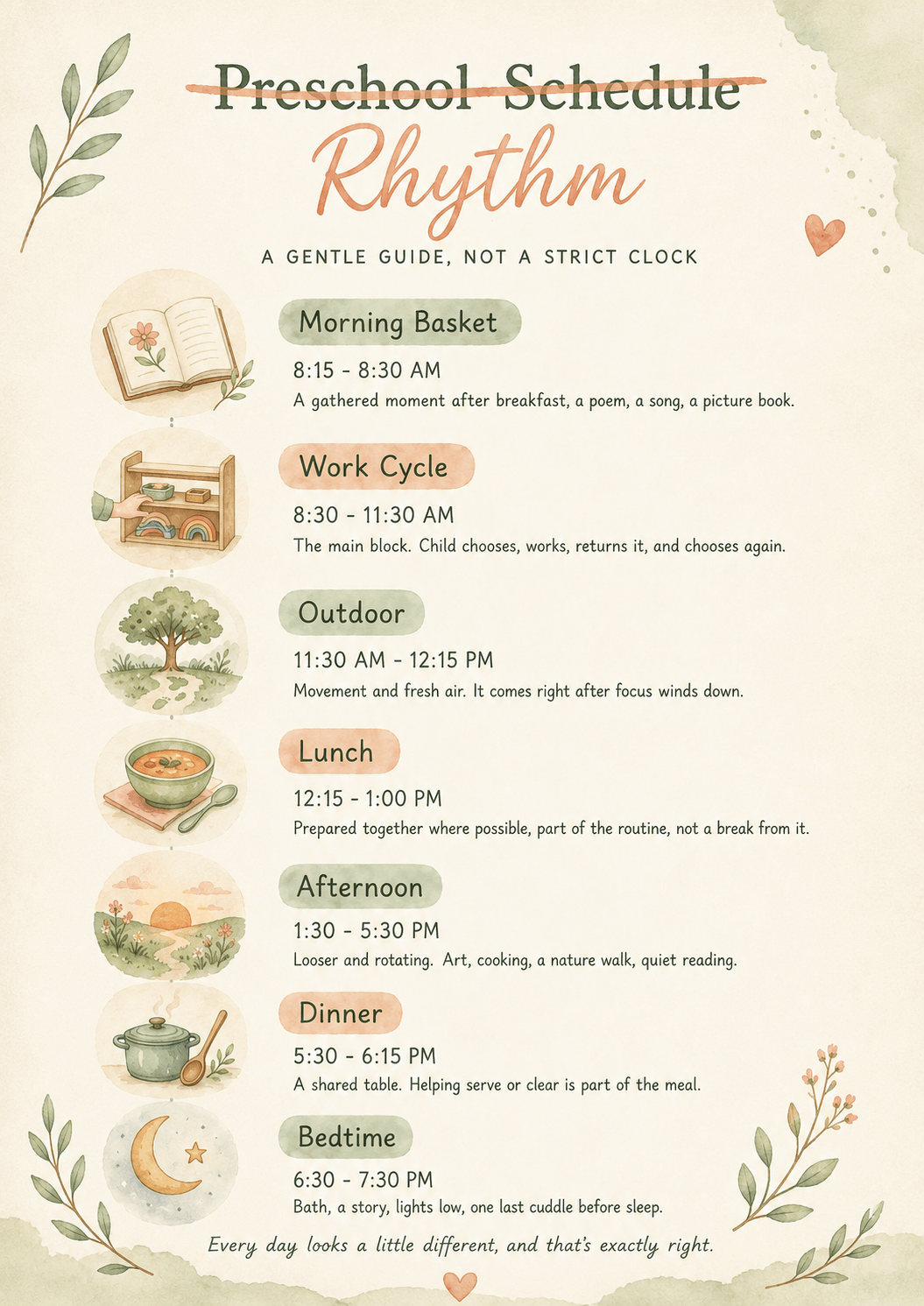
This age can genuinely sustain the full three-hour work cycle, and that block becomes the anchor the rest of the day is built around.
A short gathered moment after breakfast, a poem, a song, a picture book. Ten minutes, not a lesson.
The main block, roughly three hours. Child chooses from the shelf, works, returns materials, chooses again. You present a new lesson if one is ready, otherwise you observe.
Movement and fresh air, a walk, the garden, a park. This is not optional, and it often falls right after the work cycle naturally winds down.
Prepared together where possible, part of practical life rather than a break from it.
Looser and rotating, art one day, cooking another, a nature walk, free reading, quiet rest time. Less structured than the morning, deliberately.
Building Your Own Rhythm: Three Questions
Skip copying either example exactly. Answer these three questions about your own child and your own household instead, then build the order around the answers.
Multiple children, different ages? The younger child’s rhythm usually anchors the day, since naps and shorter attention spans are less flexible than an older child’s. An older sibling can often join the younger one’s outdoor and practical life blocks, then get their own longer work cycle during the younger child’s nap.
What to Skip Entirely
- ●A printed hourly timetable. The moment a child is deeply absorbed and the clock says move on, the clock is wrong, not the child.
- ●Recreating a classroom’s circle time. Group rituals exist in schools because there is a group. At home, with one or two children, they usually just create friction.
- ●Matching every day exactly. Real families describe similar patterns, not identical days. Illness, weather, and mood all shift things, and that is fine.
- ●Filling every minute. Boredom right before independent work often produces the deepest concentration of the day. Do not rush to fill that gap.
Need Help Figuring Out Which Activities Fit The Work Cycle?
Frequently Asked Questions
Isn’t having any schedule at all against Montessori principles?+
Authentic Montessori practice is genuinely wary of rigid schedules, and some practitioners argue a strict timetable works against the method entirely. The distinction that actually matters is between a fixed timetable, which interrupts a child regardless of what they are doing, and a rhythm, which is a predictable order of events without fixed clock times attached. The rhythm gives the day shape without overriding the child’s concentration.
My child can only concentrate for 20 minutes, not three hours. Is something wrong?+
No. The three-hour figure describes the total length of the work period, not one unbroken stretch of focus. Within it, a child might move through several shorter activities, take a break, and return. Sustained single-task concentration for the full period usually develops gradually over months, not immediately.
What if we miss the work cycle some days because of appointments or errands?+
A rhythm survives missed days far better than a schedule does, precisely because it is not tied to specific hours. Pick the work cycle back up the next available day in its usual position in the order, and do not try to make up missed time by cramming more into a single session.
The Order Matters More Than the Clock
A Montessori day at home does not need to look like a classroom, and it definitely does not need a laminated chart on the wall. What it needs is a repeatable order your child can rely on, wake, eat, move, work, rest, in roughly that shape, day after day.
Start with the order. Let the clock times settle wherever your actual life puts them.