

This guide contains affiliate links. If you buy through them, Montessori Theory may earn a small commission at no extra cost to you. Amazon links open a search so you can compare current options and prices. IKEA prices were checked on ikea.com/us in October 2026.
In the first six months, a baby’s work is looking, reaching, grasping and moving. Montessori toys for this age are few and simple, and each one matches the next skill your baby is working on.
This guide goes month by month, with what each toy develops, a free or DIY version, and what you can skip. For older babies, see Montessori toys for 1 year olds or our Montessori toys guide.
Quick Answer
- 0 to 2 months. A firm floor space with a low mirror, high-contrast images and a simple black and white mobile.
- 2 to 4 months. A sequence of slow-moving visual mobiles, then something to bat and grasp on a short ribbon.
- 4 to 6 months. Light rattles, interlocking discs, a soft ball and a safe teether.
- Mobiles and hanging toys belong over the play mat, never in the crib. Remove them once your baby pushes up on hands and knees.
What a Baby Is Working on From 0 to 6 Months
The CDC lists watching you move and looking at a toy for several seconds at 2 months. At 4 months, most babies hold a toy put in their hand, swing an arm at toys and push up on their forearms during tummy time. By 6 months, most reach for a toy they want, put things in their mouth to explore them and roll from tummy to back.
| Age | What you see | What fits |
|---|---|---|
| 0 to 2 months | Focusing on faces and strong contrasts, short tummy time | Movement mat, low mirror, high-contrast cards, Munari mobile |
| 2 to 4 months | Following moving objects, swiping at them, hands to mouth | Visual mobiles in sequence, then a bell or ring on a ribbon |
| 4 to 6 months | Reaching, grasping, passing from hand to hand, mouthing | Rattles, interlocking discs, soft ball, teether |
Not interested in a toy? It’s not a developmental test. A baby who looks away from a mobile may be tired, hungry or simply done. Try again another day. If you have concerns about how your baby is developing, talk with your pediatrician and use the CDC milestone checklists.
0 to 2 Months, a Place to Move and Things to Look At

| Toy | What it develops | Free or cheaper version | Where |
|---|---|---|---|
| 1. Firm movement mat | Free movement, tummy time, a predictable place to play | A folded quilt on a rug, or IKEA PLUFSIG folding mat ($39.99) | IKEA Amazon |
| 2. Low, shatterproof mirror fixed to the wall beside the mat | Watching faces and movement, motivation during tummy time | An acrylic mirror screwed to the wall at floor level | Amazon |
| 3. High-contrast cards or a black and white book | Focusing, following a simple shape | Our free printable cards (see below), or black and white pictures | Amazon |
| 4. Munari mobile (black and white geometric shapes) | Focusing on contrast, following slow movement | Make it from our free Munari mobile template | Amazon |
Tummy time starts in the first days, a few minutes at a time, always awake and watched. The NICHD Safe to Sleep campaign suggests two or three short sessions a day at first, building up to 15 to 30 minutes in total each day by about 2 months. Our tummy time guide and movement area guide show how to set it up.
2 to 4 Months, Mobiles in Sequence, Then Batting

Montessori visual mobiles are shown one at a time, each a little more complex than the last. Ages are approximate. Move on when your baby looks at the mobile only briefly.
| Mobile | What it shows | Usual window |
|---|---|---|
| Munari | Black and white shapes and a glass sphere | From the first weeks |
| Octahedron | Three shiny shapes in primary colors | Around 6 to 8 weeks |
| Gobbi | Spheres in five shades of one color | Around 2 to 3 months |
| Dancers | Light, shiny paper figures that move with air | Around 3 months |
| Toy | What it develops | Free or cheaper version | Where |
|---|---|---|---|
| 5. A set of visual mobiles | Tracking, depth, color gradation | DIY templates in our free baby printables | Amazon |
| 6. Bell or ring on a short ribbon (tactile mobile) | Batting, then grasping, cause and effect | A wooden ring tied to a play gym with a short ribbon | Amazon |
| 7. Simple wooden play gym | Something to hang one toy from, reaching up | IKEA LEKA baby gym in birch plywood ($39.99) | IKEA Amazon |
Hang mobiles over the movement mat, about 12 inches (30 cm) above your baby’s chest, and only while your baby is awake and watched. Hang one thing at a time.
4 to 6 Months, Reaching and Grasping
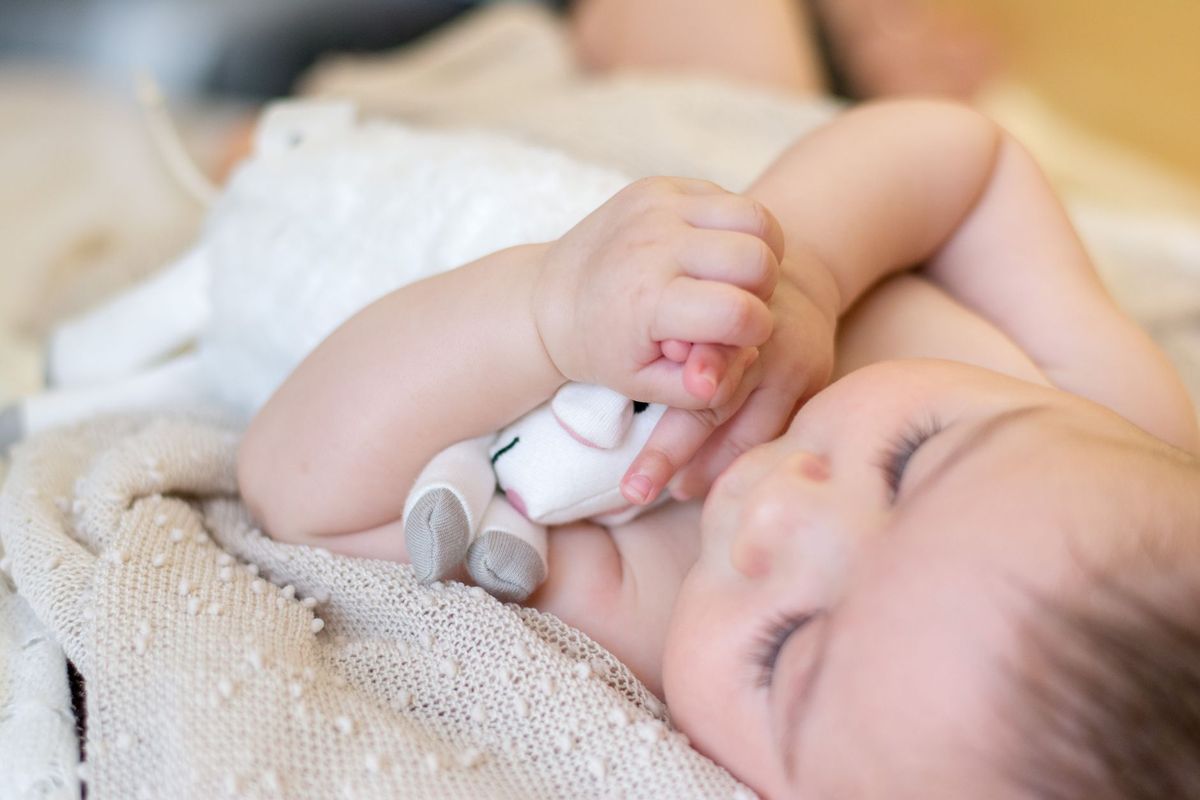
| Toy | What it develops | Free or cheaper version | Where |
|---|---|---|---|
| 8. Light rattles (wooden or fabric) | Grasping, shaking, hearing the result | IKEA SANDBI rattle ($4.99) | IKEA Amazon |
| 9. Interlocking discs | Passing from hand to hand, turning, mouthing | Two large wooden rings | Amazon |
| 10. Soft or puzzle ball | Grabbing with the whole hand, reaching, rolling toward it | A knitted or fabric ball. See our sensory balls guide | Amazon |
| 11. A safe teether (solid silicone, natural rubber or untreated wood) | Mouthing, soothing gums | A clean, chilled (not frozen) washcloth | Amazon |
Offer one or two objects at a time on the mat, just out of reach, so your baby has a reason to stretch and roll. The FDA warns against teething necklaces and bracelets because of choking and strangulation risks.
Safety for Baby Toys
- Nothing in the crib. The AAP recommends a bare sleep space with no toys, pillows or bumpers.
- Remove hanging toys at the right time. CPSC guidance is to take down mobiles and crib gyms once your baby starts pushing up on hands and knees, or by about 5 months.
- Short ribbons, always supervised. Take tactile mobiles down after play.
- Small parts. Anything that fits inside a toilet paper tube is too small for a baby.
- Mirrors. Acrylic, firmly fixed to the wall, never leaning.
What You Can Skip
- Light-up, musical mobiles. Slow, quiet movement is easier for a young baby to follow.
- Big activity gyms with many hanging toys. One object at a time is easier to focus on.
- A full shelf of toys. Two or three objects in a small basket by the mat is plenty at this age.
- Expensive subscription boxes. They can be convenient, but most items have a free version. We look at one popular brand in our Lovevery review.
Unsure about a toy? Our 7-point toy test works for babies too.
Questions Parents Ask
What Toys Does a Newborn Need?
Very few. A firm floor space, a mirror, high-contrast images and your face cover the first weeks. A Munari mobile can come in from the first weeks.
When Do Babies Start Playing With Toys?
Most babies start swiping at toys around 3 to 4 months and holding a toy you put in their hand around 4 months. Reaching for a toy they want usually comes by 6 months.
Are Montessori Mobiles Worth It?
They are a simple way to give a young baby something to watch. You can buy them or make them from paper and thread. One at a time, over the play mat, for a few weeks each.
Can I Hang a Mobile Over the Crib?
Montessori mobiles are for awake time on the play mat. In the crib, follow AAP safe sleep advice and keep the space bare.
Free Baby Printables
Download free high-contrast cards, DIY mobile templates and a first-18-months planner from our baby printables page. Our book The Everyday Montessori Baby covers birth to 18 months. Read the first chapter free.
The Everyday Montessori Baby
Book 1 of the Montessori for Real Life series, for 0 to 18 months. What your baby is working on at each stage, a sample day, safe sleep and simple activities with what you already have.
Launch price $6.99 $4.99 Kindle · $14.99 $12.99 paperback
Sources
- Centers for Disease Control and Prevention, milestones at 2 months, 4 months and 6 months.
- NICHD Safe to Sleep campaign, Tummy Time for a Healthy Baby.
- Moon RY et al. Sleep-Related Infant Deaths: Updated 2022 Recommendations for Reducing Infant Deaths in the Sleep Environment. Pediatrics 2022;150(1):e2022057990.
- U.S. Consumer Product Safety Commission, crib safety guidance on mobiles and crib gyms, and small parts rule (16 CFR Part 1501).
- U.S. Food and Drug Administration, safety communication on teething jewelry (2018).
- Montessori, M. The Absorbent Mind (1949). Lillard, P. P. and Jessen, L. L. Montessori from the Start (2003), on the infant mobiles.
- Photos from Pexels (free licence).