
This guide contains affiliate links, marked as such. If you buy through them, Montessori Theory may earn a small commission at no extra cost to you.
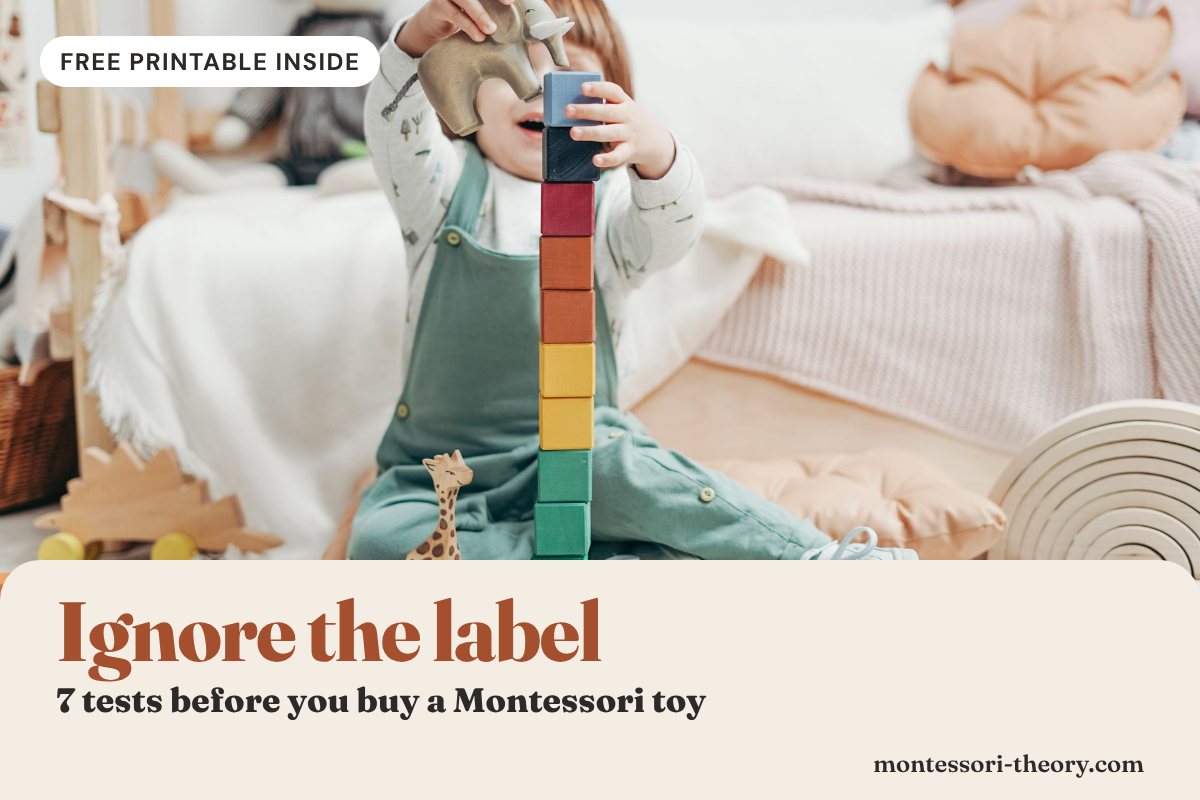
Almost every wooden toy online now says “Montessori” on the box. The label tells you nothing. What matters is whether the toy fits what your child is working on, and whether your child does the work. Here are seven tests to run before you buy, plus a free printable version for your phone or fridge. For picks by age, see our Montessori toys guide.
Quick answer
- A Montessori toy matches a skill your child is practicing now, does one thing well and lets your child do the work.
- Real or realistic beats cartoonish. Sturdy beats big sets.
- Wood is nice, but it is not what makes a toy Montessori.
- The best answer is sometimes to buy nothing and use what you already have.
- Download the one-page 7-point toy test below.
The 7 Tests
1. Does It Match What My Child Is Doing Right Now?
Watch for three or four days before you shop. Is your child posting things into gaps, carrying everything around, climbing, naming objects, pouring water at the sink? Buy for the skill you see, not for the age printed on the box. A toddler who is busy climbing will ignore the best puzzle in the world.
2. Does It Do One Thing Well?
Montessori materials isolate one skill. The pink tower changes only in size. A ball drop box has one hole and one ball. A toy with ten buttons, three songs and a mirror spreads your child’s attention thin. One clear task is easier to understand, repeat and master.
3. Does My Child Do the Work?
If lights, sounds or a motor do the playing, your child mostly watches. A wooden car that only moves when it is pushed, a stacker that only stands when the rings go on in order, a puzzle that only closes when the pieces fit. These keep your child active. Sound and light are not banned, but they shouldn’t be the point.
4. Is It Real or Realistic?
Young children are working hard to understand the real world. Realistic animal figures, books with photographs and small versions of real tools (a pitcher, a broom, a whisk) help with that. Talking animals and pink giraffes are fun, and they belong to a later stage of pretend play.
5. Is It the Right Size, and Is It Safe?
Can your child hold it, carry it and use it without help? Is it sturdy enough to be dropped? For children who still put things in their mouths, nothing should be small enough to choke on. The CPSC uses a small-parts test cylinder about 1¼ inches wide, and anything that fits inside is not safe for children under 3. A toilet paper tube is a rough home check.
6. Will It Last More Than a Week?
Good toys hold a little challenge your child can return to. Blocks, puzzles with a few more pieces than last time, stacking and nesting toys, a set of realistic animals. Natural materials feel good and last, but a well-made plastic toy that gets used every day is a better buy than a beautiful wooden one that gathers dust.
7. Do I Need to Buy It at All?
Count what you already own first. A muffin tin and some pom-poms make a sorting tray. A tissue box and scarves make a pulling activity. A kitchen drawer with wooden spoons and a pot is a whole morning. Many Montessori families buy a few well-chosen pieces and let everyday objects do the rest. Our list of things Montessori families skip buying has more ideas.
Montessori Toy or Just the Label? Examples
| Usually passes the test | Usually fails it |
|---|---|
| Ball drop box with one hole | “Activity cube” with 12 features |
| Stacking rings on a straight post | Light-up stacker that sings when complete |
| Knobbed puzzle with realistic pictures | Cartoon puzzle with 40 pieces for a 2 year old |
| Small pitcher, sponge and tray | Battery-powered toy kitchen tap |
| Basket of wooden blocks | Branded block set with a fixed model to copy |
| Realistic animal figures | Talking plush that “teaches” words |
| Climbing triangle (with supervision) | Ride-on toy that drives itself |
Are Montessori Toys Worth the Money?
Some are, some aren’t. Spend on what gets daily use for months, like a sturdy step stool, a child-sized table and chairs, a climbing triangle or a good set of blocks. Save on everything that a DIY version or an object from your kitchen can replace.
Subscription boxes and brand-name kits can be convenient, but they are not required, and many families find a few pieces from each box get most of the use. We look at one popular brand in our Lovevery review.
How Many Toys Does a Child Need?
Fewer than most homes have. Many Montessori families keep 6 to 8 activities out on a low shelf for a toddler and store the rest. Rotate when interest drops. A toy that keeps getting chosen stays out, whatever the schedule. See our toy rotation guide and how to set up a Montessori shelf.
Free Printable: The 7-Point Toy Test
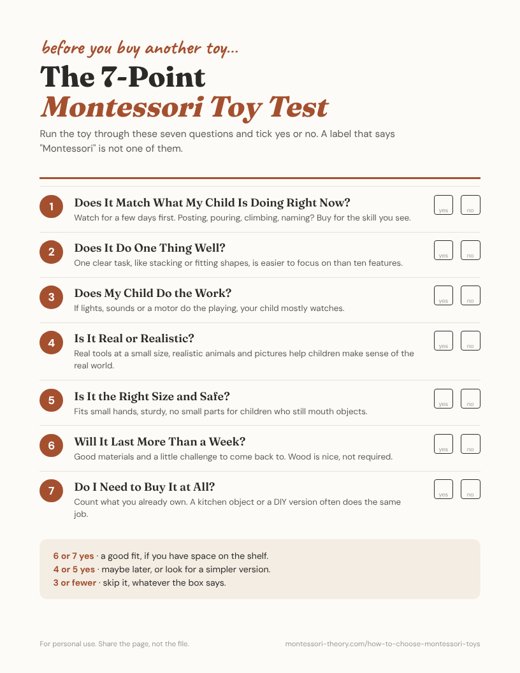
The 7-Point Montessori Toy Test
One page with the seven questions and a simple score. Keep it on your phone for store visits or on the fridge before birthdays.
Where to Start by Age
Questions Parents Ask
What Makes a Toy Montessori?
It matches a skill the child is practicing, isolates one task, lets the child do the work, is realistic and sized for small hands. The word on the box is not one of the criteria.
Do Montessori Toys Have to Be Wooden?
No. Wood is pleasant to hold and durable, which is why it is common. A simple, sturdy toy in another material can be just as Montessori.
Are Plastic Toys Bad in Montessori?
Not automatically. Look at what the toy asks of your child. A plain plastic stacking cup set passes the test better than an elaborate wooden toy that does the playing.
Sources
- Montessori, M. The Discovery of the Child (1948), on materials that isolate one quality.
- Lillard, A. S. Montessori: The Science Behind the Genius (3rd ed., 2017), on concrete, realistic materials for young children.
- U.S. Consumer Product Safety Commission, small parts rule for children under 3 (16 CFR Part 1501).