
Updated October 2026. repositioned as a complete shelf guide (height by age, what to put on it, small-space options); IKEA prices checked on ikea.com/us. No affiliate links on this page.
A Montessori shelf is the heart of a Montessori home: low, open and nearly empty, so your child can see every choice, take one, and put it back alone. You don’t need a $400 shelf to get it right. Height, depth and what you leave off matter more than the brand.
Quick Answer
- Height. the top shelf at or below your child’s chest, roughly 12 to 16 inches for a crawling baby and 20 to 24 inches for a toddler.
- Open front. no doors, no lids, no deep bins. If your child can’t see it, they won’t choose it.
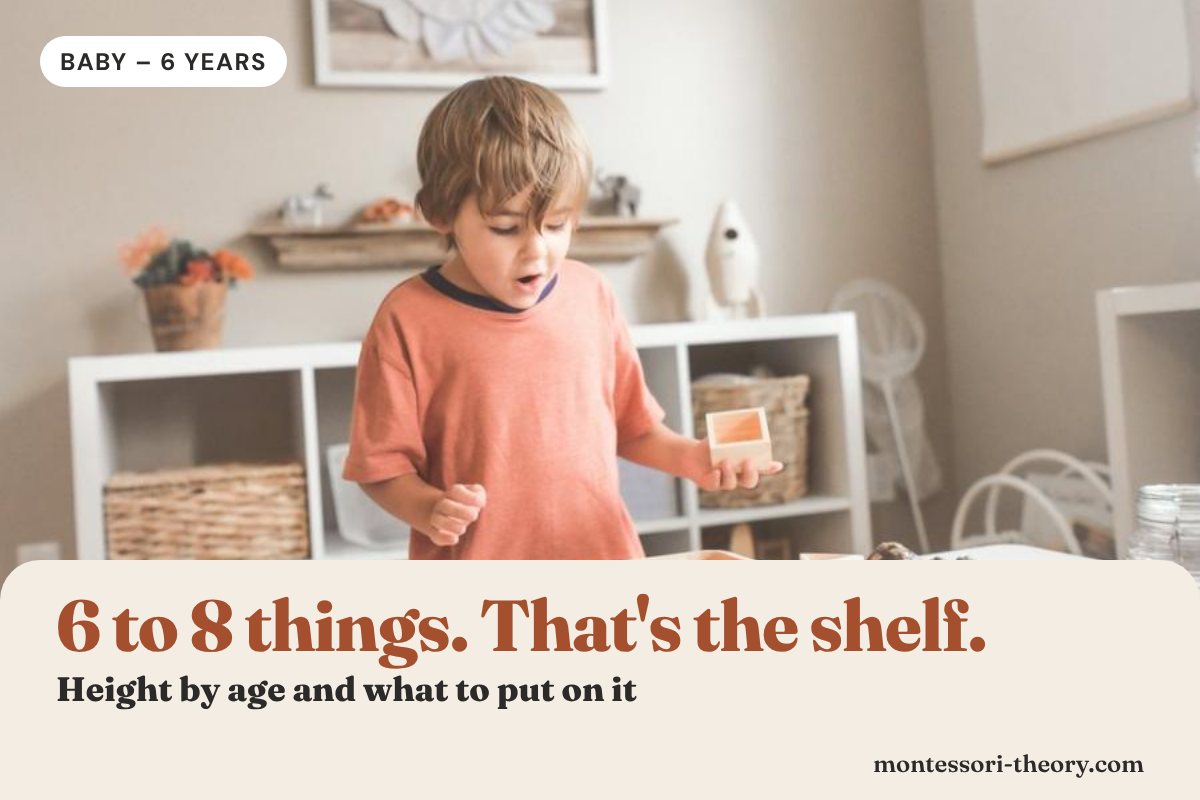
- 6 to 8 activities, one per tray or basket, with space between them.
- Anchor it to the wall, even if it is low (CPSC Anchor It).
- Budget pick. an IKEA KALLAX 1×4 laid on its side ($59.99, about 16 inches tall), or the 2-cube version ($34.99).
What Makes a Shelf Montessori
Maria Montessori described the prepared environment as a space where the child can act without waiting for an adult, with furniture at their size, materials in a fixed place, and order they can follow. A shelf is the simplest way to build that at home. It passes when
- Your child reaches every level without climbing or stretching.
- Every item is visible from where your child stands or sits.
- Each item has its own spot, so your child knows where it goes back.
- It is shallow (about 12 inches deep): deep shelves hide whatever is pushed to the back.
- It is stable, anchored, with heavier things on the bottom.
The Right Height by Age
| Age | Top shelf height | Layout |
|---|---|---|
| Baby, crawling (about 6 to 12 months) | About 12 to 16 inches | One long, low level; 3 or 4 objects |
| Toddler (1 to 3 years) | About 20 to 24 inches | Two levels; 6 to 8 activities |
| Preschooler (3 to 6 years) | About 24 to 36 inches | Two or three levels; 8 to 12 activities, grouped by type |
These are working ranges, not rules. The real test is your child. Watch them reach the top shelf. If they stretch onto tiptoes, it is too high.
What to Put on a Toddler Shelf: 8 Balanced Choices
Eight puzzles practice the same skill eight times. A balanced shelf covers different kinds of work, so your child can choose what their body and mind need that day. Here is a starting point for a 2-year-old.
- One knobbed puzzle (3 to 5 pieces, realistic images): precise hand work and matching.
- One posting activity: a box with a wide slot and large wooden discs or jar lids, for wrist turning and release.
- One language basket: three real objects from one category (fruit, kitchen tools). Name them, then ask “Can you give me the spoon?”
- One art tray: thick crayons and a small stack of paper, or a water-painting board and one brush.
- One practical life tray: spooning large beans, folding cloths, washing one toy, arranging flowers.
- One building material: a small basket of blocks or nesting boxes.
- One music choice: a hand drum, two shakers or simple bells your child can start and stop.
- One movement invitation: a beanbag to carry, a pull toy or a small basket to transport.
Where things go. puzzles and language baskets on the top shelf, at eye level; heavier and bulkier items (blocks, practical life) on the bottom. Keep small parts off the shelf if your child still mouths objects, and check every tray after use.
For babies, three or four objects are plenty, such as a treasure basket, a ball, a rattle, an object permanence box from around 8 months.
Shelf Styles for Small Spaces
A small room doesn’t need less play. It needs fewer visible choices and the rest stored elsewhere.
| Style | Holds | Best for | Watch out for |
|---|---|---|---|
| Narrow two-tier shelf (24 to 30 in wide) | 4 to 6 activities | Beside a sofa or at the end of a bed | Limited room for bulky toys |
| Long, low bench shelf | 5 to 8 activities | A free wall under a window | Keep the top from becoming a second crowded shelf |
| Cube unit on its side | 4 to 8 activities | Display plus a few baskets | Deep cubes, so keep trays at the front and leave half empty |
| Low wall-mounted shelf | 3 to 5 activities | Very narrow rooms; clear floor | Mount for the load; it must never become a step |
| Corner shelf | 3 to 4 activities | Bedrooms without a long free wall | How far the front edge sticks into the walking path |
| Rolling cart with open trays | 4 to 6 activities | Living rooms that reset every evening | Wheels must lock; a cart that moves defeats independent use |
| DIY board on two crates | 4 to 6 activities | Trying it out on a tight budget | Sand the edges, fix the board, test for tipping |
IKEA and Budget Options
Why are “Montessori” shelves so expensive? Mostly solid wood, small production runs and the label. An IKEA shelf at the right height does the same job.
| Piece (price, Oct 2026) | How to use it |
|---|---|
| KALLAX shelf unit, 1×4 $59.99 · 1×2 $34.99 | The 1×4 laid on its side is the classic long, low toddler shelf, about 16 inches tall and 58 inches wide. The 1×2 on its side gives two cubes at the same height. (A 2×4 on its side is about 30 inches tall, better for a preschooler.) IKEA |
| EKET cabinet, $28.00 per open cube | Single open cubes you can line up or wall-mount at any height. IKEA |
| IVAR shelf unit, 35 x 48 7/8 in, $95.00 | Solid pine; you set the shelf heights yourself and raise them as your child grows. Anchor it. IKEA |
| RÅSKOG utility cart, from $29.99 | Three open levels on wheels for art supplies or a rotation of small trays. IKEA |
| LACK wall shelf, from $7.99 | A short shelf mounted at your child’s height for 3 or 4 items. IKEA |
More pieces, from book displays to step stools, are in our IKEA Montessori guide. For books, see front-facing bookshelves.
Keep It Working: Rotation
A shelf only works if it changes with your child. Once a week, look at what was used. Keep what is repeated, remove what is dumped or ignored, and change one or two items at a time rather than the whole shelf. Our toy rotation guide shows how to store the rest.
Common Mistakes
- Every cube full. Leave space around each item; empty space is what makes choices visible.
- Bins with lids for current toys. Lids belong on rotation storage, not on the shelf.
- Too high “so it lasts”. Buy for today’s height, or choose adjustable shelves.
- Only one type of work. Mix hands, language, art, practical life and movement.
- No anchor. Low shelves tip too, especially when a child pulls up on them.
Questions Parents Ask
What Makes a Shelf Montessori?
Child height, open front, shallow depth, few items each with its own place, and stability. The material and brand don’t matter.
How Many Toys Should Be on a Montessori Shelf?
About 6 to 8 activities for a toddler, 3 or 4 objects for a baby, 8 to 12 for a preschooler. Fewer is easier to choose from and to tidy.
How Tall Should a Montessori Shelf Be?
Roughly 12 to 16 inches for a crawling baby, 20 to 24 inches for a toddler. Your child should reach the top without stretching.
Why Are Montessori Shelves so Expensive?
Solid hardwood, small-batch production and the “Montessori” label. A KALLAX 1×4 on its side or a board on two crates meets every requirement for a fraction of the price.
Sources
- Montessori, M. The Absorbent Mind (1949) and The Secret of Childhood (1936): the prepared environment and the child’s need for order.
- U.S. Consumer Product Safety Commission, Anchor It: furniture tip-over prevention.
- IKEA US product pages, prices checked October 26, 2026.