
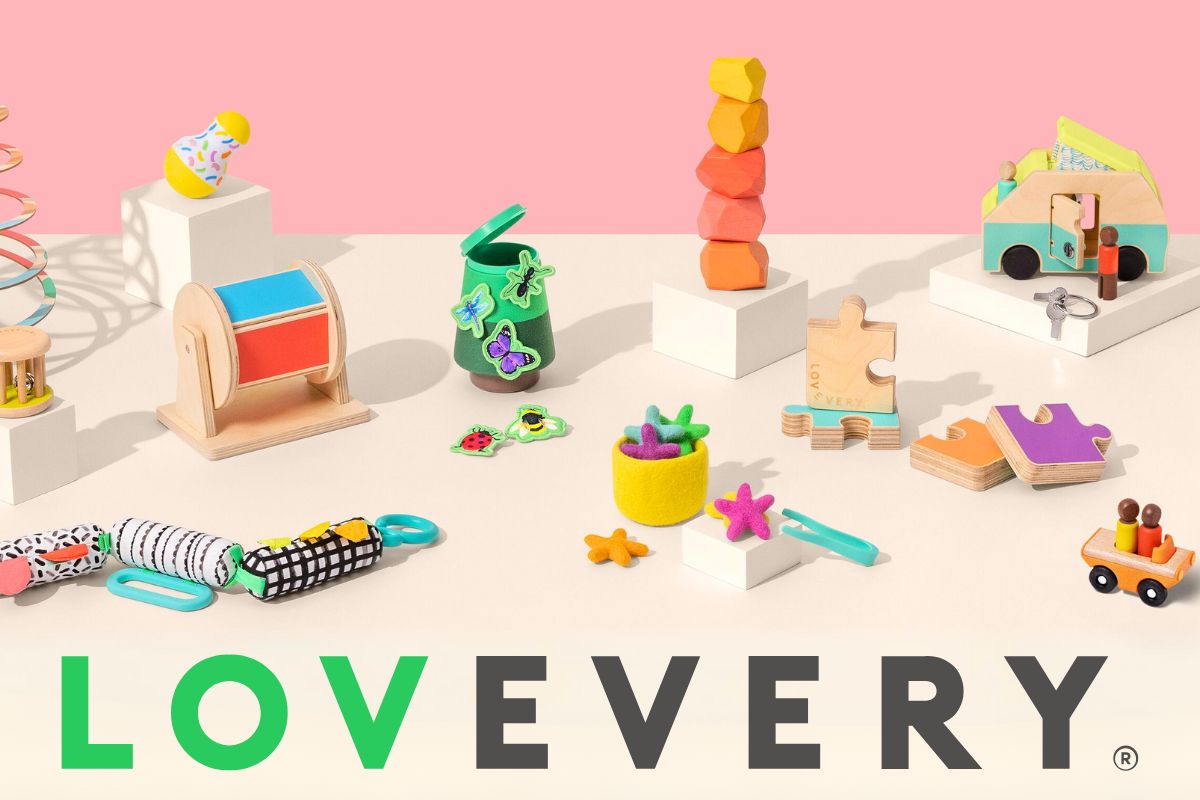
Scroll through any parenting forum, and you’ll find them: perfectly curated photos of wooden toys arranged on minimalist shelves, babies reaching for sustainably sourced rattles, toddlers engrossed in “developmentally appropriate” play. At the center of nearly every image sits a Lovevery box, opened like a treasure chest revealing its $80-$120 contents.
Some parents call it transformative. Others call it the most expensive marketing campaign ever aimed at anxious new parents. One thing everyone agrees on? No one feels neutral about Lovevery.
What We’re Actually Talking About
Lovevery is a subscription toy company valued at over $800 million that delivers age-specific play kits filled with Montessori-inspired toys. Each box contains 7-12 items designed for specific developmental windows, from birth through age 4. The company has celebrity endorsements, a devoted following, and some serious controversy surrounding its business practices and pricing.
- Price Per Box: $80-$120 depending on age (totaling $1000+ for the full subscription)
- The Promise: Montessori-inspired, research-backed developmental toys
- The Materials: Sustainably sourced wood, organic cotton, non-toxic paint
- The Reality: Designed in Idaho, manufactured in China
- The Controversy: Class action lawsuit, deleted negative reviews, automatic renewals
- The Question: Developmental necessity or luxury lifestyle product?
The $800 Million Brand Built on Parental Anxiety
Let’s start with what nobody disputes: Lovevery is incredibly successful. The company reached an $800 million valuation with over 220,000 active subscribers paying premium prices for wooden toys. Celebrities like Gigi Hadid and Jessica Alba post about their products. Instagram feeds overflow with aesthetically perfect Lovevery setups.

The Looker Play Kit for newborns: $80 for items that babies under 3 months may barely notice.
But success and value aren’t the same thing. Critics point out that Lovevery’s growth coincides with a generation of parents desperate to do everything “right” for their children. The company’s marketing speaks directly to this anxiety: your baby’s brain is developing rapidly, every moment matters, miss this developmental window and you might be setting your child back forever.
Is Lovevery solving a problem or creating one? Defenders argue the company simply provides research-backed tools that busy parents appreciate. Skeptics counter that parents have successfully raised children for millennia without $80 wooden toys delivered on subscription schedules.
What Neuroscience Actually Says
Lovevery emphasizes their team of child development experts and neuroscientists. The science behind early childhood development is real. What’s debatable is whether that science specifically requires Lovevery products or simply supports the broader principles of responsive parenting, exploration, and appropriate challenge that can be achieved through countless means.
The Class Action Lawsuit Nobody Talks About
Here’s something that doesn’t make it into the Instagram posts: in 2023, Lovevery faced a class action lawsuit alleging deceptive subscription practices. The complaint claimed the company enrolled customers in automatically renewing subscriptions without clear disclosure, used confusing cancellation processes, and charged fees without proper consent.
According to court documents, one California mother signed up for what she thought was a single purchase and was charged $128.70 two months later when her subscription automatically renewed at a 50% higher price than her original payment. When she tried to cancel, she found the process “obscured, confusing, and time-consuming.”
Customer reviews on Trustpilot and the Better Business Bureau echo similar frustrations. Some report being charged for subscriptions they thought they’d cancelled. Others describe difficult experiences trying to resolve issues with customer service. One reviewer claimed Lovevery deleted their honest, polite criticism from Instagram multiple times.
The Other Side
Lovevery supporters point out that most subscription services face similar complaints, that the vast majority of customers have positive experiences, and that the company has since updated their checkout process to make subscription terms clearer. They argue that focusing on legal disputes ignores thousands of satisfied families who found value in the products.
The “Montessori” Question
Lovevery markets itself as Montessori-inspired. But what does that actually mean when the products come in a subscription box with predetermined contents on a fixed schedule?
Dr. Montessori emphasized following the child’s interests and natural development, not following a company’s shipping schedule. She advocated for simple, open-ended materials that children could use in multiple ways, not curated kits with specific toys for two-month age windows. She believed in children choosing their own activities from available materials, not parents presenting the “right” toys at the “right” time.
Lovevery defenders argue that the company captures the spirit of Montessori: natural materials, appropriate challenge, independence, sensory exploration. The subscription model simply makes accessing these principles easier for busy families who don’t have time to research Montessori philosophy and source appropriate materials.
Montessori purists counter that convenience and Montessori philosophy are fundamentally at odds. If you’re too busy to observe your child and provide appropriate materials based on their actual interests and development, a subscription box isn’t solving the real problem.
What You Actually Get for Your Money
Let’s look at the actual economics. A Lovevery subscription for the first year costs approximately $480 for six boxes. Each box contains 7-12 items, putting the cost per item at roughly $9-15.
Supporters argue that’s reasonable for quality wooden toys made from sustainable materials. Break down what you’d pay buying similar items individually, and Lovevery’s pricing seems fair, maybe even competitive.
Critics point out that “similar items” is doing a lot of work in that sentence. Is a Lovevery black-and-white card worth $9? Could you print high-contrast images at home for pennies? The Inspector box includes a ball drop toy that’s genuinely engaging. It also includes items like wooden rings and fabric balls that you could easily find for a fraction of the cost.
The DIY Debate
Multiple parent bloggers have created detailed guides for recreating Lovevery boxes using Amazon and craft store finds, often at 30-50% of Lovevery’s cost. These guides include exact substitutes for most items in each kit.
Does this prove Lovevery is overpriced? Or does it prove that convenience has value? A parent working full time might gladly pay extra to avoid hours of research, shopping, and assembly. A stay-at-home parent with time and creativity might find DIY alternatives both cheaper and more satisfying.
The quality argument cuts both ways too. Lovevery items are undeniably well-made. The wood is smooth, the fabrics are durable, nothing feels cheap. But do babies and toddlers care about artisanal craftsmanship? Multiple parents report their children preferring cheap plastic toys or household items over beautiful wooden Lovevery pieces.
What Development Research Actually Shows
Studies consistently show that responsive caregiving matters more than any specific toy. Babies whose parents talk to them, respond to their cues, and provide varied sensory experiences thrive regardless of whether those experiences come from $80 wooden toys or free household objects. The research Lovevery cites supports the importance of developmental windows and appropriate challenge, but it doesn’t specifically endorse expensive toys as necessary for achieving these goals.
The Social Pressure Problem
Perhaps the most uncomfortable aspect of the Lovevery phenomenon has nothing to do with the company itself and everything to do with what it’s become in parenting culture.
One UK mother wrote about how Lovevery “feels very white and upper-middle-class,” creating an uncomfortable “us and them” divide in parenting communities. When celebrity endorsements and Instagram feeds overflow with Lovevery setups, what message does that send to families who can’t afford $1000+ on toys?
Defenders argue this isn’t Lovevery’s fault. Every premium brand attracts aspirational marketing and status signaling. The company can’t control how their products get used in social media culture. They offer quality products at prices that reflect their costs, and if some people want to display those products for status, that’s human nature, not corporate malfeasance.
Critics counter that Lovevery absolutely benefits from and cultivates this aspirational positioning. The aesthetic perfection of their marketing, the celebrity partnerships, the careful curation of their social media all contribute to making Lovevery feel like a marker of good parenting rather than simply one option among many.
What Parents Actually Experience
Reading through hundreds of parent reviews reveals patterns that transcend simple “worth it” or “waste of money” categories.
Many parents report that their children loved some items in each box while ignoring others completely. The Inspector ball drop gets rave reviews. The Looker box for newborns gets mixed feedback, with many parents feeling it was “more for them than the baby.” Several reviewers note that children under six months don’t engage much with any toys, making those early boxes feel less valuable.
The convenience factor is real. Parents working full time or caring for multiple children consistently cite the time savings as worth the premium. The play guides get particular praise for giving busy parents ideas and confidence.
The quality is rarely disputed. Even critics acknowledge the items are well-made and durable. Several parents mention passing toys down to younger siblings or selling used boxes for good resale value.
The Subscription Trap
Multiple reviewers mention feeling locked into continuing their subscription even when individual boxes didn’t excite them, because they’d already invested so much and didn’t want to “waste” what they’d spent. This sunk cost fallacy might be the most insidious aspect of the subscription model. You’re not just buying toys; you’re buying into a system that creates its own momentum.
The Made in China Contradiction
Lovevery emphasizes sustainability, ethical sourcing, and quality materials. The company is designed in Boise, Idaho. The products are manufactured in China.
For some parents, this matters enormously. They expected “made in USA” for the premium price. For others, Chinese manufacturing doesn’t automatically mean lower quality or unethical practices. Lovevery claims to ensure sustainable materials and ethical production regardless of location.
What’s interesting is what this reveals about the Lovevery value proposition. If the premium price reflects sustainable materials and ethical manufacturing, that’s defensible. If it primarily reflects branding and marketing to affluent parents, that’s a different calculation.
Alternatives That Exist
Lovevery isn’t the only Montessori-inspired subscription service. MonkiBox, Tiny Earth Toys, and others offer similar concepts. KiwiCo provides project-based kits for older children. Amazon is flooded with “Lovevery dupes” at lower price points.
Comparison reviews suggest that Lovevery generally offers superior quality and more thoughtful curation than competitors. Whether that superiority justifies the price premium is, once again, personal.
For budget-conscious families, the secondhand market offers another option. Lovevery items hold their value well, appearing frequently on Facebook Marketplace, eBay, and resale sites at 50-70% of retail prices. If you’re willing to give up the subscription convenience and perfect timing, buying used might capture most of the benefit at a fraction of the cost.
Questions Worth Asking Yourself
Before subscribing to Lovevery or dismissing it entirely, consider these questions honestly.
Do you genuinely need help figuring out what toys are appropriate for your child’s age, or are you confident in your ability to observe and respond to their interests?
Is the convenience of curated boxes worth $40-$60 per month to your family’s budget, or would that money create more value elsewhere?
Are you buying Lovevery for your child’s development or for your own peace of mind? Both are valid reasons, but honesty about motivation matters.
Will you realistically use the play guides and engage with the toys as intended, or will they sit on a shelf looking beautiful but unused?
Can you commit to a subscription model without feeling trapped, or would you prefer the flexibility of buying individual toys as needs arise?
The Question Nobody Can Answer For You
Here’s what we know for certain: Lovevery toys are well-made. The company has achieved remarkable commercial success. Some parents swear by the products. Others feel regret after subscribing. The pricing is premium by any standard. The developmental principles underlying the toys are sound, even if those same principles could be applied through countless other approaches.
What we can’t know is whether Lovevery is worth it for your family. That depends on your budget, your values, your time constraints, your confidence in sourcing alternatives, and honestly, how much the aesthetic appeal and convenience matter to you personally.
The uncomfortable truth might be that Lovevery works perfectly for some families while being an expensive mistake for others, and both experiences are valid. The company has tapped into real needs: busy parents want help, good materials matter, developmental guidance has value. But they’ve also tapped into anxiety, status signaling, and the modern parenting tendency to believe that doing it “right” requires buying the right products.
Your child will develop with or without Lovevery. The question isn’t whether these toys work. It’s whether they work for you at this price, with this business model, in this moment of your parenting journey. Nobody on the internet can answer that except you.
Sources & References
- ClassAction.org. (2023). Lovevery Hit with Class Action Over Alleged Automatic Subscription Renewals. Retrieved from https://www.classaction.org
- Trustpilot. (2025). Lovevery Customer Reviews. Retrieved from https://www.trustpilot.com
- Twin Perspectives. (2024). A UK Mum’s Review of Lovevery Play Kits: Are They Worth It? Retrieved from https://twinperspectives.co.uk
- Multiple parent review sources including Bless Our Littles, Anna in the House, Fairly Curated, Confidently Mom, and Baby Savers (2022-2025).
Transparency Note: This article contains no affiliate links to Lovevery or competing products. Our analysis is based on publicly available information, parent reviews, and court documents. We receive no compensation from Lovevery or any companies mentioned.