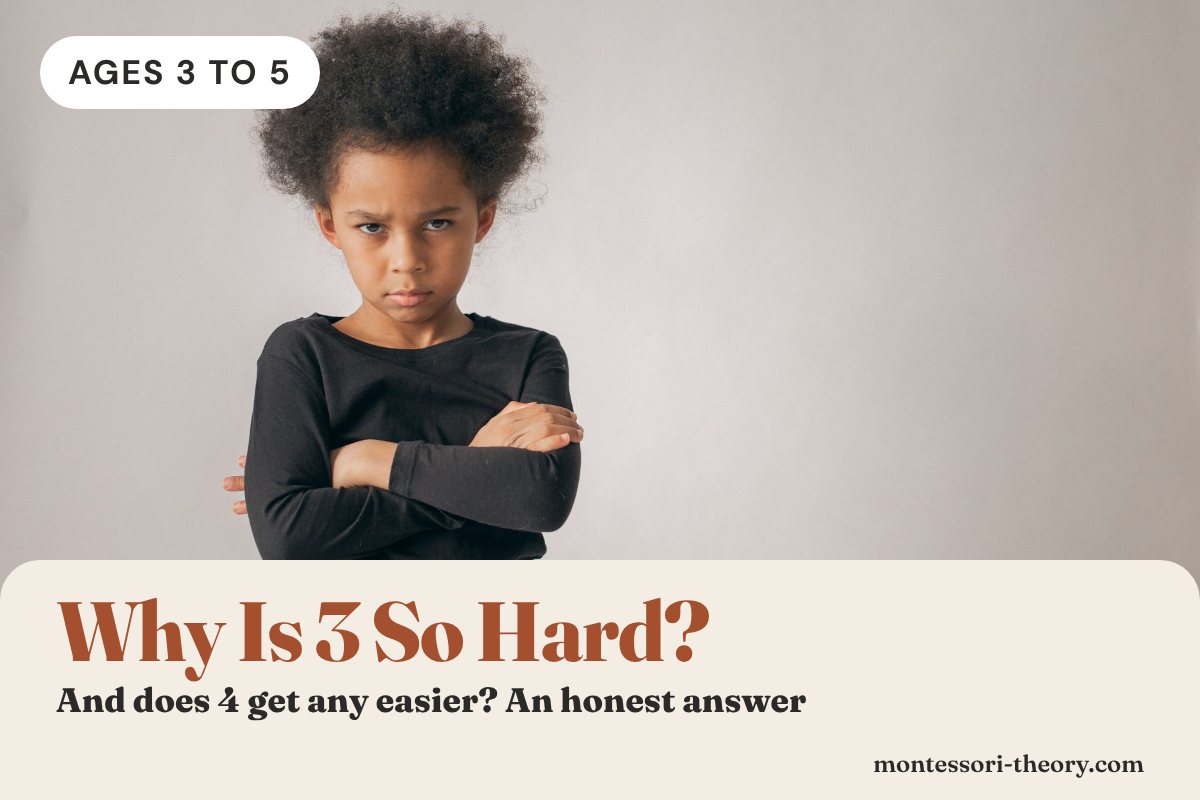
Three is hard because your child suddenly has lots of words, a strong will and very little self-control, all at the same time. Four is often easier in some ways and harder in others. Here’s what changes at 3, 4 and 5, what helps at each age, and when it’s worth asking for help.
The calm limits behind all of this are in Montessori positive discipline.
Quick Answer
- At 3, the will grows faster than the brakes. Strong opinions, big reactions, little patience.
- At 4, fewer meltdowns for many children, but more talking back, testing words and power plays.
- At 5, more self-control and better words for feelings, with new worries about fairness and friends.
- What helps at every age. Choices, routines, real jobs, calm limits and enough sleep.
Why 3 Is so Hard
At 3, children want to decide everything. They can say “no,” “mine” and “I do it” with total conviction. What they can’t yet do is stop themselves, wait, switch gears or handle disappointment. Those skills, often called executive function, develop slowly through early childhood.
So a 3-year-old knows exactly what they want, can argue for it, and has no brake when the answer is no. Add fatigue, hunger or a change in routine, and you get the “threenager” moments parents talk about. Big feelings, small triggers, very loud.
This is not a sign that you did something wrong. It’s a stage of development, and it’s often harder than the toddler years because your child now has the words to push back.
Is 4 Easier Than 3?
Honestly, it’s different. Many parents notice fewer full meltdowns at 4, because children can talk about what they want and wait a little longer. But 4 brings its own challenges.
- Talking back. Testing how far words can go, including rude or bathroom words.
- Power plays. Negotiating every rule, wanting to win every game.
- Tall tales and fibs. Imagination is booming, and the line between story and lie is still blurry.
- Bigger fears. Monsters, the dark, separation, sometimes new worries at bedtime.
Many 4-year-olds also become wonderful helpers, storytellers and playmates. The hard moments are real, and so are the easy ones.

What Changes at 5
By 5, most children follow rules better, take turns in games and use words for feelings more often. The CDC milestones at this age include following rules or taking turns when playing games with other children.
New challenges appear. Fairness (“That’s not fair!”), friendships and being left out, and the after-school crash once kindergarten starts. Children may hold it together all day and fall apart at home, which usually means home is where they feel safe.

What Helps at Each Age
| Behavior | The skill behind it | What to try |
|---|---|---|
| “No!” to everything at 3 | Independence, wanting control | Two choices you’re happy with, real jobs, “You decide which cup.” |
| Meltdowns over small things at 3 | Very little self-control yet | Stay calm and close, few words, comfort after. Protect sleep and snacks. |
| Talking back at 4 | Testing words and power | Calm, short limit. “You can be mad. You can’t call names.” Don’t argue the point. |
| Negotiating every rule at 4 | Practicing reasoning | Fewer rules, the same every day. Say it once, then follow through. |
| “That’s not fair!” at 5 | A new sense of fairness | Name it, then explain. “Fair means everyone gets what they need.” |
| Falling apart after school at 5 | Holding it together all day | Snack, quiet, few questions for the first hour home. |
For the moments when instructions don’t land, see how to get kids to listen. For the moments you lose it yourself, see how to stop yelling and repair.
Is a 4 Year Old a Toddler or a Preschooler?
A preschooler. The CDC uses “toddlers” for roughly 1 to 3 years and “preschoolers” for 3 to 5 years. Montessori groups children from about 3 to 6 in the same Children’s House classroom. In everyday talk, “threenager” and “fourenager” are jokes about these ages, not official terms.
Normal, Watch, Ask
Normal
- Daily “no” and power struggles
- Meltdowns when tired or hungry
- Testing rude words at 4
- Better behavior with others than with you
Watch
- Long, frequent meltdowns that don’t ease over months
- Hurting others often, in many places
- Very hard transitions every single day
Ask your pediatrician
- Your child loses skills they had
- Aggression that worries you or the preschool
- You dread most days and feel stuck. Help exists, for your child and for you.
For you. Not enjoying an age doesn’t make you a bad parent. Many parents find 3 harder than the baby years and quietly feel guilty about it. Lower the bar on the hard days, protect your own sleep where you can, and remember that this stage changes fast.
Questions Parents Ask
Why Is Age 3 so Hard?
Because children have a strong will and new words before they have self-control. They know what they want and can argue for it, but can’t yet handle hearing no.
Is Age 4 Easier Than 3?
Often in some ways. Many 4-year-olds have fewer meltdowns, but more talking back, negotiating and testing words. It’s different rather than simply easier.
When Do Kids Become Easier?
Many parents notice a shift around 5 to 6, as self-control, language and rule-following improve. Every child moves at their own pace.
Is a 4 Year Old Still a Toddler?
No. Children from 3 to 5 are usually called preschoolers.
Go Deeper
- Montessori for preschoolers
- How to get kids to listen
- Montessori parenting in five habits
- The peace table for siblings and friends
The Everyday Montessori Preschooler
Book 3 of the Montessori for Real Life series, for ages 3 to 6. What your child is building at 3, 4 and 5, not listening, meltdowns and hitting, with simple steps for real homes. Coming December 8, 2026.
Launch price $6.99 $4.99 Kindle · $14.99 $12.99 paperback
Sources
- Centers for Disease Control and Prevention, Positive Parenting Tips, Preschoolers (3 to 5 years).
- Centers for Disease Control and Prevention, Milestones by 5 years.
- Center on the Developing Child, Harvard University, Executive Function and Self-Regulation.
- American Academy of Pediatrics, HealthyChildren.org, Disciplining Your Child.
- Photos from Pexels (free licence).