
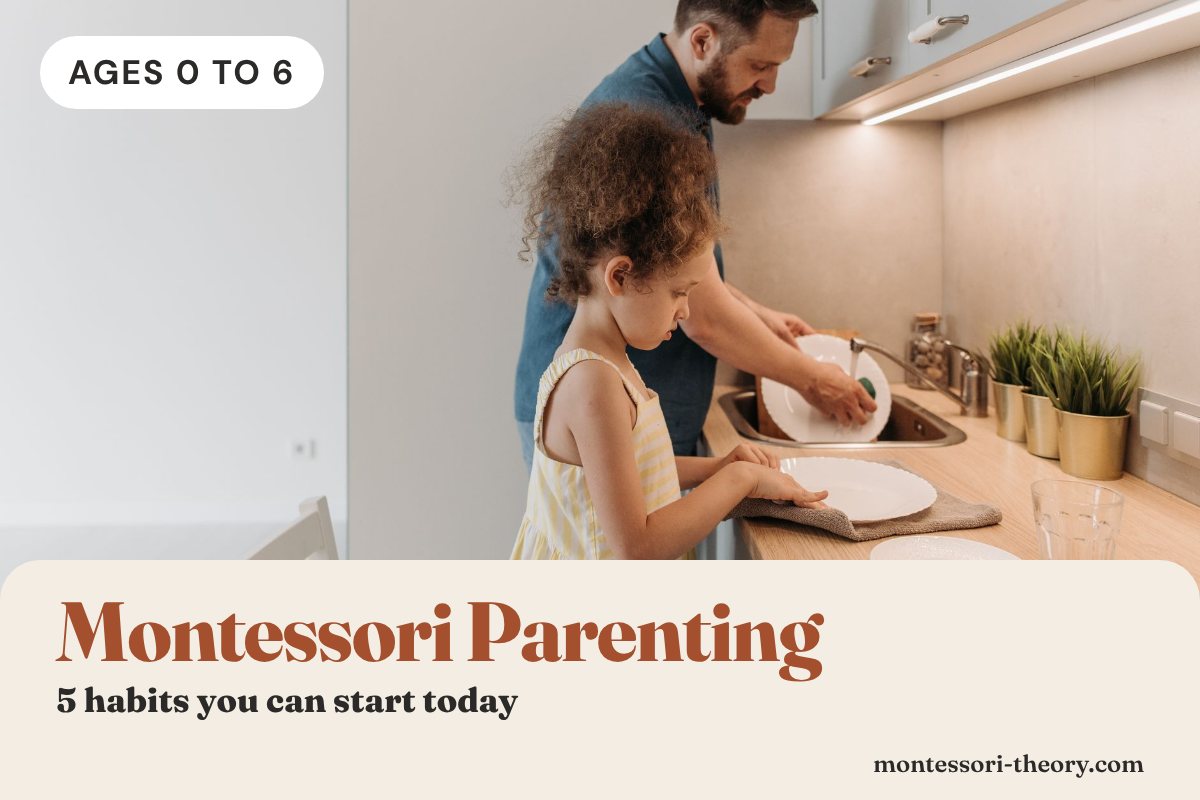
Montessori parenting isn’t a shopping list or a perfect playroom. It’s a handful of habits you can start today, in the home you already have, from the first weeks to age six and beyond. This guide covers the five habits, what they look like at each age, and the myths worth dropping.
New to the method itself? Start with what Montessori is, in plain English.
Montessori parenting in five habits
- Observe first. Watch what your child is trying to do before you step in.
- Real work, real tools. Let your child help with the actual life of the house.
- Freedom within limits. Offer choices inside a few clear, kindly held rules.
- A home they can use. Put the things your child needs where they can reach them.
- Help them do it themselves. Show slowly, then step back, and help only as much as needed.
What Montessori Parenting Means
Montessori parenting means bringing the ideas of Montessori education into family life. You treat your child as a capable person who learns by doing, you arrange the home so they can take part, and you guide with calm, consistent limits.
It is not a separate school of parenting with its own rules. The American Montessori Society describes the parent’s role at home in simple steps. Observe without interfering, model and practice household tasks together, adapt the environment so your child can succeed, and focus on inner motivation rather than rewards.
You do not need a Montessori school, special materials or a certain budget. You need time, a few changes to the house and a different way of helping.
The Five Habits of Montessori Parenting
1. Observe First
Before you fix, teach or tidy, watch for a minute. What is your child trying to do? Where do they get stuck? What do they come back to again and again?
Observation tells you what to offer next, and it stops you from rescuing a child who was about to succeed. You can say, “You’re working hard on that zipper. Tell me if you want help.”
2. Real Work, Real Tools
Young children want to do what they see adults doing. Montessori calls these jobs practical life. Pouring water, wiping a table, washing vegetables, feeding the cat, sorting socks.
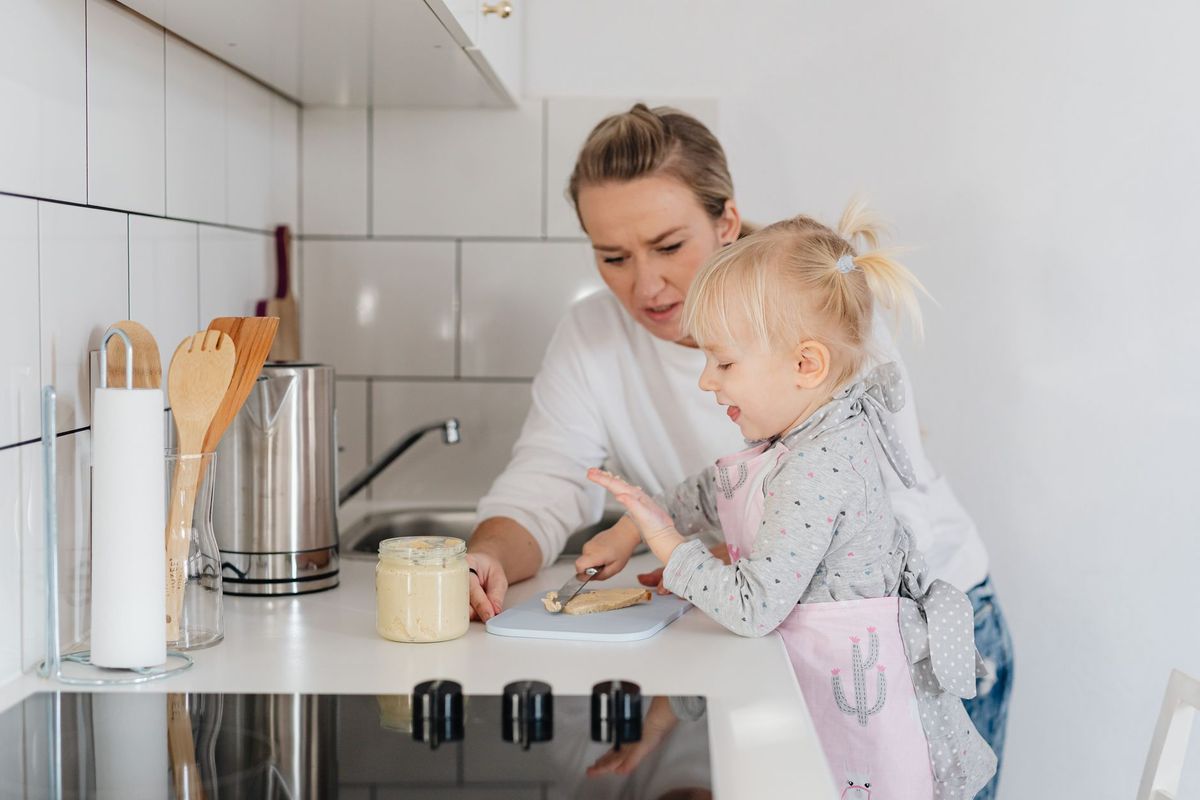
Give your child small, real versions of real tools, like a short broom, a small pitcher or a child-safe knife for soft food. The work matters to the family, and children feel that. See our practical life guide for ideas by age.
3. Freedom Within Limits
Montessori is not permissive. Children get real choices, such as which shirt, which activity or which job, inside a few limits you hold every time. Be kind to people, take care of things, put work back when you’re done.
Offer only choices you’re happy with. “Do you want to walk to the car or hop like a bunny?” works. “Do you want to leave?” usually doesn’t. More in freedom within limits.
4. A Home They Can Use
Look at your home from your child’s height. Can they reach a cup, their coat, a few toys, a towel? A step stool at the counter, a low hook by the door and one low shelf change more than any purchase.
Keep fewer things out and give each one a place. Children tidy more easily when there are six activities on a shelf than when there are sixty in a bin. Our guide to starting Montessori at home walks through it room by room.

5. Help Them Do It Themselves
“Help me do it myself” is the heart of Montessori parenting. Independence does not mean no help. It means the right amount of help, then a little less next time.
Show a task slowly, with few words. “Watch my hands.” Then hand it over. “Your turn.” If they struggle, offer the smallest help that keeps them going, like holding the jar while they turn the lid.
What It Looks Like at Each Age
| Habit | 0 to 18 months | 18 months to 3 years | 3 to 6 years |
|---|---|---|---|
| Observe first | Notice what your baby tracks, reaches for and repeats | Notice what they’re trying to do alone (“me do it”) | Notice interests, frustrations and what they avoid |
| Real work | Hold a cup, take part in dressing and bathing | Wipe spills, carry plates, put shoes away | Cut fruit, set the table, sort laundry, water plants |
| Freedom within limits | Free movement on the floor in a safe space | Two choices, few clear rules, the same every day | More choices, simple family agreements, natural consequences |
| A home they can use | A floor mat, a low mirror, a few toys in reach | Step stool, low shelf, hook for the coat | Their own drawer for clothes, a low pantry shelf, a small cleaning kit |
| Help them do it themselves | Wait a moment before you help them reach a toy | Break a task into small steps and show one at a time | Teach a whole routine, then let them own it |
For age-specific setups, see the Montessori baby room and our practical life jobs by age.
Montessori Parenting vs Gentle and Permissive Parenting
Montessori parenting overlaps with gentle parenting, but it is not the same thing, and it is clearly different from permissive parenting.
| Question | Montessori parenting | Gentle parenting | Permissive parenting |
|---|---|---|---|
| Limits | Few, clear, held calmly every time | Firm boundaries with empathy | Few or inconsistent |
| Punishment and rewards | Avoided, natural consequences instead | Avoided, connection first | Rarely used, often no follow-through |
| Main focus | Independence, concentration, the home environment | The relationship and emotions | Keeping the child happy |
| Role of the adult | Prepares the space, shows, observes, steps back | Coaches feelings, stays close | Follows the child’s demands |
The common ground is respect. The American Academy of Pediatrics also advises against spanking and harsh words, and recommends teaching through clear expectations, praise for effort and consistent follow-through. Our Montessori positive discipline guide shows what that looks like day to day.
7 Myths About Montessori Parenting
- “It’s too late if my child is 3 or 4.” Habits like real work, a reachable home and calm limits help at any age. Children aged 3 to 6 often love practical life the most.
- “You need Montessori materials.” A stool, a small pitcher, a basket of clothespins and a low hook do more than a cart full of wooden toys.
- “Home must copy a Montessori classroom.” Home is a home. Cooking, cleaning, gardening and family life are the curriculum.
- “Independence means no help.” It means the right amount of help, reduced little by little, without taking over.
- “Following the child means never teaching.” Adults show, name, demonstrate and set limits. Following the child means choosing what to show based on what you observe.
- “Montessori kids can’t play pretend.” Children’s own pretend play is welcome. Montessori classrooms simply favor real-world activities and realistic materials for the youngest children.
- “Without a Montessori school, it doesn’t count.” Most of Montessori parenting happens at home, whatever school your child attends.
Where to Start This Week
- Do one 10-minute observation. Sit nearby while your child plays, without directing. Note what they repeat and where they get stuck.
- Lower one thing. A cup and pitcher on a low shelf, a hook for the coat or a stool at the sink. Show your child how to use it, once.
- Hand over one real job. Pick something your child can do every day, like setting the spoons or feeding a pet. Show it slowly, then let it be theirs.
With a baby around? Start with the older child’s job and keep their things on a higher shelf or a table the baby can’t reach. Ten minutes of protected work time matters more than a full Montessori room.
Questions Parents Ask
What Is Montessori Parenting?
It is a way of raising children based on Montessori principles. You observe your child, let them do real tasks, offer choices within clear limits and arrange the home so they can be independent.
Is Montessori Parenting the Same as Gentle Parenting?
Not quite. Both avoid punishment and value respect. Montessori adds a strong focus on independence, practical work and preparing the home environment.
Is Montessori Parenting Permissive?
No. Children have freedom, but inside limits that adults hold calmly and consistently. Safety, respect for others and care of things are not up for negotiation.
Can You Do Montessori Parenting Without a Montessori School?
Yes. Montessori parenting is mostly about daily life at home, so it works alongside any school, or before school starts.
At What Age Should You Start Montessori Parenting?
From birth, but it is never too late. Toddlers and preschoolers adapt quickly to a home they can use and jobs they can own.
Go Deeper
- What is Montessori? The method in plain English
- How to start Montessori at home
- The prepared environment
- Montessori positive discipline
The Montessori for Real Life books
Three short guides that follow your child from birth to six. The Everyday Montessori Baby (0 to 18 months), The Everyday Montessori Toddler (18 months to 3 years) and The Everyday Montessori Preschooler (3 to 6 years, December 2026).
Sources
- American Montessori Society, Montessori at Home.
- American Montessori Society, 5 Core Components of Montessori Education.
- Sege, R. D. and Siegel, B. S. (2018). Effective Discipline to Raise Healthy Children. Pediatrics, 142(6), e20183112. doi:10.1542/peds.2018-3112.
- Montessori, M. The Absorbent Mind (1949).
- Lillard, P. P. and Jessen, L. L. Montessori from the Start (2003).
- Photos from Pexels (free licence).