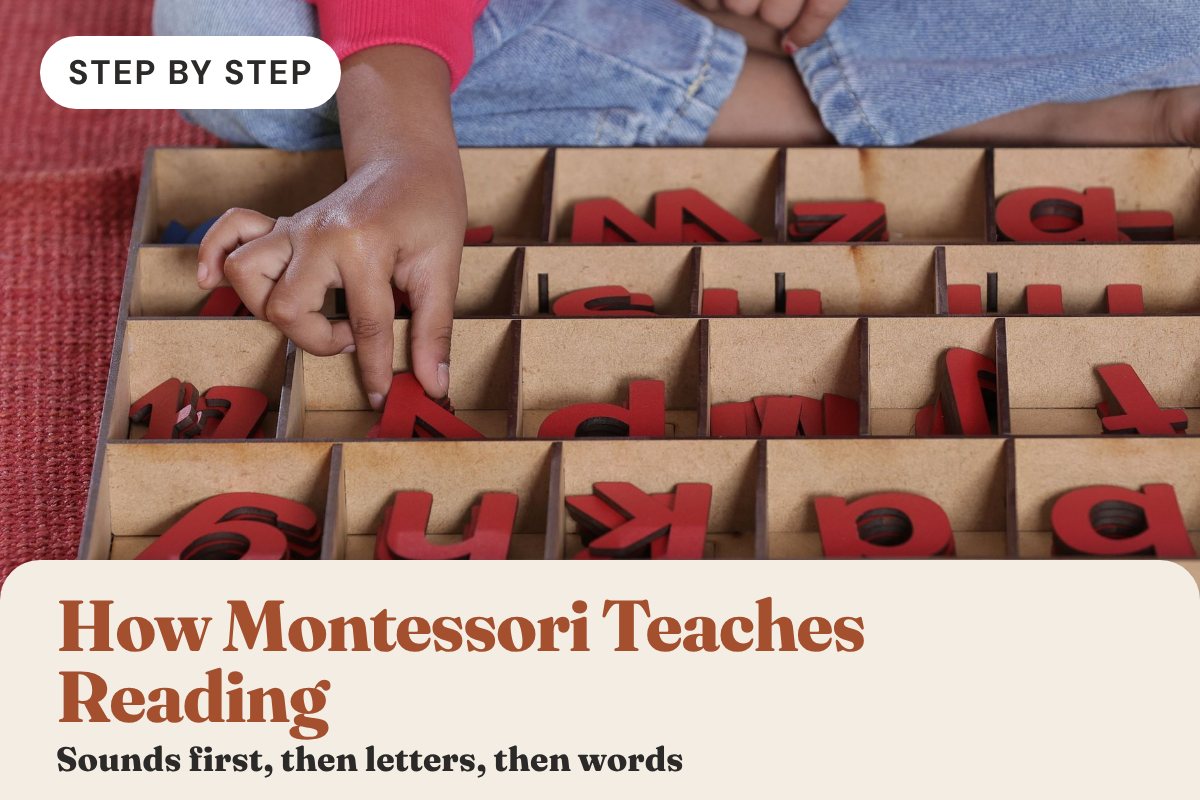
Montessori teaches reading in a clear order. Rich spoken language, then sound games, then letters children can trace with their fingers, then building words with a movable alphabet, and only then reading. Writing usually comes before reading. Here’s the sequence with approximate ages, and 5-minute games for each step at home.
For the full set of language materials, see our Montessori language materials overview.
The Montessori Reading Order
- Talk, name, read aloud. From birth, lots of conversation and real words.
- Play with sounds. Around 3, “I spy something that starts with mmm.”
- Touch the letters. Sandpaper letters, sound first, not the letter name.
- Build words. Around 4, the movable alphabet lets children spell before they can write by hand.
- Read. Often around 5, starting with simple phonetic words, then tricky “puzzle words.”
The Montessori Reading Sequence, With Ages
Ages are approximate. Children move at very different speeds, and that’s expected. What matters is the order, each step resting on the one before.
| Step | Usual age | What the child does | Key material |
|---|---|---|---|
| Spoken language | Birth to 3 | Hears and uses lots of real words, names objects | Conversation, books, object baskets, three-period lessons |
| Sound games | About 2½ to 3½ | Hears the first, last and middle sounds in words | I spy, rhyming, clapping syllables |
| Sandpaper letters | About 3 to 4 | Traces a letter shape while saying its sound | Sandpaper letters |
| Pencil control | About 3½ to 4½ | Strengthens the hand for writing | Metal insets, drawing, practical life |
| Building words | About 4 to 4½ | Spells phonetic words with loose letters | Movable alphabet, object boxes |
| Writing | About 4½ to 5 | Writes words and short sentences by hand | Chalkboard, paper, the movable alphabet |
| Reading | About 5 | Reads phonetic words, then puzzle words and phonograms | Word cards, phonetic readers, puzzle word cards |
Sounds, Letter Names and Sight Words
Montessori teaches the sound a letter makes before its name. A child learns “mmm,” not “em,” because the sound is what helps them read and spell.
- Letter sounds. Taught first with sandpaper letters. “This is /m/.”
- Letter names. Usually later, often through the alphabet song or ordering letters. A child who knows sounds but not the ABC song is right on track.
- Puzzle words. Montessori’s name for sight words that can’t be sounded out, like “the,” “was” or “said.” They come after children read simple phonetic words.
- Phonograms. Letter pairs that make one sound, like “sh,” “ch” or “ee,” introduced once simple words are easy.
Most Montessori classrooms also start with lowercase letters, since nearly all of the text a child will read is lowercase.
This approach lines up with research. The National Reading Panel found that teaching phonemic awareness (hearing the sounds in words) and systematic phonics helps children learn to read.
Why Writing Often Comes Before Reading
In Montessori, children usually write words before they read them. Writing goes from sound to letters. The child thinks “c-a-t,” finds each sound and builds the word. Reading goes the other way, from letters back to sounds and meaning, which is harder.
The movable alphabet makes this possible before the hand is ready for a pencil. A 4-year-old can build “sun” or “map” with loose letters long before writing them neatly. Montessori described the moment when children discover they can write as an “explosion into writing.”
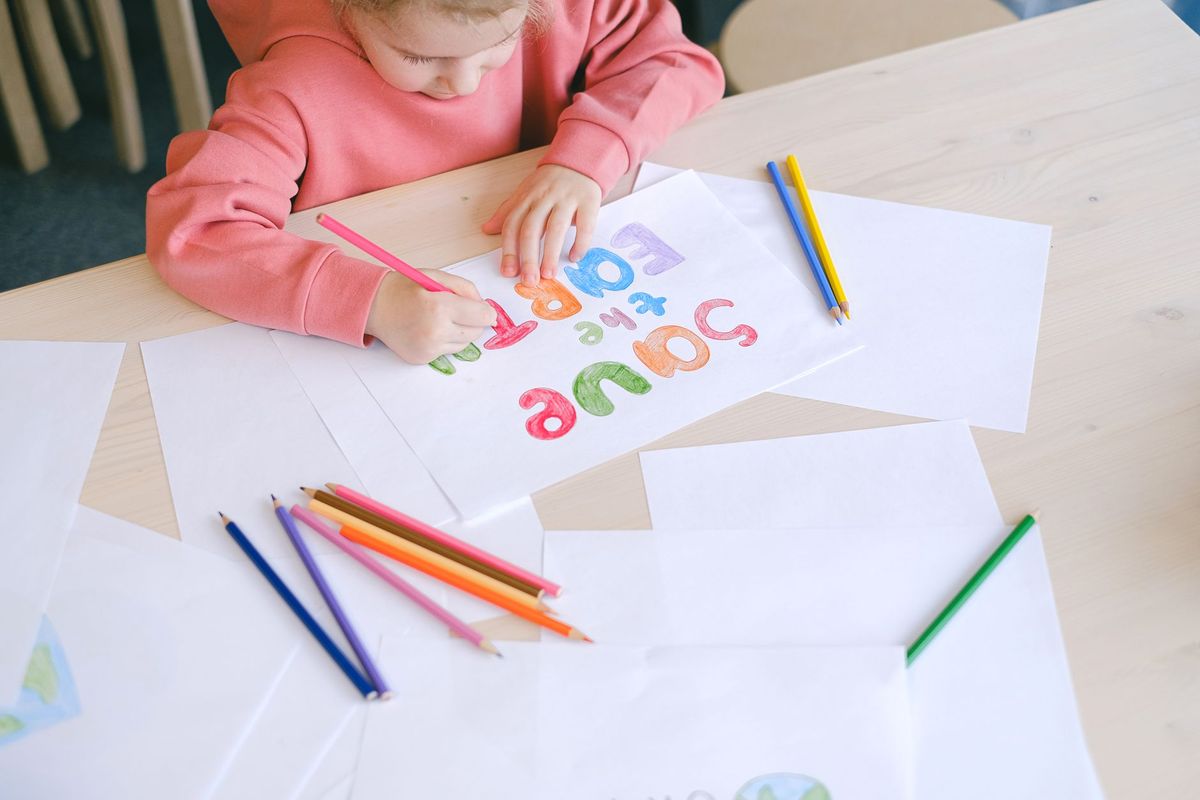
5-Minute Reading Games at Home
- I spy with sounds. “I spy something that starts with /b/.” Use the sound, not the letter name. Start with objects in front of you.
- Robot talk. Say a word in sounds, “c-u-p,” and your child blends it into “cup.” Then swap roles.
- Clap the syllables. Clap names in the family. “Ma-ri-a” gets three claps.
- Rhyme time. “Cat, hat, bat… what else?” Silly made-up words count.
- Object box. A small box of tiny objects with simple names, like a cup, pin or bug. Your child picks one and finds or builds its first sound, later the whole word.
Keep it short and stop while your child still wants more. The car, the bath and the grocery line are perfect places.
When Home Practice Ends in Tears
If reading time at home turns into a fight, step back. Pressure is the fastest way to make a child avoid letters.
- Stop formal lessons for a few weeks. Keep reading aloud and playing sound games in passing.
- Follow interests. Dinosaurs, trucks or a friend’s name make better first words than a worksheet.
- Don’t duplicate school. If your child is in a Montessori class, let the teacher lead the materials. At home, read together and play.
- Let your child be the teacher. “Can you show me how this one goes?” often works better than “Read this.”
Normal, Watch, Ask
Normal
- Not reading at 4, or even at 5
- Knowing sounds but not letter names
- Writing words with “creative” spelling
- Big jumps after weeks of nothing
Watch
- Trouble hearing rhymes or first sounds around 5
- Little interest in books or stories at all
- Frustration that grows over months
Ask
- Speech that’s hard for others to understand at 4. Talk to your pediatrician.
- Concerns about hearing
- A teacher mentions language concerns. CDC milestones by age 5 include naming some letters and writing some letters of their name.
Questions Parents Ask
Does Montessori Teach Phonics?
Yes. Montessori is a phonics-based approach. Children learn letter sounds first, blend them into words with the movable alphabet, then learn phonograms and puzzle words.
At What Age Do Montessori Children Read?
Many read simple words around 5, some earlier and some later. There is no fixed deadline in a Montessori classroom.
Why Does Montessori Teach Writing Before Reading?
Building a word from its sounds is easier than decoding someone else’s word. The movable alphabet lets children “write” before their hand can form letters.
Why Does Montessori Use Lowercase Letters First?
Because most of what children will read is lowercase. Capitals come later, usually at the start of names and sentences.
What Are Puzzle Words in Montessori?
They’re Montessori’s sight words, common words that don’t follow sound rules, like “the” or “said,” learned by sight after phonetic reading.
Go Deeper
- Sandpaper letters, when and how
- The movable alphabet
- Montessori language materials
- What kids need before kindergarten
The Everyday Montessori Preschooler
Book 3 of the Montessori for Real Life series, for ages 3 to 6. Includes fifteen 5-minute letter, sound and number games for busy days. Coming December 8, 2026.
Launch price $6.99 $4.99 Kindle · $14.99 $12.99 paperback
Sources
- Montessori, M. The Montessori Method (1912), chapters on writing and reading.
- Montessori, M. The Discovery of the Child (1948), on the “explosion into writing.”
- National Institute of Child Health and Human Development, Report of the National Reading Panel, Teaching Children to Read (2000).
- Centers for Disease Control and Prevention, Milestones by 5 years.
- Lillard, A. S. Montessori: The Science Behind the Genius (3rd ed., 2017).
- Photos from Pexels (free licence).