
In Montessori pedagogy, educators often speak of three teachers, the adult, the other children, and the environment itself. Of the three, the environment is the only one that is present for every moment of every child’s day. The adult is occupied elsewhere. The peers are doing their own work. But the environment, if it has been properly prepared, is always available, always responsive, always self-correcting.
Understanding what the prepared environment actually is: not as a decorative style or a list of furniture choices, but as a designed system for supporting independent development, is one of the most useful things a Montessori parent can know.
What this article explains
- The six principles, with the developmental mechanism behind each one
- The work cycle: the engine that makes the environment function
- What the prepared environment looks like across age groups
- What parents can actually observe to tell a genuine prepared environment from a Montessori-branded one
- How to apply the principles at home without needing specialist materials
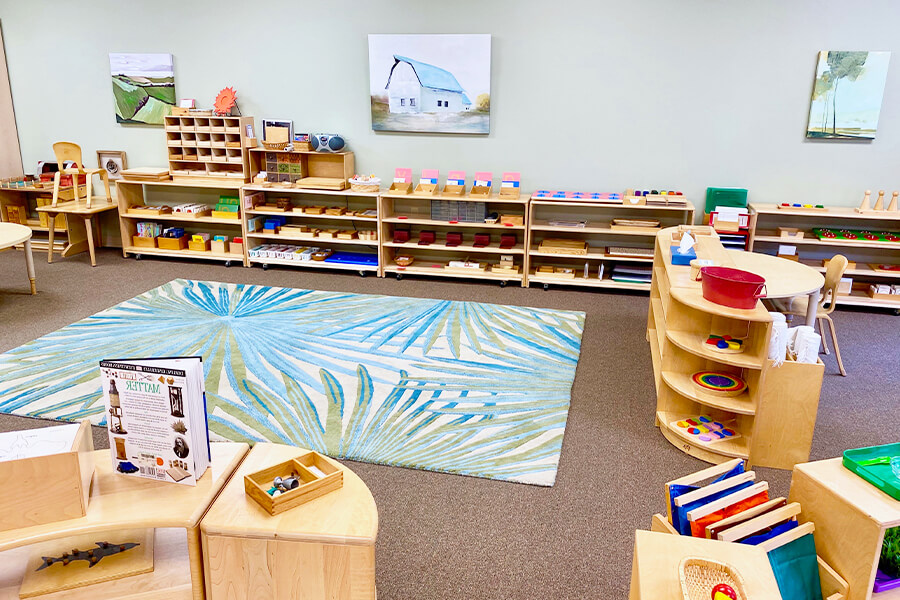
What Maria Montessori Actually Meant by “Prepared”
The phrase “prepared environment” is easy to misread. It sounds like it simply means a room that has been set up in advance. But Montessori’s meaning was more precise: the environment must be prepared to do something specific. It must be capable of responding to each child’s developmental needs without requiring constant adult mediation.
Her formulation of the prepared environment emerged from a key observation at the Casa dei Bambini. When children were placed in an environment where the materials were appropriate to their developmental stage, accessible to them physically, organized with a clear system, and designed to be self-correcting, they did not need the teacher to direct their activity. They chose their own work. They concentrated for extended periods. They repeated tasks until they achieved mastery, then moved to the next. The environment was doing the teaching.
The prepared environment is therefore a designed system, not an aesthetic. The calming colors, the natural materials, the low furniture: these are not decorative choices. Each one is functional. And the function they serve is precise: to remove every unnecessary barrier between the child and independent, self-directed engagement with the curriculum.
The Six Principles: What They Are and Why Each One Works
Most guides to the prepared environment list the six principles as categories. What is rarely explained is the developmental mechanism behind each one: why that principle produces the outcome it produces. Without understanding the mechanism, the principles can seem arbitrary. With it, they become legible, and replicable at home.
1. Freedom
What it means: Children choose their own work from what has been prepared for them. They choose when to start, how long to continue, whether to work alone or near others. The teacher does not assign tasks or direct them to specific materials during the work period.
Why it works: The research on motivation is consistent and long-established: choice is the primary driver of intrinsic motivation. When children choose an activity, they engage with it more deeply, persist longer, and remember more. The systematic review by Lillard et al. (2023) found that Montessori children showed significantly stronger mastery orientation than controls, meaning they sought challenge rather than ease. This is not a personality trait: it is the predictable outcome of an environment where there is nothing to perform for and no external reward waiting. The child works because the work is genuinely interesting. Freedom makes that possible.
2. Structure and Order
What it means: Every material has a place. Materials are arranged on the shelf from left to right, simple to complex, concrete to abstract. There is a clear visual order to the room. Materials are always returned to their exact place after use. The environment is identical every morning.
Why it works: Montessori identified order as a sensitive period: a developmental stage (particularly strong in children aged 1-3, persisting through the primary years) during which children have a powerful internal drive toward recognising and replicating patterns. A disordered environment agitates young children in a way that is often misread as bad behaviour; an ordered environment soothes them. More concretely: an ordered shelf communicates to the child which material is available, where it goes, and what comes next in the sequence. Without this structure, the child would need the teacher to navigate the curriculum. With it, the environment itself carries the pedagogical sequence, and the child can access it independently.
3. Beauty and Harmony
What it means: The environment is calm and visually uncluttered. Natural materials, soft colours, living plants. No mass-produced visual noise, no branded characters on the walls, no bright plastic competing for attention. Each object in the room is genuinely beautiful and serves a real purpose: nothing is present merely as decoration.
Why it works: Attention is limited and finite. Every unnecessary visual stimulus competes with the material the child is supposed to be concentrating on. A visually calm environment reduces this competition. It also communicates something to the child about the value of the space and the objects in it: beautiful things are handled with care, not grabbed and discarded. Montessori observed that children in beautiful environments treated their materials with greater respect and took greater pride in maintaining the order of the room. The aesthetic is not incidental: it is part of the social contract between the environment and the child.
4. Nature and Reality
What it means: The materials in a Montessori environment are real, not simulated. A child practises pouring with a real pitcher and real water, not a toy kitchen set. They cut with a real knife at child scale, not a plastic play knife. Plants in the classroom are living. The class pet is a real animal. Practical life activities use the actual tools of adult life at child-sized proportions.
Why it works: Toy versions of real tools remove the consequence that makes careful handling meaningful. A plastic pitcher dropped on the floor teaches nothing; a glass pitcher that can break teaches the child something real about the properties of materials and the cost of inattention. Natural materials also have genuinely varied physical properties: wood is warm, metal is cool, glass has weight, fabric has texture, that synthetic alternatives do not replicate. The sensory information children receive from real materials is richer, more varied, and more developmentally useful.
5. Social Environment
What it means: Montessori classrooms group children across a three-year age span. A primary classroom contains children aged 3, 4, and 5. The group changes by approximately one third each year as the oldest children move on and new youngest children enter. The social mix is always heterogeneous.
Why it works: A mixed-age group creates a natural mentoring dynamic: older children demonstrate materials and social behaviours to younger ones, which both consolidates the older child’s own understanding and develops the prosocial capacities of patience and guidance. Younger children learn by watching peers who are slightly more advanced, a process of peer learning that a single-age cohort cannot replicate. The 2025 PNAS randomized controlled trial of public Montessori preschool found evidence consistent with this: larger class sizes in Montessori produced better outcomes, not worse, because more peers means more peer tutoring and more models at different developmental levels.
6. Intellectual Environment
What it means: The materials on the shelves represent a complete curriculum across five areas: practical life, sensorial, language, mathematics, and cultural studies. They are arranged in a specific developmental sequence, from simpler to more complex, from concrete to abstract. Each material is self-correcting: it has a built-in mechanism that shows the child when something is wrong without requiring adult feedback. And each material isolates one quality or concept at a time.
Why it works: The control of error embedded in each material transforms the child’s relationship with mistakes. Rather than looking to an adult to know whether they have succeeded, the child reads the outcome of the material itself: the cylinder that doesn’t fit tells them something is wrong; the tower that doesn’t stand tells them the order is off. This means the child is running a cognitive feedback loop independently, revising their approach based on real evidence rather than authority. The Lillard et al. (2023) systematic review notes that this self-correction mechanism may be a primary driver of the executive function advantages observed in Montessori children: they have been practising self-regulation through every material interaction, every day.
The Work Cycle: The Engine of the Environment
The prepared environment does not function through any single principle in isolation. It functions through the work cycle: an uninterrupted period of two to three hours during which children move freely through the classroom, choosing their own work, completing it, returning it to the shelf, and choosing again.

The work cycle is the non-negotiable structural element that makes everything else work. The American Montessori Society recommends a minimum work period of two hours daily at the early childhood level, with three hours optimal. This is not arbitrary. Research on concentration development shows that children need extended time to move through the full cycle of a concentrated activity: choosing, beginning, working, reaching a difficulty, pushing through it, completing, and experiencing the internal satisfaction of mastery.
An interrupted work cycle: one cut short by a transition to circle time, a snack break, or a whole-class activity, systematically prevents children from reaching the deeper concentrative states that Montessori considered most developmentally important. A classroom that calls itself Montessori but schedules 30-minute activity blocks is not implementing the prepared environment, regardless of how beautiful the materials look on the shelf.
The three stages of a work cycle, as Montessori described them
- Phase 1: The child settles. Activity tends: familiar materials, social interaction, easy choices. Many observers mistake this for distraction. It is preparation.
- Phase 2: Deep work. The child engages with increasingly demanding materials and concentrates for extended periods. Interruption at this stage is particularly harmful.
- Phase 3: Consolidation. The child returns to lighter, familiar activities. This is where mastery is integrated, not where it is built. It should not be confused with the beginning of Phase 1.
How the Prepared Environment Looks Across Age Groups
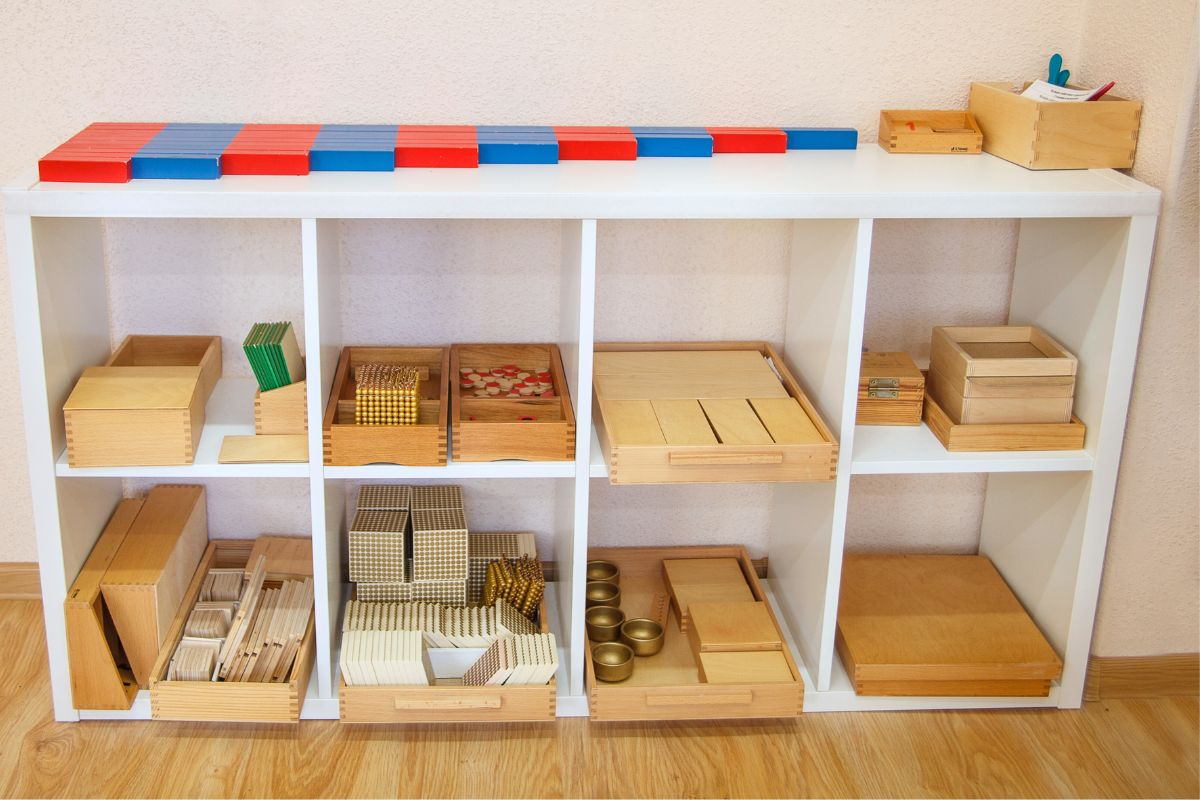
The six principles remain constant across every level of Montessori. What changes is the specific form they take: the materials, the furniture, the degree of freedom, the social structures, because the developmental needs of each age group are genuinely different.
What Parents Can Actually Observe: The Honest Checklist
The term “Montessori” is not legally protected. Any school can use it. This makes visiting, and knowing what to look for: essential. The following are observable indicators of a genuinely prepared environment, as distinct from a Montessori-branded but conventionally structured one.
What you should see
- Children choosing their own work without being directed
- Children working at different activities simultaneously (no whole-class lesson in progress)
- A teacher who is moving quietly through the room observing rather than stationed at the front
- Materials on low, open shelves, each in a clearly designated place
- Children returning materials to the shelf before choosing another
- A calm, relatively quiet room, not silent, but without shouting or rapid transitions
- A mix of ages visible in the classroom (not a single-year cohort)
- No reward charts, sticker systems, or visible ranking on the walls
- Natural materials on the shelves: wood, metal, glass, fabric
- Children working on work rugs or at tables without assigned seats
What should make you ask questions
- All children working on the same activity at the same time
- A teacher at the front giving instructions or explanations to the group
- Star charts, behaviour charts, or public recognition systems on the walls
- Schedules showing 20-30 minute activity blocks with frequent transitions
- Materials stored in bins that children cannot access without asking
- Plastic, brightly coloured, battery-operated items on the shelves
- A teacher who cannot name what a specific child worked on that day
- A classroom of children all born in the same year
- No evidence of the five curriculum areas on the shelves
Applying Prepared Environment Principles at Home
You cannot recreate a Montessori classroom at home, and you should not try. A classroom has a trained teacher, 25 children across three age levels, and a full set of sequenced materials. A home has none of these. But the underlying principles of the prepared environment can be applied to any space, with any budget, to produce meaningfully different results from a conventional home setup.

Order at child height
Everything a child needs regularly should be accessible without asking. Low hooks, reachable shelves, child-height coat storage. The environment is prepared when the child can navigate it independently.
Fewer things, more accessible
6-8 activities visible at a time, rotated as interest develops. A full shelf overwhelms; an empty shelf offers nothing. The principle of order means each item has a place it returns to.
Real tools, real tasks
A child-sized broom, a real pitcher, a small cutting board. The principle of nature and reality means avoiding simulated versions of tools your child can use in genuine form.
Protected concentration
Do not interrupt a child who is deeply focused, even to praise them. The principle of freedom includes the freedom to concentrate without adult intrusion. Observation without intervention is its own discipline for parents.
Read also
Questions Parents Ask Most Often
Does a prepared environment require Montessori-branded materials?+
No. A prepared environment is a set of principles, not a shopping list. Many of the most important elements: order, accessibility, real tools at child height, uninterrupted time, cost nothing or involve reorganising what you already have. Specific Montessori materials like sandpaper letters and golden beads are designed to teach specific concepts in a specific sequence, and they are worth having for that purpose. But the prepared environment in its home form is primarily about how the space is organised and how the adult behaves in it, not about which materials sit on the shelf.
Is a prepared environment always quiet?+
No, and this surprises many parents who visit for the first time. A genuine Montessori work period: there is movement, quiet conversation between children, the sound of materials being handled. What it is not is chaotic: the noise level is purposeful, not frantic. Children are not shouting across the room or running. The calm that Montessori describes comes from the children’s engagement in meaningful work, not from a rule of silence. If a classroom is completely silent during the work period, it is more likely that children are being directed and controlled rather than freely working.
What is the difference between a prepared environment and a learning centre?+
A learning centre in a conventional classroom is a dedicated station where children can go for specific activities: a reading corner, a maths table, a science area. Children typically rotate through these stations on a schedule directed by the teacher. The Montessori prepared environment is different in three fundamental ways: children choose which area to work in and for how long; the materials in each area are part of a developmental sequence rather than isolated activities; and the environment as a whole is structured so that the materials themselves, not the teacher, provide the feedback and the next step. A learning centre is a supplement to conventional instruction. The prepared environment replaces conventional instruction.
Can a child spend too long in a prepared environment?+
The prepared environment is not a total environment: it is a structured learning space with clear limits. Montessori schools have outdoor time, meals, rest, and social activities alongside the work period. At home, the principle applies to the organisation of specific spaces, not to every moment of a child’s day. Outdoor free play, family meals, and unstructured time in the natural world are all consistent with and complementary to Montessori principles. The prepared environment at home is one of several environments the child moves through; it does not need to dominate the household.
The Environment Teaches Because It Was Designed To
What makes the Montessori prepared environment distinctive is not any individual element: not the low shelves, not the wooden materials, not the absence of reward charts. It is the coherence of the whole. Every choice about the space, from the height of the shelf to the sequence of materials to the length of the work period, serves the same function: to make the child’s independent development possible without constant adult mediation. When a child enters a genuinely prepared environment and immediately moves to a material and begins working, this is not a personality trait. It is the environment doing exactly what it was designed to do.
Scientific References
Lillard, A.S. et al. (2023). Montessori education’s impact on academic and nonacademic outcomes: A systematic review. Campbell Systematic Reviews.
32 studies, 132,249 data points. Notes that the self-correcting nature of Montessori materials may be a primary driver of the executive function advantages found in Montessori children. Effects are strongest in high-fidelity implementation settings.
Lillard, A.S., Heise, M.J., Richey, E.M., Tong, X., Hart, A. & Bray, P.M. (2017). Montessori preschool elevates and equalizes child outcomes: A longitudinal study. Frontiers in Psychology, 8, 1783.
Lottery-based RCT. Found stronger mastery orientation in Montessori preschool children: they chose harder tasks and persisted longer than control children. Consistent with the prepared environment’s removal of extrinsic motivation.
Marshall, C. (2017). Montessori education: a review of the evidence base. npj Science of Learning, 2, 11.
Systematic evidence review. Describes the teacher’s role in the prepared environment: “Her decisions about what to teach are made on the basis of careful observations of the children. Although she might start the day with plans, she will be led by her students.” Confirms that the environment, not instruction, drives learning in Montessori.
Lillard, A.S. et al. (2025). A national randomized controlled trial of the impact of public Montessori preschool at the end of kindergarten. PNAS.
National RCT. Found that larger Montessori class sizes produced better outcomes, consistent with the social environment principle: more peers means more models, more tutoring, and a richer multi-age social environment.