
This guide contains affiliate links. If you buy through them, Montessori Theory may earn a small commission at no extra cost to you. Amazon links open a search so you can compare current options and prices.
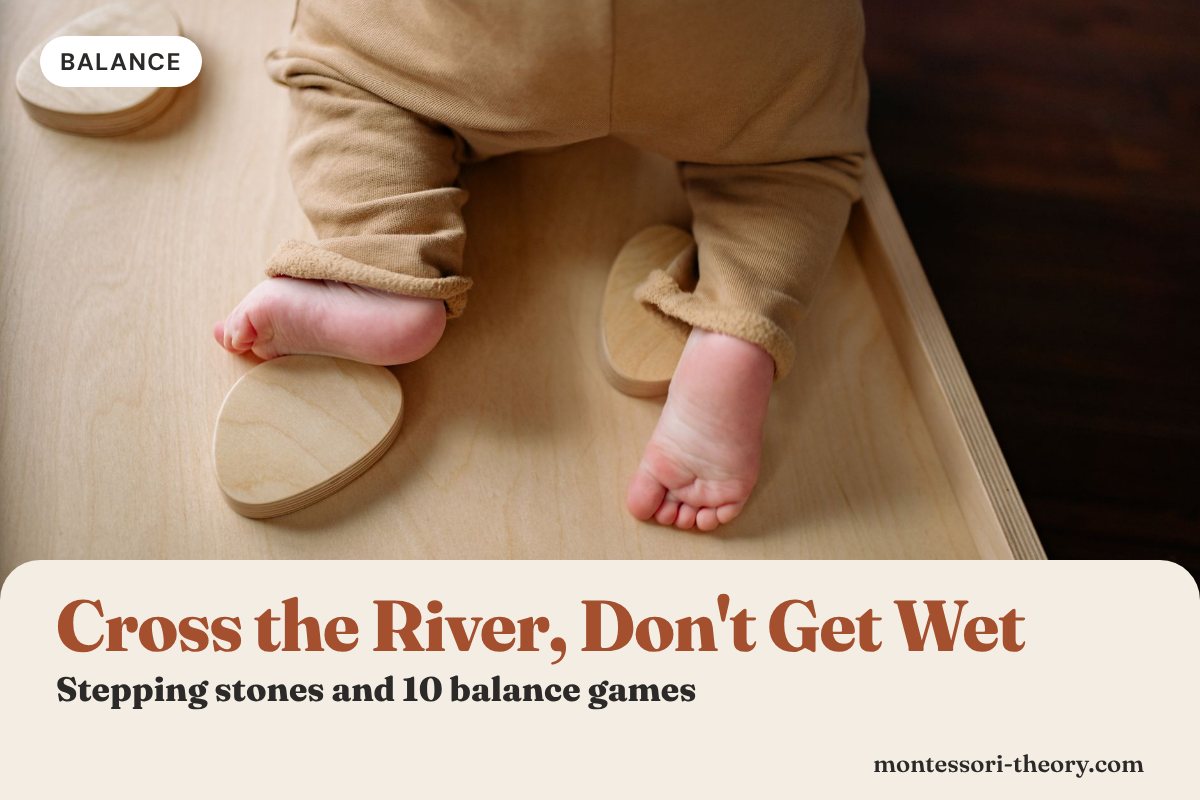
Balance stepping stones are one of the few toys that get toddlers moving indoors on a rainy day. A set of six stones becomes a river to cross, a path to follow and an obstacle course.
This guide compares the main types, what to check before buying for a toddler, how to make a free set, and 10 simple games that build balance from about 18 months.
Quick Answer
- The most important feature is a non-slip base, especially on wood or tile floors.
- For toddlers, choose low stones with rounded edges and start with them close together.
- Foam stackable sets are light and quiet but expensive. Plastic stones with rubber rims are sturdier and cheaper. Wooden stones are best indoors.
- You can start with cushions or tape circles on the floor for free.
Why Stepping Stones Work for Toddlers
Stepping from one stone to the next asks a child to look ahead, judge a distance, shift weight and land on a small surface. That is balance and coordination practice that a flat floor doesn’t give. In Montessori classrooms, a similar idea appears as “walking on the line,” where children walk heel to toe along a line taped on the floor, sometimes carrying a small object.
Stepping stones are also open-ended. The same set is a path, a bridge, a set of islands or a tower, so it lasts from toddler to early school years.
Types of Stepping Stones Compared
| Type | Good for | Watch for | Where |
|---|---|---|---|
| Foam (EPP) stackable stones, such as Stapelstein | Light, quiet, stackable, indoors and outdoors | Higher price. Some sets need a separate non-slip base on smooth floors | Amazon |
| Plastic stones with rubber rims, such as Gonge River Stones | Sturdy, good grip, stack for storage, mid-range price | Louder on hard floors. Check the height for young toddlers | Amazon |
| Wooden stepping stones | Natural look, usually low, indoor play | Check for rubber pads underneath. Not for outdoors | Amazon |
| Budget plastic sets with beams | Low cost, connect into paths | Lighter, can slide. Check that pieces lock or grip | Amazon |
Weight limits, heights and materials change between versions of the same product, so check the current listing before you buy.
What to Check Before You Buy
- Non-slip base. Put one stone on your floor and push it with your foot. If it slides, it will slide under a toddler.
- Height. Low stones for children under 3. Taller stones are for confident climbers and jumpers.
- Rounded edges. A toddler will fall onto them sometimes.
- Size of the top. A larger top surface is easier for beginners.
- Indoor or outdoor. Foam and plastic can go outside. Wood stays in.
- Storage. Stones that stack take far less space.
When to Start
| Age | How to set them up |
|---|---|
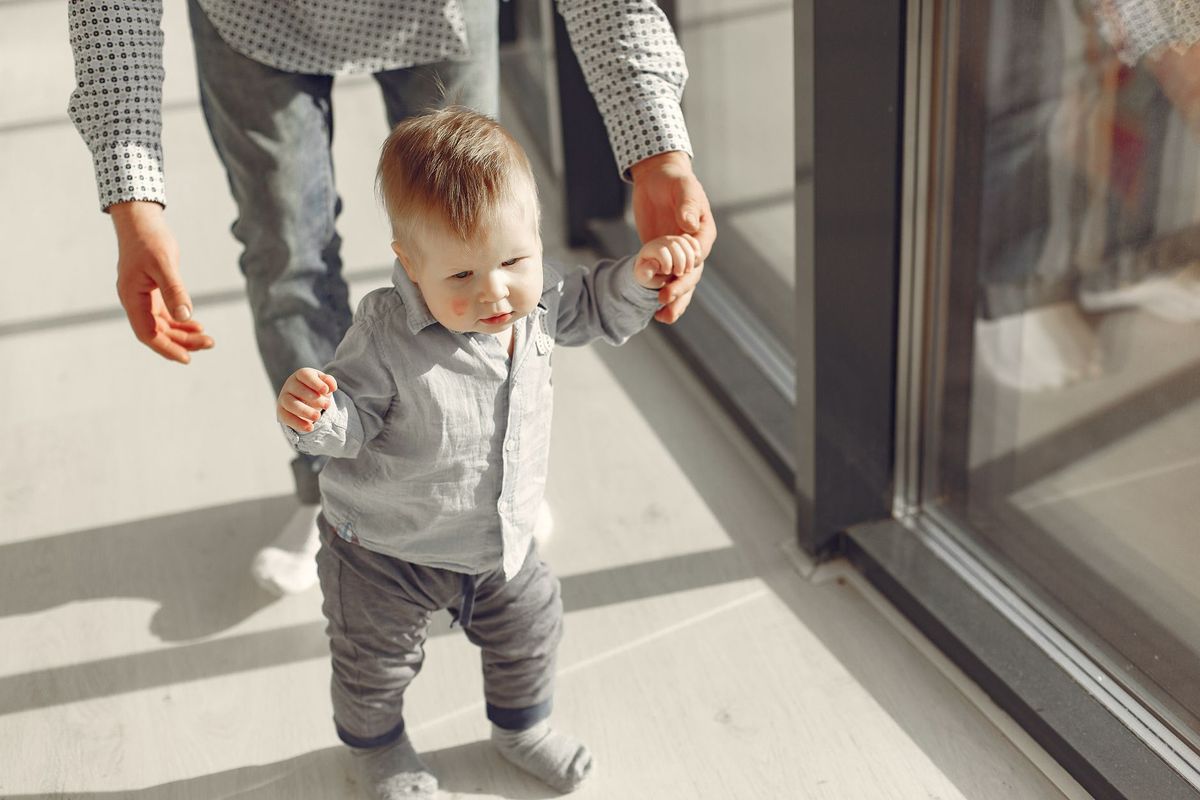
| Around 18 months, walking well | Stones touching each other, in a straight line, holding your hand |
| 2 years | Small gaps, gentle curves, walking alone |
| 3 years | Wider gaps, stepping up and down, two-feet jumps between close stones |
| 4 years and up | Mixed heights, longer jumps, carrying an object, timed courses |
Set the stones on a rug or grass, away from furniture corners. Bare feet or grippy shoes work best. Socks on smooth stones are slippery.
10 Stepping Stone Games
- Cross the river. The floor is water. Get from one side to the other without getting wet.
- Follow the color. Call a color and your child steps onto a stone of that color.
- Treasure carry. Carry a soft toy or a small basket across the path. Older children can carry a cup with a little water.
- Freeze. Play music and walk the path. When the music stops, freeze on one foot or both.
- Count the steps. Count out loud on each stone. Add number cards for preschoolers.
- Beanbag balance. Walk the path with a beanbag on the head or a hand held out flat.
- Copy me. One person makes a pose on a stone, the other copies it.
- Jump the gaps. From about 3 years, two-feet jumps between stones set close together.
- Obstacle course. Stones, then cushions to crawl over, a tunnel and a climbing triangle if you have one.
- Build it. Stack stackable stones into towers, bridges and seats. For more ideas, see our Stapelstein build and play ideas.

Free and DIY Stepping Stones
- Couch cushions and pillows. Softer and wobblier, a good challenge.
- Painter’s tape circles on the floor for the youngest walkers.
- Carpet squares or yoga blocks on a rug.
- Outdoors. Logs, flat stones and tree stumps at the park, with an adult close by.
Avoid paper plates and loose mats on hard floors. They slide.
Other Balance Toys
- Balance beam. A low beam for walking the line. See our balance beams guide.
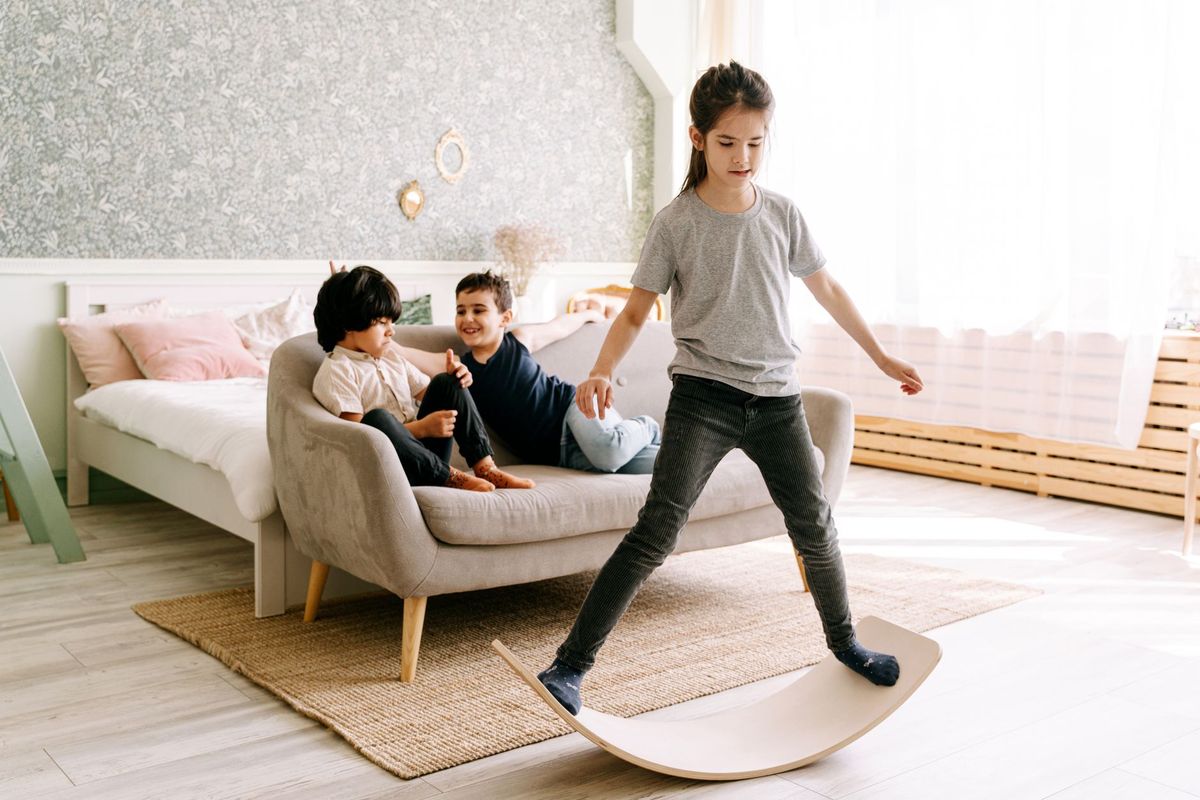
- Balance board. Rocking, bridging and pretend play, from about 2 to 3 years.
- Climbing triangle. See our climbing toys guide.
For toys matched to your child’s stage, see Montessori toys for 18 month olds and for 2 year olds.
Questions Parents Ask
What Age Are Stepping Stones For?
Most children can start once they walk well, around 18 months, with the stones touching and an adult’s hand. Gaps and jumps come between 2 and 4 years.
Are Stepping Stones Safe on Hardwood Floors?
Only if they have a non-slip base. Test each stone on your floor, and use them on a rug if they move.
Are Stepping Stones Montessori?
They are not a classic Montessori material, but they fit the Montessori idea of free movement and the “walking on the line” exercise. Many Montessori families use them.
Are Expensive Stepping Stones Worth It?
Foam stackable sets are pleasant to use and last for years, but a cheaper set with a good non-slip base does the balance work just as well. Start with cushions to see if your child enjoys it.
The Everyday Montessori Toddler
Book 2 of the Montessori for Real Life series, for 18 months to 3 years. Tantrums, limits without punishments and “me do it,” with simple steps for real homes.
Sources
- Montessori, M. The Absorbent Mind (1949), on movement and coordination.
- Lillard, A. S. Montessori: The Science Behind the Genius (3rd ed., 2017), on movement and cognition.
- Photos from Pexels (free licence).