
Most toddler travel activity lists are built for a photograph, not a journey. They include loose pom-poms, elaborate crafts, tiny puzzle pieces, and ten activities that must be packed, presented, reset, and cleaned by the parent.
A useful Montessori travel kit is smaller. It offers purposeful hand work, real choices, and enough order that the child can see what is available. Everything should fit into one pouch and survive being used in a seat with very little space.
The One-Pouch Rule
- Container: One zip pouch that fits under the seat or inside the parent’s personal bag
- Number of activities: Three to five, introduced one at a time
- Best features: Attached pieces, quiet use, low mess, easy reset, and familiar controls
- What to avoid: Rolling crayons, loose counters, noisy electronics, and activities that need a table
- Realistic expectation: Each activity may hold attention briefly and can be reused later in the journey
Travel Changes What Counts as a Good Activity
At home, a tray with six loose objects can be orderly. On an airplane, one dropped piece may roll under three rows. In a car, the adult cannot safely retrieve it. The best travel activity is not always the most Montessori-looking object. It is the one the child can use purposefully within the limits of the environment.
The travel filter: Choose activities with a clear action, very few parts, quiet use, and a reset that takes less than thirty seconds.
Build the Kit Around Moments, Not Toy Categories
The same child needs different support while waiting at the gate, sitting through takeoff, eating, becoming restless, and arriving at a hotel. Pack for those moments rather than trying to fill every minute with novelty.
Five Activities That Earn Space in the Bag
1. A Reusable Drawing Surface
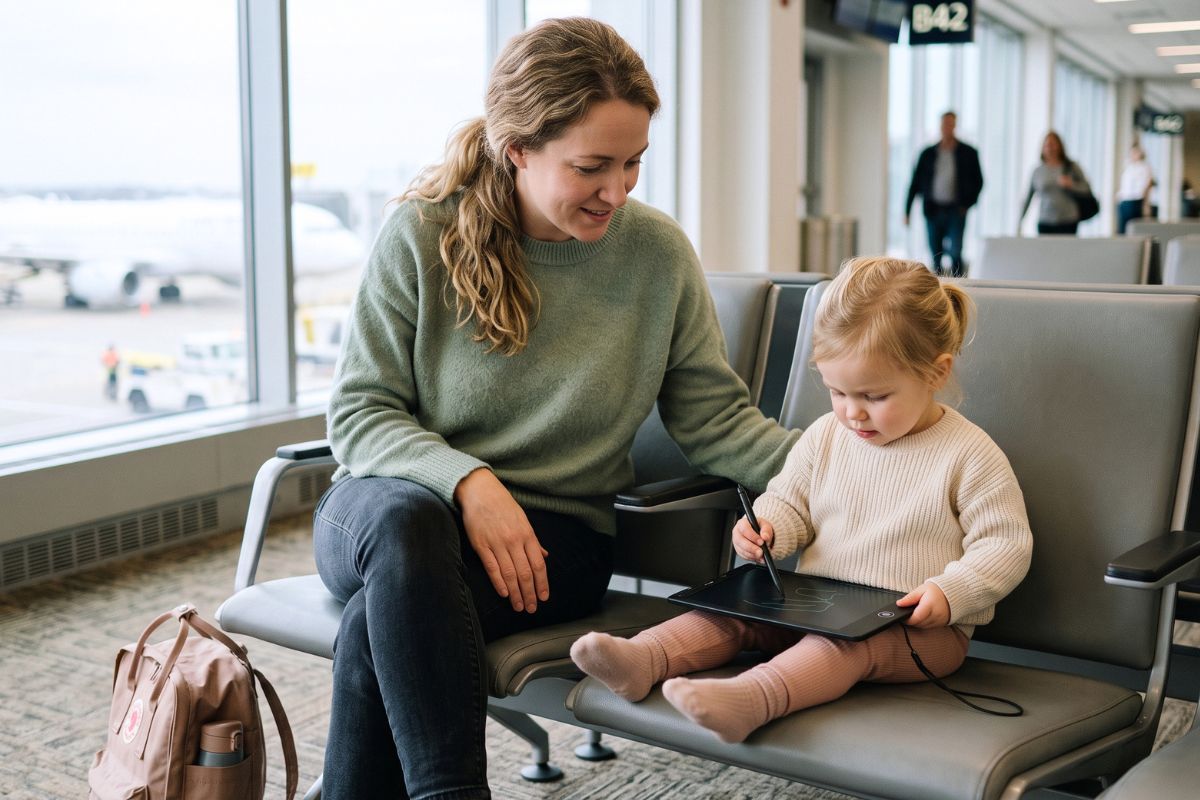
Choose a drawing tablet or wipe-clean board with a stylus attached by a short safe cord designed for the product. It replaces loose paper and rolling crayons. The action is simple, repeatable, and easy to stop when the journey changes.
2. A Soft Fastening Pouch
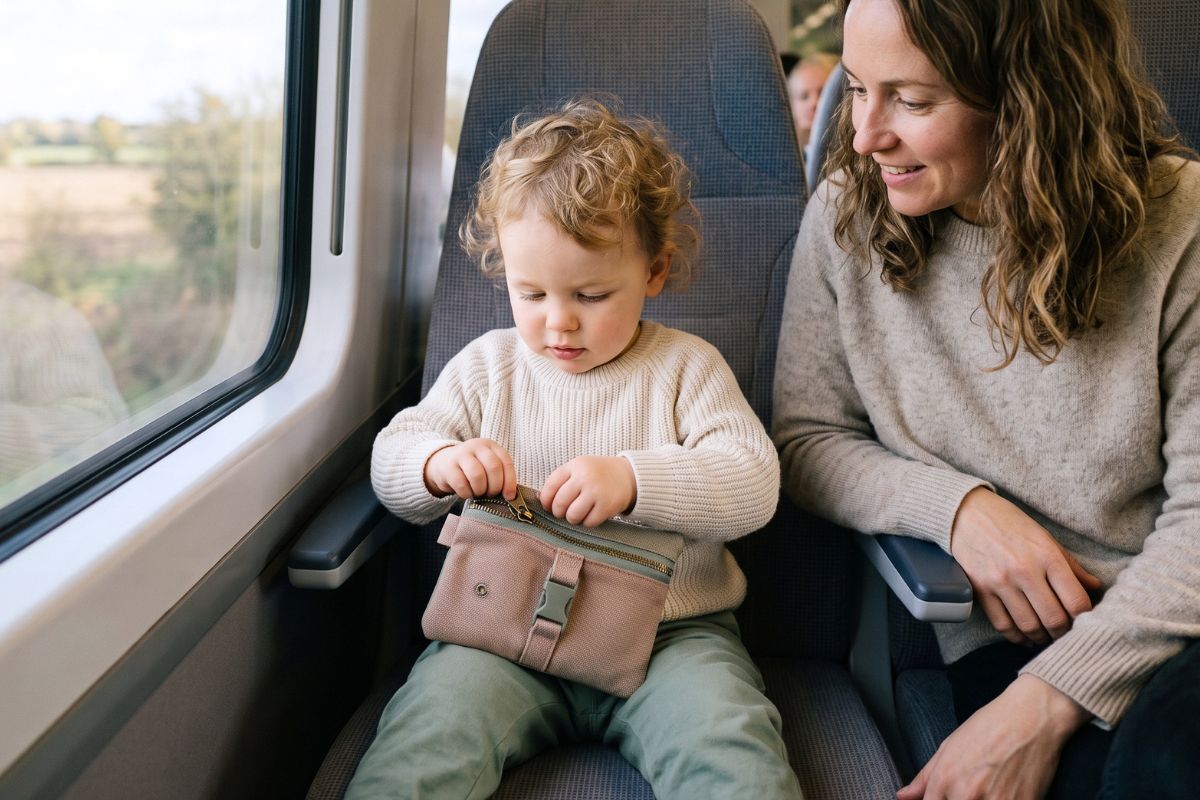
Use one zipper, buckle, or snap pouch that also stores another activity. Real fasteners give purposeful hand work and the object earns its space twice. Avoid boards crowded with twenty unrelated mechanisms.
3. A Small Family Photo Book
Include photographs of home, people the child will visit, the destination, and the steps of the journey. For a toddler, language connected to real people is often more engaging than a new toy.
4. A Magnetic Matching Activity
Use a contained board with large pieces that remain attached or strongly contained. Match animals, vehicles, or familiar objects. Test every piece before travel and avoid small magnets that could become dangerous if detached.
5. Reusable Stickers on One Board
Offer a limited sheet and one background rather than a full sticker book. Large reusable pieces are easier to manage and can support language without covering the tray table, window, or seat.
How to Present the Activities
- Keep the pouch closed at first. Let the child observe the journey and use the environment before introducing material.
- Offer one activity. Do not display the entire kit on the tray table.
- Restore it immediately. Place every piece back before opening the next pouch or snack.
- Reuse later. A familiar activity often works again after movement, food, or sleep.
The Difference Between Plane, Train, and Car
Airplane
Prioritize attached pieces, silence, and activities that work on a small tray. Save drinking, sucking, or an appropriate snack for pressure changes when suitable for the child’s age and needs.
Train
Use the opportunity to look outside, walk when permitted, name stations, and carry a small backpack. The environment itself offers more movement and language than an airplane seat.
Car
Only use soft, safely secured activities that do not interfere with the car seat. An adult should never turn around repeatedly or retrieve dropped objects while driving. Audio stories and songs often serve the setting better than detailed hand work.
Snacks Are Part of the Plan
Food is not a failure of the activity kit. Hunger changes attention quickly. Pack familiar, low-mess food in containers the child can help open when developmentally appropriate. Use the meal as practical life, with a small cloth for spills and a clear place for waste.
Safety note: Always follow current airline, train, vehicle, and child-restraint rules. Avoid loose magnets, choking hazards, long cords, sharp tools, and any object that could interfere with a car seat or safe seating position.
What About Screens
A screen is one tool, not a moral verdict on the trip. A long delay, illness, missed sleep, or an overwhelmed child may change the plan. The useful goal is not a perfect screen-free journey. It is a manageable experience for the child, the parent, and the people nearby.
Use the Montessori activities because they offer participation and connection, not because the family must prove philosophical purity at thirty thousand feet.
Packing Checklist
- One compact zip pouch
- Three to five activities with few or attached parts
- One familiar book or family photo book
- Reusable drawing surface
- Low-mess snacks and water
- Small cloth and waste bag
- One comfort object
- A downloaded audio story or emergency screen option
Pack Less and Use the Journey
A toddler does not need uninterrupted entertainment. They need movement when movement is possible, food before hunger becomes a crisis, connection during unfamiliar transitions, and a few purposeful activities that fit the space.
Keep everything in one pouch, offer one item at a time, and choose materials that can be restored quickly. The best travel kit reduces the parent’s work instead of creating a second luggage system.