

Something shifts around a child’s third birthday. The toddler who used to bang objects together and carry things from room to room is now carefully pouring water between two cups, lining up animals by size, or insisting on doing up their own buttons. They are no longer just experiencing the world: they are deliberately practising their relationship with it.
This is the best possible context for choosing Montessori toys. At 3, the right toy is not the most stimulating one. It is the one that matches what the child is already trying to do, refine, repeat, master, and do it again.
What to Know Before You Buy
- At 3, children are entering the conscious phase of development: they seek deliberate practice, not just stimulation
- The best toys target one skill at a time and have a clear outcome the child can discover themselves
- Fewer toys, better quality: 5-6 accessible at once, rotated regularly
- Natural materials (wood, metal, fabric) provide richer sensory feedback than plastic
- Battery-operated toys that do the work for the child are counterproductive at this stage
- Budget: a strong Montessori selection for 3-year-olds costs $80-150 total, not per toy
Why 3 Is Different: The Developmental Moment That Changes Everything
Between 0 and 3, children absorb the world unconsciously: they acquire language, movement, and emotional patterns simply by being in contact with them. Around 3, this shifts. The child enters what Montessori called the conscious phase: they now seek experiences deliberately, and they want to bring them to completion. This is why a 3-year-old will repeat the same task 15 times in a row: they are not bored, they are consolidating.
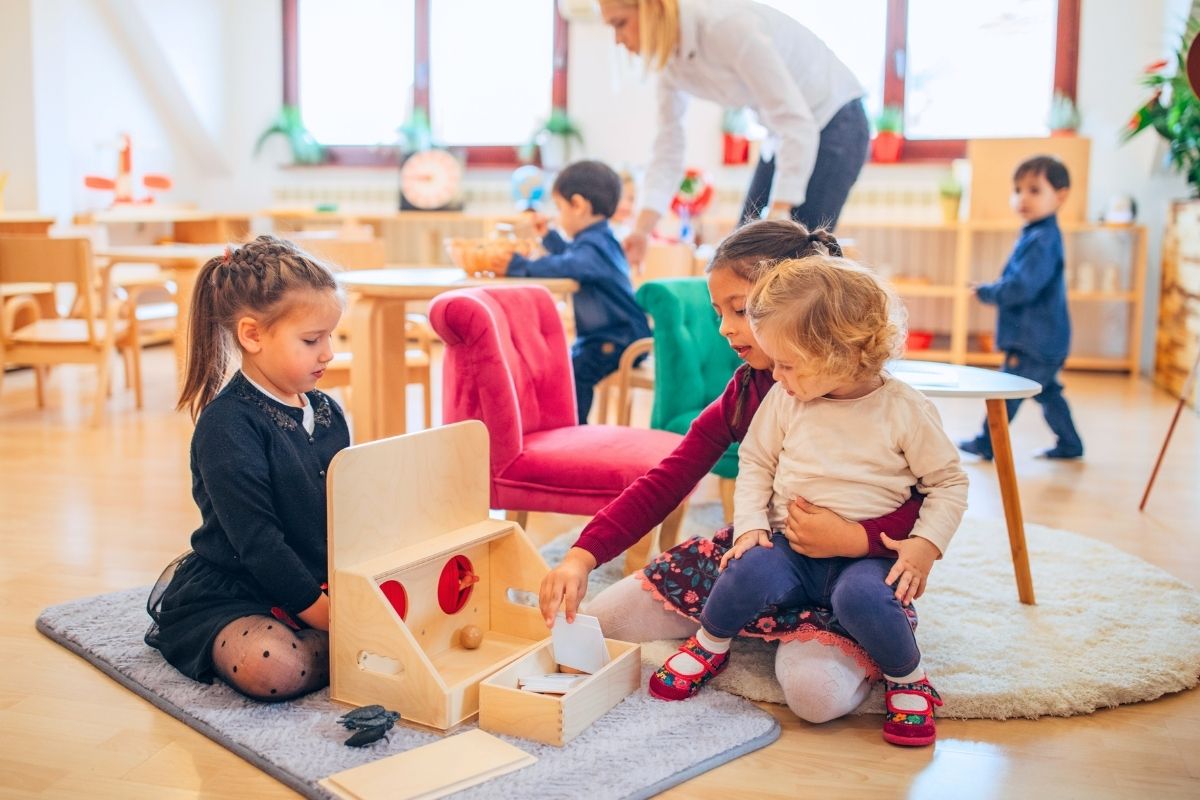
The sensitive periods that are particularly strong at this age include: refinement of fine motor movement, classification and order (sorting, grouping, sequencing), oral language and early literacy, and the beginning of number awareness. A good Montessori toy for 3 targets at least one of these windows, not by drilling the child, but by giving them something genuinely interesting to work on independently.
We have organised the recommendations below by developmental area, so you can identify what your specific child is currently drawn to and choose accordingly.
Fine Motor and Hand Refinement
At 3, the pincer grip is strengthening and the child wants to handle small things with precision. These toys channel that drive productively.
Wooden Lacing/Threading Set
Threading large wooden beads or lacing wooden shapes through a cord is one of the most effective fine motor activities for this age. It demands bilateral hand coordination, sustained attention, and produces a result the child can see and be proud of. Look for beads with at least 1.5cm diameter holes and a cord with a stiff end.
Concentration
Color sorting
Melissa & Doug Wooden Cutting Food Set
Velcro-fastened wooden food pieces that the child cuts with a wooden knife. This is practical life play at its best: it mimics a real adult task, requires controlled hand pressure, and has a satisfying result. The 3-year-old’s desire to help in the kitchen is neurologically real: this is a safe outlet for it. Made from solid wood, durable enough to last years.
Hand strength
Vocabulary
Gross Motor and Movement
At 3, children have enough balance and body awareness to tackle genuine physical challenges. These are not toys that entertain from the outside: they demand active engagement from the child’s whole body.
Pikler / Climbing Triangle
The Pikler triangle is the single most versatile gross motor investment for a 3-year-old. At this age the child can climb, balance, and begin to hang, building core strength, spatial confidence, and risk assessment, all on their own terms. A foldable version allows indoor use. Look for FSC-certified solid wood with a weight limit above 50kg so it grows with the child. Piccalio and Sprout Kids are well-regarded brands with solid safety records.
Core strength
Risk calibration
Wooden Balance Board (Wobbel or equivalent)
A curved wooden board that rocks and can be used standing, sitting, as a bridge, a slide, or a boat. At 3, children have just enough vestibular development to find the balance challenge achievable but genuinely engaging. The Wobbel original is the benchmark: 12mm layered birch, weight limit 150kg, usable well into adolescence. Less expensive alternatives in solid beech are available at around $40-60 and perform similarly for this age group.
Open-ended
Imagination
Classification, Order, and Early Math
The sensitive period for order is at its strongest between 1 and 3, and continues into the fourth year. Children at this age have a genuine drive to sort, group, and arrange: toys that feed this drive are absorbed with particular intensity.
Grimm’s Stacking Rainbow
Eleven rainbow-painted wooden arches in graduated sizes that can be stacked, nested, lined up by color, used as tunnels for small animals, or built into towers. At 3, the child is developmentally ready for gradation work: ordering objects from smallest to largest is exactly the cognitive operation this toy demands. The Rainbow is one of the most enduring open-ended Montessori toys available, used productively from age 1 through school age. German-made with water-based paint. More expensive than alternatives but it will outlast every plastic toy in the house.
Color sorting
Open-ended
Safari Ltd. Animal Figurines (Toob Sets)
Realistic, to-scale plastic animal figurines in themed sets (safari, ocean, farm, insects). At 3, children are in a sensitive period for language and classification simultaneously: sorting animals by habitat, pairing adult and baby animals, naming them, and using them in imaginative play covers all three. Safari Ltd. figurines are the Montessori community standard: accurate anatomy, appropriate sizes for small hands, no sharp edges, phthalate-free. A set of 10-12 animals costs $12-20 and provides more developmental value per pound than almost anything else on this list.
Vocabulary
Imaginative play
Language and Early Literacy
The sensitive period for language runs from birth to around six, with a second, more specific window for the symbolic representation of sound, what becomes reading and writing, opening around age three. These toys meet that window before formal instruction begins.
Sandpaper Letters
Individual letter shapes cut from fine sandpaper and mounted on wooden tiles. The child traces the letter while hearing its phonetic sound: a multisensory input that builds the letter-sound connection through touch, movement, and hearing simultaneously. This is the Montessori pre-writing material par excellence, and it is used from age 3 in primary classrooms precisely because the sensitive window is open. Available in cursive or print depending on your preference. Lowercase only to start.
Pre-writing
Tactile
Wooden Matching / Nomenclature Cards
Three-part cards (image + label + control card) or simple picture-matching sets. At 3, the ability to match a word card to a picture card and to an object is at its peak. This is an early reading precursor, a classification activity, and a language expansion tool in one. Look for cards with real photographic images rather than illustrations: Montessori materials use reality, not cartoon approximations. Many quality sets are available on Etsy from specialist printable Montessori makers at $5-15.
Reading readiness
Classification
Construction and Spatial Reasoning
The child who builds is doing mathematics before they know the word for it. Spatial reasoning, volume, balance, symmetry: all of these are accessible through good construction materials at 3.
Unit Wooden Blocks (Classic Set)
A set of hardwood unit blocks in multiple shapes and sizes is the most versatile and long-lasting construction toy available. At 3, children are building with intention: creating enclosures, bridges, towers with deliberate balance. The key is dimensionality: proper unit blocks are precisely sized so that two short blocks equal one long block, two thin blocks equal one wide one. This mathematical relationship is absorbed through handling before it is ever understood abstractly. Melissa & Doug and HABA both offer quality sets that hold up for years.
Early math
Open-ended
Connetix / Magna-Tiles Magnetic Tiles
Translucent magnetic geometric tiles that connect on any edge to build 2D and 3D structures. The magnetic connection gives the child immediate feedback: pieces click together or, making this a self-correcting material in the Montessori sense. At 3, the child can build flat shapes and simple 3D enclosures. The material grows in complexity through to age 8+. Connetix (Australian) and Magna-Tiles (American) are the two quality leaders; cheaper alternatives have weaker magnets that frustrate small hands.
Self-correcting
Creativity
Quick Reference: All 10 Toys at a Glance
What to Avoid at This Age
The list of things not to buy is as important as what to buy. These categories are common gifts at this age and consistently underperform developmentally compared to simpler alternatives.
Battery-operated toys
They do the work for the child. The child watches: they do not act. The brain circuit that forms through doing is not activated by watching.
Toys with only one purpose
A toy that can only do one thing is finished the day the child masters that one thing. Open-ended toys continue to provide challenge as the child develops.
Too many toys at once
Abundance creates superficiality. A 3-year-old with 6 accessible toys will engage more deeply with each one than a child with 40. Rotate rather than accumulate.
Screen-based “educational” content
At 3, the brain builds through physical interaction with real objects. A sandpaper letter builds more neural architecture than 30 minutes of alphabet animation.
Read also
Parents Ask Most Often
How many Montessori toys should a 3-year-old have?+
The number accessible at once matters more than the total owned. Montessori practice suggests 5 to 8 items on a low, open shelf at any one time. The rest are rotated in storage. When a familiar toy returns after 3 to 4 weeks away, a 3-year-old engages with it again with renewed focus. This rotation principle keeps interest high without requiring constant purchasing. In terms of total toys, quality over quantity: 10 to 15 good toys that the child genuinely uses beats a room full of options that overwhelm rather than invite.
Do Montessori toys have to be wooden?+
No, but there are good reasons wood appears so often in Montessori settings. Wood has weight, texture, grain, temperature variation, and smell. It responds differently depending on how it is handled. Plastic is uniform: it feels the same wherever you touch it, regardless of how you interact with it. For a young child building neural architecture through sensory contact, varied materials provide richer developmental input. That said, Safari Ltd. animal figurines are plastic and are used in Montessori classrooms worldwide because they prioritize realistic representation over material purity. The question is always whether the material serves the developmental purpose.
My child ignores the wooden toys and wants the plastic ones. What do I do?+
This is almost always a presentation issue, not a preference issue. Montessori materials need to be shown to a child with a clear, slow demonstration before being left for independent use. A child who has never seen how to use a lacing board will ignore it. A child who has watched an adult thread three beads with focused attention and been invited to try will almost always engage. The other factor is accessibility: toys stored in bins compete with each other and none wins. Toys displayed on a low shelf with space between them invite attention individually. Try reducing the number of things available and demonstrating the one thing you want them to engage with.
Are Legos appropriate for a 3-year-old in a Montessori context?+
Classic Duplo (large Lego) is well-suited to 3-year-olds and aligns with Montessori values: it is open-ended, self-correcting, and encourages construction and spatial thinking. The small pieces of standard Lego are a choking hazard below age 4, and even above 4 they require fine motor control that many children do not yet have. Themed Lego sets with instruction booklets are a different category: they direct rather than invite, which is less consistent with Montessori principles. A tub of plain Duplo is a different proposition from a licensed character set that requires following a prescribed sequence.
Start with One, Use It Well
The most common mistake when buying Montessori toys is buying too many at once. A 3-year-old who receives a Pikler triangle, a threading set, sandpaper letters, animal figurines, and wooden blocks on the same day will likely ignore most of them within a week. A 3-year-old who receives one thing, is shown how to use it, and has space and time to master it will return to it for months.
If you are starting from scratch: buy the animal figurines and the threading beads. They cost under $40 combined, they fit in a basket, they target three different developmental areas, and a child of 3 will engage with both of them seriously. Everything else can follow as you observe what your specific child is drawn to.