
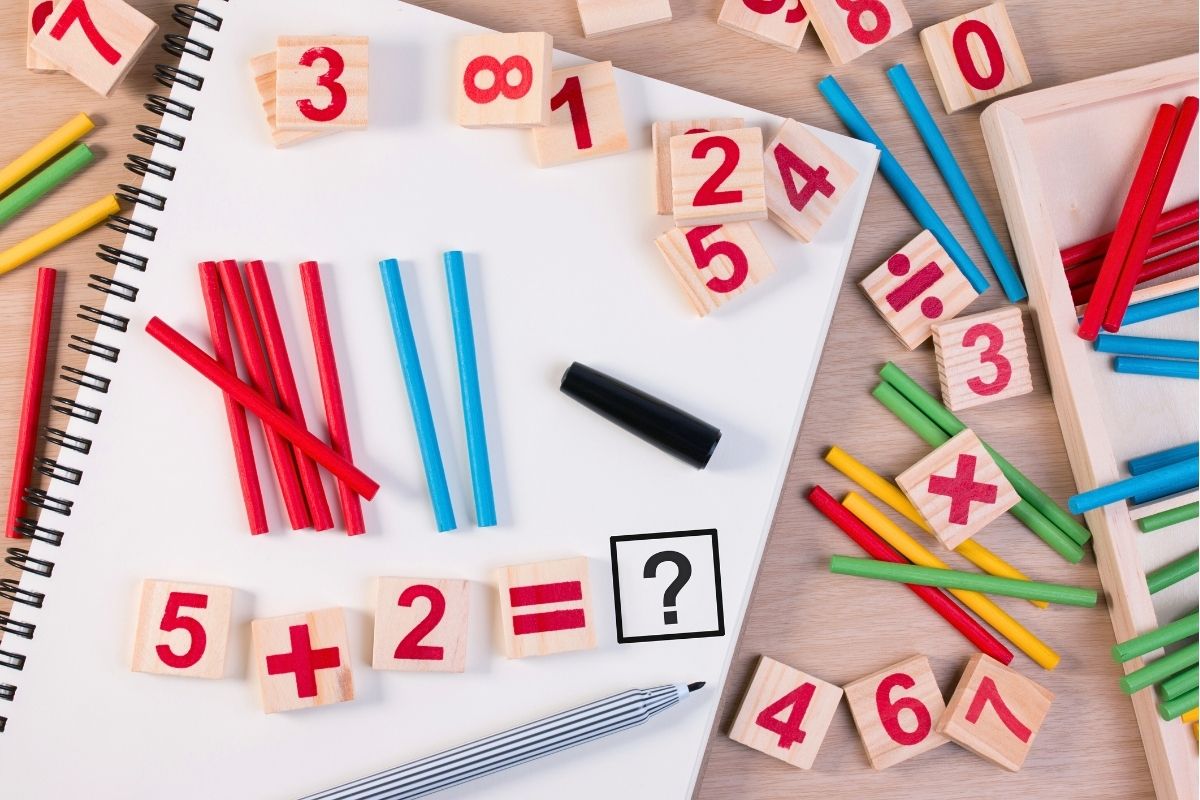
Watch a five-year-old work with a Montessori bead chain. They lay it out on the floor, moving slowly from one coloured section to the next, placing a small number ticket at each group of five. 5. 10. 15. 20. Their finger traces the beads. They are not memorising a number sequence. They are discovering one, feeling the rhythm of it in their hands, seeing it stretched out across the mat, hearing it as they count aloud.
This is how Montessori approaches skip counting: not as a performance to memorise, but as a pattern to discover. The difference in outcome is significant.
What this guide covers
- What skip counting actually is and why it matters developmentally
- When to introduce it and what readiness looks like
- The 6 core Montessori materials for skip counting, with how to use each
- Step-by-step activities for home and classroom
- The sequence from skip counting to multiplication
What Skip Counting Actually Is: and Why It Matters
Skip counting means counting forward by a number other than one. Instead of 1, 2, 3, 4… you count 2, 4, 6, 8… or 5, 10, 15, 20. You are skipping the numbers in between and landing only on the multiples of your chosen interval.
This sounds simple. The reason it matters is not simple. Skip counting is the conceptual bridge between two mathematical operations that children will spend years working with: addition and multiplication. When a child skip counts by three: 3, 6, 9, 12 : they are doing something that is simultaneously repeated addition (3+3+3+3) and the three times table. They do not know that yet. They are just following a pattern. But the pattern is the multiplication table, experienced concretely before being expressed abstractly.
In conventional education, multiplication tables are introduced around age seven or eight and drilled through memorisation. Montessori introduces skip counting through physical materials at age four or five, during the sensitive period for number when children have a strong, active interest in quantity and pattern. By the time formal multiplication is introduced, a Montessori child has already been living with these sequences for two or three years. The multiplication table is not a new burden to memorise. It is a familiar pattern being given a name.
When to Introduce Skip Counting
Skip counting is typically introduced between ages 4 and 6, but the right moment depends more on what the child can already do than on their birthday. Before introducing skip counting, a child should be comfortable with linear counting to at least 20, able to recognise numerals, and showing genuine interest in counting and quantity. These are the signs of readiness, not age.
Signs a child is ready for skip counting
- Counts objects accurately to at least 20 with one-to-one correspondence
- Recognises and names numerals 1-10 reliably
- Understands that the last number counted represents the total quantity
- Shows natural interest in counting groups of objects
- Can follow a simple pattern (red, blue, red, blue) in concrete objects
The sequence in which skip counting numbers are introduced matters. Montessori typically begins with two and ten (the most intuitive patterns), then five (visible rhythm on fingers), then three, four, six, seven, eight, and nine. This is not arbitrary: it follows the difficulty of the patterns and the readiness of the materials.
The Montessori Materials: What They Are and How They Work
The power of Montessori math materials for skip counting is that they make the invisible visible. A child who counts “2, 4, 6, 8” in the air is following an auditory sequence. A child who lays out a bead chain and places number tickets at each group of two can see the sequence, feel its rhythm, and return to it independently. The material holds the mathematics; the child interacts with it.
1. Bead Bars and the Bead Stair
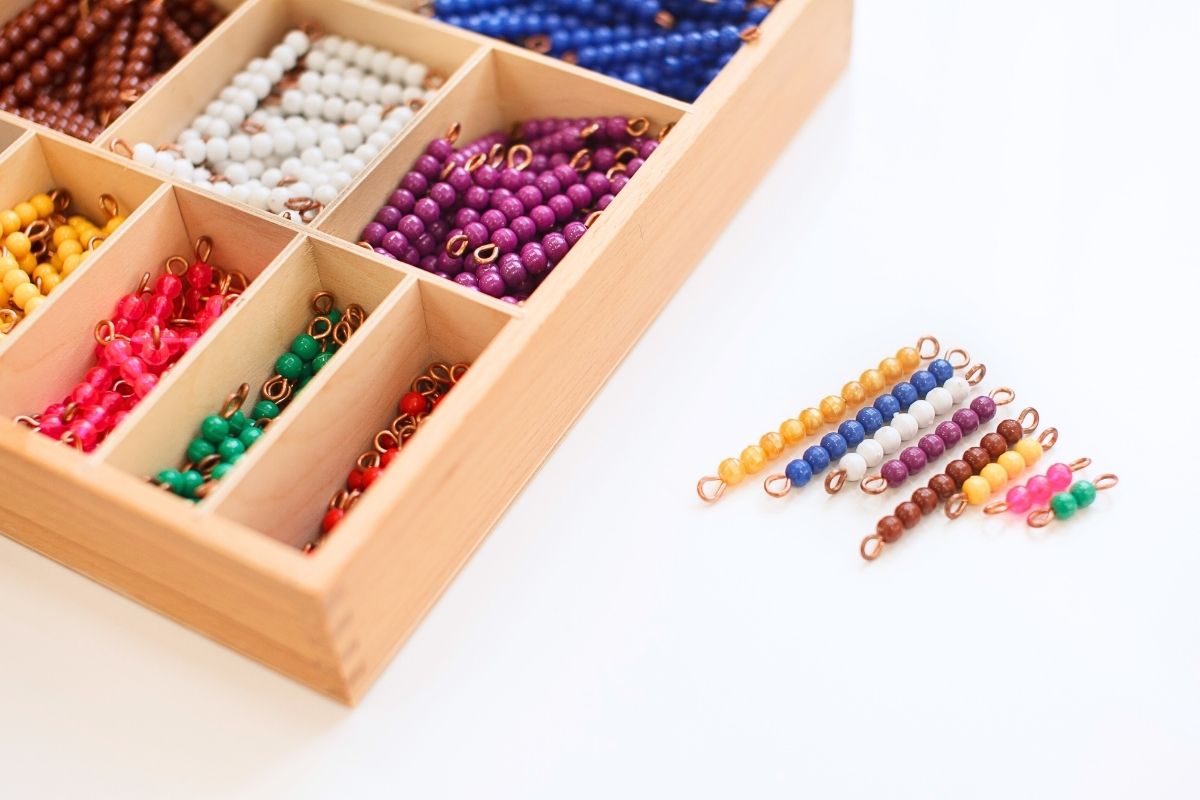
What it is: Individual bars of colour-coded beads, one bar per number from 1 to 10. The one-bar is red, the two-bar is green, the three-bar is pink, and so on, always the same colours in authentic Montessori materials.
How it’s used for skip counting: A child can lay out five two-bars in a line and count: 2, 4, 6, 8, 10. Or three three-bars: 3, 6, 9. The physical grouping makes the skip pattern concrete. This is the first skip counting material, introduced from around age 4.
Age: 4-5 years | Level: Pre-Kindergarten
2. Short Bead Chains
What it is: A chain made of bead bars linked end to end. The short chain for the number two is two two-bars linked together (4 beads total). The short chain for five is five five-bars linked together (25 beads). Each chain represents a number squared.
How it’s used for skip counting: The child lays the chain on a floor mat and places small number tickets at each group. For the five-chain: ticket reading “5” after the first five-bar, “10” after the second, “15” after the third, and so on to 25. The physical length of the chain gives the sequence a spatial dimension that reinforces pattern recognition.
Age: 5-6 years | Level: Kindergarten to Grade 1
3. Long Bead Chains
What it is: A chain representing a number cubed. The long chain for five has 125 beads (five-bars, 25 of them, linked together). When laid out on the floor, the chain for ten stretches over three metres. This physical scale is pedagogically intentional: the child can walk the length of a multiplication sequence.
How it’s used for skip counting: Same ticket-placing process as the short chain, but over a much longer sequence. Counting by fives to 100 with the long five-chain. Counting by tens to 1,000 with the long ten-chain. By this stage, the child is building a physical and spatial understanding of very large numbers that precedes any symbolic representation of them.
Age: 6-7 years | Level: Grade 1 to 2
4. The Hundred Board
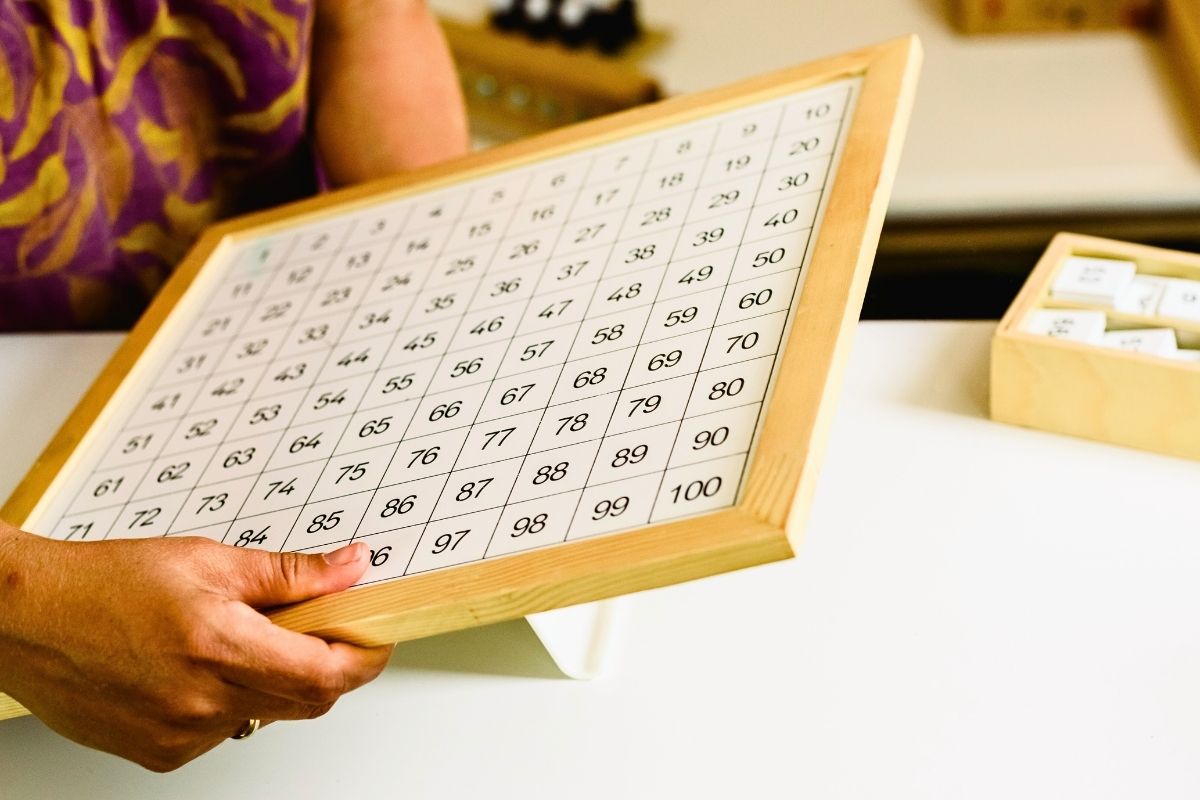
What it is: A 10×10 grid with 100 numbered tiles. The child places tiles from 1 to 100 in sequence, building both linear and grid-based number sense. It is one of the most versatile Montessori math materials.
How it’s used for skip counting: The child places only the multiples on the board, leaving the rest empty (or marking them differently). For skip counting by two: only tiles 2, 4, 6, 8… are placed. The visual gap between placed tiles makes the skip pattern immediately visible as a grid pattern: every other tile, every third column, every fifth row. The hundred board is particularly powerful for helping children notice that multiplication tables create regular patterns across the grid, not random sequences.
Age: 4-6 years | Level: Pre-Kindergarten to Kindergarten
5. Number Rods
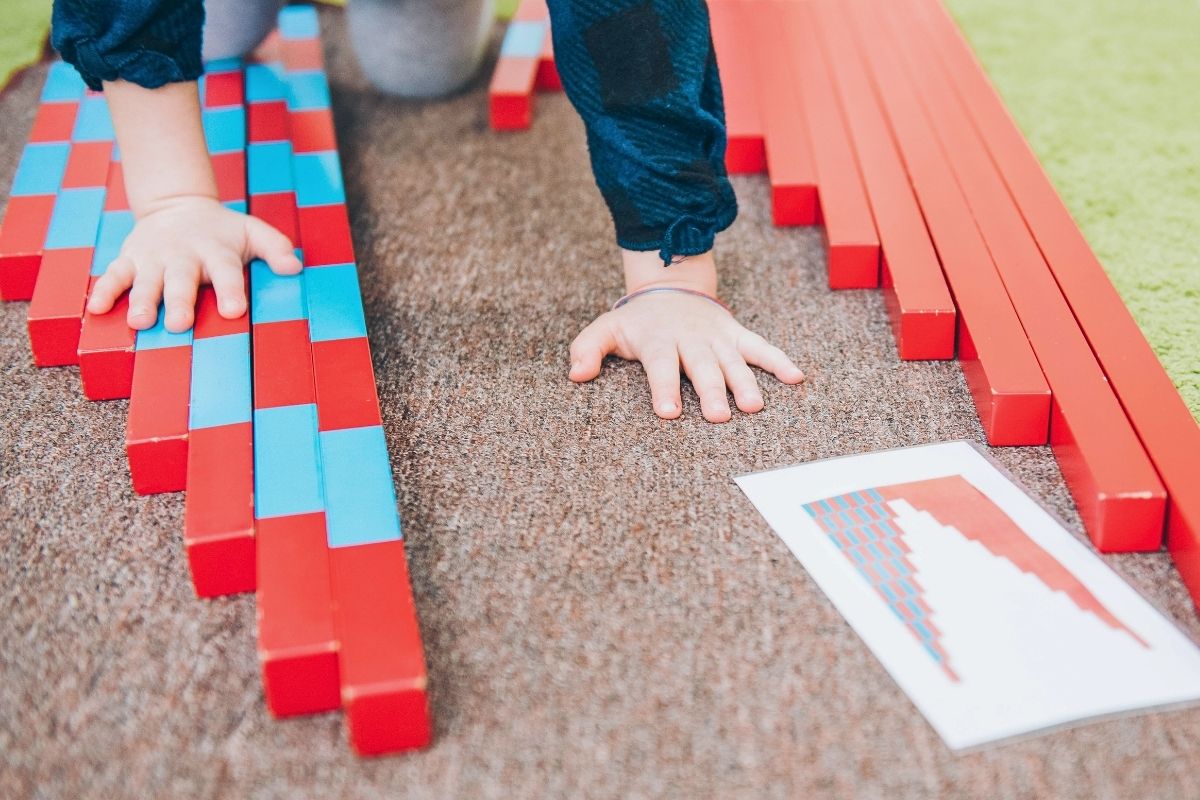
What it is: Ten wooden rods graduated in length from 10cm (rod one) to 100cm (rod ten), divided into alternating red and blue segments. The rods are one of the earliest Montessori math materials, introduced in the sensorial area before number work begins.
How it’s used for skip counting: By repeating the same rod, a child can build a visual staircase of equal increments. Three repetitions of the five-rod demonstrates 5, 10, 15. Two repetitions of the four-rod alongside one repetition demonstrates 4, 8. The physical equality of the rods makes the “equal jumps” concept of skip counting visually explicit in a way no worksheet can replicate.
Age: 4-5 years | Level: Pre-Kindergarten
6. Number Cards
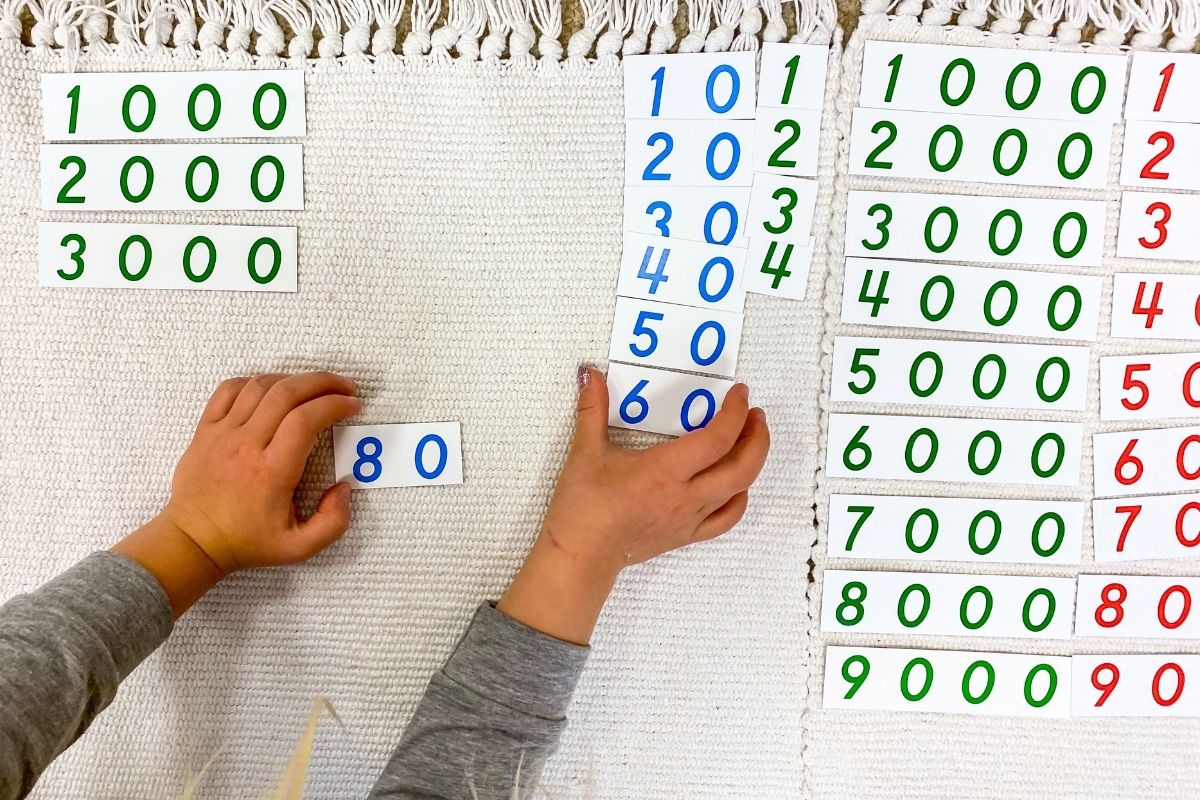
What it is: Small cards bearing numerals, used alongside bead chains and other materials to connect the physical quantity to its symbolic representation.
How it’s used for skip counting: After a child has laid out a bead chain and counted the beads aloud, they place number cards at each group to label the running total. This is the crucial step that bridges the concrete (the beads) and the symbolic (the numeral). Without this bridge, skip counting remains a physical exercise that does not generalise to abstract arithmetic. With it, the child begins to build the symbolic fluency that will eventually allow them to skip count mentally.
Age: 4-6 years | Used alongside all other materials
Step-by-Step: A Skip Counting Lesson at Home
You do not need a full Montessori classroom to teach skip counting effectively at home. What follows is a simple sequence that parents can use with a short bead chain or even with household objects.
Lesson: Skip Counting by Fives with a Bead Chain
- Prepare the space. Lay a floor mat or clear a table surface. Unroll the five-chain so it stretches out fully. Prepare number tickets for 5, 10, 15, 20, 25 nearby.
- Demonstrate without talking first. Touch each bead, moving slowly down the chain. When you reach the end of the first five-bar, pause, and place the “5” ticket. Then continue. This silent demonstration allows the child to observe the pattern before language introduces it.
- Invite the child to continue. Hand them the “10” ticket. Let them find where it goes. Guide only if needed. The material itself communicates where each ticket belongs: after each group of five beads.
- Count aloud together. Once all tickets are placed, run your fingers along the chain together from the start: 5, 10, 15, 20, 25. Slow and deliberate. Let them feel the rhythm.
- Invite independent repetition. Remove the tickets and ask the child to set them back up on their own. Resist the urge to help or correct at speed. Repetition is the point.
- Extend when ready. On another day: “Can you count the fives without the tickets?” This is the transition from concrete to mental. Do not rush it.
Activities That Don’t Require Montessori Materials
Good Montessori materials are worth having. But the underlying principles: physical grouping, visible patterns, sensory engagement, can be applied without specialist equipment.
Grouping real objects
Place coins, buttons, or dried beans in groups of two. Count the groups: 2, 4, 6, 8. The child sees that each jump adds one more group, not one more object. This is the core concept.
A number line on the floor
Write numbers 1-20 on sticky notes and lay them in a line. The child hops on every second: 2, 4, 6… or every fifth: 5, 10, 15. Physical movement encodes the pattern in a different way than the hands alone.
Hopscotch with multiples
Draw hopscotch squares and number them with multiples only. Counting by threes: squares read 3, 6, 9, 12. The child hops and calls the number on each landing. This works particularly well for children who need large motor activity to focus.
Clapping rhythms
Count aloud from 1 to 20, clapping or tapping on multiples of two (or three, or five). The silent beat in between physically marks the “skipped” numbers without naming them. This builds auditory pattern recognition alongside the visual and tactile.
From Skip Counting to Multiplication: The Montessori Sequence
Skip counting is not an end in itself. It is part of a carefully sequenced journey that Montessori designed to lead children naturally from concrete counting to abstract arithmetic. Understanding the full sequence helps parents and educators see where skip counting fits and what comes next.
The key insight in this sequence is that by the time a Montessori child encounters multiplication as a formal concept, they have spent two to three years physically working with the underlying patterns. They are not being asked to memorise something new. They are being asked to name something they already know in their hands and their body. This is why Montessori children often find the transition to formal multiplication significantly easier than children whose first encounter with it is a times table chart.
Read also
Parents Ask Most Often
In what order should I introduce skip counting numbers?+
The recommended Montessori sequence is: 2, 10, 5 (the most intuitive and most used in daily life), then 3, 4, 6, 7, 8, 9 in roughly that order. Start with two because the pattern of even numbers is visually simple on a hundred board and easy to feel on a bead chain. Ten comes early because it connects directly to the decimal system work the child is doing in parallel. Five is natural on fingers. The remaining numbers follow the difficulty of the patterns rather than their numerical order.
My child can skip count aloud but doesn’t understand what they’re doing. Is that a problem?+
Yes and no. Auditory memorisation without understanding is common when skip counting is introduced through songs and chanting alone. The child can recite the sequence but cannot apply it. This is why Montessori insists on the concrete-to-abstract sequence: the child first works with physical materials until the pattern is understood, then uses the materials to bridge to symbolic representation, and only then moves to abstract recitation. If your child can skip count verbally but is confused by the bead chain, go back to the physical material and slow down. The verbal sequence will follow the physical understanding, not precede it.
How long should a skip counting session last?+
As long as the child’s concentration sustains it, and no longer. For most children aged 4-6, this is between 10 and 20 minutes for a first session with a new material. As the material becomes familiar, the child may work for much longer. The key Montessori signal is the moment the child begins to lose quality of attention: this is the right time to stop, not after a fixed duration. Ending before the child is frustrated means they will return to the material willingly. Pushing past concentration ends the session on a negative note and can create resistance.
Can I use printable worksheets for skip counting in a Montessori approach?+
Printables are appropriate as a recording or consolidation activity, not as an introduction. A child who has worked extensively with bead chains and understands the five-sequence concretely can use a fill-in-the-blank worksheet (5, 10, __, 20, __) as a way to practise the symbolic representation they have already built physically. Using printables to introduce skip counting before the concrete work short-circuits the Montessori sequence and produces the same surface memorisation problem. Concrete first, symbolic second, abstract third.
The Pattern Was There All Along
When Montessori children encounter the multiplication table for the first time as a formal concept, many of them recognise it. “That’s the fives chain,” one child reportedly said, encountering the 5× column in a multiplication grid. She was right. She had laid that chain out on a mat dozens of times. She knew its rhythm in her fingers.
This is what skip counting, done well, actually accomplishes. Not memorisation of sequences. Not rote performance. A genuine, embodied familiarity with the patterns that mathematics is made of, built slowly, through repetition with physical materials, before a single multiplication symbol is ever written down.
Scientific References
Lillard, A.S. (2005). Montessori: The Science Behind the Genius. Oxford University Press.
Foundational review of the research supporting Montessori mathematics pedagogy, including the concrete-to-abstract sequence and the role of manipulative materials in number concept development.
Lillard, A.S. et al. (2023). Montessori education’s impact on academic and nonacademic outcomes: A systematic review. Campbell Systematic Reviews, 19(3), e1330.
32 studies. Notes that Montessori math materials, which isolate one concept at a time and provide built-in error control, are associated with stronger math outcomes than conventional instruction, particularly in the early years.
Geary, D.C. (2011). Consequences of mathematical learning disability for the development of typical mathematical cognition. In D. Berch & M. Mazzocco (Eds.), Why Is Math So Hard for Some Children? Brookes Publishing.
Documents the developmental significance of early number sense and quantity representation for later arithmetic fluency. The concreteness of Montessori bead materials directly addresses the embodied number sense that predicts multiplication and division success.
Mix, K.S., Levine, S.C. & Huttenlocher, J. (1999). Early fraction calculation ability. Developmental Psychology, 35(1), 164-174.
Demonstrates that children as young as 4-5 can reason about proportional quantities when presented concretely, supporting the Montessori practice of introducing ratio and multiplicative thinking through physical materials before formal instruction.