When my daughter first held a golden bead thousand cube, her eyes went wide. “It’s so heavy!” she exclaimed, comparing it to the tiny unit bead in her other hand. That moment, that physical experience of feeling the weight difference between one and one thousand, taught her more about place value than any worksheet ever could.
Montessori math materials work because they make the invisible visible. But here’s what nobody tells you when you’re starting out: the sheer number of materials can feel overwhelming. There are beads and rods and frames and boards, all with specific purposes. This guide breaks it all down by age, so you know exactly which materials matter when.
Skip the 50-material shopping lists. Here’s what matters based on where your child is right now.
Have a toddler (0-3)? Focus on everyday counting. Save your money on formal materials.
Starting preschool (3-6)? Colored bead bars and golden beads are your foundation. Everything else builds from there.
Elementary age (6-9)? They’ll revisit primary materials in new ways. Add specialized tools only as interest emerges.
Homeschooling? Start with 2-3 key materials, master the presentations, then expand based on your child’s response.
The best Montessori math setup is the one your child actually uses. Quality over quantity, always.
Whether you’re homeschooling, supplementing your child’s education, or just curious about what happens in a Montessori classroom, you’ll find practical information about which materials matter when and why they work the way they do. More importantly, you’ll learn which ones you can skip entirely.
Transparency Note
This post contains affiliate links to products I genuinely recommend based on years of experience with Montessori math materials. When you purchase through these links, I may earn a small commission at no extra cost to you. This helps support my blog and allows me to continue sharing honest resources about Montessori education.
The Montessori Approach to Mathematics
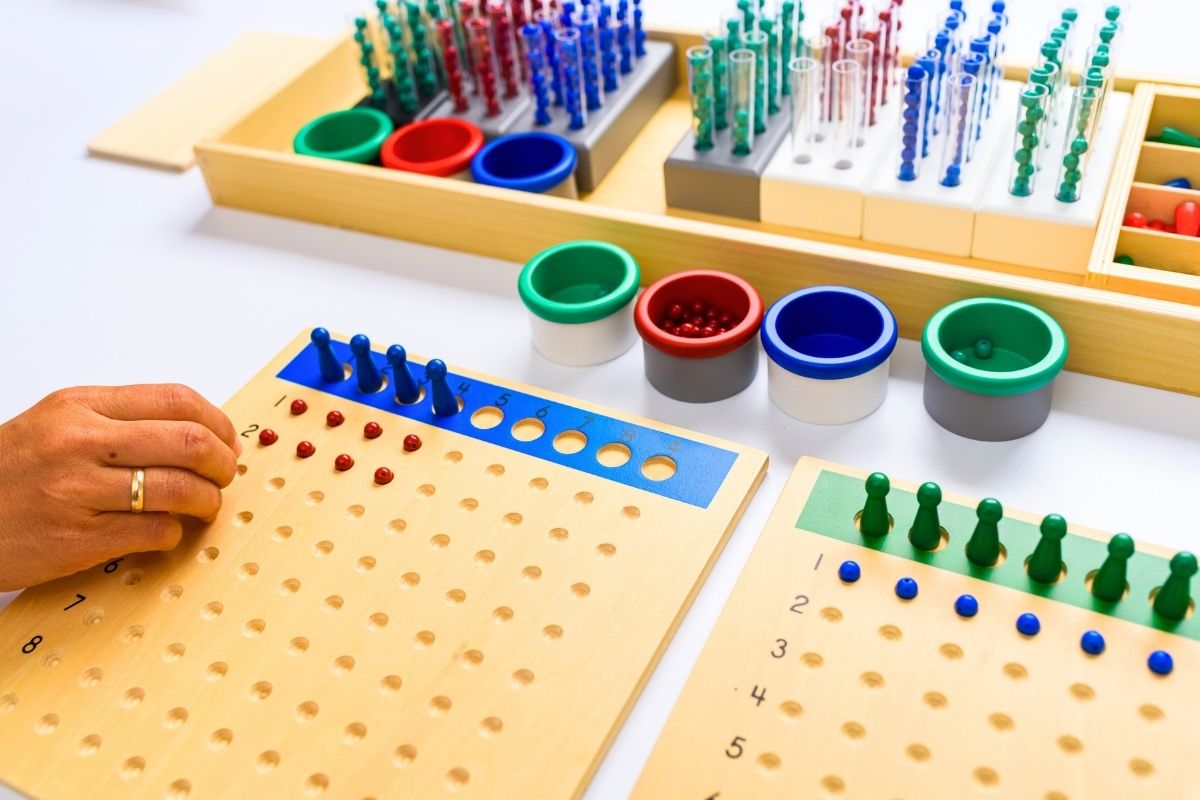
The Multiplication Boards, or Peg Boards, are used for hands-on practice and mastery of basic multiplication tables.
Before diving into specific materials, it helps to grasp how Montessori math differs from traditional teaching methods.
Dr. Maria Montessori observed something interesting about young children: they’re naturally drawn to order, patterns, and precision. She called this the “mathematical mind.” Watch a three-year-old arrange their toy cars in perfect rows or a four-year-old insist on equal portions at snack time. That innate sense of order? That’s the mathematical mind at work.
The Montessori math curriculum builds on this natural tendency through three key principles that make it remarkably effective.
From Concrete to Abstract
Children don’t start with abstract symbols. They begin by physically holding “three” in their hands as three beads. Only after extensive concrete experience do they transition to recognizing the numeral 3, and eventually to mental math without materials at all.
This progression might seem slow if you’re used to flashcards and worksheets. But children who build this concrete foundation develop genuine understanding rather than memorized procedures. When they eventually move to abstract work, they’re not just following rules. They know why the rules work because they’ve experienced it with their hands.
Isolation of Difficulty
Each material focuses on one concept at a time. When children work with number rods, they’re only thinking about quantity and sequence. When they work with sandpaper numbers, they’re only focusing on the symbol. Later, these concepts connect.
This matters because young brains can’t process multiple new concepts simultaneously. By isolating each difficulty, we give children the space to truly master one idea before moving to the next.
Control of Error
Many Montessori materials are self-correcting. If a child miscounts beads when working with the spindle box, the spindles won’t fit correctly. If they put the wrong numeral with the number rods, the visual mismatch is obvious.
This builds independence and confidence. Children learn to check their own work and correct mistakes without needing constant adult verification. The material itself becomes the teacher.
Montessori Math Materials for Ages 0-3 (The Foundation Years)
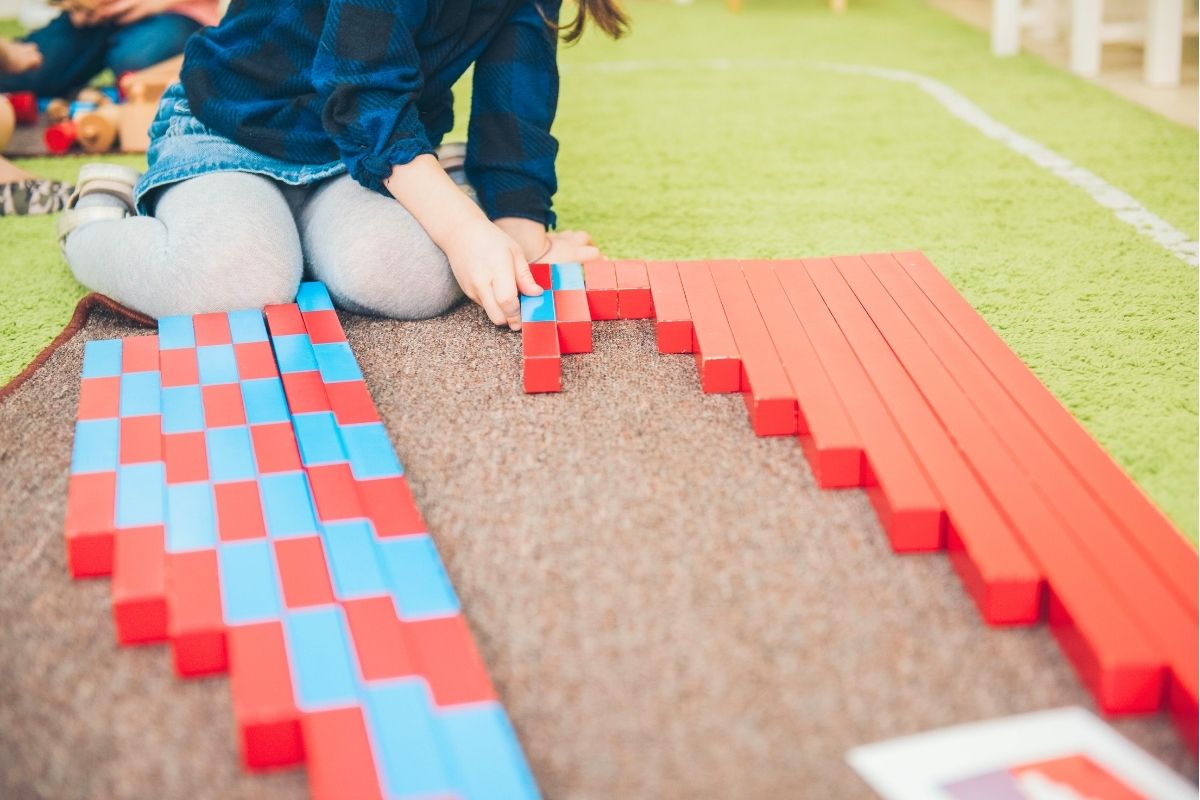
The Red and Blue Number Rods provide a concrete understanding of quantities and the number sequence from 1 to 10.
At this age, we’re not doing formal math. We’re building the foundation that makes math possible later.
Dr. Montessori identified that children develop their mathematical sensitivity around age four. Before that, the focus is on practical life activities, sensorial experiences, and language development. These seemingly unrelated activities actually prepare the mathematical mind in ways that directly impact later math learning.
What “Math Readiness” Actually Looks Like
When a toddler sorts toys by color, they’re learning classification. When they stack blocks from largest to smallest, they’re exploring seriation. When they pour water from one container to another, they’re experiencing volume. All of these activities develop mathematical thinking without involving numbers at all.
Material
Purpose & Description
What It Develops
How to Use
Number Rods
Ten wooden rods varying in length from 10cm to 100cm, painted in alternating red and blue segments. Each rod represents a number from 1-10 through its physical length and segmentation.
Quantity and number association, visual discrimination of length, sensorial impression of numbers
Count segments together while touching each one. Build stairs by ordering from shortest to longest. Compare rod lengths.
Numerals 0-9 cut from sandpaper and mounted on smooth boards. Children trace them with their fingers while saying the number name, engaging touch, sight, and sound simultaneously.
Tactile recognition of numeral shapes, muscle memory for writing numbers, multisensory learning
Trace with two fingers in the direction of writing while saying the number name. Repeat several times for muscle memory.
Two wooden boxes with compartments numbered 0-9, used with wooden spindles. Children count out the correct number of spindles for each compartment and bundle them with rubber bands.
Counting accuracy, concept of zero as empty, associating quantities with written symbols, one-to-one correspondence
Count spindles one at a time into hand, bundle with rubber band, place in correct numbered compartment. Leave zero empty.
Four sets of ten cylinders that vary systematically in height and diameter. Children order them by size, developing visual discrimination and preparation for understanding measurement.
Size gradation, seriation skills, visual discrimination, preparation for understanding fractions and decimals
Arrange cylinders from smallest to largest. Compare sizes by placing them next to each other. Build towers with different sets.
Individual loose beads used for simple counting exercises. Children move one bead at a time while counting aloud, creating a physical connection between the spoken number and each object.
Basic one-to-one correspondence, tactile counting experience, fine motor development
Move beads one at a time from one bowl to another while counting. Touch each bead as you count it aloud.
Simple frames with beads on wires or rods. Children slide beads across while counting, providing a structured way to practice number recognition and quantity association.
Introduction to numbers and quantities, early number sense, hand-eye coordination
Slide beads one at a time while counting. Practice moving specific quantities (show me 5 beads).
Wooden puzzles where each piece is shaped like a numeral. Children feel the shape, trace it, and fit it into the correct space, experiencing numbers as physical objects.
Tactile introduction to number shapes, spatial awareness, preparation for numeral recognition
Trace number shapes with finger, then fit into matching space. Name numbers as you place them.
A set of colored bead bars representing numbers 1-9, arranged in stair formation from shortest to longest. Each number has its own distinct color for easy visual recognition.
Counting practice, number recognition, understanding number sequence and relationships
Build stairs from 1 to 9. Mix them up and rebuild. Compare bar lengths to understand bigger/smaller.
Activities where children thread beads onto strings or laces. While developing fine motor skills, they can count beads, create patterns, or sort by color and size.
Fine motor skills essential for writing, hand-eye coordination, early counting, pattern recognition
Thread beads onto string while counting each one. Create simple patterns (red, blue, red, blue). Count completed strand.
But honestly? At this age, the best “math materials” are everyday objects. Let your toddler count stairs as you climb them together. Have them help set the table by placing one napkin at each seat. Count the apples as you put them in your shopping cart.
These concrete, meaningful counting experiences build understanding in ways that abstract number recognition never could. Save your money on formal materials for now. Your time and attention are the only “materials” toddlers really need.
Montessori Math Materials for Ages 3-6 (The Primary Years)
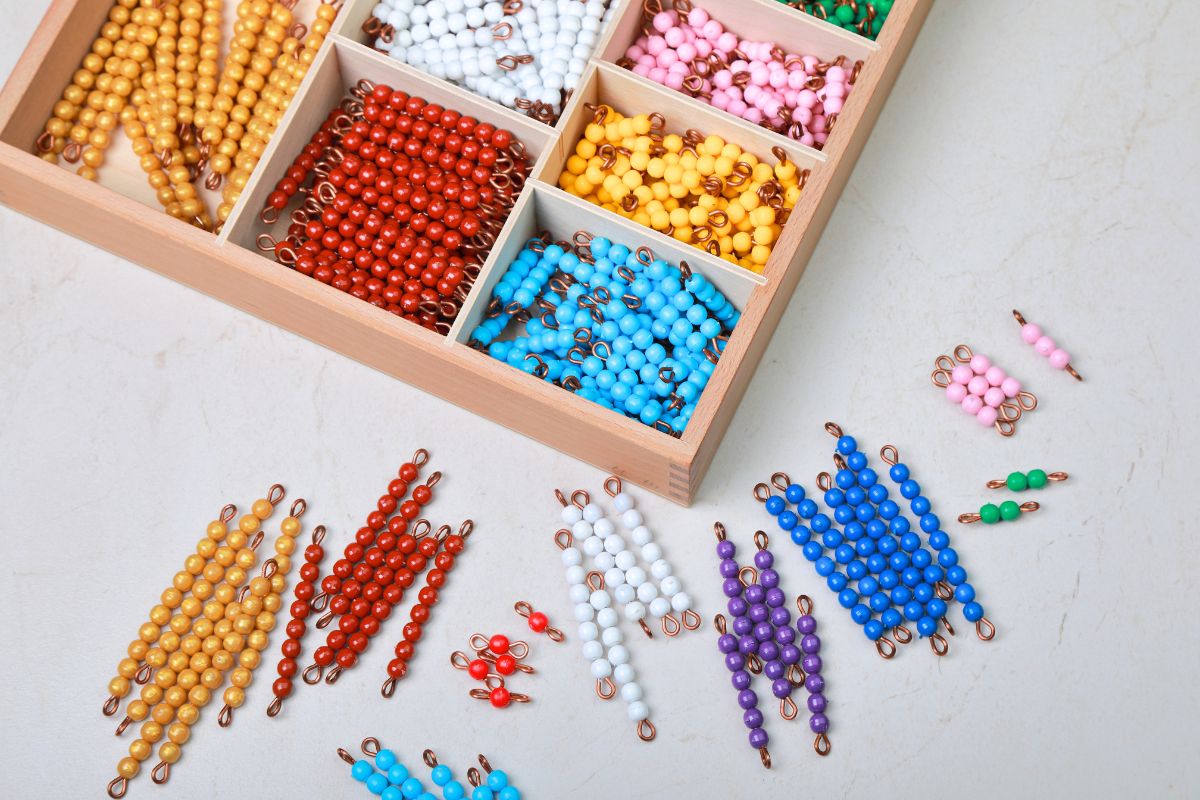
The Colored Bead Chains are used for a hands-on introduction to counting, skip counting, and multiplication concepts.
This is where Montessori math really shines. Between ages three and six, children move from basic counting to grasping the decimal system, performing all four operations, and beginning to memorize math facts.
The materials for this age group form the core of the Montessori math curriculum. They’re also the ones you’ll see most often in photos of Montessori classrooms because they’re visually stunning and genuinely fascinating to watch in action.
Quantity Recognition Materials
Material
Purpose & Description
Key Learning
How to Use
Bead Bars (Colored)
Color-coded bead bars where each number 1-10 has its own color (red for 1, green for 2, pink for 3, etc.). Children can visually identify quantities and use them for basic operations like addition and subtraction.
Visual quantity recognition at a glance, basic arithmetic operations, understanding commutative property
Place bars side by side to compare. For addition, put 3-bar and 2-bar next to 5-bar to see they’re equal. Count beads on each bar.
The cornerstone material. Individual unit beads, ten bars (10 beads wired together), hundred squares (10 ten-bars), and thousand cubes. Children physically build numbers and perform all four operations with quantities up to 9,999.
Decimal system foundation, place value through weight and size, all four operations with multi-digit numbers
Build numbers (1,234 = 1 cube, 2 squares, 3 tens, 4 units). Combine quantities for addition. Exchange 10 units for 1 ten bar when regrouping.
Wooden sticks or rods of varying lengths, often color-coded. Children arrange them by size and use them for counting exercises.
Line up sticks from shortest to longest. Touch each stick while counting aloud. Make patterns with different colored sticks. Compare which stick is longer or shorter.
Size comparison, seriation, early counting, pattern creation
A board with 100 squares and separate tiles numbered 1-100. Children place tiles in order, discovering number patterns, odds and evens, and skip counting sequences.
Number sequence to 100, pattern recognition (rows of ten), odd and even numbers, skip counting preparation
Place number tiles in order from 1-100. Look for patterns in columns (11, 21, 31…). Practice skip counting by covering certain numbers.
Two boards: one for teens (11-19) and one for tens (10-90). Children place number cards over “10” to create teen numbers or multiples of ten, used alongside colored bead bars for concrete quantity work.
Teen number formation (10+3=13), tens concept, building numbers 11-99 with understanding
Place cards over “10” to form teens. Match with bead bars (10-bar plus 3-bar for 13). Count the beads to verify.
Color-coded cards representing units (green), tens (blue), hundreds (red), and thousands (green). Cards overlap to show how 4,356 is built from 4000+300+50+6, making place value visible and manipulable.
Place value visualization, understanding that 35 is thirty AND five, connecting quantities to written symbols
Overlap cards to build numbers. Use with golden beads to match card (4,356) with actual quantity (4 cubes, 3 squares, 5 tens, 6 units).
Wooden numeral cards 1-10 paired with red counters (typically 55 counters total). Children place the correct number of counters below each card, arranging them in two columns to visually discover which numbers are odd (one counter left alone) and even (all paired up).
Symbol-quantity association, odd and even number discovery, counting accuracy, understanding that odd numbers have a “lonely” counter
Lay out cards 1-10 in order. Starting with 1, count out one counter and place it below. For 2, count two counters and arrange them as a pair (one on left, one on right). Continue through 10, always trying to make pairs. Children discover that 1, 3, 5, 7, 9 have a “lonely” counter at the bottom (odd), while 2, 4, 6, 8, 10 pair up perfectly (even).
Colored bead bars arranged in a “snake” formation. Children count groups of ten and exchange them for golden ten bars, experiencing addition with carrying/regrouping in a concrete, visual way.
Addition with regrouping, making tens, understanding why we “carry” in addition
Lay out colored bead bars in a long snake. Count ten beads at a time and exchange them for a golden ten bar. Continue until the entire snake becomes golden bars and loose beads, showing the total.
Addition/Subtraction Strip Boards
Wooden boards with spaces numbered 1-18 (addition) or 1-18 (subtraction). Children place colored strips to visualize operations and discover math facts through repeated use, leading to memorization.
Memorizing addition and subtraction facts, visual representation of equations, self-checking work
For 5+3, place the blue strip on 5, then place the red strip for 3 next to it. The answer shows at the end. Children work through all combinations until facts become automatic.
A board with a grid and numbered markers. Children place a specific number of beads in each row to create multiplication facts (3 rows of 4 beads = 12), seeing multiplication as repeated addition.
Multiplication as repeated addition, memorizing times tables, understanding multiplication structure
To solve 3×4, place the “3” marker and distribute 4 beads in each of 3 rows. Count all beads to get 12. The child sees that 3×4 means “3 groups of 4.”
A board with small cups and beads. Children distribute beads equally into cups (sharing), experiencing division as equal distribution. Any leftover beads become the remainder.
Division as equal sharing, remainders, memorizing division facts, connecting to multiplication
For 15÷3, place 3 cups and distribute 15 beads one at a time into each cup. When done, count beads in one cup to get the answer: 5. Leftover beads show remainders.
Small colored tiles representing units, tens, hundreds, and thousands. More abstract than golden beads but still manipulable, serving as the bridge between concrete beads and written arithmetic.
All four operations with exchanging, transition from concrete to abstract, independent arithmetic practice
Build each number with stamps (2,346 uses 2 thousand stamps, 3 hundred stamps, etc.). Combine or subtract quantities, exchanging 10 units for 1 ten stamp when needed.
A paper board with dots representing place values. Children use colored pencils to mark dots for addition, practicing carrying between place values in a structured, visual format.
Visual addition with carrying, connecting manipulatives to written work, structured arithmetic practice
Write numbers at the top, then color in dots for each digit. When a column has 10+ dots, circle 10 and carry one dot to the next column. Count remaining dots for the answer.
Long chains of colored beads (100-chain, 1000-chain) with numbered arrows marking milestones. Children unroll chains across the floor, count by ones or skip count, experiencing linear counting and multiplication foundations.
Skip counting (count by 5s, 10s), linear counting to 1000, squaring numbers (5×5=25 beads)
Unroll chain on floor. Place arrows at intervals (10, 20, 30…). Count by ones or skip count. Fold short chains into squares.
Beautiful wooden cabinet storing all bead chains organized by color and type. The organization itself teaches mathematical order and relationships between squares, cubes, and skip counting sequences.
Mathematical organization, relationship between materials, skip counting sequences for all numbers 1-10
Select chain from cabinet. Note organization by color (matching bead bars). Return chains to proper location after use.
Fraction Circles
Metal insets divided into fractions (halves, thirds, quarters, etc.) in different colors. Children physically compare fractions, discover equivalences (2/4 = 1/2), and experience parts of a whole concretely.
Fraction concepts, equivalence, comparing fractions, addition of fractions with like denominators
Compare piece sizes. Stack equivalent fractions. Combine pieces to make whole. Name each fraction as you handle it.
Drawers containing geometric shape insets (circles, triangles, squares, polygons). Children trace shapes, learn precise names, and explore relationships between different geometric forms.
Shape recognition and naming, geometry vocabulary, visual discrimination, preparation for geometry study
Remove shape inset. Trace around it and inside it. Match shape to frame. Learn correct geometric names (pentagon, not “five-sided shape”).
Binomial Cube
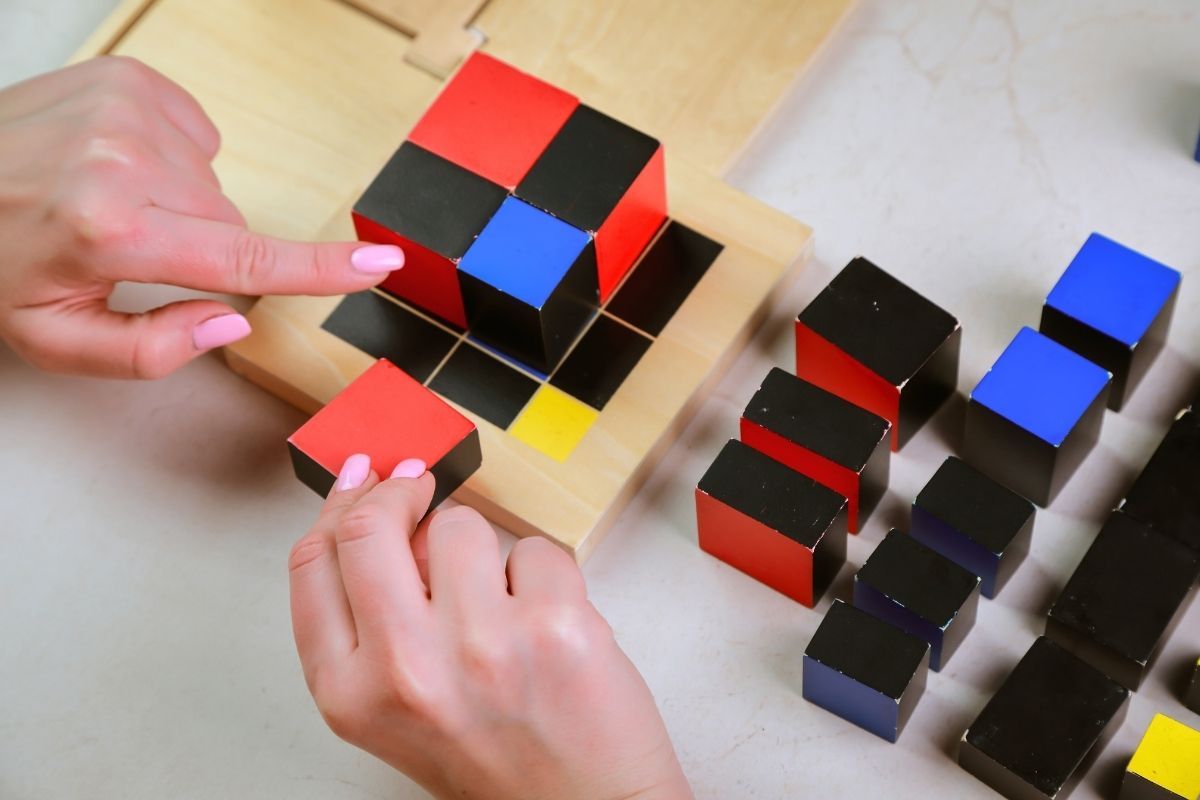
A 3D puzzle with colored blocks representing the algebraic formula (a+b)². Initially used sensorially as a puzzle, later connecting to algebra. Children don’t need to understand the formula to benefit from the spatial and pattern work.
Sensorial preparation for algebra, spatial relationships, pattern recognition, visual discrimination
Disassemble cube. Rebuild using color and size clues. Work with lid open, then closed. Layer by layer or all at once.
More complex than binomial cube, representing (a+b+c)³. Children work with this puzzle for years, building spatial intelligence and mathematical intuition that supports later algebraic thinking.
Advanced spatial relationships, preparation for algebra, pattern complexity, three-dimensional thinking
Similar to binomial but with three layers. Rebuild systematically. Notice patterns in block arrangements. Challenge: rebuild without lid.
If I could only recommend one set of Montessori math materials, it would be the golden beads. These glass or wooden beads represent the decimal system: individual unit beads, ten bars (10 beads wired together), hundred squares (10 bars forming a square), and thousand cubes (10 hundred squares forming a cube). Children physically build numbers. Want to show 1,234? You gather one thousand cube, two hundred squares, three ten bars, and four unit beads. The physical difference between these quantities is impossible to miss. That thousand cube is heavy and impressive. The unit bead is tiny and light. With golden beads, children perform addition, subtraction, multiplication, and division with multi-digit numbers long before they could do the same operations on paper.
Montessori Math Materials for Ages 6-9+ (The Elementary Years)
The Binomial Cube offers sensory preparation for algebra and helps develop visual perception of dimensions and patterns.
Elementary-age children revisit many primary materials but use them in more sophisticated ways. They’re also introduced to new materials that explore more complex mathematical concepts.
At this stage, the curriculum expands to include advanced operations, fractions, decimals, geometry, and even introductory algebra concepts. The materials become more abstract, but they’re still hands-on and manipulable.
Advanced Operations Materials
Material
Purpose & Description
Mathematical Concept
How to Use
Checkerboard
A checkered grid where colored beads represent different place values. Children solve multi-digit multiplication (like 23 × 47) by placing beads systematically, seeing multiplication as creating area and experiencing partial products concretely.
Multi-digit multiplication, multiplication as area, place value interactions, partial products
Write multiplicands. Place beads where place values intersect. Count beads diagonally for each place value. Exchange as needed.
Bead Frame
A wooden frame with color-coded beads on wires representing place values (green=units, blue=tens, red=hundreds, green=thousands). Children slide beads to perform operations, bridging between concrete beads and abstract calculation.
All four operations more abstractly, exchanging between place values, mental math preparation
Build numbers by sliding beads. Add/subtract by combining/removing beads. Exchange 10 from one wire to 1 on next wire.
Color-coded boards and tubes for working through long division step-by-step. Each step of the division process has a physical action, making the algorithm understandable rather than just memorized.
Long division process, division algorithm understanding, place value in division
Set up dividend in tubes. Divide each place value starting from left. Distribute beads into divisor number of cups. Record at each step.
A complete set of colored bead bars arranged to show all multiplication facts from 1×1 to 10×10. Children can build the entire multiplication table, discovering patterns (like commutative property) through physical arrangement.
Uses gray “negative” beads alongside colored positive beads. Children physically experience that positive and negative cancel out (5 + (-3) = 2), making abstract integer operations concrete and visual.
Integer operations, positive and negative numbers, concept of opposites canceling, integer addition/subtraction
Build snake with positive and negative bars. Match pairs of opposite beads (they cancel). Count remaining beads for answer.
Wooden pieces representing fractions in three dimensions. Children can stack, compare, and combine fractions physically, discovering equivalences and performing operations with fractions using tangible objects.
Similar to golden beads but smaller, representing decimal place values (tenths, hundredths, thousandths). Children see how decimals relate to whole numbers and fractions, performing operations with decimal quantities.
Decimal place value, relationship between decimals and fractions, decimal operations
Build decimal numbers using small beads and squares. Compare to whole number beads. See that 0.1 is 1/10 of unit. Perform operations.
Extends place value beyond thousands to millions. Color-coded pieces show the pattern of units-tens-hundreds repeating in each “family” (thousands family, millions family), revealing the structure of our number system.
Extended place value to millions, number system structure, decimal families and patterns
Layout pieces to show number families. See color pattern repeat. Build large numbers. Notice relationship between families.
Colored bead bars or pegs arranged to create perfect squares visually. Children discover square roots by finding which number, when multiplied by itself, creates a given square area.
Square roots as reverse of squaring, perfect squares, relationship between area and side length
Build squares with bead bars. Count side length and total beads. Discover that 7×7=49, so √49=7. Try non-perfect squares.
Boards with pegs for exploring patterns, sequences, and basic algebraic thinking. Children create visual patterns and explore relationships between quantities in preparation for formal algebra.
Pattern exploration, algebraic thinking, sequences, visual representation of mathematical relationships
Create patterns with pegs. Show number sequences visually. Explore growing patterns. Predict next term in sequence.
Three-dimensional wooden shapes (sphere, cube, cone, cylinder, pyramid, etc.). Children hold, compare, trace bases, and explore properties of 3D geometry through sensorial experience.
3D shape recognition and naming, properties of solids, relationship between 2D and 3D shapes
Let children hold and feel each solid. Trace the base on paper to discover the 2D shape. Use a blindfold for sensorial matching. Sort by properties like “rolls” vs “doesn’t roll” or count faces, edges, vertices.
Colored triangles that can be combined to create other polygons. Children discover that two triangles make a square, three make a hexagon, etc., exploring geometric relationships through hands-on construction.
Geometric relationships, area composition, discovering that shapes can form other shapes
Start with one box at a time. Show how two right triangles placed together form a square. Let children experiment with different combinations. They discover that the same triangles can create multiple shapes.
Sticks of varying lengths and colors for constructing lines, angles, and shapes. Children create geometric figures, explore angle properties, and investigate perimeter and area relationships.
Use sticks to build triangles, squares, and polygons. Compare perimeters by counting sticks. Create angles and compare sizes. Build parallel and perpendicular lines. Explore which triangles are possible with different stick lengths.
Tool for measuring angles in degrees. Introduced after extensive sensorial work with angles, allowing children to quantify angle measurements and explore angle relationships.
First, let children explore angles with sticks or paper. Then introduce the protractor to measure. Align the center point and baseline, read where the other line crosses. Measure angles in the room, in shapes, in nature.
Metal insets that visually demonstrate the Pythagorean theorem (a² + b² = c²). Children can physically see and prove that the areas of squares on two shorter sides equal the area of the square on the hypotenuse.
Pythagorean theorem, relationship between sides of right triangles, visual geometric proof
Build a right triangle with the insets. Create squares on each side. Physically rearrange the smaller square pieces to fit exactly into the largest square, proving that a²+b²=c². This makes the theorem visible and tangible.
Whether you’re creating a homeschool curriculum or supplementing your child’s education, grasping the Montessori math sequence helps you make informed decisions.
The Montessori math curriculum isn’t linear. Children don’t complete one material and move to the next. Instead, they work with multiple materials simultaneously, each reinforcing different aspects of mathematical thinking.
1
Quantity (Ages 3-4)
Children learn to recognize and count quantities from 1-10 using number rods, counting activities, and bead bars. They’re building sensorial impressions of “how much” each number represents.
2
Symbol (Ages 3-4)
Simultaneously, they learn to recognize numerals through sandpaper numbers and number cards. The tactile experience helps them remember the shape of each symbol.
3
Association (Ages 4-5)
Now they connect quantity and symbol through materials like spindle boxes and cards and counters. This is where the “aha moment” happens as abstract symbols connect to concrete quantities.
4
Decimal System (Ages 4-6)
Golden beads introduce place value and the concept that our number system builds in groups of ten. Children physically experience the relationship between units, tens, hundreds, and thousands.
5
Operations (Ages 5-6)
Using golden beads and stamp game, children perform all four operations with large numbers. They’re not memorizing algorithms but grasping the process behind each operation.
6
Memorization (Ages 5-7)
Strip boards, bead chains, and other materials help children memorize basic math facts. But this memorization comes after deep understanding, making it stick more effectively.
7
Abstraction (Ages 6-9)
Children transition to written work while maintaining access to materials when needed. They can now work abstractly because they have years of concrete experience to draw upon.
These ages are approximations. Some children move faster, others need more time. The beauty of Montessori is that the curriculum follows the child, not arbitrary grade-level expectations.
Teaching Montessori Math at Home (What Actually Works)
The biggest question I get from parents: “Do I need to buy all these materials to teach Montessori math at home?”
The short answer is no. The longer answer is: it depends on your child’s age, your budget, and your goals.
If your child attends a Montessori school, you don’t need to replicate the math area at home. Instead, support their learning through everyday activities and conversations. Count stairs together. Compare sizes while cooking. Sort laundry by color or type. These practical life activities reinforce mathematical thinking without requiring special materials.
Start With These Basics
Ages 3-4: Colored bead bars (1-10) and sandpaper numbers. Budget around $30-50.
Ages 4-6: Add golden beads (units, tens, hundreds, one thousand cube). Budget around $60-80.
Ages 6+: Consider bead chains and more specialized materials based on your child’s interests. Budget varies widely.
Remember: quality matters more than quantity. One set of well-made materials used regularly beats a shelf full of materials gathering dust.
Your Questions About Montessori Math Materials
After talking with dozens of parents implementing Montessori math at home, these questions come up repeatedly.
Should I buy glass or plastic beads?+
Glass beads are more expensive but provide better sensorial feedback. Children can feel the weight difference between quantities more clearly. Plastic works fine for tight budgets, but if you can afford glass, it’s worth the investment for golden beads especially. The weight and temperature of glass create a richer sensory experience.
My child isn’t interested in the math materials. What should I do?+
Step back. Montessori relies on intrinsic motivation. If your child isn’t ready or interested, forcing it creates negative associations with math. Put the materials away for a few weeks or months. Continue with practical life activities and wait for natural interest to emerge. Sometimes the timing just isn’t right yet.
Can I mix Montessori math with traditional worksheets?+
You can, but recognize that worksheets introduce abstraction before children have built concrete understanding. If your child uses Montessori materials at school, adding worksheets at home can confuse them. If you’re homeschooling, use materials extensively before transitioning to paper work. The materials should come first, always.
How do I know if my child is ready for the next material?+
Watch for mastery and sustained interest. If your child can complete an activity easily, accurately, and independently multiple times, they’re probably ready for something more challenging. If they’re making frequent errors or showing frustration, they need more time with preliminary materials. Trust your observations.
Are Montessori math materials worth the investment?+
It depends on your situation. For homeschoolers committed to the Montessori method, yes, quality materials used for years justify the cost. For supplementing traditional school, focus on one or two key materials. For children attending Montessori school, everyday math activities at home are often sufficient. Consider your budget and long-term plans.
What’s the most important material to start with?+
For ages 3-4, colored bead bars are incredibly versatile and affordable. For ages 4-6, golden beads are transformative. Don’t feel pressure to have everything. One material used well teaches more than ten materials sitting unused on a shelf.
Where Math Meets Wonder
Montessori math materials work because they honor how children actually learn. Not through memorization or repetition, but through touching, moving, exploring, and discovering.
When my daughter arranges golden beads on the rug, she’s not just “doing math.” She’s building neural pathways that connect abstract symbols to concrete quantities. She’s developing the kind of deep mathematical thinking that will serve her for decades.
You don’t need every material mentioned in this guide. You don’t need a perfect Montessori classroom in your home. You just need to meet your child where they are, provide appropriate materials for their current stage, and trust the process.
The best Montessori math curriculum is the one your child actually uses. Start small, observe carefully, and let your child’s interest guide you. That’s the real Montessori way.
Sources & References
Carbonneau, K. J., Marley, S. C., & Selig, J. P. (2013). A meta-analysis of the efficacy of teaching mathematics with concrete manipulatives. Journal of Educational Psychology, 105(2), 380-400. DOI: 10.1037/a0031084
Laski, E. V., Jor’dan, J. R., Daoust, C., & Murray, A. K. (2015). What Makes Mathematics Manipulatives Effective? Lessons From Cognitive Science and Montessori Education. SAGE Open, 5(2). DOI: 10.1177/2158244015589588
Montessori, M. (1949). The Absorbent Mind. Clio Press Ltd.
National Research Council (2001). Adding It Up: Helping Children Learn Mathematics. The National Academies Press. DOI: 10.17226/9822
Lillard, A. S. (2017). Montessori: The Science Behind the Genius (3rd ed.). Oxford University Press.