If you have ever visited a Montessori nursery or preschool and wondered what all those wooden materials on the shelves actually do, and why they look so different from conventional toys: this guide explains it. Each material in a Montessori classroom exists for a specific developmental reason, belongs to one of five curriculum areas, and is designed to be used independently by a child who has been shown how.
Understanding the five areas and what they build helps you read the classroom, have better conversations with your child’s teacher, and, if you want to extend the environment at home, know where to start and what to look for.
The five curriculum areas at a glance
- Practical Life: Real tasks that develop independence, concentration, and fine motor control
- Sensorial: Materials that isolate one quality (size, weight, texture, sound) and train precise observation
- Language: From spoken vocabulary to letters, writing, and reading through a sensory-first approach
- Mathematics: Quantities before symbols, concrete before abstract, through a carefully sequenced set of materials
- Cultural: Geography, science, botany, zoology, and history introduced through maps, specimens, and nomenclature cards
The areas are not isolated subjects. Practical life builds the concentration that makes sensorial work possible. Sensorial work builds the discrimination that supports mathematics. Language runs through everything. The five areas are five entry points into the same prepared environment.
Why Montessori Materials Look the Way They Do
Before going through the five areas, it helps to understand the design principles that all Montessori materials share: because once you see them, you start recognising authentic materials immediately and can tell them apart from imitations.
Isolation of one quality
Each material teaches one concept at a time. The pink tower cubes are identical in every way except size. The colour tablets vary only in colour. This isolation means the child’s attention goes to exactly the right place.
Built-in control of error
Every material has a self-correcting feature. Cylinder blocks do not fit in the wrong holes. The pink tower only stands when ordered correctly. The child sees the error without being told, and revises independently.
Natural materials
Solid wood, glass, metal, natural fibre. Not plastic, not digital. Natural materials have real sensory properties: weight, temperature, texture, that plastic imitations cannot replicate. This matters for tactile learning.
Child-sized and complete
Every material is proportioned for a 3-6 year old hand. Everything needed for the activity is in one place on the shelf, complete and ready to use without adult preparation. This allows independent access from the beginning.
Area 1: Practical Life
Practical life is always the first area introduced in a Montessori preschool environment, and always the most complete. It includes real tasks using real tools: pouring water from a pitcher into a glass, using a sponge to wipe a table, carrying a tray without spilling, threading a needle, peeling a carrot, sweeping with a child-sized broom. These are not simplified versions of adult activities: they are the actual activities, scaled to child-sized equipment.
The reason practical life comes first is that it builds the concentration and fine motor control that every other area of the curriculum depends on. A child who has spent weeks perfecting the precise wrist movement required to pour without spilling has built a hand-mind coordination that transfers directly to sensorial work, writing, and mathematical manipulation. Practical life is the foundation of everything else.
What practical life activities look like in a preschool classroom
- Pouring work: Grain first, then water, into increasingly similar containers, gradually demanding greater precision
- Transferring work: Using a spoon, tongs, or tweezers to move small objects, developing pincer grip for writing
- Dressing frames: Wooden frames with buttons, zips, snaps, buckles, velcro and bows: each isolates one self-care fastening skill
- Care of environment: Sweeping, dusting, washing a table, polishing wood or metal, building real contribution and pride in the shared space
- Food preparation: Slicing banana, spreading butter, preparing a simple snack, real kitchen tools, real outcomes
- Grace and courtesy: Structured lessons in how to greet someone, wait your turn, interrupt politely, say thank you, taught through role-play, not rules
The most common mistake parents make when trying to replicate practical life at home is replacing real tools with child-safe plastic versions. The Montessori principle is that children should use real things: real glasses, real pitchers, real sweeping brushes, at child-appropriate scale. The weight of a real glass, the fragility of it, is part of what makes the activity worth doing carefully. Plastic imitations remove the consequence and remove the lesson.
Area 2: Sensorial
The sensorial materials are what most people picture when they think of a Montessori classroom. They are beautiful, precise, and deeply intentional. Their purpose is to refine the child’s ability to perceive and discriminate among the qualities of the world around them: dimension, colour, texture, weight, temperature, sound, taste, and smell. Each material isolates one of these qualities completely.
Key sensorial materials and what they teach
Pink Tower
Ten wooden cubes that vary only in size, from 1cm³ to 10cm³. The child builds a tower from largest to smallest. Teaches three-dimensional size discrimination, visual estimation, order, and precise muscle control, and indirectly prepares for mathematics by introducing the decimal system through volume (each cube is exactly 10x the volume of the previous one).
Cylinder Blocks (Knobbed Cylinders)
Four wooden blocks, each containing 10 cylinders that vary in height and/or width. The cylinders only fit in their correct holes. A classic self-correcting material that builds visual discrimination, fine motor control (the knob is precisely the width of a pencil grip), and the habit of checking one’s own work.
Colour Tablets
Three boxes of wooden tablets in all hues: the first box introduces primary and secondary colours, the second expands the range, and the third offers 7 shades of each of 8 colours to be graded from light to dark. Children develop the visual discrimination that later supports reading (distinguishing similar letter shapes) and the vocabulary to describe what they see precisely.
Sound Boxes
Two sets of six cylinders filled with different materials, each producing a different volume of sound. Children shake each cylinder, match pairs by sound, and grade them from loudest to quietest. Builds auditory discrimination, the same faculty needed to distinguish similar phonemes in reading and spelling.
Baric Tablets and Thermic Materials
Tablets of different weights for pairing and grading (baric sense), and cylinders or tablets of different temperatures for thermic discrimination. These materials develop the sensory capacities that are rarely explicitly trained but underlie scientific observation: the ability to perceive and describe physical properties precisely.
Binomial and Trinomial Cubes
Colour-coded wooden blocks that fit together to form a perfect cube, each representing the algebraic expansion of (a+b)³ and (a+b+c)³ respectively. At the preschool level, children work with them purely as three-dimensional puzzles, with no algebraic explanation. The understanding comes later; the sensory experience is laid down now.
Area 3: Language
The Montessori language sequence is built on a principle that runs counter to conventional literacy instruction: writing comes before reading, and both come after spoken language enrichment and sensory experience with the shapes of letters. This is not intuitive, but it reflects Montessori’s observation that children find it easier to produce language than to decode it.

The language sequence for 3-6 year olds
Spoken language enrichment and nomenclature cards
Three-part cards (an image, a label, and a control card combining both) are used to teach the precise names of objects, parts of objects, and concepts. A set on the parts of a tree includes individual cards for trunk, branch, root, leaf, bark, and so on, each named through the three-period lesson. This builds the precise vocabulary that later supports reading comprehension.
Sandpaper Letters
Wooden boards with individual letters traced in sandpaper. The child traces the letter with their fingertips while saying its phonetic sound (not its name). The multi-sensory experience: seeing the shape, feeling it with the fingers, hearing its sound, moving the hand in the direction of writing, creates a stronger memory trace than visual-only instruction. This is the foundation of both writing and reading.
Metal Insets
Ten geometric metal frames and insets (square, triangle, circle, oval, and so on) used for tracing and colouring activities. The child traces the frame and the inset, then fills in the resulting shapes with coloured pencils in fine parallel lines. This develops the pencil control needed for handwriting without the cognitive demand of forming letters.
Moveable Alphabet
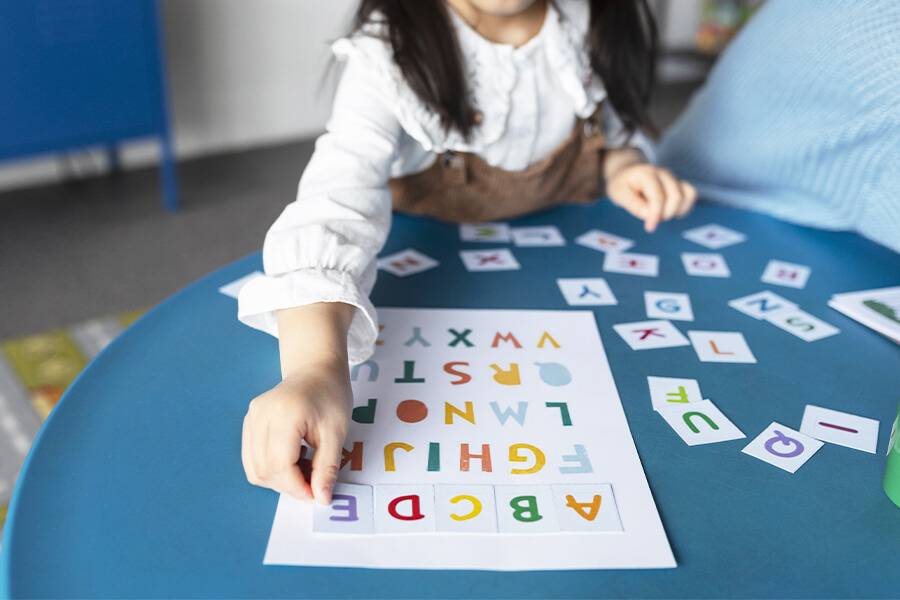
A box of individual letter cutouts in two colours: red for vowels and blue for consonants. Children use these to compose words, “encoding”, before they are able to write by hand. The physical manipulation of letters allows a child who knows phonetic sounds to compose words, sentences, and stories without the fine motor demand of handwriting. Many children produce their first “written” words months before they can hold a pencil correctly for extended writing.
Sandpaper Globe and Geography Cards
The sandpaper globe: land surfaces in sandpaper texture, water surfaces smooth, introduces the concept of continents and oceans through touch before the child can read the labels. This is language area work that crosses into cultural studies: building vocabulary for the world’s geography through physical experience.
Area 4: Mathematics
The Montessori mathematics sequence begins with quantities: physical objects that can be held, counted, arranged, and compared, before introducing the written symbols that represent them. No child in a Montessori preschool is asked to write a number before they can show what that number means with physical objects. The abstract follows the concrete; the symbol follows the quantity.

The mathematics sequence for preschool
Number Rods
Ten wooden rods painted in alternating red and blue sections, from 10cm (representing 1) to 100cm (representing 10). The child arranges them from shortest to longest, physically handling the difference in length that represents the difference in quantity. The rod for 5 is literally 5 times longer than the rod for 1. Quantity becomes physically present before it becomes symbolic.
Sandpaper Numbers
Like sandpaper letters, these are the numerals 0-9 traced in sandpaper on wooden boards. The child learns the symbol for each quantity after already knowing the quantity itself, reinforcing the association between quantity and written numeral through the same multi-sensory tracing approach.
Coloured Bead Material
Each number from 1 to 9 has its own colour, consistently used throughout the Montessori system. Bead bars: short strings of beads in each colour, are used for counting, addition, subtraction, and eventually multiplication and division. The coloured bead stair (bars arranged in a staircase from 1 to 10) gives a vivid visual representation of how quantities grow. Children often count these same beads many hundreds of times before moving to abstract notation.
Golden Beads (Decimal System Material)
Single beads (units), bars of 10 beads, flat squares of 100 beads, and large cubes of 1,000 beads. The thousand cube is literally a thousand times the size of the unit bead. Children build quantities into the thousands, exchange units for tens and tens for hundreds through physical exchange, and perform all four operations using these materials, all before abstract written arithmetic.
Spindle Box and Cards and Counters
The spindle box has 10 compartments labelled 0-9. The child places the correct number of wooden spindles in each compartment, introducing zero (the only empty compartment) concretely. Cards and counters associates written numerals with physical counters and also introduces the concept of odd and even through the arrangement of the counters below each number.
Area 5: Cultural Studies
Cultural studies in a Montessori preschool covers geography, science, botany, zoology, and the beginnings of history. Unlike the other four areas, cultural studies does not follow a single linear sequence: it is more of an ever-expanding web of interconnected content that the child encounters through physical materials, three-part cards, and direct observation.

Cultural materials in the preschool classroom
Puzzle Maps
Wooden puzzle maps of each continent, with individual country pieces that can be lifted by knobs and replaced. The child first works with the World Map (continents), then with each continent map. Each country piece can be traced, named, and associated with nomenclature cards showing flag, animal, landmark. Geography begins as a physical, tactile activity long before it involves reading or writing.
Botany and Zoology Nomenclature Cards
Three-part cards showing the parts of a flower (sepal, petal, stamen, pistil, receptacle), the parts of a leaf, the parts of different animals, and classification families. Children learn to name the parts of the natural world with scientific precision, through the same three-period lesson structure used throughout the Montessori curriculum. Classification into vertebrates and invertebrates, mammals and reptiles, begins as sorting activities with cards and miniature animal figurines.
Botany Cabinet
A wooden cabinet with drawers of leaf-shaped insets in different forms (oval, lanceolate, ovate, cordate). Like the geometric cabinet in the sensorial area, this allows children to trace the outline of each shape and feel its distinctive form. Classification of leaves by shape introduces the scientific habit of identifying by formal properties.
Science experiments and living materials
Authentic Montessori classrooms typically include living plants and sometimes animals as part of the prepared environment. Children care for them as part of practical life. Simple science observations: floating and sinking, magnets, growing seeds, are introduced as activities on the shelves alongside the other materials, following the same independent structure.
Questions Parents Ask Most Often
At what age should a child start using Montessori materials?+
The formal preschool curriculum (5 areas as described above) is designed for ages 2.5 to 6. Practical life activities: pouring, transferring, self-care, can begin well before 2.5, as soon as the child can participate meaningfully. Sensorial materials are typically introduced around age 2.5-3. Mathematics and language materials follow once the child has developed sufficient fine motor control and concentration through practical life and sensorial work. The readiness indicators are the child’s actual concentration, coordination, and interest, not their age in months.
Do I need to buy authentic Montessori materials or are cheaper alternatives fine?+
For practical life materials, you mostly already own them: real pitchers, real glasses, real brooms at child scale. For sensorial materials, quality matters more than brand: solid wood, correct proportions, and non-toxic finish are what you need. For the sandpaper letters and moveable alphabet, the proportions and colour coding (red vowels, blue consonants) matter and should be consistent with the Montessori standard. Cheap plastic versions of Montessori materials usually miss the design details that make the materials work: the weight, the texture, the precise sizing. Buy fewer things and buy them with attention to material quality rather than building a large collection of approximate versions.
My child goes to a Montessori nursery. Should I also have materials at home?+
Generally, no: or at least not classroom materials. Children who are already using the full sequence at school do not need the same materials at home, and introducing them in a different context can occasionally create confusion about how they are “supposed” to be used. What home can offer that school cannot is real practical life experience: cooking real food, caring for plants, cleaning with real tools, spending time outdoors observing nature. These extend the Montessori environment naturally without duplicating the classroom. If your child shows strong interest in a specific area at school, you can ask their teacher what they are working on and how to support it at home: the teacher will know exactly where the child is in the sequence.
How do I know if my child’s nursery is using real Montessori materials?+
You can ask to observe during the work period (a genuine Montessori nursery will welcome this), and you should be able to see all five areas represented on the shelves with materials that look like the ones described in this guide. Ask the teacher to name a specific material and explain what it is for: a trained Montessori educator will answer immediately and specifically. Red flags include: all children working on the same activity at the same time, no Montessori-named materials visible on shelves, reward systems such as sticker charts, and a teacher who cannot name materials when asked. See our full Montessori nursery checklist for a detailed visit guide.
Why the Five Areas Work Together
The five curriculum areas are not a menu to pick from. They are five aspects of a single developmental environment that works because each area feeds the others. Practical life builds the concentration that sensorial work requires. Sensorial work builds the discrimination that mathematics and language require. Language runs through all of them as children name and classify what they observe. Cultural studies gives the content: the world, living things, maps, history, to which all the other skills are applied.
What makes a Montessori preschool work is not any individual material but the coherence of the environment as a whole: every object on the shelf has a place, a purpose, a next step, and a connection to something else. When a child spends three hours moving freely through that environment, choosing their own work and returning it before choosing another, they are not playing and they are not being taught. They are building something that no worksheet can build: a sustained, self-directed, increasingly capable relationship with the world.
How Many Materials Does a Child Need at Home?
If your child attends a Montessori preschool, the answer is probably fewer than you think. They are already working with the full sequence during the school day. What is most valuable at home is not replicating classroom materials but providing complementary practical life opportunities: cooking together, caring for plants, cleaning with real tools, spending time outdoors observing and classifying natural things.
If you are homeschooling or supplementing with Montessori principles at home, a sensible order to acquire materials is practical life first (mostly items you already have), then a small sensorial set, then sandpaper letters and the moveable alphabet. You do not need everything at once. The Montessori environment works because each material is available when the child is ready for it, not because the shelf is full.
The single most important thing to get right at home
Fewer materials, accessible and organised, with uninterrupted time to use them. The quality of the Montessori environment comes from its order and intentionality, not its quantity. A shelf with five well-chosen materials that the child can access and return independently is more valuable than a room full of Montessori-branded items used without understanding. Rotate materials in and out as interests develop rather than trying to have everything present simultaneously.