
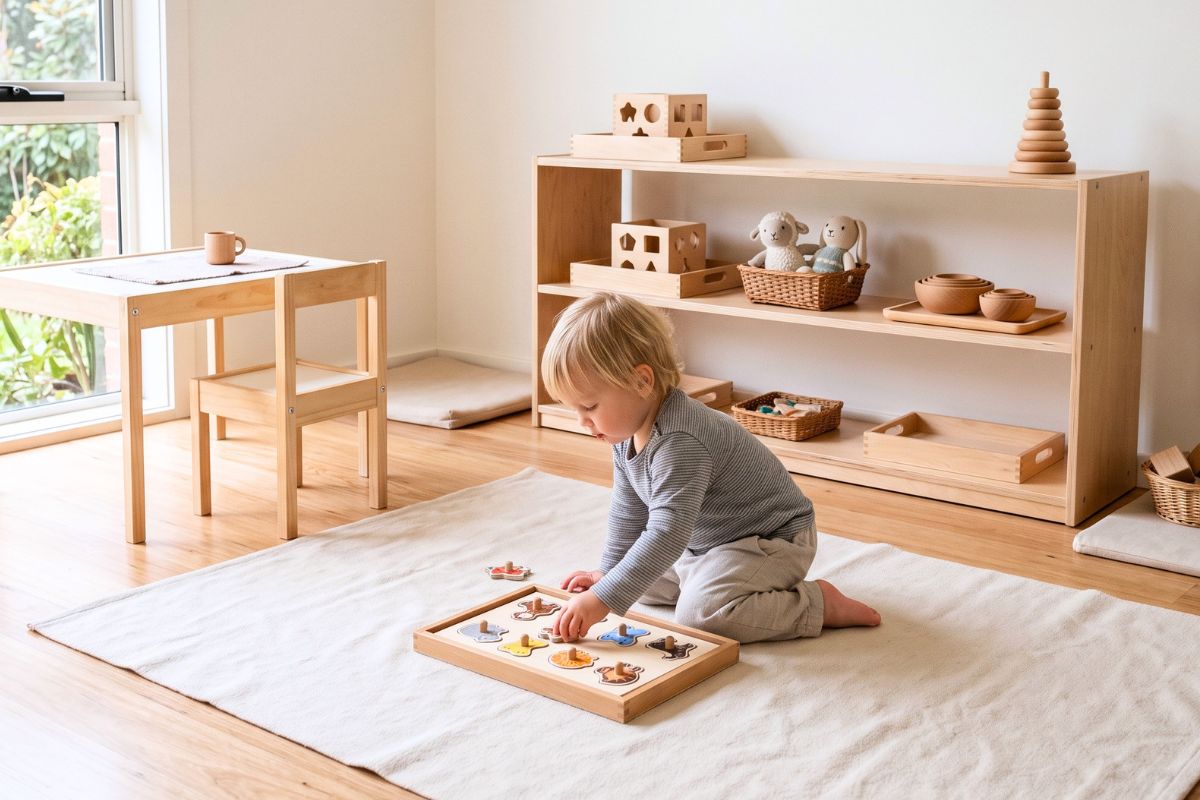
I used to think a Montessori playroom needed the right shelf, a neutral rug, and a carefully arranged row of wooden toys. Then I watched my child ignore the shelf, empty every basket onto the floor, and carry the one favorite activity into the kitchen where I was standing.
The problem was not that the room looked wrong. The problem was that I had designed a photograph instead of a system.
What the room actually needs to do
A functional Montessori playroom helps the child do four things with less adult intervention. The child sees a choice, carries it, uses it, and returns it. Everything else is optional. Start with one low shelf, one clear work area, one reading or quiet spot, and hidden storage for everything that is not currently available. Put out fewer activities than the shelf can hold. Observe what gets used before buying anything else.
Setting up for a baby?
This article is designed for mobile toddlers and preschoolers. For sleep, movement, feeding, and physical care during the first year, use the baby room guide instead.
You Do Not Need a Separate Playroom
A Montessori playroom can be a dedicated room, but it can also be six feet of wall in the living room, one side of a shared bedroom, or a shelf beside the kitchen.
Children often choose to work near the adults they trust. A beautiful room at the other end of the house can remain unused while the living-room floor becomes the real play space.
Dedicated room
Useful when supervision is easy and the child naturally chooses to spend time there.
Shared living space
Often better for younger toddlers who want proximity to the adult.
Bedroom corner
Works when sleep remains visually calm and stimulating materials stay away from the bed.
Before You Buy Furniture, Answer These Four Questions
1
Where does your child already choose to play?
Start with behavior, not floor plans. Watch where the child carries objects, where concentration lasts longest, and where cleanup currently falls apart.
2
What kind of work is happening now?
A young toddler may be carrying, posting, stacking, opening, closing, pouring, and repeating. A preschooler may need a puzzle surface, art access, language materials, building space, and longer uninterrupted work.
3
What causes the current mess?
Too many visible choices, containers that hide their contents, activities with missing pieces, deep bins, and storage that the child cannot reset are more important than the color of the walls.
4
Where will everything else go?
A low shelf only works when the toys that are not available have somewhere else to live. Plan the hidden storage before you plan the display.
The Four Zones of a Functional Montessori Playroom
You do not need four equal corners. In a small space, a rug, shelf, and wall ledge may create all four functions within one compact area.
Zone 1: The Activity Shelf
The shelf is not storage for the entire toy collection. It is a short menu of complete activities.
Each activity should be visible enough to understand, complete enough to use, and simple enough to return. Avoid stacking multiple puzzles, mixing loose pieces in one basket, or filling every open space because the shelf looks unfinished.
A practical starting range
Begin with around four to six choices for a young toddler and roughly six to eight for an older toddler or preschooler. These are not official Montessori rules. They are starting points. Reduce the number when the child dumps, wanders, or cannot restore the shelf.
Include a mix of functions rather than eight versions of the same toy.
- One fine-motor activity
- One language or matching activity
- One construction or open-ended material
- One Practical Life task
- One puzzle or problem-solving activity
- A small number of front-facing books
Zone 2: Floor and Table Work
The child needs somewhere to use the activity after choosing it.
A small work mat creates a visible boundary on the floor. A child-sized table provides a stable surface for puzzles, art, matching, and Practical Life. You do not need both immediately. Choose the surface that matches the work your child already prefers.
Why the empty floor matters
A room full of furniture leaves no place to carry a tray, roll out a mat, build a tower, or move around another child’s work. Empty space is part of the setup.
Zone 3: Movement
Movement does not require a full indoor gym. It may mean a clear path, a balance board, a low climbing element appropriate for the child, or enough room for music and carrying work.
Keep movement equipment away from shelves holding delicate or incomplete materials. If one child is climbing while another is building, the room needs enough separation to protect both activities.
Zone 4: Reading, Creativity, or Practical Life
The fourth zone should respond to your child, not to a standard playroom checklist.
Choose one of these based on current use.
- A reading corner with five to eight visible books
- An art area with only the supplies the child can manage
- A Practical Life station for wiping, flower arranging, or simple food preparation
- A quiet space for a child who needs to step away from noise
You can change this zone later. A playroom is an environment under observation, not a permanent installation.
The Hidden Half of the Playroom: Rotation Storage
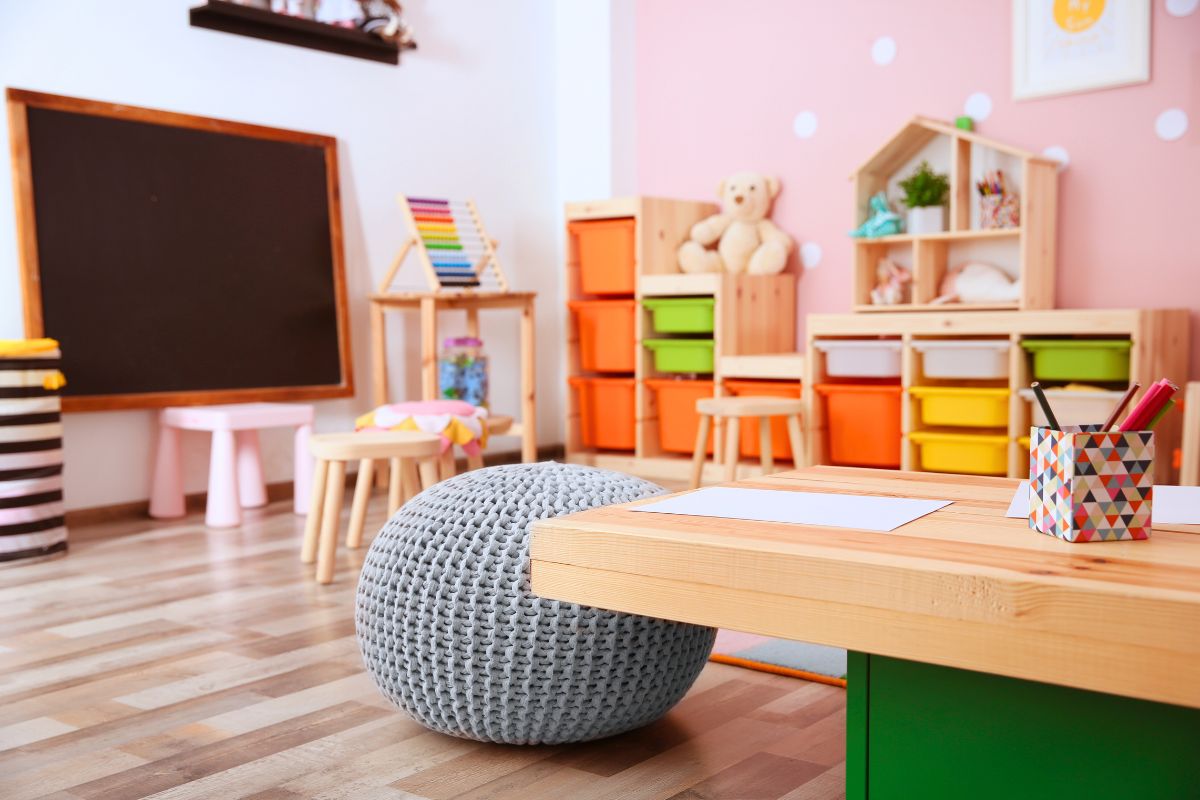
Most playroom photographs show the shelf. They do not show the closet, cabinet, or opaque boxes that make the shelf possible.
Out-of-rotation materials should be
- Out of the child’s immediate sight
- Grouped by function or developmental stage
- Stored as complete sets
- Easy for the adult to review
- Protected from younger siblings when small pieces are involved
You do not need to rotate everything every Friday. Change the environment when observation gives you a reason.
How to Set Up the Shelf by Age
Around 18 to 24 Months
Prioritize carrying, posting, opening, closing, stacking, simple matching, first puzzles, and Practical Life. Use large, safe pieces and stable containers.
Around 2 to 3 Years
Add more exact pouring, sorting, language baskets, simple art, knob puzzles, threading with appropriately large pieces, and activities that have a clear beginning and end.
Around 3 to 6 Years
The shelf can support longer sequences, early language and math, cutting, gluing, classification, care of the environment, and more complex construction. The child may also need a more defined table area.
Do not stock the shelf for the age printed on the box
Choose according to what the child is trying to do. Age ranges help you filter unsafe or unrealistic options, but observation decides what belongs in the room.
Small-Space Montessori Playroom
In a small home, your best setup may be one shelf, one rug, one book ledge, and one closed cabinet.
Use the wall vertically for adult-controlled storage, but keep the child’s active choices low. A rug can define the play area without adding furniture. A table can double as an art, puzzle, and snack surface. A basket can hold the rolled work mat when the floor needs to return to adult use.
Do not force a full playroom into a shared room. The goal is not to fit every zone. The goal is to make the available choices understandable.
Playroom for Siblings of Different Ages
A shared shelf should not give a younger child unrestricted access to small parts simply because the older child uses them.
Create three levels of access.
Shared zone
Safe materials both children can use independently.
Older-child zone
Small parts or delicate work stored higher or used with supervision.
Movement zone
Enough separation that active play does not destroy another child’s work.
Eight Playroom Mistakes That Create More Work
- Filling every shelf opening. Empty space makes choices legible.
- Using deep toy bins as the main presentation. The child has to empty them to see what exists.
- Rotating on a rigid calendar. Observation should trigger change.
- Keeping incomplete activities available. Missing pieces create frustration.
- Putting all art supplies within reach at once. Independence depends on manageable limits.
- Buying for the next stage. Advanced materials often become shelf decoration.
- Ignoring adult storage. The visible shelf cannot stay calm without hidden storage.
- Expecting independent cleanup without teaching it. Returning work is a presentation, not an instinct.
The Five-Minute Daily Reset
The playroom should not require a full redesign every evening.
- Return complete activities to their place
- Remove broken or incomplete work
- Put loose pieces into the correct tray or basket
- Leave the repeated favorite available
- Change nothing else unless observation gives you a reason
Invite the child to participate, but do not turn the reset into a nightly conflict. Model the sequence, reduce the amount available, and make every destination obvious.
What the Adult Does After the Room Is Finished
The adult’s work is not to constantly suggest activities. It is to observe.
Notice
- Which objects are chosen without prompting
- Where concentration breaks
- Whether the child can carry and restore the activity
- Which actions repeat across different toys
- Whether the room is located where the child actually wants to be
A shelf cannot compensate for an adult who interrupts every choice. It also cannot compensate for an environment that asks the child to manage more than their current skills allow.
Minimal Playroom Checklist
- One stable low shelf
- Four to eight complete choices, adjusted after observation
- One clear floor or table work surface
- A small book display
- Hidden storage for out-of-rotation items
- Furniture anchored where necessary
- Safe circulation and movement space
- One obvious place for every available item
Frequently Asked Questions
How many toys should be in a Montessori playroom?+
There is no universal official number. Start with fewer choices than you think you need, often four to six for a young toddler and six to eight for an older toddler or preschooler. Adjust according to use, dumping, concentration, and the child’s ability to restore the shelf.
Do all toys need to be wooden?+
No. Material quality, purpose, safety, and the action required from the child matter more than a wooden aesthetic. A useful metal pitcher or fabric dressing frame may fit the environment better than a decorative wooden toy.
How often should I rotate toys?+
Rotate when the environment stops working. Leave repeated favorites. Remove items that are consistently ignored, too difficult, incomplete, or creating indiscriminate dumping.
Can the playroom be in the living room?+
Yes. For many toddlers, a shared room works better because the child wants to be near the adult. Use a shelf, rug, book ledge, and closed rotation storage to define the area.
What is the difference between a Montessori baby room and a playroom?+
A baby room supports sleep, movement, feeding, and physical care during the first year. A playroom supports independent choice, sustained activity, movement, reading, creativity, and cleanup during the toddler and preschool years.
The Room Is Working When the Child Is Working
Do not judge the setup by how calm it looks before the child enters. Judge it by whether the child can choose, concentrate, move, and restore with less help than before.