

The Montessori approach to multiplication is not a single activity or a clever game. It is a sequence of materials that builds over several years, starting in preschool with skip counting and arriving at multi-digit multiplication by age 7 or 8. Each material does something specific and concrete before the next one can make sense.
This guide walks through that sequence in order: what each material is, exactly how a child uses it, and what it is preparing the child to understand next. If you are setting up at home or trying to understand what your child is doing in the classroom, this is the explanation most resources skip.
The sequence at a glance
- Age 3-5: Golden Beads: First encounter with multiplication as repeated addition using concrete quantities
- Age 4-6: Bead Chains (skip counting): Counting by 2s, 5s, 10s, the foundation of times table patterns
- Age 5-6: Multiplication Bead Board: Learning all multiplication facts from 1×1 to 10×10 through arrays of red beads
- Age 6-7: Working Charts: Transitioning from building answers to recalling them, with self-correction built in
- Age 6-7: Stamp Game: Multiplication of larger numbers using color-coded tiles representing place values
- Age 7-8: Checkerboard: Multi-digit multiplication up to billions, using beads on a color-coded grid
Why Multiplication Starts at Age 3
In most conventional education, multiplication is introduced around age 7 or 8, usually as a new operation to memorize. In Montessori, children encounter multiplication concepts from around age 3 or 4 through work with the golden bead material, without anyone calling it “multiplication.”
The golden bead material represents the decimal system concretely: a single golden bead is 1, a bar of 10 beads strung together is 10, a flat square of 100 beads is 100, and a large cube of 1,000 beads is 1,000. Children learn to build quantities, exchange units for tens, and eventually perform all four operations using these physical objects. When a teacher asks a child to “bring me three bars of ten,” the child is handling 30, experiencing place value and multiplicative structure through their hands before they have any formal name for what they are doing.
This early concrete foundation is what allows the later multiplication materials to work. A child who has spent months building and exchanging quantities with the golden beads arrives at the multiplication bead board with an intuitive sense of what multiplication means physically, not just symbolically.
Step 1: Skip Counting with Bead Chains (Age 4-6)
The bead chains are the bridge between counting and multiplication tables. Each chain is a string of color-coded bead bars. The short bead chains represent squares: the chain of 5 has 5 bars of 5 beads each (25 beads total). The long bead chains represent cubes: the chain of 5 has 25 bars of 5 beads each (125 beads). Each number has its own color throughout the Montessori system, so a 5-chain is always red, a 3-chain is always pink, and so on.
What the child actually does with bead chains
The child unrolls a chain (often across the floor for the longer ones), counts each bead, and places a small numbered arrow at each interval. For the chain of 5, arrows go at bead 5, 10, 15, 20, and 25. The child is counting: “5, 10, 15, 20, 25”, which is the 5 times table read forward. When they fold the short chain back into a square, they see with their hands that 5×5 = 25 is literally a square shape. Squaring is not abstract: it is visible.
Children often become absorbed in this work for a very long time. A child laying the 100 chain and marking every tenth bead is placing arrows at 10, 20, 30 … 100. By the time they finish, they have physically experienced the pattern of the 10 times table with their whole body. This is not drilling. The child chose this work.
Skip counting with bead chains is introduced around ages 4-5 and continues into early elementary. The same chains later serve a different purpose: in upper elementary, children use the long chains to work with cubing (the long chain of 3 has 27 beads, which is 3³). The material grows with the child.
Step 2: The Multiplication Bead Board (Age 5-6)
This is the most widely recognized Montessori multiplication material and the one where children work through the full times tables concretely. It is a square wooden board with 100 holes arranged in a 10×10 grid, numbers 1-10 printed along the top, and a slot on the left side for a small number card. The child uses 100 small red beads and a red disc (a moveable marker).

Exactly how a lesson with the bead board works
Take the number 4 card and slide it into the slot on the left side. The slot now shows “4.” The child has a set of equation cards (1×4=, 2×4=, 3×4=…) and a recording sheet.
1×4: Move the red disc to the 1 at the top. Place 4 red beads in the first column (4 beads in a vertical line). Count the beads: 4. Write 4 on the recording sheet.
2×4: Move the red disc to the 2. Add 4 more beads in the second column, next to the first. Count all the beads on the board: 8. Write 8. The child can count from where they left off rather than starting from 1, which subtly introduces the efficiency of multiplication over repeated addition.
Continuing: Each step moves the disc one column right and adds another row of 4 beads. By the time the disc reaches 10, the board shows 10 columns of 4 beads each: 40 beads in a visible array. The child has built, counted, and recorded 4×1 through 4×10. The entire times table of 4 is on the board in front of them.
Then the child selects a different number card and works through another table. Over many sessions, they work through all 10 tables. They are not memorizing by repetition of abstract symbols: they are building arrays and counting the result, every time.
The control of error in this material is the recording sheet: if the child’s answers are inconsistent with what they build, they can see the discrepancy without the teacher pointing it out. The board is introduced around age 5-6 and is typically revisited many times before the child moves to the charts.
Step 3: Multiplication Working Charts (Age 6-7)
After working extensively with the bead board, children move to the multiplication charts. This is where the transition from building answers to recalling them begins: the first step toward abstract memorization, but still with a concrete support.
The chart sequence
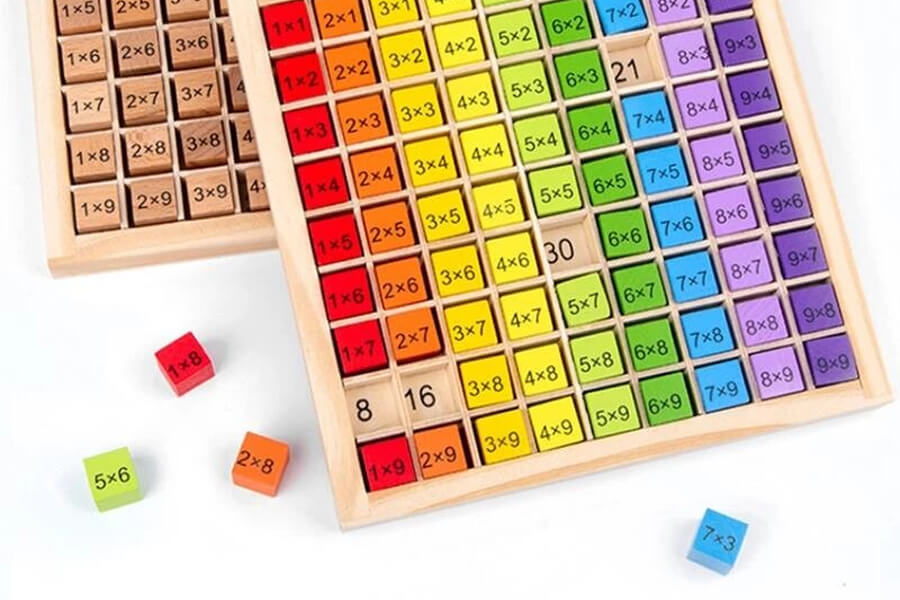
Control chart: The complete multiplication table from 1×1 to 10×10, printed in full. The child uses this to check their own work. It is always visible but is used for verification, not copying.
Working charts 1-3: Charts with progressively less information shown. The child completes the missing products by retrieving them from memory, then checks against the control chart. The scaffold decreases with each chart until the child is working from memory alone.
There is also a box of wooden product chips. The child draws an equation card, determines the answer, finds the matching chip, and places it on the correct square of the chart. The physical act of placing the chip gives the answer one more concrete anchor before it becomes purely abstract.
The working charts can be introduced around the same time as the bead board, or shortly after. Many children work with both simultaneously, depending on which table they are consolidating at a given time.
Step 4: The Stamp Game for Multiplication (Age 6-7)
The stamp game moves multiplication from single-digit tables to larger numbers. The material is a box of small wooden tiles: green tiles stamped with “1,” blue tiles stamped with “10,” red tiles stamped with “100,” and green tiles stamped with “1000”, the Montessori hierarchical color system that the child has already encountered with the golden beads.
Multiplication with the stamp game: a concrete example
For 234 × 3: the child lays out 234 as stamps (2 red hundreds, 3 blue tens, 4 green units). Then they lay out that quantity three times in parallel rows. They end up with 6 red hundreds, 9 blue tens, and 12 green units. When they count the units and see 12, they must exchange: 12 units becomes 1 ten and 2 units. They physically move the tiles to complete the exchange. The process of exchanging with tiles makes carrying visible and physical.
This is called “static” multiplication when no exchanging is needed and “dynamic” multiplication when it is. Children work with static problems first, then dynamic ones. The stamp game makes the structure of multi-digit multiplication transparent in a way that abstract column arithmetic does not.
The stamp game is typically introduced around age 6-7 and is also the material through which children learn long multiplication before the checkerboard. Some children begin stamp game work in the primary classroom (ages 3-6); others begin it in their first year of elementary.
Step 5: The Multiplication Checkerboard (Age 7-8)
The checkerboard is the most advanced multiplication material in the Montessori elementary sequence. It is a large board or mat with 9 columns and 4 rows of squares, alternating between green, blue, and red, the same hierarchical colors as every other Montessori math material. Green squares represent units, blue squares represent tens, red squares represent hundreds, and this pattern repeats across three number families: simple numbers, thousands, and millions. The board can be used to work multiplication problems with products in the billions.
How the checkerboard works: 34 × 23
The child represents the multiplicand (34) along the bottom of the board using white number tiles: a 4-tile in the first green (units) column and a 3-tile in the first blue (tens) column. The multiplier (23) is placed along the right side using grey tiles: a 3-tile in the first green (units) row and a 2-tile in the first blue (tens) row.
First row (multiplying by 3 units): The child places bead bars at each intersection of the first row with each column of the multiplicand. At the intersection of the units column and the units row, they place a 4×3 = 12 result, which means a 2-bead bar in the green square and a 1-bead bar carried to the blue square. At the intersection of the tens column and units row, they place 3×3 = 9. They work across the row, then slide all bead bars diagonally down to the bottom of the board to collect the partial product.
Second row (multiplying by 2 tens): The child works the second row in the same way, then slides these bead bars diagonally down as well, but one column to the left, because this is multiplication by a tens digit. The diagonal movement automatically accounts for the place value shift.
When both rows are complete, the child adds up the bead bars in each column of the board, exchanges as necessary, and reads off the final product. The material is self-correcting: the place value of the square tells the child exactly where each bead bar belongs, and if a bead bar is in the wrong column, the child can investigate why.
What the checkerboard reveals is that multi-digit multiplication is not a trick or an algorithm: it is what happens when every digit of one number is multiplied by every digit of the other, and the partial products are placed at the correct place value and added together. Children who understand this with the checkerboard are genuinely comprehending long multiplication, not memorizing steps. The checkerboard is typically introduced around age 7-8.
The Pattern Across All Materials
Every material in this sequence shares three features that are not coincidental.
Adapting the Approach at Home
You do not need a complete Montessori math cabinet to use these principles at home. The underlying approach: concrete before abstract, child-paced, self-correcting: it can be applied with simpler materials.
Start with skip counting using any objects
Stones, buttons, pasta: any countable object in uniform sets works for the foundational skip counting work. Group 8 sets of 5 buttons and count: 5, 10, 15, 20, 25, 30, 35, 40. The child who has done this with their hands understands why 8×5 = 40 before they have memorized it. Use a number line marked at intervals of 5 for the same purpose.
Build arrays before writing equations
Before writing 4×6 = 24, build it: 4 rows of 6 objects. Count the total. Rearrange to 6 rows of 4. Count again: same result. This is the commutative property of multiplication, experienced rather than stated as a rule. Only after the child has built and counted the array should you write the equation next to it.
Use color coding consistently
If you are introducing place value alongside multiplication, borrow the Montessori color system: always use green for units, blue for tens, red for hundreds when writing multi-digit problems. This small consistency significantly reduces the cognitive load of multi-digit multiplication because the child does not have to also remember which column means what.
Do not rush to flashcards
Flashcard drilling of multiplication facts works, but only after a child has built the conceptual foundation. A child who understands that 7×8 = 56 because they have counted 7 rows of 8 objects will retain that fact far more durably than a child who memorized it without any physical referent. The Montessori materials build the referent first, then the memorization follows naturally through repeated use. Rushing to abstract drill before the concrete work is done produces children who can recite facts but cannot apply them flexibly.
What “Knowing Your Times Tables” Means in Montessori
A child who has worked through this full sequence does not simply know that 6×7 = 42. They know it in the way that comes from having placed 6 columns of 7 red beads on a bead board, from having counted 7 intervals on a bead chain in groups of 6, and from having recalled it repeatedly from a working chart while checking against the control. The fact has multiple physical memories attached to it, not just an auditory one from chanting.
This matters when the child encounters a problem they have not memorized: they have the mental model to reconstruct the answer rather than simply drawing a blank. And when they arrive at multi-digit multiplication, the checkerboard has already made the underlying structure visible, so the abstract algorithm makes sense rather than being an arbitrary procedure to follow.
Questions Parents Ask Most Often
My child is 7 and still doesn’t know their times tables. Should I be worried?+
In Montessori, multiplication facts are not expected to be memorized by age 7. A child at this age is typically still working with the bead board and the working charts, building fluency through repeated concrete work. Abstract memorization comes after, usually between ages 7-9. If your child has been using the bead board and can construct a multiplication table correctly with the material, they understand multiplication. Memorization of the facts follows; it is not a prerequisite for that understanding.
Can I buy a multiplication bead board for home use?+
Yes, and it is one of the most worthwhile Montessori math purchases for home use. It is relatively compact, inexpensive compared to other Montessori materials, and can be used independently by a child who has been shown the basic technique once. Look for one that includes the sum cards and recording sheets. Etsy has some good wooden versions from small makers; Montessori-specialist stores carry complete sets with all the components.
Is it bad that my child’s Montessori school doesn’t use all these materials?+
Not necessarily: the sequence above reflects a complete Montessori implementation, and not all schools follow it identically. What matters is whether the underlying principles are present: concrete experience before abstract notation, child-paced progression, and materials that allow self-correction. Some schools use the full sequence; others prioritize certain materials over others based on their approach and the child’s needs. If you have questions about what your child’s school uses, a conversation with the teacher about where your child is in the math progression is always worthwhile.
At what age should I start introducing multiplication at home?+
If your child is counting reliably and has some experience with adding quantities concretely, informal skip counting can start around age 4-5. Group objects, count them, group the same objects differently, count again. The word “multiplication” does not need to appear: you are building the physical intuition. The bead board is appropriate from around age 5-6 once the child understands what multiplication represents. Follow the child’s interest and readiness rather than a strict age cutoff.
Concrete First, Abstract Later
The Montessori multiplication sequence is not about making times tables “fun” through games and activities. It is about building a genuine mathematical understanding of what multiplication is, using materials that make the structure visible before it becomes abstract. The games come from the child’s intrinsic engagement with the materials at each stage: because when you are physically building something and watching the pattern emerge in your hands, you do not need external motivation to keep going.