When parents start researching Montessori schools, they tend to find one of two things: breathless praise from Montessori advocates, or sharp criticism from people who think it is overpriced and underscrutinised. Neither is particularly useful if you are trying to make an actual decision about your child’s education.
This article attempts something different. It lays out the genuine, research-supported advantages of Montessori education, and then honestly addresses the limitations, because any approach that has only advantages should make you suspicious.
The research bottom line
- A 2023 systematic review of 32 studies found Montessori shows meaningful positive impact on academic and non-academic outcomes relative to traditional education
- Effects are strongest in high-fidelity implementation: a school that calls itself Montessori but doesn’t follow the method shows weaker results
- The advantages are real but not universal: Montessori works better for some children than others
- Adults who attended Montessori schools as children report higher wellbeing decades later

The 8 Genuine Advantages: What the Research Actually Shows
1. Stronger Executive Function
The most consistent finding across all Montessori research
Executive function refers to the cluster of cognitive capacities that allow us to plan, focus attention, remember instructions, and manage competing demands. It includes working memory, cognitive flexibility, and inhibitory control. It is one of the strongest predictors of academic and life success, more predictive, some researchers argue, than IQ.
The lottery-based longitudinal study by Lillard et al. (2017) found significantly stronger executive function development in Montessori children compared to matched controls. The proposed mechanism is structural: in a Montessori environment, children make choices, manage their own time, complete tasks from beginning to end, and return materials to their place, dozens of times per day. Every work cycle is a self-regulation exercise. The benefit is not taught directly. It accumulates through the structure of the environment.
2. Mastery Orientation Over Performance Orientation
Montessori children choose harder tasks, without being asked to
In the same Lillard et al. (2017) study, children were given a choice between an easier and a harder version of a task. Montessori children chose the harder version significantly more often than controls. They also rated their experience of schoolwork as more enjoyable.
This matters because intrinsic motivation, the drive to engage with challenges because they are interesting rather than because they lead to external reward, is one of the strongest long-term predictors of academic persistence and creative achievement. In a Montessori environment, there are no grades, no sticker charts, no gold stars. The work itself, and the internal satisfaction of completing it, is the reward. Children who have spent years in this environment appear to internalise this orientation rather than waiting for external validation.
3. Early Academic Advantage That Equalises Across Income Groups
One of the only education models to genuinely close the achievement gap
The Lillard et al. (2017) lottery-based study, which is methodologically rigorous precisely because it removed the selection bias of parents choosing Montessori, found that Montessori preschool children showed significantly better gains in reading, math, and vocabulary compared to controls. Critically, this advantage was observed across income groups. Lower-income children in Montessori showed comparable gains to higher-income children, a result that is nearly absent in the research literature on other educational approaches.
The mechanism appears to be the self-paced, materials-based learning structure: a child who needs more time with a concept gets it without stigma. A child who is ready to advance moves forward without waiting. The prepared environment serves each child’s actual developmental moment rather than an average.
4. Better Social Skills and Prosocial Behaviour
Mixed-age classrooms produce natural mentors and helpers
Montessori classrooms group children across a three-year age span. A six-year-old who was the youngest child two years ago is now one of the oldest, mentoring the children who were where they once were. This role shift happens naturally and repeatedly. Research shows Montessori children score higher on measures of prosocial behaviour, fairness, and social problem-solving than age-matched peers in conventional classrooms.
The 2017 Lillard et al. study found significantly better social problem-solving in Montessori children. The absence of competition for teacher approval (there are no grades, no public rankings) removes a key driver of social anxiety and status-seeking behaviour that is common in conventional classrooms. Children in Montessori environments tend to cooperate rather than compete, in part because the environment offers no incentive for competition.
5. Alignment With How the Developing Brain Actually Works
The sensitive periods and the absorbent mind are now confirmed by neuroscience
Montessori developed her method from direct observation of children in 1907, without access to brain imaging or modern developmental neuroscience. The 2020 review by Fabri and Fortuna in The Neuroscientist confirmed that her observations aligned precisely with what we now understand about brain plasticity, sensitive periods, and experience-dependent neural development.
In practical terms: the Montessori curriculum introduces concepts during the developmental windows when the brain is most receptive to them. Sandpaper letters during the sensitive period for language and writing (ages 3-5). Mathematical operations during the number sensitive period (4-6). This is not coincidence: it is the result of Montessori’s systematic observation of when children were naturally drawn to particular types of work. The neuroscience retroactively confirms what she mapped empirically.
6. Concrete Understanding Before Abstract Notation
Children build the concept before they encounter the symbol
In conventional education, children are often introduced to mathematical notation (the symbol “4”, the operation “+”) before they have a firm concrete understanding of what these symbols represent. The result is that many children learn to perform operations they do not understand: they can follow the procedure without grasping the concept.
The Montessori mathematics sequence is deliberately designed in the opposite direction. A child works with golden bead material, physically grouping units, tens, hundreds, and thousands, before the abstract symbols for these quantities are introduced. Multiplication is experienced physically through skip counting with bead chains before it is written as a×b. This concrete-to-abstract progression means that by the time abstraction is introduced, the concept is already embodied in the child’s experience. Abstract notation becomes a language for something they already understand, not a procedure for something they do not.
7. Long-Term Wellbeing, Not Just Academic Performance
The 2021 adult wellbeing study is one of the most striking findings in educational research
Lillard et al. (2021) conducted a study of adults who had attended Montessori schools as children and compared their self-reported wellbeing to matched controls. The results were significant: adults who had attended Montessori reported higher wellbeing across multiple dimensions. Critically, there was a dose-response relationship: the more years of Montessori the person had attended, the higher their adult wellbeing scores.
This is a rare finding in educational research, where most studies track outcomes only through school age. The suggestion that an educational approach might have measurable effects on adult wellbeing decades later is significant. The proposed mechanism is that Montessori develops autonomy, intrinsic motivation, and self-efficacy: characteristics that contribute to wellbeing over a lifetime rather than academic performance over a school year.
8. The Prepared Environment as the Third Teacher
An environment that teaches without demanding
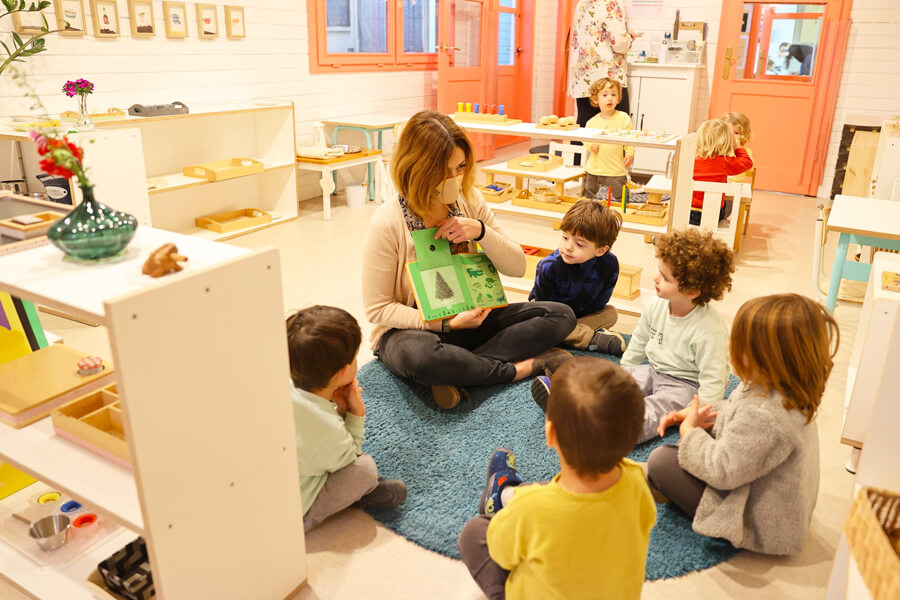
In Montessori pedagogy, the environment is designed to be a teacher in its own right. Materials are arranged in a precise developmental sequence, from simple to complex, concrete to abstract. Each material is self-correcting: it tells the child when they have made an error without requiring adult intervention. Everything is at child height and child scale, making independence not just encouraged but structurally possible.
The result is an environment in which the child can work independently for extended periods without waiting for teacher instruction or feedback. This sustained independent activity builds concentration, self-reliance, and the capacity for deep focus that is increasingly rare in both education and adult life. The 2025 PNAS randomised controlled trial found that this effect scales: larger Montessori classes produced better outcomes because more peers created more peer tutoring and modelling, not worse outcomes as conventional wisdom would predict.
The Honest Limitations: What Montessori Does Not Do Well
Any guide that lists advantages without limitations is a brochure, not an analysis. These are the genuine limitations of Montessori education that parents should weigh carefully.
Quality is wildly variable
The term “Montessori” is not legally protected. Any school can use it. A high-fidelity Montessori school with trained teachers, authentic materials, and uninterrupted three-hour work periods produces the outcomes described above. A school that uses the label but runs 30-minute activity blocks with conventional instruction does not. The research effects depend entirely on implementation quality.
Cost and accessibility
Most quality Montessori schools are private with tuition that places them beyond many families. Public Montessori programmes exist but vary considerably in quality and availability. The Lillard et al. lottery studies specifically examined public Montessori, which is more accessible but may have lower fidelity than private schools with more resources.
Not right for every child
Children who need more external structure, clear adult direction, and explicit feedback may not thrive in a Montessori environment. Children with certain learning profiles, including some children with ADHD and some with autism, may find the open, self-directed structure confusing or anxiety-provoking. The child-led model requires the child to generate internal motivation that some children genuinely cannot sustain without more scaffolding.
Limited emphasis on collaborative group projects
The individual work cycle that builds concentration and self-direction does so at the partial expense of extended collaborative group projects. While Montessori children develop strong prosocial skills, they have less experience with the specific kind of structured group work, shared deadlines, division of labour, group accountability, that is characteristic of school and workplace settings from secondary education onward.
Transition to conventional schooling requires adjustment
Children who move from a Montessori environment to a conventional school, particularly if the transition happens in the middle of primary school rather than at a natural endpoint, need time to adjust to teacher-directed instruction, assigned seating, and external evaluation. Most manage this transition well, but some find the shift from autonomy to compliance genuinely difficult. This should factor into planning if you are not intending to keep your child in Montessori through elementary.
Research gaps remain
Despite a growing evidence base, most Montessori studies still have methodological limitations: self-selected samples, short follow-up periods, difficulty measuring what Montessori values most. The lottery-based RCTs are significant precisely because they are rare. More rigorous long-term research is still needed, particularly on Montessori outcomes at secondary and tertiary level.
How to Tell If a Montessori School Is Actually Montessori
Given that the label is unprotected, here is what to look for when visiting a school that calls itself Montessori. These are the observable markers of genuine implementation.
Parents Ask Most Often
Do Montessori children do well when they transition to conventional school?+
Generally yes, and often very well academically. The executive function, reading, and math advantages that Montessori children develop tend to carry forward. The adjustment challenge is behavioural rather than academic: moving from an environment where you choose your work to one where a teacher assigns it requires some adaptation. Most children manage this within a few weeks. Children who transition at natural transition points (end of primary Montessori, start of conventional middle school) tend to have an easier adjustment than those who move mid-programme.
Is Montessori only for gifted children?+
No, and this is one of the most important findings in the research. The achievement gap-closing result from the Lillard et al. lottery study is particularly compelling on this point: Montessori produced comparable outcomes for lower-income children and higher-income children, precisely because the self-paced structure is indifferent to starting point. A child who enters behind their peers moves forward from where they are. A child who enters ahead also moves forward from where they are. The environment serves both without the stigma of tracking or remedial grouping.
Do Montessori children miss out on play?+
This question reflects a misunderstanding of what Montessori work is. Montessori called children’s activity “work” not to suggest it is joyless, but to signal that it is purposeful, and she observed that children experience purposeful activity as play. A five-year-old who spends 45 minutes carefully pouring water between containers is not being made to work. They are deeply, happily, voluntarily absorbed in an activity. The Montessori concern is about a different kind of play: fantasy play, open-ended imaginative play, and dramatic play are less central in Montessori than in Waldorf or play-based preschools. If this matters to you specifically, it is worth weighing.
How do I know if my child will thrive in Montessori?+
The children who tend to thrive most readily are those who are naturally curious, who persist with self-chosen tasks, who handle independence without becoming anxious, and who can tolerate ambiguity (there is no teacher telling them what to do next). Children who need a lot of external structure, who become dysregulated without adult scaffolding, or who require explicit instruction before attempting tasks may find the environment initially challenging. This does not mean they cannot succeed in Montessori, many do with time, but it may require more patience during the settling period. The best indicator is a trial period with careful observation.
The Case Is Solid: With Caveats
The research case for Montessori education is, by the standards of educational research, unusually strong. The advantages in executive function, intrinsic motivation, academic outcomes, and long-term wellbeing are supported by genuine evidence including randomised controlled trials, something most educational approaches cannot claim.
The caveats are real too. Quality varies enormously. Cost limits access. Not every child will flourish in the self-directed model. And the research, while strong, still has gaps. What the evidence supports is this: for many children, in a genuinely implemented Montessori environment, the outcomes are meaningfully better than conventional alternatives. Whether it is right for your specific child, in your specific city, in the specific school available to you, requires more than reading this article. It requires visiting, observing, and trusting your knowledge of your own child.
Scientific References
Randolph, J.J. et al. (2023). Montessori education’s impact on academic and nonacademic outcomes: A systematic review. Campbell Systematic Reviews, 19(3), e1330.
32 studies, 132,249 data points. Meaningful positive impact on academic and nonacademic outcomes. Effects strongest in high-fidelity implementation.
Lillard, A.S., Heise, M.J., Richey, E.M., Tong, X., Hart, A. & Bray, P.M. (2017). Montessori preschool elevates and equalizes child outcomes: A longitudinal study. Frontiers in Psychology, 8, 1783.
Lottery-based RCT. Significantly better gains in executive function, reading, math, vocabulary, and social problem-solving. Closed the achievement gap between lower- and higher-income children.
Lillard, A.S., Meyer, M.J., Vasc, D. & Fukuda, E. (2021). An association between Montessori education in childhood and adult wellbeing. Frontiers in Psychology, 12, 721943.
Adults who attended Montessori as children reported significantly higher wellbeing. Dose-response relationship: more years of Montessori correlated with higher adult wellbeing scores.
Marshall, C. (2017). Montessori education: a review of the evidence base. npj Science of Learning, 2, 11.
Systematic review of Montessori evidence. Confirms the teacher’s role as observer rather than director, and documents that embodied hands-on learning aligns with neuroscientific findings on motor-cognitive development links.
Fabri, M. & Fortuna, S. (2020). Maria Montessori and Neuroscience: The Trailblazing Insights of an Exceptional Mind. The Neuroscientist, 26(5-6), 464-479.
Documents the convergence between Montessori’s developmental observations and modern neuroscience: sensitive periods, brain plasticity windows, movement-cognition links, and language acquisition mechanisms all confirmed by imaging research her era could not perform.
Lillard, A.S. et al. (2025). A national randomized controlled trial of the impact of public Montessori preschool. PNAS.
National RCT. Larger class sizes in public Montessori produced better outcomes, consistent with the social environment principle. Confirms that the prepared environment and peer modelling scale positively.