By around two or three, many children speak in short sentences. Nobody taught them grammar or sat them down with rules. They simply lived among people who spoke a language and absorbed it, effortlessly and completely, in a way that adult learners of a new language rarely manage, however many hours they study.
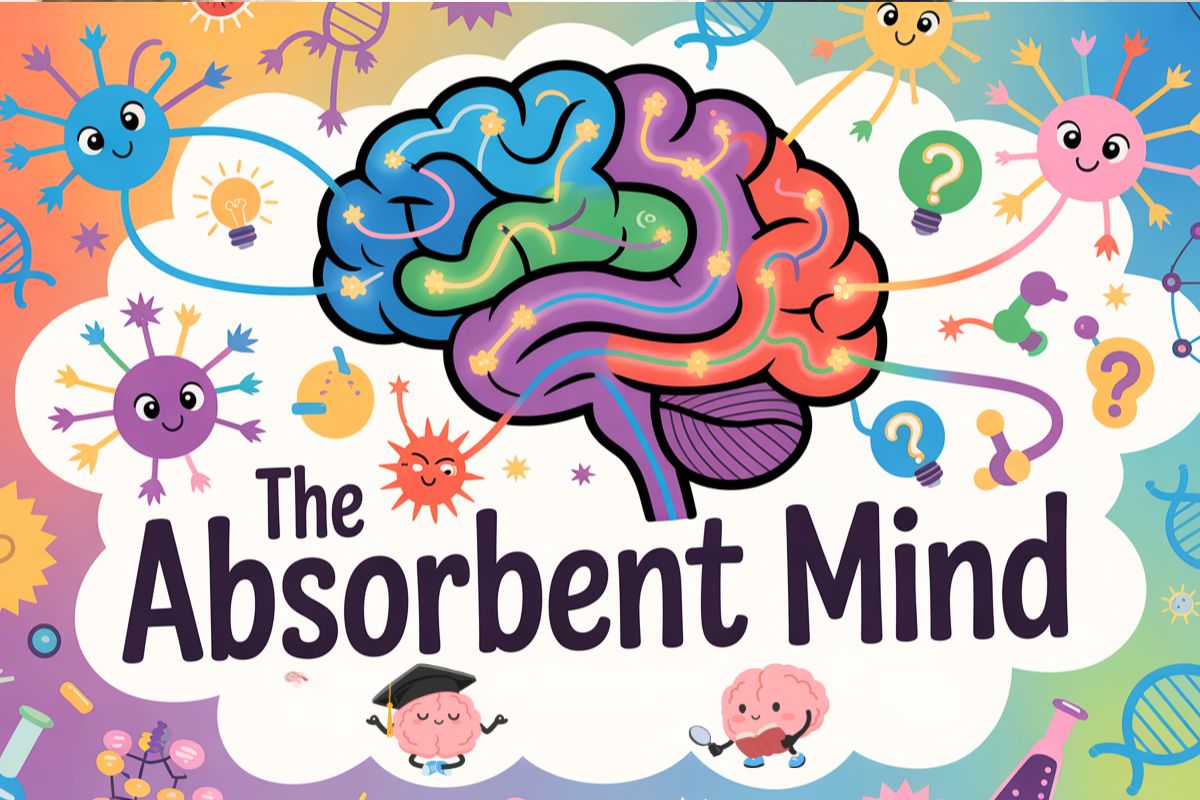
Maria Montessori called this the absorbent mind. It is one of the most important concepts in her work. It is also one of the most misunderstood. It gets reduced to the “sponge brain” idea, which is true as far as it goes, but misses what matters most: why the brain works this way, and what that means for the environments we create around young children.
What this article covers
- What Montessori actually meant by the absorbent mind, and why it was radical in 1949
- The neuroscience: synaptogenesis, synaptic pruning, and the “use it or lose it” principle
- The two phases and the biological mechanism behind each one
- How the absorbent mind connects to sensitive periods
- What actually enriches the brain during this window, and what quietly impoverishes it
- The most common misunderstandings, answered directly
What Montessori Observed: Why It Was Radical
In 1949, when Maria Montessori wrote The Absorbent Mind, the prevailing view of young children was that they were essentially incomplete adults: incapable of sustained attention, needing to be taught everything directly, developing through stages that could not be significantly influenced by the environment. Montessori disagreed on every point.
Her central observation was that children from birth to approximately six years of age learn through a fundamentally different process than older children or adults. Adults learn through effort, through deliberate study, through repetition that requires will. Young children learn by being in contact with an environment.
The language around them becomes their language. The order or disorder of their space becomes their internal model of the world. The emotional register of the adults around them shapes their own emotional architecture.
She used the phrase absorbent mind to describe this: the child does not learn the things around them. They become them. As she wrote in The Absorbent Mind: “The things he sees are not just remembered; they form part of his soul.”
This was not poetry. Montessori was a trained scientist and physician. She was describing a real biological phenomenon that the tools of her era could not yet measure. Neuroscience, 70 years later, has now confirmed exactly what she described.
The Neuroscience: What Is Actually Happening in the Brain

The absorbent mind is not a metaphor. It is the description of a biological mechanism that operates according to two precisely timed phases: explosive connection-building, followed by selective pruning. Understanding both phases changes how you think about early childhood entirely.
Phase 1: Synaptogenesis: Building More Than You Need
An infant is born with roughly 100 billion neurons. In the first years of life, these neurons begin forming connections with each other at a rate that is, genuinely, extraordinary: some estimates suggest the brain forms up to one million new neural connections per second in early infancy.
By the time a child reaches two to three years of age, synaptic density in some brain regions is 50 to 100% higher than it will be in adulthood.
This is deliberate overproduction. The brain is not being inefficient; it is creating the raw material for selection. It is building a vast network of potential connections from which experience will choose which ones to keep. The child at this stage is, neurologically speaking, maximally open to the world.
Every experience leaves a trace. Every repeated pattern strengthens a circuit. This is what Montessori meant by absorption: the environment does not just influence the child’s learning: it literally constructs the architecture of the child’s brain.
Phase 2: Synaptic Pruning: Use It or Lose It
Starting around age two to three and continuing actively through the primary years, the brain begins eliminating synapses. This pruning is not damage. It is refinement. Neural connections that are used repeatedly are strengthened and preserved. Connections that are rarely or never activated are eliminated.
Researchers at PNAS (2020) describe this as selective pruning that “optimizes the brain’s circuits.” The resulting network is faster, more efficient, and more specialized than the overproduced original.
The critical detail is that pruning is driven by experience. The environment the child inhabits during this window literally determines which connections survive. A child surrounded by rich language retains extensive neural architecture for language processing. A child who handles varied objects, explores textures, and navigates real physical challenges retains more elaborate sensorimotor circuitry.
A child in a chaotic, unpredictable environment may develop stress-response circuits at the expense of the prefrontal circuits that support attention and executive function. By age five, approximately 85% of core brain structure is in place. This is not a reversible process.
This is what Montessori intuited without the vocabulary to name it. When she described the absorbent mind, she was describing synaptogenesis and pruning. When she said the environment forms the child, she was describing experience-dependent plasticity. When she insisted that the early years are irreplaceable, she was correct in a way that the neuroscience of her time could not yet verify.
The 2020 review in Fabri and Fortuna confirms that her three critical periods in child development align precisely with what modern neuroscience has mapped. Her intuitions preceded the evidence by seven decades.
The Two Phases of the Absorbent Mind
Montessori divided the absorbent mind stage into two sub-phases that map closely onto what neuroscience now describes as distinct developmental windows.
| Phase | Age range | What is happening neurologically |
|---|---|---|
| Unconscious absorption | Birth to 3 years | Peak synaptogenesis. The child absorbs language, order, movement patterns, emotional tones without intentional effort. Learning occurs through imitation and sensory contact. The child cannot explain what they know because it has not yet become conscious: it is architecture, not memory. |
| Conscious absorption | 3 to 6 years | Active pruning phase begins. The child now seeks experiences deliberately, refines what they have absorbed, and begins to apply it consciously. They want to do things themselves, repeat activities until they achieve mastery, and ask why. The brain is selecting and consolidating. |
The Unconscious Phase (0 to 3 years): Construction Without Effort
In the first three years, a child absorbs their entire world without intending to. They do not decide to learn their mother tongue. They do not work to internalize the emotional patterns of their caregivers. They do not practice becoming whoever they are becoming. All of this happens passively, continuously, and permanently, driven by the brain’s massive synaptogenesis and the mirror neuron system that makes imitation as automatic as breathing.
Mirror neurons, discovered in the 1990s and studied in relation to human development, fire both when a child performs an action and when they observe it in another person. This means that watching an adult handle a tool, navigate a social conflict, express frustration, or show care is neurologically equivalent, for the infant, to doing it themselves.
The environment is not influencing the child. It is building them. There is no separation between the two.
This is why Montessori’s approach to the infant environment is so specific: the quality of what surrounds a child in these years is not a preference or an aesthetic choice. It is a developmental input of the highest significance.
The Conscious Phase (3 to 6 years): Refinement Through Action
From around three years of age, children retain the absorptive capacity but add intentionality. The child who absorbed language in the first phase now plays with it, tests it, uses it purposefully. The child who absorbed movement patterns now seeks to perfect specific physical skills.
The characteristic behavior of this phase is repetition: a three-year-old who pours water from a pitcher into a glass and back again twenty times is not playing. They are completing a neural consolidation that the conscious mind is directing and the unconscious has been preparing for.
This is also the phase when children become intensely interested in order, in doing things “the right way,” in completing tasks from beginning to end without interruption. These behaviors are often read by adults as stubbornness or rigidity. In neurological terms, they reflect the pruning phase: the brain is selecting and stabilizing circuits, and the child’s drive for repetition and completion is the subjective experience of that process.

The Absorbent Mind and Sensitive Periods: How They Work Together
The absorbent mind is the general capacity. Sensitive periods are the specific windows within it. If the absorbent mind is the open state of the child’s brain during the first six years, sensitive periods are the moments when that openness is concentrated toward a particular domain.
During a sensitive period for language (roughly birth to six years, with peaks at different stages), the brain directs extra resources toward building language circuits. During a sensitive period for order (particularly strong between one and three years), the child is hypersensitive to inconsistency in their environment and seeks to map and preserve predictable sequences.
During a sensitive period for small objects and fine motor refinement (around eighteen months to three years), the child is driven to handle, manipulate, and examine small things with precision.
These periods are not arbitrary. They correspond to windows of heightened synaptic density in specific brain regions, when circuits are forming most rapidly and pruning has not yet closed off the most efficient acquisition pathways. An experience offered during the relevant sensitive period is absorbed with an ease and completeness that cannot be replicated later.
This is why learning to read in a Montessori environment at four feels effortless to a child, while the same learning at seven requires significantly more deliberate effort, not because the child is less capable, but because the dedicated window has begun to close.
What Enriches the Absorbent Mind: What Quietly Impoverishes It
Understanding the neuroscience of the absorbent mind changes the question from “how do I teach my child?” to something more important: “what kind of environment am I creating?” The distinction matters because in this phase, you cannot choose whether the environment influences the child. You can only choose what kind of influence it has.
What enriches
- Rich, varied spoken language
- Calm, consistent order in the environment
- Real objects with genuine physical properties
- Freedom to move, explore, and repeat
- Emotionally regulated, present caregivers
- Hands-on tasks with natural consequences
- Silence and periods without stimulation
- Access to nature and the outdoor world
What impoverishes
- Chronic background screen noise
- Excessive, cluttered toy environments
- Passive entertainment replacing exploration
- Interrupted concentration cycles
- Adult stress and unpredictability absorbed as normal
- Plastic toys with limited sensory variation
- Constant over-stimulation without rest
- Language replaced by gestures toward screens
A note on screens: the question is not whether screens are inherently harmful. It is whether they displace richer inputs during a window when the brain is building from whatever is present. A child who watches two hours of video daily is a child whose brain is not, during those two hours, receiving language from a responsive human, handling physical objects, exploring spatial relationships, or observing adult emotional regulation. The opportunity cost is the issue, not the screen itself.
What the Absorbent Mind Means in Practice
For a parent or educator, understanding the absorbent mind produces a shift in orientation. The goal is not to fill the child with information. It is to create conditions in which the child’s own absorptive capacity can operate on the richest possible material.
In practical terms, this means:
- Talking is more important than teaching. Narrating what you are doing, naming what you see, reading aloud every day: these build language architecture that no formal lesson can replicate later.
- Order matters more than people think. A consistent, predictable environment during the sensitive period for order builds the internal model of the world that will support the child’s sense of security for years. Disorder absorbed during this window is also retained.
- Interrupting concentration is costly. When a child is deeply absorbed in a task: pouring, stacking, examining: that is not idleness. It is active neural consolidation. Interrupting it breaks a cycle that cannot simply be resumed.
- Your emotional state is absorbed, not just observed. A calm adult is a developmental input. A chronically anxious or irritable adult is also a developmental input. The child does not distinguish between the two.
- Real materials do more than toys. A wooden spoon, a glass of water, a piece of fruit to cut: these have weight, texture, smell, consequence. The child’s brain builds richer architecture from interacting with them than from any battery-operated substitute.
Read also
Questions Parents Ask Most Often
Does the absorbent mind mean I need to be teaching my child constantly?
No, and this is perhaps the most important misunderstanding to address. The absorbent mind does not require teaching. It requires a rich environment. The difference is significant: teaching means an adult directing the child toward specific content at specific times.
Creating a rich environment means arranging the child’s everyday life so that the material being absorbed is worthwhile. A child who lives in a household where adults read, have real conversations, handle objects carefully, and regulate their emotions is absorbing all of that. No lesson plan is needed.
If a child’s early environment was difficult, is the damage permanent?
The brain retains plasticity beyond age six: this is an important point that the “85% by age five” statistic can obscure. Children who experience difficult early environments can and do develop, heal, and build new capabilities. The research consistently shows that stable, responsive caregiving after a difficult early period produces significant recovery in many domains.
What the neuroscience actually says is that early environments matter more than we used to think, not that later environments are ineffective. The goal is not to create panic about the early years, but to understand their genuine weight.
Does the absorbent mind end at six?
Montessori described the absorbent mind as a characteristic of the first plane of development, which she placed from birth to six. This does not mean learning becomes difficult at six. It means the specific mode of effortless, non-intentional absorption transitions.
Children older than six still learn readily, still benefit enormously from rich environments, and still absorb language and culture through immersion. The change is in the mechanism: older children learn more through deliberate engagement and less through passive contact. Montessori saw this transition as the natural conclusion of the absorbent phase and the beginning of a new period of reasoning and imagination.
Is the absorbent mind specifically Montessori, or is it accepted by mainstream science?
The term “absorbent mind” is Montessori’s. The underlying concept, that early childhood is a period of exceptional neural plasticity driven by experience-dependent synaptogenesis and pruning, is now mainstream neuroscience. The Harvard Center on the Developing Child, the peer-reviewed literature on synaptic pruning, and the research on sensitive periods in developmental neuroscience all describe the same phenomenon in technical language.
Montessori named it in 1949 without the tools to prove it. The proof came later and confirmed her entirely. The 2020 review by Fabri and Fortuna specifically documents this convergence across multiple domains of her theory.
Can I overwhelm my child by providing too rich an environment?
Yes, and this is an important nuance. “Rich” in the Montessori sense does not mean maximally stimulating. A Montessori environment is deliberately calm and uncluttered, with a limited number of carefully chosen materials rather than an overwhelming abundance. Chronic over-stimulation, whether from noise, visual clutter, too many toys, or constant screen activity, stresses developing stress-response systems and can work against concentration rather than supporting it.
The goal is an environment that is rich in meaning and varied in sensory quality, while remaining calm enough for the child to focus and absorb deeply.
The Early Years Are the Foundation, Not the Decoration
The absorbent mind is not a charming observation about how quickly children learn. It is a description of a real biological window during which experience constructs the physical architecture of the brain. What a child absorbs during these years does not just become memory. It becomes structure. It becomes the lens through which they will see and respond to everything that comes after.
You do not need to fill these years with lessons or programs or deliberately educational content. You need to inhabit them with attention. Speak clearly and often. Create order and keep it. Let your child handle real things. Protect their concentration when it appears. Regulate your own emotional life as much as you can. The child will do the rest. That is what the absorbent mind was designed to do.
Scientific References
Fabri, M. & Fortuna, S. (2020). Maria Montessori and Neuroscience: The Trailblazing Insights of an Exceptional Mind. The Neuroscientist, 26(5-6), 464-479.
Documents the convergence between Montessori’s three critical developmental periods and modern neuroscientific findings, including brain plasticity windows, the role of manipulation in neuropsychological development, and the neural basis of language acquisition. Confirms that her intuitions preceded the evidence by decades.
Sakai, J. (2020). Core Concept: How synaptic pruning shapes neural wiring during development and, possibly, in disease. Proceedings of the National Academy of Sciences, 117(28), 16096-16099.
Describes the mechanism of synaptic pruning in early childhood: the “use it or lose it” principle, the role of microglia in synapse elimination, and how experience-dependent activity determines which circuits survive. Peak synaptic density at 2-3 years; visual cortex pruning continues until approximately age 6.
Lillard, A.S. et al. (2023). Montessori education’s impact on academic and nonacademic outcomes: A systematic review. Campbell Systematic Reviews.
Systematic review of 32 studies. Effects of Montessori education are strongest in high-fidelity settings, consistent with the hypothesis that full work cycles and self-correcting materials engage the developing brain’s consolidation mechanisms in ways partial implementation does not.
Marshall, C. (2017). Montessori education: a review of the evidence base. npj Science of Learning, 2, 11.
Evidence review noting that embodied, hands-on learning with real materials: core to Montessori : aligns with neuroscientific findings on how early motor experience drives cognitive development. The movement-cognition link Montessori described is now supported by imaging research.