Most introductions to Maria Montessori go something like this: Italian doctor, born 1870, opened a school in 1907, developed the Montessori Method, died 1952. What they leave out is the part that makes her story worth telling.
She had a secret son she could not publicly acknowledge for fifteen years. She watched fascist governments burn her books and close her schools across Europe. She spent seven years under house arrest in India during World War II, unable to leave, and wrote her most important book in exile. She was nominated for the Nobel Peace Prize three times. The comfortable version of her biography skips most of this.
A Woman Who Refused Every Assigned Role
Maria Montessori was born on August 31, 1870, in Chiaravalle, a small town in the Marche region of Italy. Her father was a government official, her mother a well-educated woman with a genuine passion for reading. The family moved to Rome when Maria was five, and it was there that her education began, and immediately ran against the social expectations of the time.
At 13, she enrolled in an all-boys technical school to study engineering. By the time she was ready for university, she had changed direction again: she wanted to study medicine. Her parents wanted her to become a teacher, which was one of the few professions open to women. She refused. Medicine was dominated almost exclusively by men, and her initial applications were rejected. She persisted, eventually gaining entry to the University of Rome, reportedly with the endorsement of Pope Leo XIII, a detail that says something about how seriously her case had to be made.
Her time at medical school was not easy. She faced open prejudice from male colleagues and was required to work alone on anatomical dissections, as mixed-sex dissection rooms were not permitted. She graduated on July 10, 1896, becoming one of the first women in Italy to hold a medical degree. In September of the same year, she was asked to represent Italy at the International Congress for Women in Berlin, where she argued publicly for equal pay, a position that hadr a woman who had just broken through one professional barrier, had obvious personal weight.
Key dates
- 1870: Born in Chiaravalle, Italy
- 1896: Graduates from the University of Rome Medical School
- 1898: Gives birth to Mario, her son, who is placed with a family in the countryside
- 1900-1901: Co-directs the Orthophrenic School, Rome
- January 6, 1907: Opens the first Casa dei Bambini in San Lorenzo, Rome
- 1909: First training course, first book: Il Metodo della Pedagogia Scientifica
- 1912: The Montessori Method published in English, reaches #2 on U.S. nonfiction bestseller list
- 1929: Founds the Association Montessori Internationale (AMI) with her son Mario
- 1933-1936: Montessori schools closed by Nazis in Germany, then by Mussolini in Italy
- 1939-1946: Stranded in India during WWII; writes The Absorbent Mind
- 1949, 1950, 1951: Nominated three times for the Nobel Peace Prize
- May 6, 1952: Dies in Noordwijk, Netherlands, aged 81
The Orthophrenic School: Where the Method Was Born
After graduating, Montessori worked as a surgical assistant and joined a volunteer research program at the psychiatric clinic of the University of Rome. There she began visiting asylums housing children with intellectual and developmental disabilities: children who, at the time, were warehoused rather than educated. She noticed immediately that they lacked sensory stimulation and that their environment gave them nothing to work with and nothing to do.
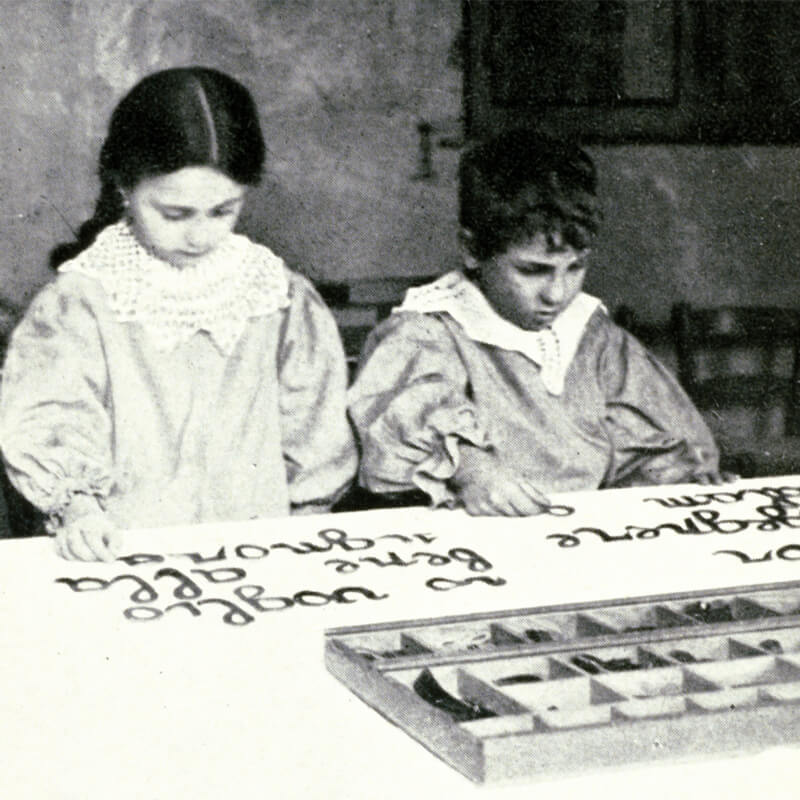
She immersed herself in the work of two French educators who had come before her: Jean-Marc Itard, who had worked with the “wild boy of Aveyron,” and Édouard Séguin, Itard’s student, who had developed methods for teaching children with intellectual disabilities using concrete materials and structured, staged instruction. Montessori spent months reading, translating, and reproducing their work by hand. Then she set about refining it.
She was appointed co-director of the Orthophrenic School in Rome, a specialized institution for children with a broad spectrum of disorders. For two years she worked there with total absorption, teaching and observing the children during the day and writing up her notes at night. The children she worked with made such extraordinary progress under her methods that many passed the standard public exams taken by children from ordinary schools. This result, which should have been celebrated, troubled Montessori deeply: if children considered intellectually disabled could reach the same level as their peers, what did that say about what ordinary schools were doing to ordinary children?
It was this question that set her on a different path entirely.
The Hidden Son
In 1898, during her time at the Orthophrenic School, Montessori became pregnant by her co-director, Giuseppe Montesano. Their relationship did not survive. Mario was born that year and was placed with a family living in the countryside near Rome. Montessori visited often, but for years she introduced Mario publicly as a nephew or, later, her adopted son. He was not publicly acknowledged as her biological son until 1940, when Montessori was pleading with the British colonial government in India to release him from detention.
She brought Mario to live with her in Rome in 1913, when he was about fourteen. From that point he became her closest collaborator, accompanying her on lecture tours around the world, translating her Italian into English, and eventually taking over the leadership of the AMI after her death. The personal cost of keeping their relationship hidden for so long, and the circumstances under which it finally became public, is part of her story that most biographical summaries quietly omit.
The Casa dei Bambini: January 6, 1907
The first Children’s House opened on the Feast of the Epiphany, January 6, 1907, at 53 Via dei Marsi in the San Lorenzo district of Rome. San Lorenzo was one of the poorest neighborhoods in the city. A developer building new housing blocks had a problem: the children of the workers were damaging and vandalizing the construction sites while their parents were working. He asked Montessori to open a school to occupy the children during the day.
The opening ceremony was small and expectations were low. Almost no one anticipated anything remarkable. Montessori later recalled that she had “a strange feeling which made me announce emphatically that here was the opening of an undertaking of which the whole world would one day speak.” The school began with roughly 40 children between the ages of 2.5 and 6, supervised initially not by a trained teacher but by the porter’s daughter.
Montessori equipped the room with materials she had developed at the Orthophrenic School, placed them in an environment where children could access them freely, and then observed. What she found was that children placed in a carefully prepared environment, one with materials designed to match their developmental stage, did not need to be taught in the conventional sense. They chose their own work. They concentrated deeply. They returned to the same activities repeatedly, with increasing precision. She called this capacity for self-directed learning “auto-education.”
Within two years, five Case dei Bambini were operating. News spread internationally with remarkable speed. The Italian-speaking cantons of Switzerland began converting their kindergartens. Educators from across Europe and the United States arrived to observe. In the summer of 1909, Montessori gave her first training course to approximately 100 students in Città di Castello. She wrote her notes from this period into a book, in roughly a month, now publishedshed the same year in Italy. In 1912, the English translation appeared in the United States under the title The Montessori Method. It reached second place on the U.S. nonfiction bestseller list and was subsequently translated into more than twenty languages.

Fascism and the Burning of Her Books
The 1920s and early 1930s saw the Montessori movement at the height of its international expansion. Schools had opened across Europe, in the United States, and in India. In 1929, Montessori and Mario co-founded the Association Montessori Internationale (AMI) to maintain the integrity and quality of what was being taught in her name.
Then fascism arrived, and it arrived personally. Mussolini had initially supported Montessori schools; the AMI’s first headquarters was in Berlin, and had even served as the honorary president of a national Montessori organization in Italy. But when Montessori refused to cooperate with his plans to incorporate Italian Montessori schools into the fascist youth movement, the relationship ended. In 1934, two years after her refusal, all Montessori schools in Italy were closed.
In Germany, the situation was more violent. By 1933, all Montessori schools in Germany had been shut down by the Nazis. An effigy of Maria Montessori was burned above a bonfire of her books in Berlin. The AMI moved its headquarters from Berlin to Amsterdam. Montessori, who had been living in Barcelona, fled the Spanish Civil War in 1936 on a British battleship and made her way to the Netherlands.
India: Seven Years in Exile, and The Absorbent Mind
In 1939, Montessori and Mario accepted an invitation from the Theosophical Society in Madras to run a three-month training course in India. She was 69 years old. The trip was meant to be brief. It lasted seven years.
When Italy entered World War II on the side of Germany in June 1940, Montessori and Mario were immediately classified as “enemy aliens” by the British colonial government. Mario was interned as a prisoner of war in Pallavaram, confined behind barbed wire. Montessori, out of deference to her age and international standing, was placed under house arrest within the compound of the Theosophical Society rather than imprisoned, but she could not leave India, and she could not work freely without her son.
On her 70th birthday, the British Viceroy made an unusual gesture: Mario was released from internment as a birthday gift to his mother. It was at this moment, while pleading with the British government for her son’s release, that Montessori first publicly acknowledged Mario as her biological son rather than her nephew or adopted child. The circumstances stripped away the cover story she had maintained for decades.
Together, Montessori and Mario trained over 1,500 Indian teachers during the war years. They spent two years in the rural hill station of Kodaikanal, where the experience of working with nature, with the interdependence of living things, shaped what would become Cosmic Education, an approach for children aged 6 to 12. She met Gandhi, Nehru, and Tagore. She lectured in precise, melodic Italian while Mario translated into English.
The book that emerged from those years of enforced reflection: The Absorbent Mind, first published in Madras in 1949, considered her most complete and philosophically developed work. The enforced stillness of house arrest, the distance from Europe, and the richness of the Indian intellectual and spiritual environment had pushed her thinking further than any of her previous books. It was, in its way, a book that could only have been written in exile.
Montessori and Mario returned to the Netherlands in 1946. The following year she addressed UNESCO on “Education and Peace.” She returned to Italy for the first time since the war and helped rebuild the Montessori movement there. She was nominated for the Nobel Peace Prize in 1949, 1950, and 1951. On May 6, 1952, a few months before her 82nd birthday, she died peacefully in Noordwijk aan Zee, on the Dutch coast. Her last words, reportedly, were “Do I not see clearly that children have the power to change the world?”
What Her Method Actually Said
The Montessori Method is often summarized as “child-led learning” or “learning through play,” neither of which captures what Montessori actually argued. Her position was more specific and more radical than either phrase suggests.
She believed that children pass through what she called “sensitive periods”: specific windows of development during which they have a particular readiness to absorb certain types of information. Language, order, movement, small objects, sensory refinement: each has a window during which learning it is effortless and after which it requires significantly more effort. The task of education, in her view, is not to teach at predetermined times but to prepare an environment that makes the right materials available when the child is in the right sensitive period.
She also argued that children have what she called an “absorbent mind”: a capacity during the first six years of life to take in information from their environment without conscious effort, the way a sponge absorbs water. This is not the same as learning from instruction. It is pre-conscious absorption. Which means that what a child’s environment contains during those six years matters enormously, regardless of whether anyone is deliberately “teaching” anything.
These were not soft philosophical positions. Montessori was a physician and a scientist. She reached these conclusions through systematic observation of thousands of children across multiple countries and cultures over decades. Her conviction that the same developmental laws applied universally: that the sensitive period for language was not a European or Italian phenomenon but a human one, came from watching children in India, in the United States, in England, and in the slums of Rome, all behaving according to the same internal timetable.
Her Books: Where to Start
Montessori was a prolific writer. If you want to understand her ideas directly rather than through secondhand summaries, here are the books that matter most, in a sensible reading order.
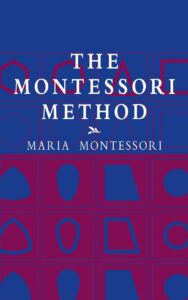
Maria Montessori · 1909
The Montessori Method
Her first book, written from notes taken during her first training course. Concrete and practical: it describes exactly what she was doing in the Casa dei Bambini, material by material. It reached #2 on the U.S. nonfiction bestseller list in 1912 and was translated into over 20 languages. Start here for the origins of the method in her own words.
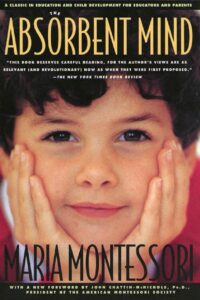
Maria Montessori · 1949
The Absorbent Mind
Written under house arrest in India, based on lectures to Indian audiences. Her most philosophically complete work: the absorbent mind, sensitive periods, normalization, the prepared environment explained in full. The most important book she ever wrote, and one that could only have been written in exile.
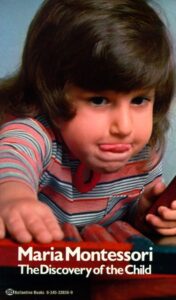
Maria Montessori · 1948
The Discovery of the Child
A revised and expanded version of her 1909 work, drawing on several more decades of observation. It covers the nature of the child and the educational approach in greater depth, with particular attention to the prepared environment. Often read alongside The Absorbent Mind as the two books that together give the fullest picture of her thinking.
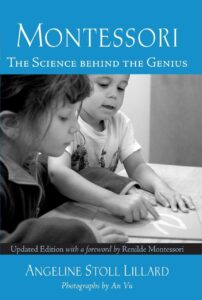
Angeline Lillard · 2005
Montessori: The Science Behind the Genius
Not written by Montessori, but by a developmental psychologist at the University of Virginia who examined what contemporary research says about each of her core claims. For parents who prefer the cognitive science angle over biography, this is the most rigorous book available. Lillard asks what experimental studies say about whether each pillar of the method works and why.
What She Left Behind
Today there are more than 22,000 Montessori schools operating in over 110 countries. The AMI, which she founded with Mario in 1929, continues to oversee teacher training and set standards for authentic implementation. The materials she developed: the golden beads, the sandpaper letters, the pink tower, the bead chains, are still in use in classrooms around the world, largely unchanged from what she designed at the Orthophrenic School and refined at the Casa dei Bambini.
What is less often discussed is why the method survived fascism, two world wars, exile, and decades in which “progressive education” became a term of mockery in many countries. The answer is probably that it was not primarily a philosophy: it was a practice, with specific materials, specific techniques, specific outcomes that could be observed and replicated by anyone trained to use them. Maria Montessori built something that could outlive her because she had made it concrete enough to be learned, transmitted, and adapted without losing its essential shape.
Questions People Ask Most Often
Was Maria Montessori really the first woman to graduate from a medical school in Italy?+
She was among the first, and she was the first woman to graduate from the medical school of the University of Rome. The claim that she was definitively the first woman to receive a medical degree anywhere in Italy is sometimes disputed by historians, as there were a small number of women who had obtained equivalent degrees in other parts of the country before her. What is accurate is that her graduation in 1896 was a genuine landmark and that she became known nationally for it.
Why did Montessori hide that Mario was her son?+
Mario was born out of wedlock in 1898, and the social consequences of acknowledging an illegitimate child would have been severe for a woman in her professional position in turn-of-the-century Italy. Her relationship with Mario’s father, Giuseppe Montesano, had ended. She made the decision to place Mario with a family in the countryside and to visit him without making their relationship public. Over time she introduced him first as a nephew, then as her adopted son. The situation was finally resolved in 1940 when she petitioned the British colonial government in India for Mario’s release from internment and had to acknowledge that he was her biological son. Their mother-son relationship became public from that point forward.
Why was she nominated for the Nobel Peace Prize?+
Montessori made a consistent argument throughout her later life that education is inseparable from peace: that children raised in environments that respect their autonomy, foster self-discipline, and develop their capacity for concentrated work grow into adults less susceptible to manipulation by authoritarian forces. She addressed the League of Nations in Geneva in 1932 on “Education and Peace” and UNESCO in 1947 on the same theme. In the context of a Europe that had just been through fascism and a world war, her argument that the roots of peace were in early childhood carried considerable weight. She was nominated in 1949, 1950, and 1951, dying in 1952 before a fourth nomination could be made.
Which book by Montessori should I read first?+
If you are approaching Montessori as a parent curious about the method, The Absorbent Mind is the most complete statement of her ideas and the most accessible for a general reader. If you want the historical starting point, The Montessori Method from 1909 is where it all began: concrete, practical, and full of specific observations from the Casa dei Bambini. If you prefer to approach through contemporary research, Angeline Lillard’s Montessori: The Science Behind the Genius examines the method through the lens of current developmental psychology without requiring any prior knowledge of Montessori.
The Person Behind the Method
What makes Maria Montessori’s biography worth reading in full is not the list of schools she opened or the countries she visited. It is the quality of her determination in circumstances that would have stopped most people: against social expectations as a woman in 19th-century Italy, against the personal cost of her hidden son, against the political forces that burned her books, against wartime imprisonment in a country she had never planned to stay in. She continued working, observing, writing, and teaching through all of it. The method she left behind carries the shape of that stubbornness.