
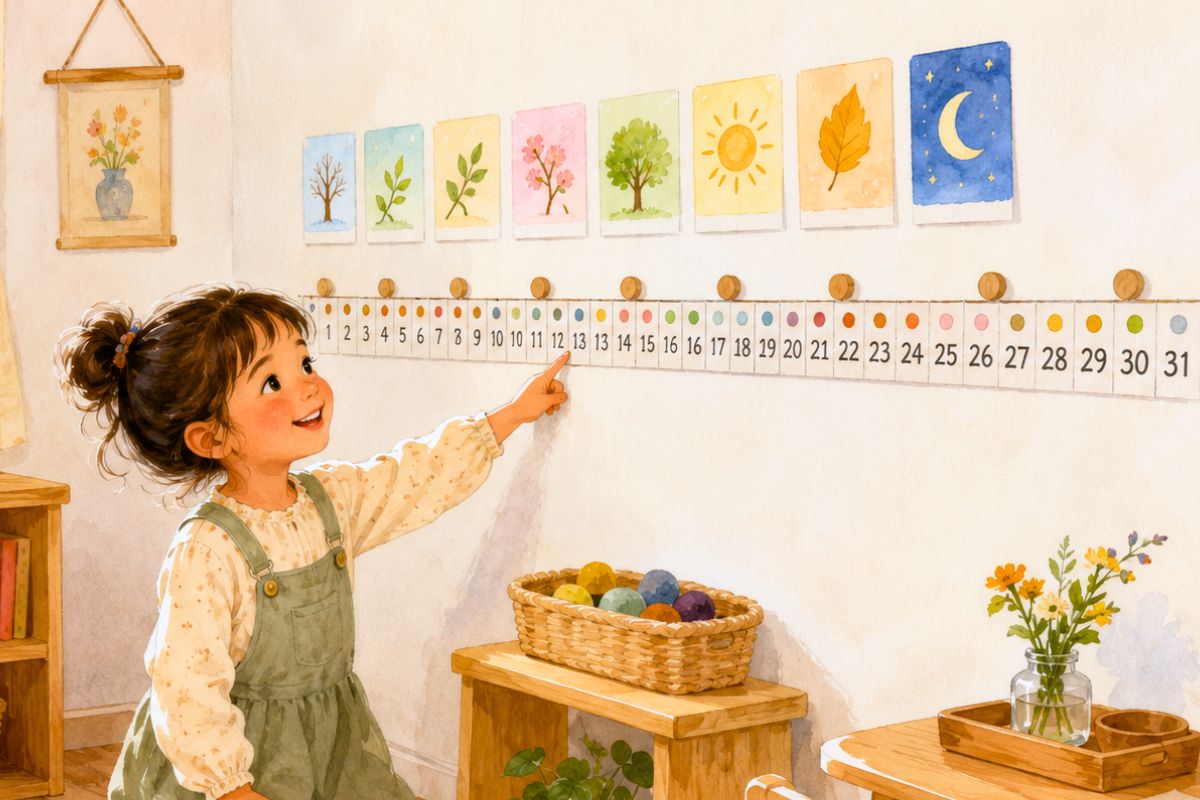
“How many sleeps until my birthday?” “Is our vacation tomorrow?” “When will grandma visit?”
Young children experience time differently from adults. A traditional calendar shows dates, but it often does not show distance. A Montessori linear calendar transforms time into something children can see, follow, and understand.
Instead of separate boxes that restart every week, a Montessori linear calendar creates one continuous path from one day to the next. Children can see where today is, what already happened, and how far away an important event feels.
Download FREE Montessori Linear Calendar
Print your own Montessori-inspired linear calendar with a simple left-to-right timeline designed for children.
What Is a Montessori Linear Calendar?
A Montessori linear calendar is a visual timeline that displays days in a continuous sequence from left to right. Each day follows naturally after the previous one, helping children understand that time moves forward.
Unlike a traditional monthly calendar made of separated squares, the linear format creates a physical representation of time. Children can move a marker, count spaces, compare distances, and connect future events with something they can actually see.
The simple idea behind it
Time is invisible. Children cannot touch yesterday or hold tomorrow. A linear calendar gives time a visible shape by turning days into a path they can follow.
Time Is Invisible, So We Must Make It Physical
Adults naturally understand time because years of experience have created a mental map. We know that a week contains seven days, that months follow each other, and that an event three spaces away is closer than an event twenty spaces away.
Young children do not have this invisible mental timeline yet. Words like “next week”, “in three days”, or “last month” can feel abstract because they describe something they cannot see.
A Montessori linear calendar solves this problem by connecting language with a physical experience. When a child moves a marker one space forward, time becomes movement. When they count spaces until a birthday, time becomes distance.
Why it works
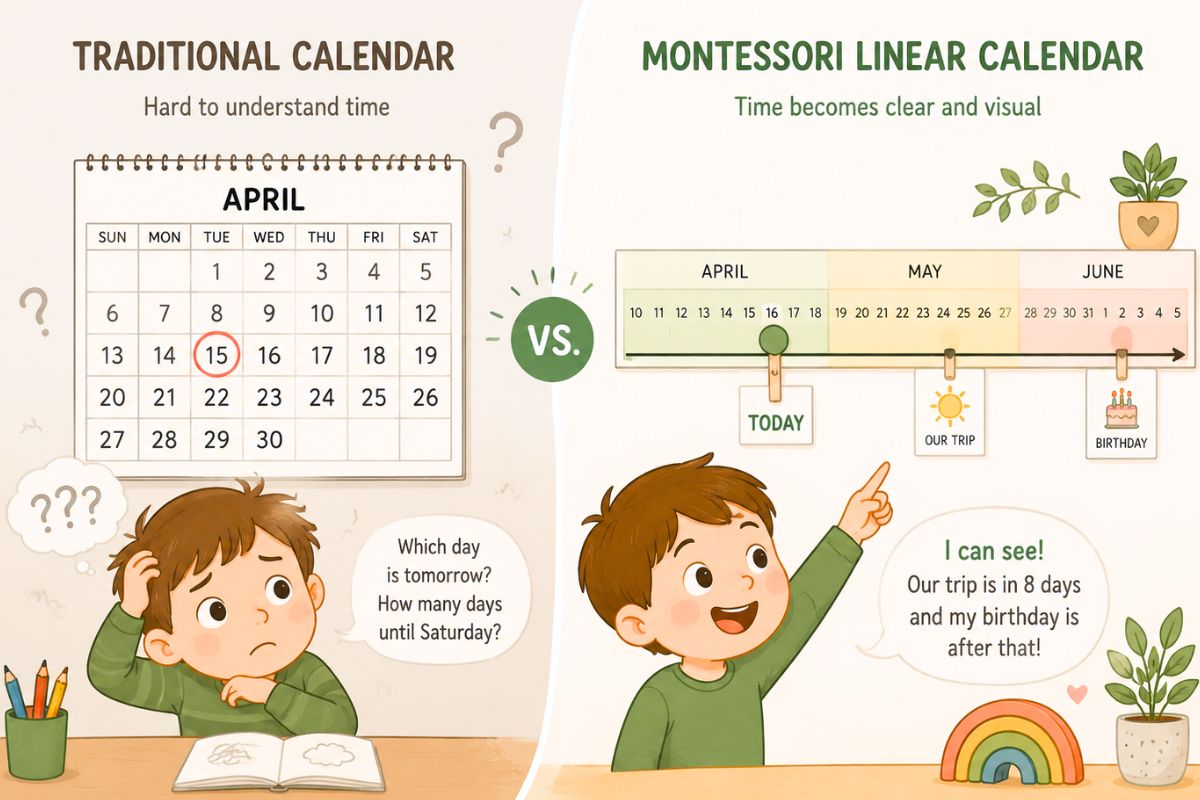
A square calendar answers “Which date is in this box?” A linear calendar is better at answering “How far away is it?” and “What comes before or after?”
Why Children Struggle With Traditional Calendars
Most adults use a traditional calendar every day without thinking about it. A grid feels logical because we already understand the hidden structure behind it.
For a young child, however, a calendar grid contains many invisible rules. They need to understand that the boxes continue from one row to another, that the next week starts below, and that the first day of a new month does not mean time restarted.
Traditional Calendar Grid
- ●Separate boxes
- ●Time appears fragmented
- ●Requires understanding hidden rules
- ●Designed mainly for adult organization
Montessori Linear Calendar
- ●One continuous path
- ●Shows distance between events
- ●Follows natural left-to-right movement
- ●Designed for active participation
How Children Learn Time Step by Step
Understanding time does not happen all at once. Children usually build this concept gradually through repeated experiences connected to their daily life.
A Montessori linear calendar supports this natural progression by moving from simple ideas to more complex ones. The goal is not to memorize dates, but to develop a real sense of sequence and duration.
Step 1: Today, Tomorrow, Yesterday
Young children first understand time through immediate experiences. Today is where they are. Yesterday is what already happened. Tomorrow is what is coming next.
The today marker gives these words a physical location.
Step 2: Days of the Week
Once children understand daily movement, they begin noticing repeating patterns. Monday comes after Sunday. A weekly activity returns again and again.
The calendar becomes a predictable rhythm rather than a list of names.
Step 3: Months and Seasons
Children begin connecting time with natural changes. They notice colder weather, flowers, longer days, leaves changing, and seasonal celebrations.
Monthly illustrations make these changes visible.
Step 4: The Concept of a Year
Over time, children understand that months are connected and that a year is one long cycle.
They begin seeing patterns: birthdays return, seasons repeat, and events have a place in time.
The Anatomy of a Montessori Linear Calendar
A good Montessori linear calendar does not need to be complicated. The strength comes from clarity. Every element should have a purpose and help the child understand the passage of time.
The essential elements
- ●Month sections. Clear divisions help children see that the year contains smaller periods.
- ●Daily sequence. Each day follows naturally after the previous one.
- ●Today marker. A movable marker creates a daily connection between the child and the calendar.
- ●Important events. Birthdays, trips, holidays, and visits give meaning to the timeline.
- ●Seasonal elements. Small illustrations connect time with the real world.
Who Is a Montessori Linear Calendar Best For?
Ages 3 to 6
This is usually the ideal age range. Children can discuss upcoming events, count spaces, and begin building a stronger understanding of sequence.
Toddlers 2 to 3
Keep it simple. Focus on today, tomorrow, and one meaningful event instead of explaining the entire calendar.
Elementary Children
Older children can use a linear calendar for planning projects, school breaks, goals, and understanding longer periods.
How to Set Up Your Free Montessori Linear Calendar
The setup should feel simple. A linear calendar is valuable because it becomes part of daily life, not because it looks perfect on the wall.
1
Print the calendar using landscape orientation.
2
Cut the monthly strips and place them in chronological order.
3
Choose a visible location at your child’s height.
4
Add a simple today marker.
5
Introduce one or two meaningful events.
6
Start using it naturally during daily routines.
The honest caveat
A beautiful calendar that nobody uses has little educational value. The goal is not decoration. The goal is helping your child slowly connect words, experiences, and the movement of time.
The Montessori Morning Calendar Routine
The most effective way to use a Montessori linear calendar is to create a small daily ritual. It does not need to become a formal lesson. A few minutes of consistent interaction is enough to help children build a relationship with time.
A simple 5-minute routine
1
Find today. Invite your child to move the marker to the current day.
2
Name the day. Talk about today, yesterday, and tomorrow.
3
Observe the season. Notice the weather, temperature, plants, or changes outside.
4
Look ahead. Count how many days remain before an important event.
5
Continue the day. Let your child return to normal activities after this short connection.
The goal is not to test your child. Avoid asking questions like “What day is it?” repeatedly. Instead, model the language naturally and allow understanding to develop through repetition.
What Should You Mark on a Montessori Linear Calendar?
The best events are the ones that matter to your child. A calendar becomes meaningful when the child understands why a specific day is important.
Personal Events
- ●Birthday
- ●Family visits
- ●Special outings
- ●Playdates
Natural Events
- ●First day of a season
- ●Weather changes
- ●Plant growth
- ●Moon observations
Family Rhythms
- ●Weekly activities
- ●School days
- ●Family traditions
- ●Holiday preparation
Best practice
Start with only a few important events. A calendar full of stickers and decorations can become visually overwhelming. The power comes from clarity.
Five Simple Activities That Make Time Visible
1
Countdown to a Special Event
Instead of saying “your birthday is soon”, let your child count the spaces between today and the event. The distance becomes understandable.
2
Track Seasonal Changes
Add small observations connected to nature. A child can notice when flowers appear, when leaves change, or when the days become longer.
3
Create a Family Timeline
Mark meaningful memories such as trips, celebrations, or visits. Children begin understanding that personal experiences also have a place in time.
4
Compare Past and Future
Use the calendar to talk about what already happened and what is coming next. This builds the foundation for chronological thinking.
5
Connect Time With Real Life
The calendar works best when connected to daily experiences rather than used as an isolated learning tool.
Common Mistakes That Make Children Ignore the Calendar
- ●Adding too much information. Too many colors, stickers, and decorations can hide the main idea.
- ●Using it only as decoration. Children need interaction, not just a beautiful wall display.
- ●Explaining too much too early. Start with simple concepts before introducing months, seasons, and longer periods.
- ●Turning it into a quiz. The calendar should create curiosity, not pressure.
- ●Ignoring the child’s interests. Connect events to things your child actually cares about.
How the Free Montessori Linear Calendar Was Designed
A useful Montessori calendar should feel calm, clear, and inviting. The design choices focus on helping children understand time rather than creating a busy decoration.
Clear Structure
A continuous timeline makes the passage of days easier to follow.
Seasonal Details
Gentle monthly illustrations connect abstract time with the natural world.
Child-Friendly Use
The calendar leaves space for movement, observation, and meaningful events.
Frequently Asked Questions
What age is best for a Montessori linear calendar?+
Many children between 3 and 6 years old are ready to explore a linear calendar. Younger children can still benefit from simple ideas like today, tomorrow, and upcoming events.
Can I use a Montessori linear calendar at home?+
Yes. It works especially well in homes because it connects naturally with birthdays, family routines, trips, and everyday experiences.
Is a Montessori linear calendar better than a normal calendar?+
They serve different purposes. Traditional calendars are excellent for adult organization. Linear calendars are designed to make the passage of time easier for young children to understand.
How long should we spend using it each day?+
A few minutes is enough. The consistency of the routine matters more than the length of the activity.
Make Time Visible for Your Child
A Montessori linear calendar is not about teaching children to memorize dates. It is about helping them build an internal understanding of sequence, change, and anticipation.
Start with today. Mark one meaningful event. Move the marker together. Over time, your child begins to see something adults often take for granted, time is a journey that moves forward.