
Toy rotation advice usually assumes one child, one age, and one shelf. Add a crawling baby and a four-year-old to the same room and the usual rules fall apart. The baby’s safe materials bore the older child. The older child’s work contains pieces the baby cannot touch. Every activity becomes a negotiation.
A shared Montessori space does not need identical access to everything. It needs clear common ground, a safe area for the youngest child, and a protected place where older work can continue without constant interruption.
The Three-Zone Method
- Youngest child zone: Large safe materials on the lowest level
- Shared zone: Blocks, books, music, movement, and open-ended materials
- Protected zone: Higher or gated work for small pieces and complex projects
- Rotation rhythm: Change individual materials separately from shared materials
- What not to promise: Every toy does not need to be available to every child at every moment
Why One Shared Shelf Creates Constant Conflict
When every material sits at the baby’s height, the older child cannot preserve a puzzle, construction, or careful arrangement. When everything is raised, the youngest child loses meaningful access. The issue is not that the siblings do not know how to share. The environment is asking them to do incompatible work in the same physical space.
The core principle: Equal respect does not require identical access. Each child needs work that matches their development and a place where that work can remain safe.
Build Three Clear Zones
Zone One for the Youngest Child
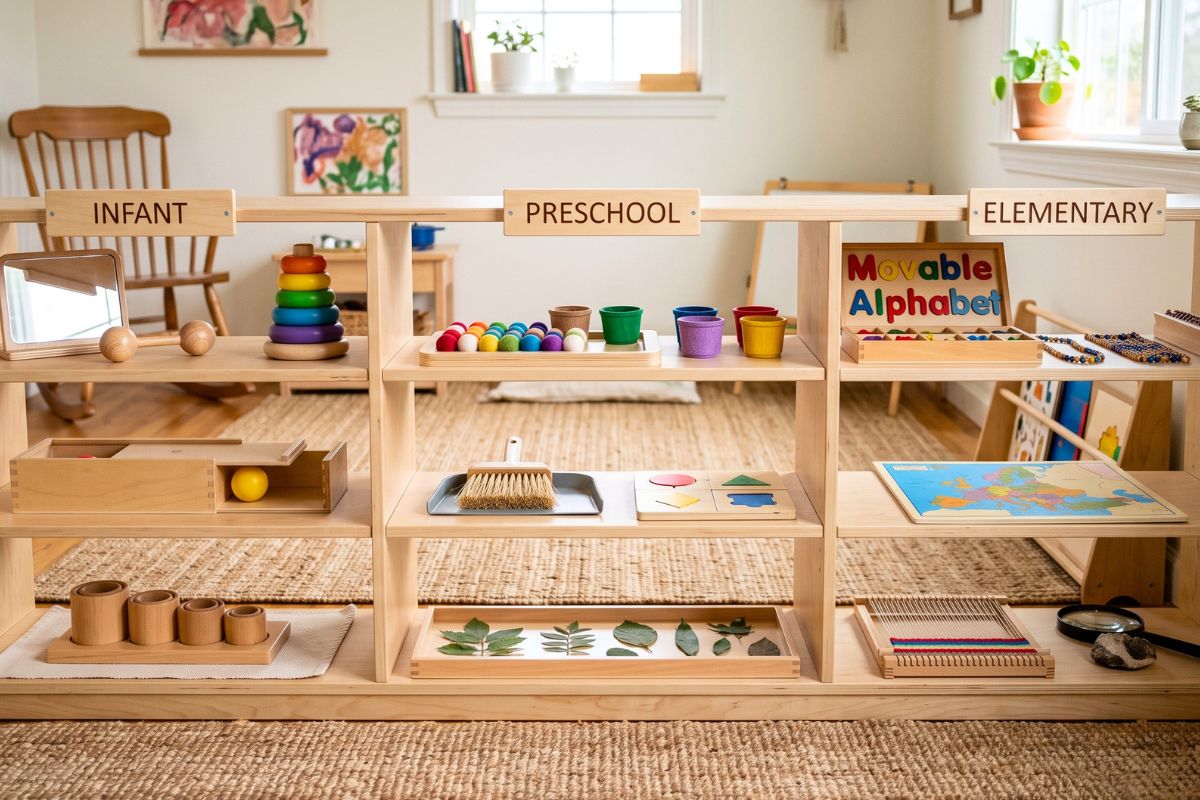
Use the lowest shelf or a separate small unit with large grasping objects, balls, posting work, sturdy books, nesting materials, and simple instruments. Everything in this zone should remain safe when the adult briefly turns away.
Zone Two for Shared Materials
Place durable open-ended materials where both children can reach them. Large blocks, scarves, animal figures, board books, simple musical instruments, and movement equipment often work across several ages when used in different ways.
Zone Three for Protected Work
Use a higher shelf, table, gated corner, or room used with supervision. This is where the older child keeps beads, detailed puzzles, cutting work, sewing materials, or a construction that needs to remain undisturbed.
What to Put in the Shared Zone
How Many Materials Should Be Out
Do not multiply the standard shelf number by the number of children. A room with three children does not need thirty trays. Begin with four to six materials for the youngest child, four to six for the older child, and three or four shared choices. Some activities can remain in closed rotation storage.
The useful question is not how many toys each child owns. It is whether each child can see a manageable choice and complete work without another child’s materials spilling into the same space.
Rotate by Child, Not by Room
- Observe each child’s current repetition. The baby may still post objects daily while the preschooler has finished with matching work.
- Keep shared favorites stable. Blocks and books do not need weekly replacement when both children use them deeply.
- Change one zone at a time. Rotating the entire room creates unnecessary novelty and makes it harder to see what caused renewed engagement.
- Store complete activities together. A tray should return with every necessary piece so the next rotation does not begin with searching.
The Small-Parts Problem
Small pieces require a physical solution, not repeated verbal reminders to the baby. Use a table the youngest child cannot reach, a high shelf, a play yard that protects the older child’s workspace, or a separate room during focused work. Relying on “do not touch” creates constant failure for a child whose development requires touching.
Safety first: Any object that presents a choking risk must remain physically inaccessible to a child who mouths objects. Supervision supports safety, but supervision is not a substitute for secure storage and age-appropriate access.
How to Protect Work Without Teaching Possession Over Everything
An older child can have a protected work mat or table while still learning that shared materials return to the community shelf. Use precise language. “This puzzle is Mia’s work right now. You may choose the blocks.” Later, when the puzzle is restored, it becomes available again.
When the Younger Child Interrupts
Move close, block gently, and redirect to a similar safe action. If the older child is threading beads, offer the baby large rings on a post. The goal is not to create an identical activity. It is to recognize the younger child’s interest and provide a developmentally safe version.
When the Older Child Controls the Whole Room
Protected work does not mean every material becomes private. Define which shelf is shared and which active work is temporarily unavailable. Consistent physical boundaries reduce arguments more effectively than negotiating every object.
When Buying Two of the Same Toy Makes Sense
Duplication is useful when both children repeatedly need the same basic tool at the same time, such as a small cleaning cloth, watering can, or drawing surface. It is less useful for expensive materials used briefly or for activities that naturally support turn-taking. Observe the conflict before buying the solution.
A Shared Room Can Still Respect Individual Work
The goal is not a perfectly equal shelf. It is a room where the baby can explore safely, the older child can concentrate, and both children have meaningful shared materials.
Create physical zones, rotate each child’s work separately, and protect small-piece activities with more than words. The environment should carry the boundary so the parent does not spend the entire day enforcing it.