
Walk into any baby store and the tummy time section will look like a sensory explosion, flashing lights, motorized toys, foam gyms with twelve detachable pieces. Most of it is designed to look impressive on a shelf, not to serve what tummy time is actually trying to do.
A baby doing tummy time does not need entertainment. They need something worth lifting their head to see. That is a much simpler brief, and it points toward very different products than what most buying guides recommend.
Quick Picks
- Best mat overall (Montessori-friendly): Lovevery Play Gym: organic cotton, developmental stages, grows to 12 months
- Best budget mat: A firm cotton blanket on the floor, genuinely no gimmicks
- Best single tummy time tool: A shatterproof floor mirror (no contest)
- Best for reluctant babies: Tummy time water mat: tactile novelty, light support
- Best natural toy for 0-3 months: Montessori visual mobiles (Munari, Octahedron)
- Best natural toy for 3-6 months: Wooden rattle, grasping ring, patchwork ball
- What to avoid: Electronic toys, noisy gyms, tummy time pillows that do the work for the baby
What Makes a Good Tummy Time Setup (The Montessori Lens)
Before getting into specific products, it helps to understand what tummy time is actually doing developmentally, because it shapes what kind of support is useful versus what simply distracts.
Tummy time builds strength by asking a baby to fight gravity. The neck and shoulder muscles that eventually support rolling, sitting, crawling, and walking all develop through this daily effort against a firm surface. A systematic review in Pediatrics (Hewitt et al., 2020) confirmed that supervised prone floor time supports motor, visual, and sensory development, with the AAP recommending it from birth.
Good tummy time equipment does one thing: gives the baby a reason to lift their head. A face, a mirror, a slowly moving mobile. Everything else is secondary. What does not help is anything that either does the lifting for the baby (very thick tummy time pillows propping them up completely) or overwhelms them with stimulation before they can process it (eight flashing lights and a musical soundtrack for a six-week-old).
The Montessori Filter: Natural materials, calibrated stimulation, one or two things to focus on rather than twelve, and products that grow with the baby’s development rather than trying to entertain passively. These principles cut the buying list significantly and point toward better developmental outcomes.
The Best Tummy Time Mats
The mat is the foundation. It needs to be firm enough for the baby to push against, clean enough to trust face-down, and large enough to not feel restrictive as the baby starts to roll and explore. Here are the options worth considering.
Lovevery Play Gym: Best Montessori-Aligned Mat
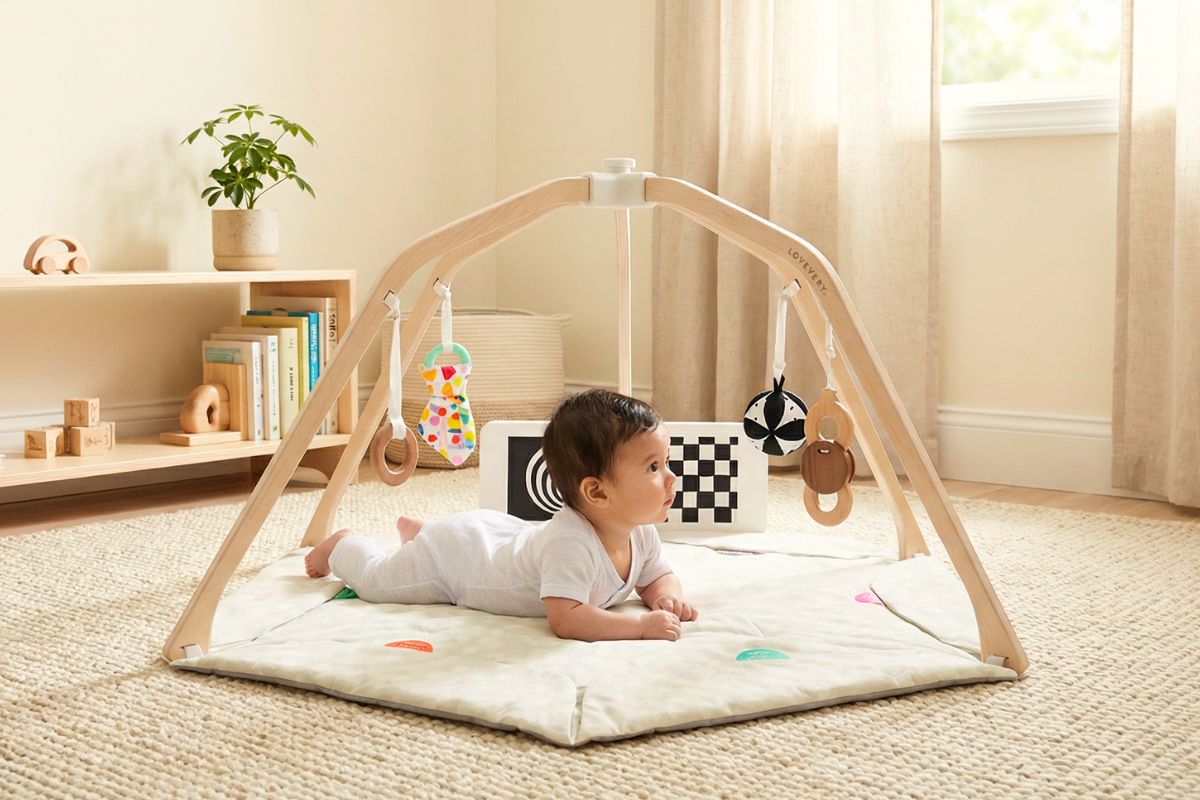
Designed by child development experts, the Lovevery play gym is the closest thing to a Montessori-calibrated commercial mat. The mat itself is organic cotton with a firm base, large enough to give a rolling baby real space. It comes with five developmental zones and stage-based activities that change as the baby’s abilities develop: visual contrast for newborns, reaching practice for two to four months, hiding and finding for five months plus. The toy bar holds a black-and-white high contrast ball (appropriate for newborn tummy time), a crinkle book, and a shatterproof mirror. Crucially, you can remove most elements and use it as a simple firm mat with just the mirror, which is exactly the Montessori movement area setup.
Materials & Safety
Organic cotton mat, OEKO-TEX tested polyester filling, baby-safe silicone, sustainably sourced wood toy bar. No PVC, no BPA. GREENGUARD Gold certification in progress. Converts to a play tent for toddlers.
The honest caveat: Lovevery is expensive ($150-180). The mat itself, without the gym structure, is functionally a firm organic cotton surface. If budget is tight, a firm cotton blanket on the floor and a separate shatterproof mirror achieves 80% of the same developmental value at a fraction of the cost.
Pros
Stage-based activities, not random stimulation
Mirror included
Converts to play tent
Cons
Flat to dry after washing
Lalo The Play Gym: Best Natural Materials Alternative
The Lalo play gym uses FSC-certified beech wood arches and a Lyocell mat made from sustainably harvested eucalyptus. It has a simpler, more minimal aesthetic than Lovevery, which actually aligns better with Montessori principles: less visual clutter, fewer simultaneous elements. The mat is plush, breathable, and noticeably soft, which makes prolonged floor sessions more comfortable for the baby. It comes with a mirror (the most important single attachment), natural wood rings, and a few soft hanging toys. Machine washable mat.
Pros
Minimal, calm aesthetic
ASTM certified, Prop 65 compliant
Cons
Also expensive (~$125+)
Tummy Time Water Mat: Best for Reluctant Babies
A water-filled vinyl mat with floating sea creatures that move as the baby shifts their weight. This is not a Montessori product, it is vinyl, it is not naturally sourced, and it produces passive entertainment. But for a baby who genuinely resists every other tummy time surface, it works. The cool, slightly giving surface is interesting enough to break the resistance cycle, and the gentle support it provides makes tummy time feel less overwhelming for babies who find flat surfaces distressing.
Think of it as a bridge, not a permanent setup. Two to four weeks of positive sessions on the water mat can build enough tolerance and muscle to transition to a firm surface with a mirror. It is not the long-term goal, but it can unstick a baby who has been refusing all prone time for weeks.
Good for
Transition tool, 2-4 months
Budget-friendly (~$15-20)
Not ideal for
Newborns under 2 months
The Budget Setup That Actually Works
A firm cotton blanket or thin wool rug on the floor, plus a shatterproof acrylic mirror positioned horizontally at floor level. Total cost under $30 if you use an IKEA LOTS mirror and a blanket you already own.
This is the Montessori movement area in its simplest form, and it is what most experienced Montessori families use for the newborn stage. The mirror provides the developmental value. The firm blanket provides the surface. Your face, down at their level, provides the motivation. No product closes the gap between this setup and a $150 play gym when it comes to what actually matters for a newborn’s development.
The Single Most Important Tummy Time Tool: The Mirror
If you buy one tummy time accessory, buy a shatterproof floor mirror. Not a tummy time gym. Not a pillow. Not a noisy rattle. A mirror.
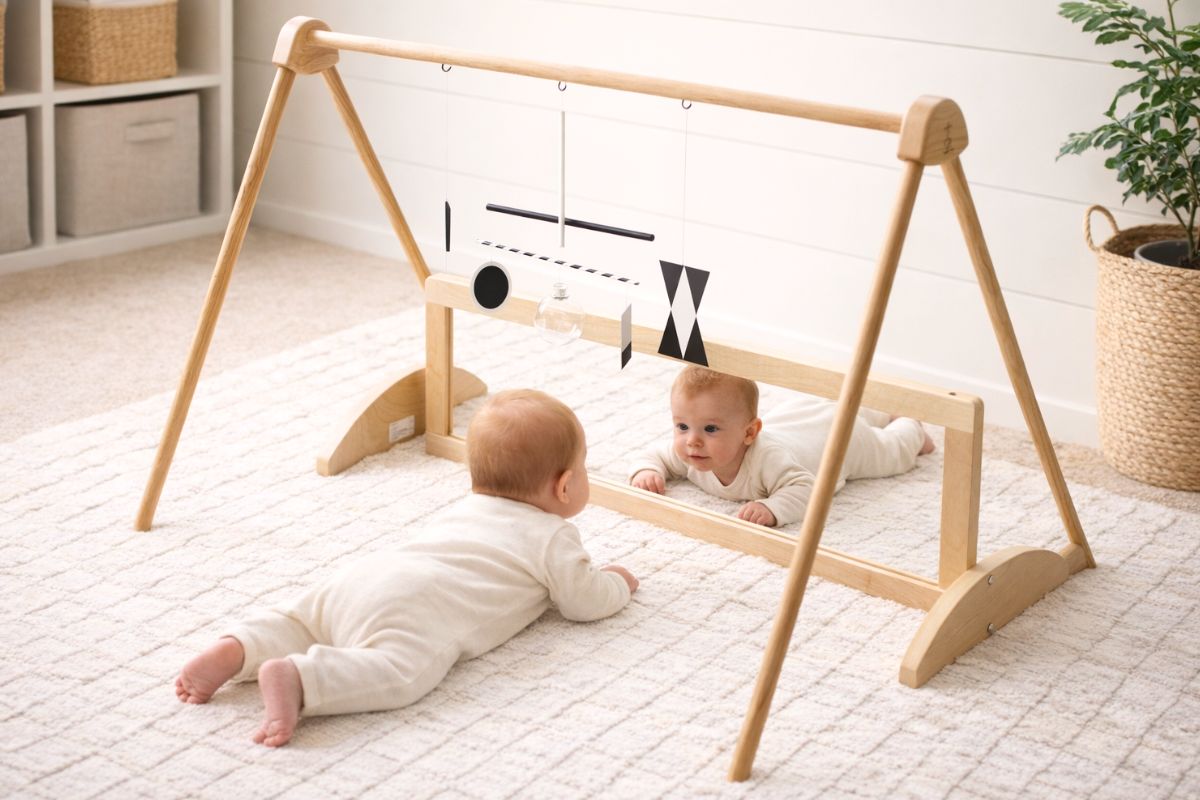
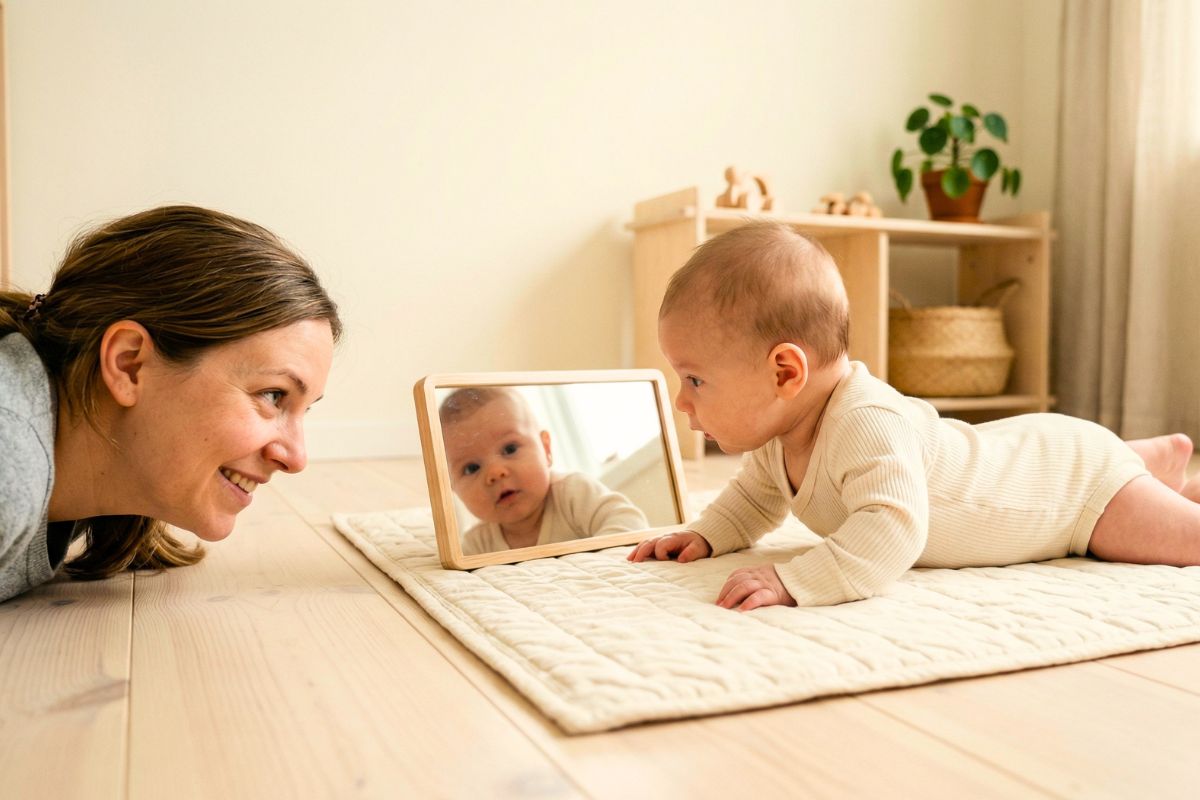
Babies are neurologically wired to attend to faces. A horizontal mirror at eye level during prone time gives them a face to look at even when you are not directly in front of them. It motivates the head lift, sustains the effort longer, and begins supporting body awareness and self-recognition from the earliest weeks.
The IKEA LOTS mirror (around $10) works well mounted horizontally at floor level, though it is glass. For floor use directly, the safer option is a large acrylic shatterproof mirror: GrowGo Kids and several other brands make purpose-built floor mirrors with a solid wood frame that stands independently or mounts horizontally. The mirror stays relevant far beyond the tummy time phase: it becomes the standing mirror beside the pull-up bar as the baby becomes mobile.
The Best Tummy Time Toys by Age
Tummy time toys serve a specific purpose: they give the baby something worth lifting their head to see, and later, something worth reaching toward. The right toy changes with the stage.
0-3 Months: Visual, Not Tactile
In the first three months, the goal is purely visual: give the baby something that contrasts clearly against the floor, moves gently in air circulation, and is positioned at the right distance for a developing visual system (25-30 cm from their eyes). Tactile toys are not yet meaningful because the baby cannot intentionally grasp. Noisy toys create unnecessary stimulation that interferes with focused visual effort.
What works
Octahedron mobile (4-6 weeks)
High-contrast black-and-white cards propped at eye level
Your face, directly in front of them
What to skip
Colourful cluttered gyms (overstimulating)
Anything the baby cannot yet interact with
3-6 Months: Reaching And Grasping Begins
From around 3 months, efficient reaching begins. Tummy time now involves the baby actively pushing up and reaching forward, making materials placed slightly in front of them useful as motivators. The goal shifts from “lift the head to see” to “push up to reach.” Objects with varied textures, interesting shapes, and natural materials are appropriate from this stage. Keep the selection small: 2-3 items near the mat, not a dozen competing for attention.
What works
Interlocking rings (grasping practice)
Ball with protrusions (easy to grab)
Patchwork sensory ball (varied textures)
Gobbi or Dancers mobile overhead
What About Tummy Time Pillows?
Tummy time pillows (sometimes called tummy time bolsters) are wedge-shaped cushions placed under the baby’s chest to prop them up slightly during prone time. They are widely sold and widely used. The Montessori position on them is worth understanding before you buy.
When A Tummy Time Pillow Helps: In the first 4-6 weeks, a small rolled towel (not a full bolster) under the chest can give a baby with very limited upper body strength a slight advantage that makes the difference between fruitful tummy time and pure frustration. Used temporarily, this is reasonable.
When A Tummy Time Pillow Gets In The Way: A large, thick tummy time bolster that elevates the chest significantly and holds the head above the surface removes the primary stimulus that makes tummy time developmentally valuable. The baby is no longer fighting gravity to lift up: the pillow has done it for them. This reduces the muscular effort that builds strength. After 6-8 weeks, wean off the pillow onto a flat firm surface. The goal is for the baby to do the work.
Comparison Table
The Simplest Setup Wins
The best tummy time setup is the one that happens every day. A firm blanket and a mirror will beat the most expensive play gym if the expensive play gym sits folded in the corner because it takes five minutes to set up.
Keep the mat out. Keep the mirror at floor level. Do two minutes after each diaper change. That consistency, starting in the first days home, will build the strength your baby needs to hit every motor milestone across the first year. No product closes that gap.
For the full picture of how tummy time fits into the Montessori floor-based movement environment, our movement area guide walks through the complete setup from birth to first steps.
Scientific References
Hewitt, L., Kerr, E., Stanley, R.M. & Okely, A.D. (2020). Tummy Time and Infant Health Outcomes: A Systematic Review. Pediatrics, 145(6), e20192168.
Carson, V., Zhang, Z., Predy, M., Pritchard, L. & Hesketh, K.D. (2022). Longitudinal associations between infant movement behaviours and development. International Journal of Behavioral Nutrition and Physical Activity, 19, 10.
Zhang, Z., Predy, M., Hesketh, K.D., Pritchard, L. & Carson, V. (2023). Characteristics of tummy time and dose-response relationships with development in infants. European Journal of Pediatrics, 182(1), 113–121.
American Academy of Pediatrics. Back to Sleep, Tummy to Play. HealthyChildren.org →