
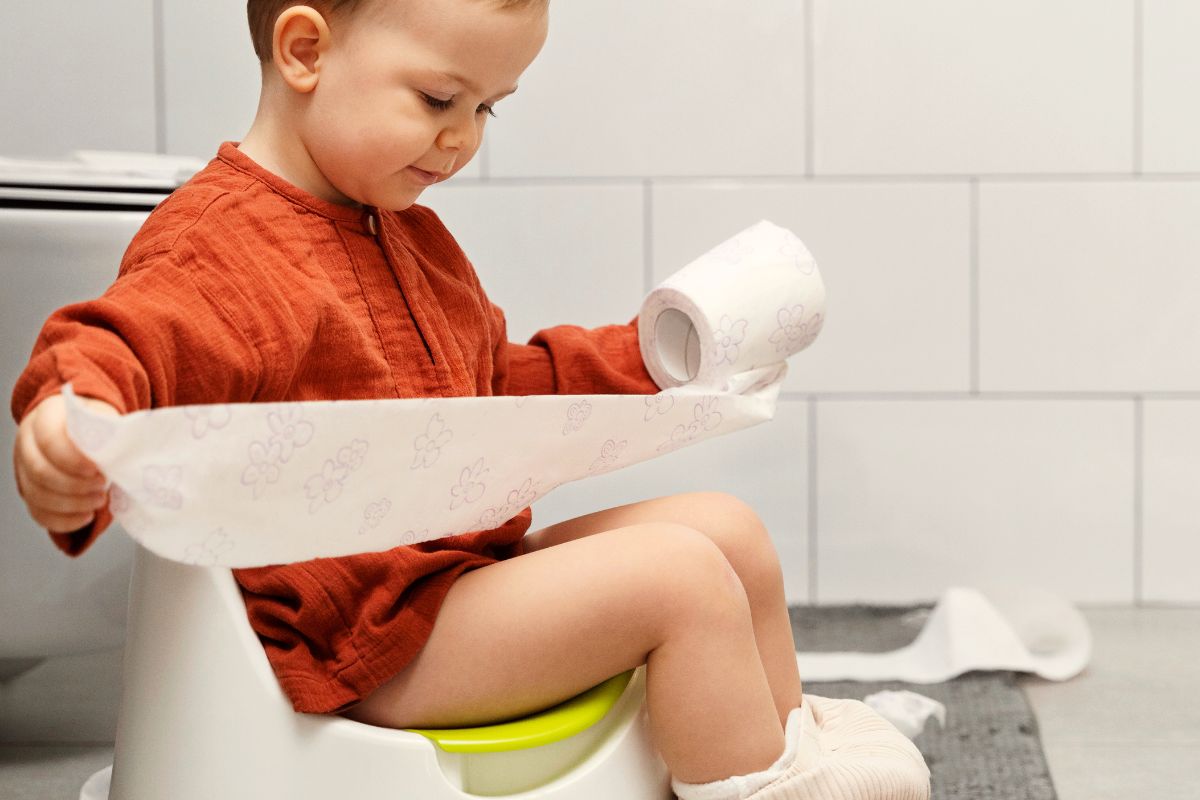
When my son was about 20 months old, a well-meaning relative told me he was “behind” on potty training. He was not behind. He was not trained yet. There is a difference, and that difference is the whole point of the Montessori approach to toilet learning.
The Montessori world uses the term “toilet learning” deliberately. Not potty training. Not a boot camp. Not a three-day method. Learning, which is something that happens in the child, not something done to them. For boys specifically, who statistically take longer than girls to reach daytime dryness, this distinction matters even more than parents are typically told.
Quick Reference
- When boys typically begin readiness: Median interest at 26 months, median daytime dryness at 35 months (Schum et al., 2002)
- When to introduce the potty: From 12-15 months, as a piece of furniture to explore, not a training tool
- Physical readiness signal: Crawling with belly fully off the floor and stable sitting: both indicate sphincter control is neurologically possible
- Sitting vs. standing: Sitting for everything first, always. Standing comes later, naturally, through imitation
- No rewards: Stickers, praise, and celebrations turn a natural bodily function into a performance, the opposite of what Montessori aims for
- Accidents: Factual, calm, and practical, not dramatic in either directionirection
- When to worry: Resistance is normal; persistent holding, pain, or regression beyond 6 months warrants a pediatrician visit
Why Boys Take Longer: The Science Behind the Timeline
Before getting into the practical setup, it helps to understand why boys typically take longer than girls to achieve daytime dryness, because this directly affects how you approach the process and what realistic expectations look like.
A large longitudinal study published in Pediatrics (Schum et al., 2002) followed 267 children weekly until they completed daytime toilet training. The findings were clear: girls achieved nearly all toilet training milestones earlier than boys, with a median age for sustained daytime dryness of 32.5 months for girls and 35.0 months for boys. The spread was wide: the interquartile range for boys spanned up to 14.6 months, meaning a completely typical boy might achieve dryness anywhere between 28 and 42 months. This is not a failure. It is normal variation.
The neurological piece: A 2020 study of 269 toddlers (Wyndaele et al., Global Pediatric Health) confirmed that age alone cannot predict readiness; development signs matter more than any calendar. The neurological pathways to the sphincters develop at different rates in different children. A practical indicator: a child who can crawl with their belly fully off the floor and sit stably has likely developed enough neuromuscular maturity for voluntary control to be possible. This typically arrives between 12 and 18 months, though it does not mean the child is ready to use the toilet, only that the physical foundation is in place.
The Montessori view is that starting too late is as unhelpful as starting too early. A research review in Pediatrics (Blum et al., 2003) found that while earlier initiation correlated with an earlier age at completion overall, it also correlated with a longer duration, suggesting that a child whose readiness window has already opened will make progress more efficiently than one pushed to start before they are ready. Follow the child, as Montessori would say, but follow them closely enough to notice when the window opens.
Readiness Signs to Watch For
Readiness is not a single moment. It is a gradual accumulation of physical, communicative, and behavioral signals. The more of these you observe consistently, the more the timing makes sense to start an intentional transition.
Physical Readiness
- Stays dry for at least 2 hours during the day (bladder capacity sufficient for holding)
- Passes urine in a larger, more predictable quantity rather than continuously
- Has bowel movements at roughly predictable times
- Can pull trousers and underwear up and down independently, or is close to it
- Walks and squats with coordination
Communication Readiness
- Understands and uses real words for urine, bowel movement, and body parts, not invented euphemisms
- Can tell you during or just after eliminating (even if not yet before)
- Follows simple two-step instructions reliably
- Shows awareness of a soiled or wet diaper, often with discomfort or a desire to change
Behavioral Readiness
- Shows interest in what adults or older siblings do in the bathroom
- Sits on the potty voluntarily, even just for exploration
- Demonstrates a strong drive toward independence in dressing and daily care
- Is not in a period of major disruption (new sibling, move, illness, any significant transition)
On timing disruptions: If you have just had another baby, are in the middle of moving house, or your child has recently started at a new nursery, this is not the right time to begin the transition. Montessori educators consistently note that regression and resistance during toilet learning are often rooted in stress rather than readiness problems. Address the environmental root first.
The Montessori Foundation: Starting Well Before the Potty
What most parents do not realize is that the Montessori approach to toilet learning begins in infancy, through the way diaper changes are handled, not through any formal introduction of a potty.
From birth, narrating diaper changes without shame or excessive reaction builds a child’s body awareness and vocabulary. “Your diaper is wet, you urinated. Let’s get you clean.” Said matter-of-factly, every time, from the first weeks. This does several things: it normalizes elimination as a bodily function, not something shameful or exciting; it builds the vocabulary the child will need later; and it begins the association between physical sensations and words.
From around the time the child can stand steadily (typically 12-15 months), standing diaper changes are introduced. The child participates: pulling down their own trousers, fetching clean underwear from a low shelf, disposing of the soiled diaper. These are practical life skills in the Montessori sense: small, real contributionss to their own care that build competence, engagement, and the habit of participating in bodily routines. By the time intentional toilet learning begins, the groundwork has already been laid for years.
A small potty in the bathroom from around 12 months is available simply as a piece of furniture to sit on, imitate, and explore. No pressure to use it. No celebration if they do. The pot is simply there, like everything else in the prepared environment, available when the child is ready to make use of it.
Preparing the Environment for Toilet Learning
When the readiness signs are present and the transition feels right, the bathroom setup makes all the difference. Independence, meaning the ability to manage the entire process without calling for an adult, is the goal, and the environment either supports it or it does not.
On pull-ups: The Montessori position is clear: pull-ups feel identical to diapers to the child, removing the sensory feedback (the feeling of wetness) that motivates the learning. Real cotton underwear, which the child can feel wet in, is the right choice from the day the transition starts. If you are not ready for accidents, you are not ready to start the transition.
The Transition: How to Actually Start
When the readiness signs are clear and the environment is set up, the transition itself is more gradual than most other methods. There is no “day one” where everything changes. There is, rather, a window where diapers are used less and underwear more, and the child’s own signals begin to guide the schedule.
Begin by offering the potty at predictable times, not asking if the child wants to go. “It is time to use the potty” works better than “Do you want to try the potty?” because the answer to an open question is almost always no. Offer after waking from a nap, before going outside, after meals, and before baths. These are the natural elimination windows and creating a routine around them reduces accidents without pressure.
Stay in the bathroom with the child without hovering. The child sits for a reasonable amount of time, one to three minutes, keeping them company calmly. If nothing happens, you move on. The routine is the point at this stage, not the result. Over days and weeks, the child begins to recognize the signals and act on them before you offer.
Sitting vs. Standing: The Honest Guide for Boys
This question comes up in almost every conversation about toilet learning for boys, and the answer is simpler than the debate suggests.
Sitting first, for everything
During toilet learning, boys sit for both urination and bowel movements. This is simpler, requires fewer concurrent skills, and allows the child to focus on learning the bodily signals without simultaneously managing aim and standing posture. The small floor potty with a front guard makes this comfortable and prevents misses. Learning one thing at a time is a core Montessori principle: do not ask the child to manage two new skills at once.
Standing comes through imitation, not instruction
Once a boy has established reliable daytime dryness sitting down, standing urination typically emerges naturally through observing male family members or peers. This does not require a formal lesson. When he expresses interest, a sturdy step stool at the toilet and calm modeling are all that is needed. The Montessori position here is that imitation is one of the most powerful learning mechanisms a toddler has. Let it work. If he needs aim practice, let him try naturally; the Cheerio target trick works, but treat it as a practical game, not a performance.
Why Rewards Do Not Work Here
Sticker charts and candy rewards are the most widely recommended approach outside the Montessori world. The problem is not that they feel wrong; they often produce quick short-term results. The problem is what they undermine.
When a child earns a sticker for using the potty, using the potty becomes about the sticker, not about the internal experience of bodily control and independence. The day the stickers stop, the motivation can stop with them. More importantly, a natural bodily function has been reframed as an achievement requiring external validation, the opposite of the intrinsic motivation that the Montessori approach aims to cultivate across everything from reading to practical life skills.
The Montessori Foundation guidance is direct on this: “There should be no pressure, no reward or punishment, no adult deciding when the child should learn.” Over-celebrating a success is as counterproductive as scolding an accident, because both make the toilet into something emotionally loaded. The goal is for the potty to be as unremarkable as a chair, something the child uses when needed, calmly, without drama in either direction.
What works instead is factual acknowledgment: “You felt you needed to urinate and you came to the bathroom. That is exactly what grown-ups do.” No clapping. No treats. The competence itself is the reward, and boys feel it without being told to.
When He Has Accidents
Accidents are not failures. They are information: either about timing, about environmental factors, or simply about the fact that learning is still in progress. The adult’s response sets the entire tone.
The Right Response To An Accident
- Stay calm and neutral in voice and body language, not disappointed, not overly reassuringerly reassuring
- State what happened simply: “You are wet. You urinated in your underwear.”
- Involve him in the cleanup: “Let’s go get some dry clothes from the bathroom.”
- Let him pull on the clean underwear himself, put the wet ones in the bucket himself
- Move on without commentary; no “That’s okay”, no sigh, no “next time we’ll do better”
This approach gives the child ownership of the consequence: wet is uncomfortable, getting dry is good, and the child manages both. There is no shame and no rescue. The discomfort of wearing wet clothes for the 90 seconds it takes to get to the bathroom is part of how the learning works.
When He Refuses
Resistance is almost always either a timing problem or a stress problem, and occasionally both. Before assuming the child is not ready, work through these possibilities.
If The Resistance Is To Sitting At All
Stop offering the potty as a question and return to a simple statement at routine times. Do not interrupt play. Offer when you know his natural elimination times are (after meals, after naps) and wait for him to finish his current activity first. Interrupting a child mid-task is one of the most reliable ways to generate resistance.
If There Has Been A Recent Change In The Household
New sibling, new childcare setting, house move, illness, travel, any of these can trigger regression or resistance in a child who was previously making progress. This is not stubbornness. It is a predictable response to stress. A two-week pause, returning to diapers without comment, is a legitimate and Montessori-consistent response. Address the root, not the symptom.
If The Readiness Signs Simply Are Not There Yet
Pause for a month and revisit. Continued resistance in the absence of stress or timing problems is almost always the child telling you that the window has not opened yet. This is information, not failure. Come back in four to six weeks and observe again. Boys who transition later often do so more smoothly than boys who were pushed before they were ready.
Montessori Gear Worth Having
The environment does most of the work. The right few pieces mean the child can manage independently; the wrong setup creates dependence on the adult for every step.
A Small Floor Potty: BabyBjörn Smart Potty
Stable, simple, no sounds, no lights, no unnecessary features. The inner bowl lifts out so the child can carry it to the toilet and empty it themselves, a practical life task in the Montessori sense. The front splashguard is well-designed for boys. This is not the most exciting potty on the market, which is exactly the point.
No distractions
Front guard for boys
Easy to clean
A Visual Routine Card, Not a Reward Chart
A visual sequence of the steps: pants down, sit, wipe, pants up, flush, wash hands. This helps a child remember the routine without adult prompting for each step. This is a reference card, not a sticker chart. There is no tracking, no ticks, no celebration for completion. It is a practical visual aid for a child who is learning a multi-step sequence. You can find printable versions or use photographs of your own child doing each step (Montessori educators often recommend this: a child’s own photo is more meaningful than a generic illustration).
Reduces dependence on adult prompting
Not a tracking chart with ticks or stickers
The Summary
Toilet learning for boys is slower than many parents expect, and this is not a problem. The median age for daytime dryness in boys is around 35 months, with perfectly normal variation extending past 40 months. Pushing earlier does not help, and celebrating each success too loudly often creates dependence on external validation rather than genuine mastery.
Prepare the environment, follow his signals, respond to accidents calmly and practically, and trust that a child given the right conditions will learn to use the toilet with the same quiet competence he brings to every other practical life skill. That is what Montessori means when it says follow the child.
Parents Ask Most Often
My son is 3 and still not using the potty. Should I be worried?+
At 3 years, if your son shows no interest in the potty, cannot yet stay dry for 2 hours, and does not communicate about elimination, it is worth mentioning to your pediatrician at the next visit. If he shows all the readiness signs but is resisting, that is a different situation, likely timing or stress-related rather than developmental. Most boys complete daytime training by 36-42 months. Beyond 48 months with no progress warrants a conversation with your doctor.
Can I start toilet learning at nursery if we have not started at home?+
Consistency between home and nursery makes the process significantly easier. If the nursery uses a child-led approach similar to Montessori, coordinating timing, starting both simultaneously when readiness signs appear, is ideal. A child who wears underwear at nursery but diapers at home receives a confusing message about what is expected and where. Talk to the nursery team and agree on an approach before starting either location.
He is fine at home but has accidents every day at nursery. What is happening?+
This is very common and almost always reflects the higher cognitive and social demands of a group setting: the child gets absorbed in play and does not notice the signals until too late. It is also partly an environment problem: can he reach the bathroom himself without asking an adult? Is the routine at nursery as predictable as at home? Ask the nursery team what their setup looks like and whether he is offered the toilet at set times. With consistency, this usually resolves within a few weeks.
What about night dryness?+
Night dryness is controlled by a hormonal mechanism (ADH production) that is largely outside a child’s conscious control and develops separately from daytime learning, often 6-18 months later. Keep a nappy or night trainer on for sleep, without comment or pressure, until the child wakes consistently dry for two weeks. Night dryness cannot be trained in the same way as daytime dryness. It arrives when the physiology is ready.
Scientific References
Schum, T.R., Kolb, T.M., McAuliffe, T.L. et al. (2002). Sequential acquisition of toilet-training skills: a descriptive study of gender and age differences in normal children. Pediatrics, 109(3), e48.
Wyndaele, J.J., Kaerts, N., Wyndaele, M. & Vermandel, A. (2020). Development signs in healthy toddlers in different stages of toilet training: can they help define readiness and probability of success? Global Pediatric Health, 7, 2333794X20951086.
Blum, N.J., Taubman, B. & Nemeth, N. (2003). Relationship between age at initiation of toilet training and duration of training. Pediatrics, 111(4), 810–814.
Montessori Foundation. A Montessori Approach to Toilet Training. Susan Stephenson, The Joyful Child. montessori.org →


