
I remember standing in front of a Pikler triangle in a toy shop, my six-month-old on my hip, wondering if it was way too early. The label said “ages 6 months to 5 years” and I thought: there’s no way this baby is climbing anything anytime soon. I bought it anyway, half convinced I’d wasted the money.
Two weeks later she was pulling herself up on the rungs with this look of total concentration. She wasn’t climbing. But she was already using it exactly the way she needed to. That’s the thing about Montessori climbing toys, the right one at the right age doesn’t look impressive. It just fits.
Montessori Climbing Toys by Age: What You Need to Know First
There is no single “best” Montessori climbing toy — there’s the right one for where your child is right now. This guide is organized by developmental stage, not just age, because a confident 14-month-old and a cautious 20-month-old are not in the same place physically, even if they’re close in age.
- 6-12 months: Pull-to-stand phase — Pikler triangle as a support bar, foam climbers
- 12-18 months: First real climbing — low triangle, arch rocker, foam sets
- 18 months – 3 years: The peak climbing phase — triangle + ramp, arch, balance board
- 3-6 years: Complex play and real physical challenge — full sets, climbing walls, cubes
- One rule across all ages: Never put your child in a position they can’t get into themselves
Why Children Need to Climb at Every Age
Before getting into the age guide, it helps to understand what climbing actually does for a child’s development — because it’s more than just “good for gross motor skills.”
Every time a child climbs, their brain is doing several things at once: calculating distance, planning the next grip, shifting weight, and recovering balance when things go slightly wrong. That’s not exercise — that’s problem-solving, spatial reasoning, and self-regulation happening simultaneously in a small body.
Dr. Maria Montessori identified what she called sensitive periods — windows where children are driven to practice certain skills with unusual intensity. The sensitive period for movement peaks in the toddler years, which is why a two-year-old who is told not to climb the couch will simply find something else to climb. The answer isn’t redirection. It’s a better option.
One principle that applies at every age: in Montessori and Pikler philosophy, you should never place your child on a structure they couldn’t reach themselves. It sounds counterintuitive, but it matters. When a child gets into a position independently, they’ve already developed the strength and coordination to be there. Placing them higher than they climbed to creates real risk, and removes the developmental benefit of figuring it out themselves.
6 to 12 Months: “I Want to Pull Myself Up on Everything”
Your baby isn’t climbing yet, but something important is already happening. Around 6 to 9 months, most babies discover that they can use their arms to pull their body upright. They’ll grab at your hands, the edge of the couch, the coffee table leg. Anything stable will do.
This is the pull-to-stand phase, and it’s the foundation of everything that comes after. A child who pulls themselves up on a rung is developing the grip strength, core stability, and body awareness that will eventually become confident climbing. The mistake parents make at this age is waiting until their child “is ready to climb” before buying anything. At 6 months, they’re already ready for a structure to pull against.
What works at 6-12 months
Pikler triangle — not as a climbing structure yet, but as a pull-up bar. The horizontal rungs are exactly the right thing for a baby learning to stand: they’re stable, they’re at varying heights, and the baby can practice repeatedly without your help. By 9-10 months, some babies start hauling their knees up onto the lowest rung. You’ll know it when you see it.

Foam modular climbers — low foam shapes (steps, wedges, tunnels) that a baby can crawl over, lean against, and eventually climb. They’re particularly good for this age because the softness removes the consequence of a tumble on a hard floor. Look for GREENGUARD Gold certified foam and machine-washable covers.
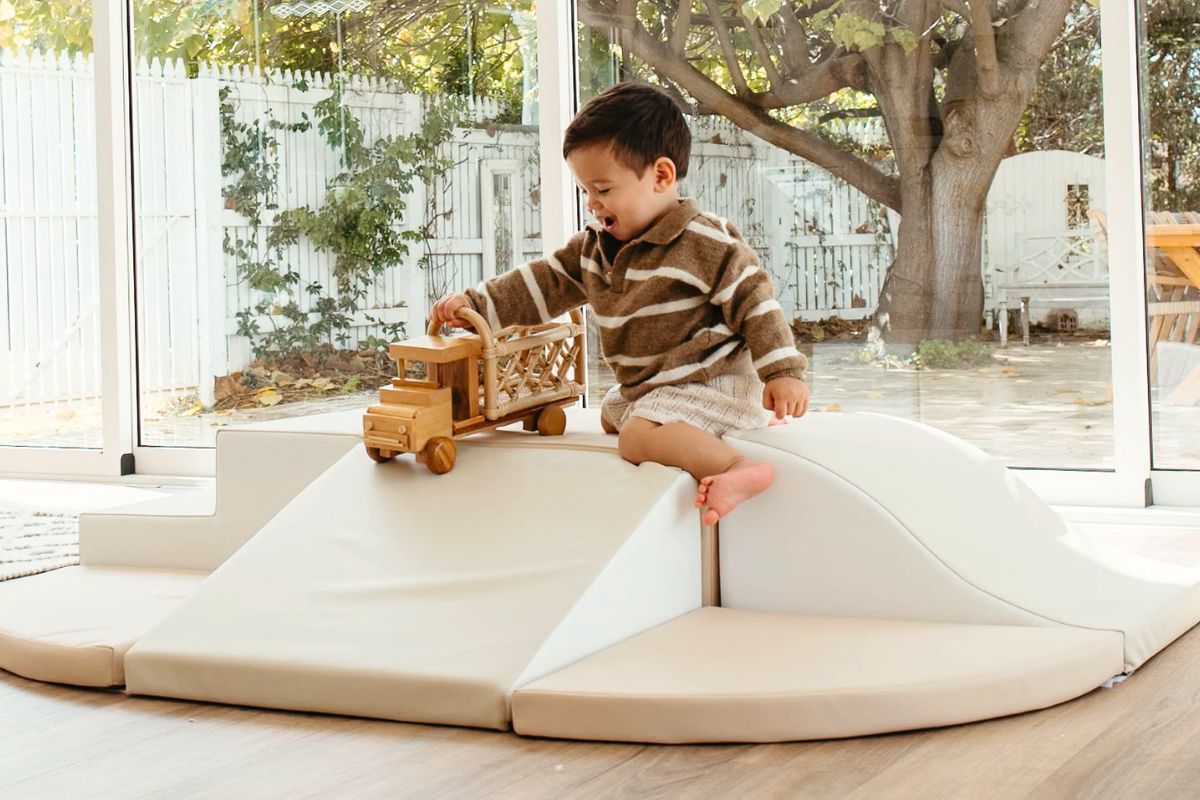
Arch rocker (flipped as a rocker with cushion) — a climbing arch flipped upside-down becomes a gentle rocker. For babies under 12 months, this provides vestibular stimulation — the inner ear’s balance system — in a safe, controllable form. It costs nothing extra if you’re buying an arch anyway.

What to watch for
Tries to climb low steps or sofa edge
Pulls up repeatedly on anything stable
Montessori note: Stay nearby but don’t hover. At this age, babies are learning to get down as much as they are learning to get up. Let them work out the descent themselves. It’s the frustration of figuring it out that builds the skill.
12 to 18 Months: “I’m Going Up, But Coming Down Is the Problem”
This is when real climbing starts, and it comes with a very specific challenge that every parent recognizes: the child can get up just fine, but getting back down is terrifying. You’ll find your toddler at the top of the triangle, frozen, looking at you with a mix of pride and panic.
That moment is not a problem. It’s the learning. The brain is recalibrating, figuring out that descent requires a different weight distribution than ascent. This is where so much of the spatial reasoning and proprioception development happens. Your job is to resist catching them before they need to be caught.
What works at 12-18 months
Arch rocker — now used as both a rocker and a climbing structure. The curved shape is naturally lower to the ground than the triangle, which makes it ideal for children still working on their confidence with heights. Flipping it gives a completely different challenge. One piece, two functions, excellent value at this stage.

Foldable climbers — a practical choice for families without a dedicated playroom. Most fold flat and store behind a door or under a bed. The climbing experience is slightly more limited than a full Pikler, but the trade-off in storage makes them a realistic daily-use option for apartments.

Pikler triangle with a soft mat underneath — if you already have the triangle from the previous stage, this is when it starts being used properly. Place a thick foam mat or a folded duvet underneath. The fall from the lowest rungs is small, but the mat removes the hesitation that would otherwise hold the child back from experimenting freely.

What to watch for
Attempts to climb furniture at home
Repeats the same climb over and over
A note on repetition: if your toddler climbs the same three rungs forty times in a row, that’s not boredom. That’s mastery in progress. Resist the urge to show them “a better way.” They’re doing exactly what they need to do.
18 Months to 3 Years: The Peak of the Climbing Phase
This is the stage where the climbing toy earns back every penny. Children in this window are physically driven to climb, jump, balance, and test what their body can do. This is also the age where Dr. Montessori’s sensitive period for movement is at its most intense — the nervous system is genuinely demanding this kind of input for development.
What changes from 18 months onward: climbing becomes intentional. Your toddler isn’t just going up anymore. They’re choosing where to put their hands, planning the route, sometimes asking themselves mid-climb if they should go left or right. Pretend play also starts merging with physical play. The triangle becomes a castle. The ramp becomes a dragon’s tail. This combination of physical and imaginative engagement is exactly what Montessori climbing equipment is designed to support.
What works at 18 months to 3 years
Pikler triangle with a ramp — this is the combination most families find gives the best daily use. The ramp adds a second dimension: one smooth side for sliding, one textured side for climbing. Children at this age will spend long stretches alternating between going up one way and down the other, sometimes for 40 minutes at a stretch. That sustained concentration is exactly what you’re looking for.

Climbing arch — by this age, the arch is used properly as a climbing challenge. Going over the top of it requires children to commit their full body weight over the apex, which demands real courage and coordination. It’s a different movement pattern from the triangle, which is why the two work so well together. If budget allows for only one, the arch gives more developmental range earlier.
Balance board — often underestimated, but one of the most used pieces in this age window. A curved wooden board that children rock on, balance on, sit inside, use as a ramp, or bridge between other structures. It stores easily, works in any room, and children return to it for years. It develops the same vestibular and proprioceptive systems as climbing, just in a quieter, more meditative way.

Climbing sets (triangle + arch + ramp) — if you’re buying at this stage and want longevity, a 3-piece set covers everything. Children reconfigure the pieces constantly, creating different combinations that keep the challenge fresh without buying new equipment. Brands like Wood & Hearts, Goodevas, and Piccalio offer good quality at this format.

What to watch for
Incorporating pretend play into climbing
Trying to combine structures creatively
3 to 6 Years: More Challenge, More Imagination, More Independence
By age three, most children have mastered the Pikler triangle. That doesn’t mean they’ve outgrown it — it means they need more from it. At this stage, the physical challenge shifts: children want height, they want upper body work, and they want structures complex enough to build imaginative worlds around.
They also start needing less supervision. A four-year-old who has spent a year and a half on a Pikler triangle has a very accurate sense of their own abilities. They know which risks are fine and which ones aren’t. This is not the time to add more protective measures — it’s the time to give them access to more appropriate challenge.
What works at 3 to 6 years
Climbing cube — an open wooden cube children can climb into, over, and through. At this age, the imaginative dimension is as important as the physical one. Children turn it into a house, a shop, a cave. Some brands (notably RAD Children’s Furniture) design their cubes to connect directly with the triangle and arch, creating expandable configurations that grow with the child.

Climbing wall (Swedish wall / stall bars) — a wall-mounted ladder grid that uses vertical space rather than floor area. This is the most space-efficient option for families with older children, and it provides real upper-body strength work that a triangle no longer offers. Children can climb, hang, traverse horizontally, and develop grip strength. Requires wall mounting, so check your wall structure first.

Climbing dome — the natural step up for children who are ready for more challenge and group play. The dome’s multi-directional structure develops agility and coordination differently from a triangle. It also accommodates multiple children at once, which matters at this age when social play starts driving everything.

Climbing tower — for children who have mastered the triangle and want height. Multiple platforms at different levels, places to perch and observe from. Children at this age spend time just being up high, looking out — it builds spatial awareness in a different, quieter way than active climbing.
What to watch for
Builds elaborate games around the structure
Wants to hang, swing, test upper body strength
Quick Reference: Climbing Toys by Age and Stage
Every child develops at their own pace. These are typical windows, not rules. If your 20-month-old is still working on pull-to-stand, that’s completely fine — match the toy to the stage, not the birthday.
Setting Up Safely at Any Age
The climbing toy itself is only part of the equation. A few practical things that make a real difference regardless of age.
- Put a soft mat underneath — especially under 2 years old. A foam play mat or thick rug reduces the consequence of a fall enough that children will experiment more freely, which is the whole point.
- Keep 18 inches of clear space around the structure — children instinctively try to bridge from the triangle to nearby furniture. Remove that option.
- Check for loose bolts every few weeks — wooden climbing toys use hardware that can work loose with heavy daily use. Two minutes with a screwdriver is worth it.
- Stay close but don’t hover — under 18 months, stay within arm’s reach. After 18 months, stay in the room but let them work through the problem before you intervene. The struggle is where the development happens.
- Choose age-appropriate heights — select the toy size matched to your child’s current stage, not the stage you’re hoping for.
Ready to choose the right brand? We’ve reviewed the best Montessori climbing toys on the market with detailed safety certifications, prices, and honest pros and cons.
Questions Parents Ask Most Often
After years of conversations with parents navigating this purchase, these come up again and again.
Is 6 months really old enough for a Pikler triangle?+
Yes, but not for climbing. At 6 months, a baby uses the Pikler triangle as a pull-up bar — exactly what they’d do with a coffee table leg or your hands. The difference is that the rungs are at multiple heights, so the challenge grows with the baby over the following months without you doing anything. You’re not buying a climbing toy at 6 months. You’re buying a pull-up tool that will still be used daily at age 5.
My toddler gets to the top and then cries. What should I do?+
Wait, calmly. You can say “I’m right here” and stay close, but try not to immediately lift them down. The frustration of figuring out the descent is where most of the motor learning happens. If they’re genuinely distressed, guide their feet to the next rung verbally before using your hands. Over days and weeks, they’ll work it out — and when they do, the confidence they gain is real and lasting.
Should I start with the triangle or the arch?+
If your child is under 12 months, start with the arch. The rocking function serves babies before they’re ready to climb, so you get more use earlier. If your child is already walking and attempting to climb, go straight to the triangle. It offers more climbing height and stays relevant longer as a stand-alone piece. If budget allows, getting both is worth it: they develop different movement patterns and children use them differently.
When do children outgrow Montessori climbing toys?+
A standard Pikler triangle starts to feel small around age 5-6 for most children, though some use it longer as a fort base or imaginative play structure. Quality wooden sets hold their value well and are commonly resold for 60-80% of the original price, which makes the investment more manageable in hindsight. If your child is 5 and visibly bored with the triangle, a climbing wall or dome gives the physical challenge they’re now ready for.
The Right Climbing Toy Changes Everything — If the Timing Is Right
My daughter is five now. The same Pikler triangle that served as a pull-up bar at six months has been a climbing structure, a fort frame, a puppet theater, and last week apparently a very important spaceship. My son, at two, uses it in a completely different way from how she did at the same age. There is no single right way to use it.
What I’ve learned is that the value isn’t in any specific toy. It’s in having something available that matches where your child is right now — something that challenges them just enough to engage fully, but not so much that they give up. That window changes every few months. Paying attention to it is more useful than any buying guide.
Start earlier than you think you need to. Buy slightly below your child’s current ability, not above it. And then step back and watch what they figure out.
Sources & References
- Pikler, E. (1971). Peaceful Babies — Contented Mothers. International Child Development Programmes.
- Montessori, M. (1949). The Absorbent Mind. Clio Press Ltd.
- Adolph, K. E., & Hoch, J. E. (2019). Motor development: Embodied, embedded, enculturated, and enabling. Annual Review of Psychology, 70, 141-164. DOI: 10.1146/annurev-psych-010418-102836
- Bornstein, M. H., & Arterberry, M. E. (2010). The development of object categorization in young children. Developmental Psychology, 46(2), 350-365. DOI:10.1037/a0018411
- National Institute of Child Health and Human Development. (2006). The NICHD Study of Early Child Care and Youth Development. NIH Publication.