
This guide contains affiliate links. If you buy through them, Montessori Theory may earn a small commission at no extra cost to you. Amazon links open a search so you can compare current options and prices.
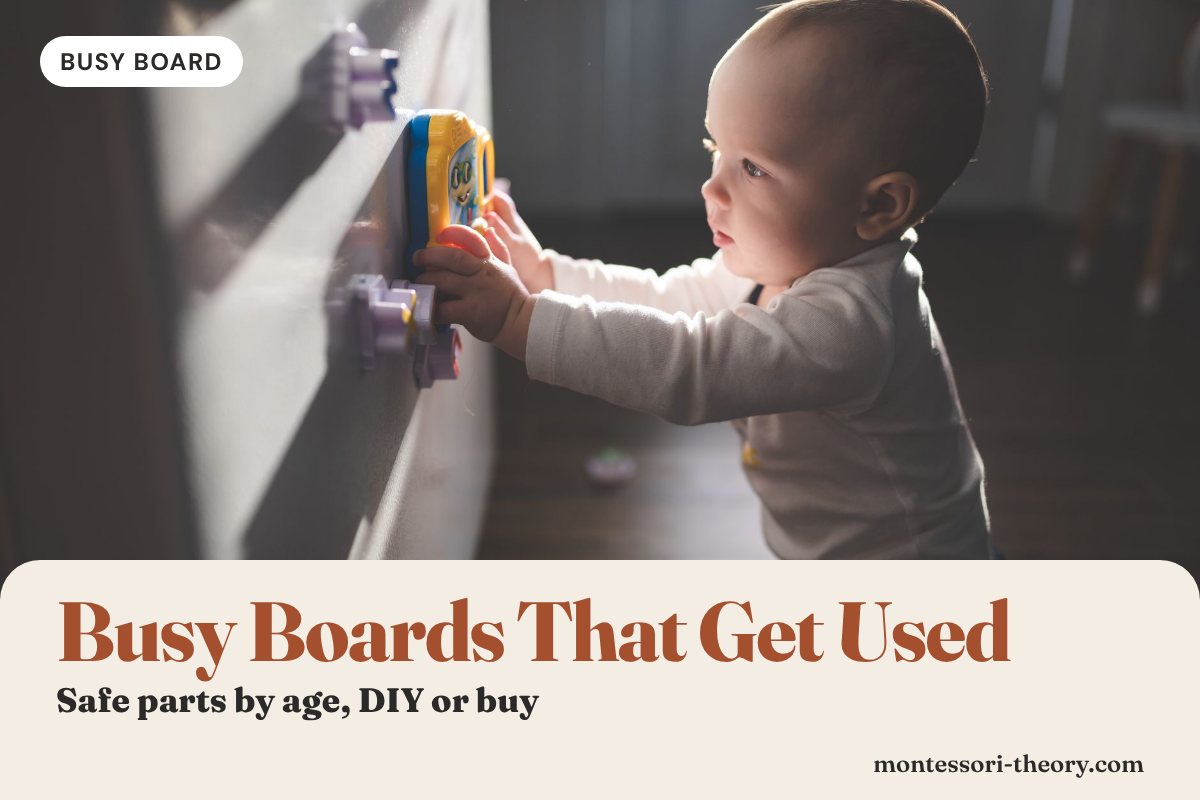
A busy board is a sturdy panel fitted with real mechanisms, like latches, locks, wheels, switches and zippers, that a toddler can work again and again. Some get used for months. Others are ignored after a week.
This guide covers what a busy board actually builds, what to put on it at each age, the parts to leave off for safety, DIY versus buying, and what to offer instead when your child wants to take real things apart.
Quick Answer
- A busy board practices hand skills on real mechanisms, like turning, sliding, pulling and fitting a key.
- Most children are ready for a simple board around 12 months. Add harder mechanisms between 18 months and 3 years.
- Leave off anything with button batteries, magnets, small caps, long cords or sharp edges. A “Montessori” label does not make a board safe.
- Boards that open onto something, a picture, a mirror or a small space, hold interest longer than mechanisms that do nothing.
Is a Busy Board Montessori?
Partly. A classic Montessori material isolates one skill. The dressing frames, for example, each teach a single fastening, buttons on one frame, a zipper on another, a buckle on a third. A busy board puts ten mechanisms side by side, which is the opposite approach.
What a busy board does share with Montessori is real objects. A real barrel bolt and a real light switch are closer to the house a toddler lives in than a plastic toy that beeps. Used well, a busy board can be a Montessori-inspired material.
- Fewer mechanisms, better made. Four solid latches beat fifteen flimsy ones.
- A purpose behind each one. A door that opens onto a photo of the family, a bolt that locks a small box.
- Real life first. Opening the real cupboard you’ve cleared for your child, zipping their own coat and turning on the real lamp all count as the same work.
What a Busy Board Builds
| Mechanism | Hand skill | Real-life use |
|---|---|---|
| Spinning wheel, large knob | Turning with the whole hand | Door handles, lids |
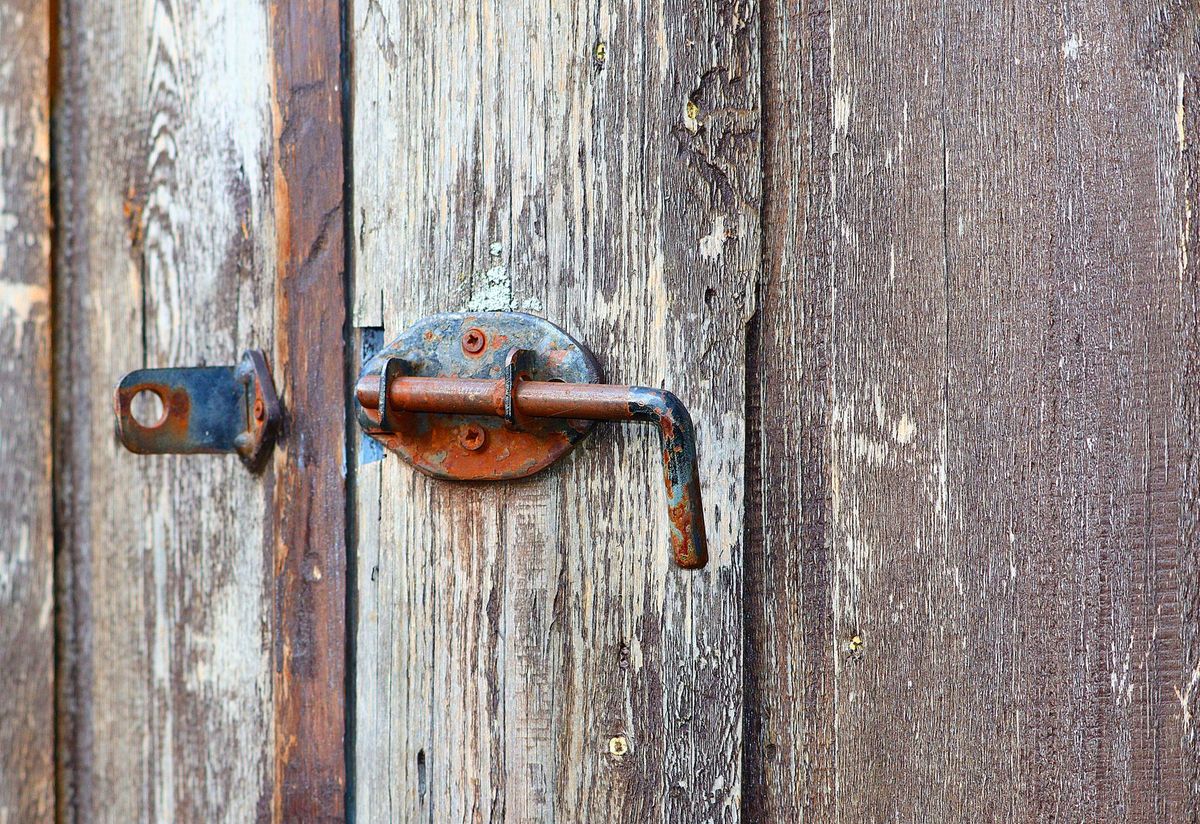
| Barrel bolt, sliding latch | Pushing and pulling in a line | Gates, cabinet locks |
| Hinged door with a picture behind it | Opening, object permanence | Cupboards, books |
| Zipper, hook and loop, large buttons | Pinching, two hands working together | Getting dressed |
| Key and padlock | Precise wrist turn | Doors, mailboxes |
| Buckle, clasp, chain door guard | Strength and sequence | Car seat, bags, belts |
What to Put on a Busy Board by Age
| Age | Mechanisms that fit | Keep for later |
|---|---|---|
| 12 to 18 months | Spinning wheel, large knob, light switch with no power, hinged door with a photo behind it, acrylic mirror, wide drawer | Keys, buckles, small latches |
| 18 to 24 months | Large barrel bolt, sliding latch, hook and loop strap, large zipper, push button doorbell with no battery | Padlocks, buttons |
| 2 to 3 years | Padlock with key, chain door guard, buckle, large buttons, gears that turn together, hook and eye latch | Screws and tools |
| 3 years and up | Screw-on lids, nuts and large bolts, a combination lock, a dressing frame set | Move on to real tinkering (below) |
Start with three or four mechanisms your child can almost do. Add a new one when the board stops getting chosen.
Busy Board Safety, Beyond the Label
Many boards sold as Montessori come with parts that are not suitable for young children. Check every part yourself, whatever the packaging says.
- No button or coin batteries. The CPSC warns that swallowed button batteries can cause severe internal burns within hours. Skip battery lights and buzzers unless the compartment is screwed shut, and check the screw often.
- No small magnets. Swallowed magnets can attract each other inside the body and cause serious injury.
- No small parts. Anything that fits inside a toilet paper tube is a choking risk for children under 3, including the rubber caps on door-stop springs, small keys and loose screws.
- No long cords or loops. Keep any string shorter than your child’s forearm.
- Smooth edges, solid fixing. Sand every edge. Fix hardware with screws from the back of the board, and check them every few weeks.
- Stable board. Screw a large board to the wall or lay it flat on the floor. A heavy board leaning on a wall can fall on a child.
DIY or Buy?
- DIY board. About $30 to $60 in plywood and hardware, real full-size parts you choose, easy to change as your child grows. It takes an afternoon.
- Store-bought board. From about $25 for small boards to $100 or more. Ready to use, but parts are often miniature, so check every one.
To make one. Use a piece of 1/2-inch plywood about 24 by 18 inches. Sand the edges and corners round. Lay out four to six mechanisms with space for small hands between them. Fix each one with screws long enough to hold but short enough not to come through the front. Mount the board to the wall at your child’s chest height, or keep it on the floor.
To buy one. Look for full-size, metal hardware, smooth edges and no batteries. Compare current options on Amazon, or look at Montessori dressing frames for one fastening per frame.
Why Some Busy Boards Get Ignored
- Everything is solved in a day. Mechanisms that are too easy lose their pull fast. Add a harder one.
- Nothing happens. A latch that opens onto nothing is less interesting than a cupboard. Put something behind each door.
- Too much at once. Fifteen parts on one board is hard to focus on. Cover some, or rotate.
- The real thing is more interesting. Many toddlers prefer the real door, the real lamp and the real cupboard. That is not a problem. Give them a few real ones they are allowed to use.
If your child ignores the board for a few weeks, store it and bring it back later. Lack of interest says nothing about development. It usually means the board doesn’t match what they are working on right now.
For Children Who Want to Take Things Apart
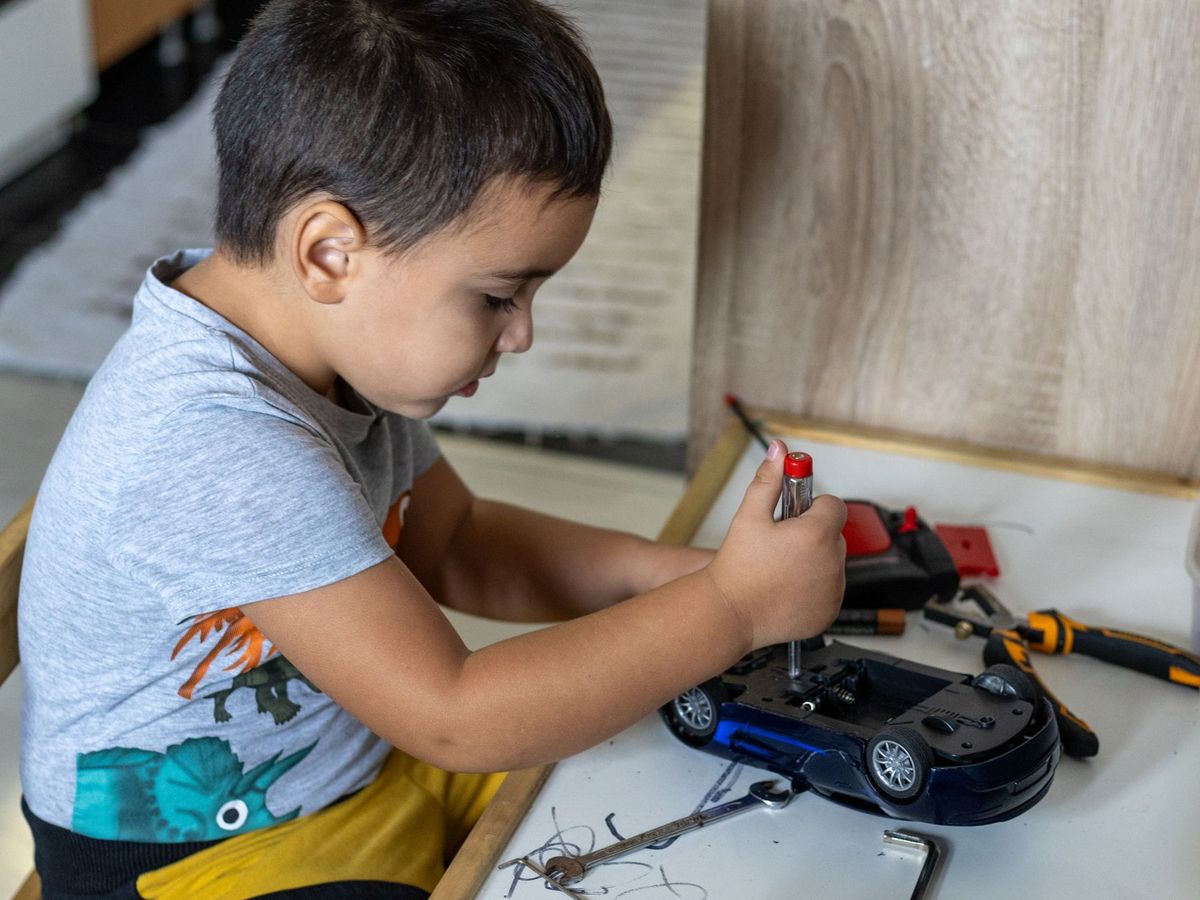
Some children are less interested in a board than in how real objects work, the vacuum cleaner, the coffee maker, the door hinge. That curiosity can be given a safe place.
- From about 2 years. Jars and bottles with different lids, a lock box with keys (see our lock box guide), a hand-crank flashlight, a whisk and a salad spinner.
- From about 3 years. Large nuts and bolts on a board, a child-sized screwdriver and a block of soft wood with screws started for them, a take-apart toy vehicle.
- From about 4 years, with an adult. An old keyboard or a simple mechanical toy, unplugged with the cord cut off and all batteries removed. Avoid microwaves, old TVs and anything with a large power supply, which can hold a charge after unplugging.
Our practical life guide has more real jobs that use the same hand skills.
Questions Parents Ask
What Age Is a Busy Board For?
A simple board with a wheel, a knob and a hinged door suits many children from about 12 months. Most of the use comes between 18 months and 3 years.
What Should I Put on a Busy Board for a 1 Year Old?
A spinning wheel, a large knob, a light switch with no power, a hinged door with a family photo behind it and an acrylic mirror. Avoid keys, small latches and anything with batteries.
Are Busy Boards Good for Toddlers?
They can be, if the parts are safe and match your child’s skills. They are one option among many. Real cupboards, clothes and household objects build the same skills.
Is a Busy Board Good for Travel?
Small fabric busy books travel better than wooden boards. For more ideas, see our travel activities for toddlers.
Free Toddler Printables
Our book The Everyday Montessori Toddler (18 months to 3 years) comes with free printables, including 24 activity cards. Download them here.
Sources
- U.S. Consumer Product Safety Commission, button battery and magnet ingestion warnings, and small parts rule for children under 3 (16 CFR Part 1501).
- Montessori, M. The Discovery of the Child (1948), on the dressing frames and materials that isolate one difficulty.
- Lillard, A. S. Montessori: The Science Behind the Genius (3rd ed., 2017).
- Photos from Pexels (free licence).