
When I was pregnant with my first, I saved nursery after nursery on Pinterest. Every room looked calm and expensive. The crib was the centerpiece, the art was hung at adult height, and the toys were arranged for the photograph rather than for the baby lying on the floor.
A Montessori baby room starts with a less glamorous question. What does my baby need to see, reach, and experience from where they actually are? That question changes the room. It also prevents you from spending money on furniture that looks useful now but does very little for the baby during the first year.
A Montessori baby environment is organized around four consistent functions. These zones can share one bedroom or be distributed across your home. The goal is not to create a miniature playroom. It is to support the needs that dominate the first 12 months.
Baby room or playroom?
This guide is for babies from birth to 12 months. It covers sleep, movement, feeding, and care. For a mobile toddler who needs an activity shelf, work mat, reading corner, and toy rotation system, use the playroom guide instead.
What Makes a Montessori Baby Room Different?
A traditional nursery is usually organized around adult convenience. Storage sits at adult height. The baby is moved from crib to changing table to swing. Most of the room can only be used when an adult places the baby there.
A Montessori-inspired baby environment gives the infant more opportunity for free movement, visual concentration, predictable care, and gradual participation. It does not require a special aesthetic. Pale wood, beige walls, and woven baskets are optional. Access, consistency, and safety are not.
Designed from floor level
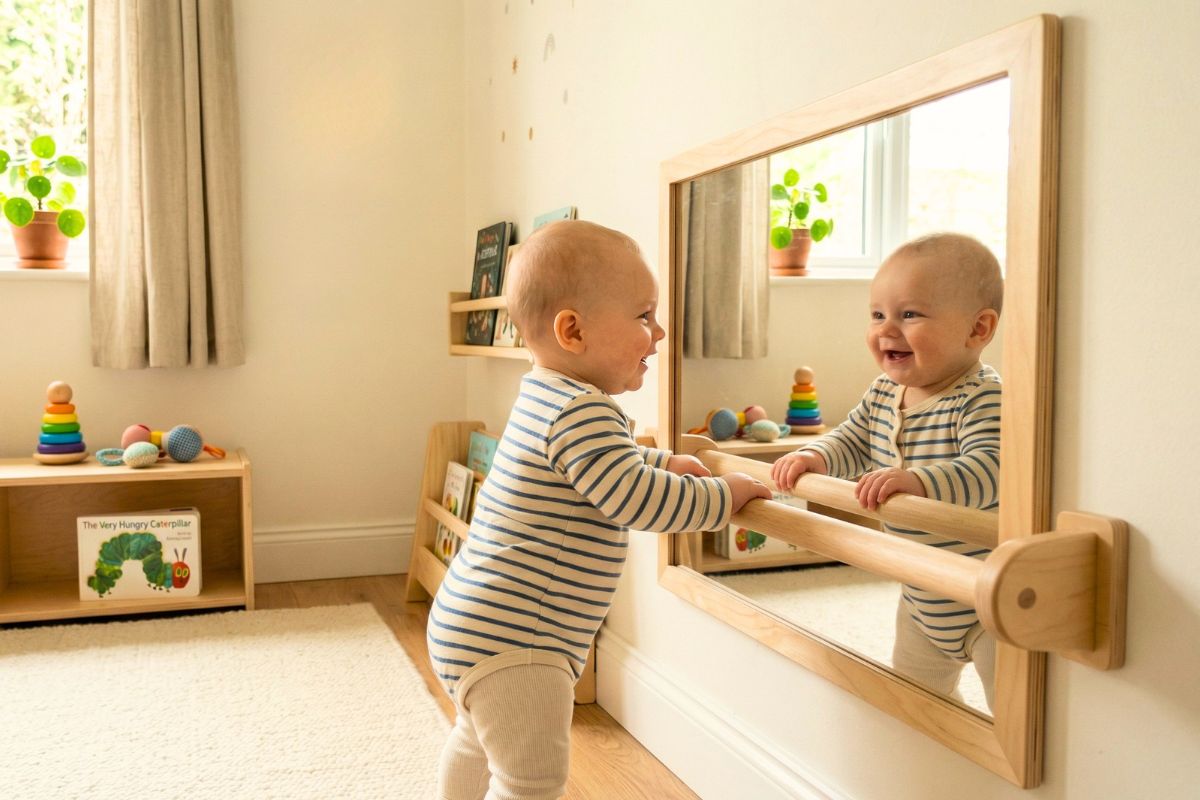
The mirror, images, movement mat, and first objects are visible from the baby’s real position.
Movement before equipment
Clear floor space matters more than another seat, jumper, or entertainment device.
Consistent care
Feeding and physical care happen in predictable places with the adult fully present.
Fewer objects
The environment changes with development instead of trying to entertain every stage at once.
The Four Zones of a Montessori Baby Environment
The four-zone model is useful because it stops the room from becoming a general container for every baby product. Each area has one primary job.
In a small apartment, the sleeping area may be in the parents’ bedroom, the movement area in the living room, and the feeding chair in a quiet corner. The zones do not need to fit into one photograph. They need to work in your actual home.
Zone 1: Safe Sleep
This is the section where online Montessori advice often becomes too confident. A philosophy of independence does not replace infant safe-sleep guidance.
Important sleep-safety note
For infants, the American Academy of Pediatrics, CDC, and U.S. Consumer Product Safety Commission recommend a firm, flat surface in a safety-approved crib, bassinet, portable crib, or play yard, with a fitted sheet only. Babies should be placed on their backs, and soft bedding, pillows, bumpers, and toys should remain outside the sleep space.
A mattress placed directly on a bedroom floor is not automatically equivalent to a regulated infant sleep product. Discuss any alternative sleep arrangement with your pediatric professional and follow the safety guidance applicable in your country.
For many families, the Montessori element is not the absence of a crib. It is the calm, uncluttered sleep area, the predictable routine, and the decision not to fill the sleep space with entertainment.
Prioritize
- A safety-approved infant sleep product appropriate for the baby’s age
- A firm, flat mattress with a tightly fitted sheet
- A bare sleep space
- Room sharing during the early months, following pediatric guidance
- Warm, low light for night care
Keep out of the sleep space
- Loose blankets and pillows
- Stuffed animals
- Positioners and loungers
- Mobiles intended to stimulate attention
- Feeding pillows
Zone 2: Free Movement
The movement area is the developmental center of the first year. It is where the baby lies, looks, reaches, rolls, pivots, crawls, and eventually pulls to stand.
You do not need a large room. You need a stable floor surface and enough clear space for the body to move without constantly meeting furniture.
A useful first setup
- Firm movement mat or thin rug
- Secure shatter-resistant mirror at floor level
- One visual mobile during alert awake time
- One or two grasping objects when reaching begins
- Clear space around the baby
The mirror is not decoration. It gives the baby visual information about movement. The mobile is not a sleep aid. It belongs above the movement area during a short period of calm, alert observation.
A low shelf can appear later in the first year, but it should not look like a toddler shelf. Start with two or three objects that match what the baby is currently doing. A rolling object, a grasping ring, or a simple container may be enough.
Zone 3: Feeding
The first feeding zone is mostly for the adult. A supportive chair, water within reach, and a calm environment make it easier to stay present rather than searching for supplies mid-feed.
As solids begin, the environment changes. Some families use a stable high chair, others add a low weaning table for supervised meals or snacks when the child can sit safely and manage the position.
Choose by function, not by label
The seat should support a stable upright position, fit the child, allow close supervision, and be easy to clean. A product is not automatically better because it is marketed as Montessori.
The Montessori goal is gradual participation. The baby sees the real cup, spoon, cloth, and food. The adult slows down enough to allow the child to take part.
Zone 4: Physical Care
Diapering, dressing, washing, and grooming are not interruptions between the important activities. They are the important activities.
A functional care area keeps supplies within the adult’s reach so attention can stay on the baby. The adult narrates what is happening, pauses before moving the body, and gradually invites participation.
During the later months, the area can begin to include
- A small basket with two clothing choices
- A low mirror
- A stable place to sit while dressing
- A washcloth the child can hold
- A low hook or basket for frequently used items
The Montessori Mobile Sequence
Montessori visual mobiles are designed around changing visual abilities. They are used while the baby is awake and alert in the movement area.
Age ranges are approximate. Watch the baby. Turning away, fussing, or repeatedly losing focus tells you more than a printed schedule.
How the Environment Changes From 0 to 12 Months
What to Buy First
The fastest way to overspend is to shop zone by zone before observing your baby. Start with the needs that already exist.
Priority 1
A safety-approved sleep space and a bare sleep setup.
Priority 2
A firm movement surface with clear floor space.
Priority 3
A secure floor-level mirror and one appropriate visual experience.
Priority 4
Comfortable feeding and care supplies arranged within reach.
What You Probably Do Not Need Yet
- A large toy shelf from birth
- Ten different rattles
- A themed nursery furniture set
- A house-shaped bed frame
- Decorative cushions in the sleep area
- Battery toys intended to hold the baby’s attention
- A separate product for every developmental milestone
The first year changes quickly. Buy for the stage in front of you, not for the room you imagine using three years from now.
Small Room or Shared Bedroom?
You do not need four corners of one nursery. A small rug can define movement in the living room. Feeding can happen in the adult bedroom. Care supplies can live in the bathroom. Sleep can remain in the parents’ room during the early months.
The useful question is not, “Can I fit every Montessori zone into this room?” It is, “Does each recurring activity have one safe, predictable place?”
When the Baby Room Becomes a Playroom
Near the end of the first year, the environment begins to shift. The child starts carrying objects, choosing books, posting items into containers, standing at furniture, and participating more actively in dressing and cleanup.
This is the moment to stop expanding the infant room and begin planning the toddler’s working environment. You may add a small shelf, a work mat, a low book display, and hidden rotation storage.
Montessori Baby Room Checklist
- Safe, regulated infant sleep product
- Bare sleep environment
- Clear movement area
- Secure floor-level mirror
- One developmentally appropriate mobile or object
- Comfortable feeding position
- Care supplies within the adult’s reach
- Furniture anchored and cords inaccessible
- No pressure to complete all four zones immediately
Frequently Asked Questions
Do I need a separate Montessori nursery?+
No. The four functions can be distributed around the home. Consistency matters more than keeping them in one room.
Does a Montessori baby need a floor bed?+
No. Montessori principles can be applied while using a safety-approved crib, bassinet, portable crib, or play yard. For infant sleep, follow current pediatric and product-safety guidance rather than treating a floor mattress as automatically safe.
How many toys should be available?+
During the early months, the baby needs very few objects. Add one or two items that match the current movement or grasping skill. Later in the year, two or three clearly visible choices may be enough.
Can I combine Montessori with other approaches?+
Yes. Many families combine Montessori ideas with Pikler-inspired movement, a traditional crib, babywearing, or a conventional high chair. Use the principles that improve participation and access without ignoring safety or your family’s reality.
Build for the Baby You Have Now
Start with safe sleep, free movement, attentive feeding, and respectful care. Add objects only when your baby’s development gives them a clear purpose. The room does not need to look finished. It needs to keep changing.
Safety Sources
American Academy of Pediatrics
U.S. Consumer Product Safety Commission
Centers for Disease Control and Prevention