
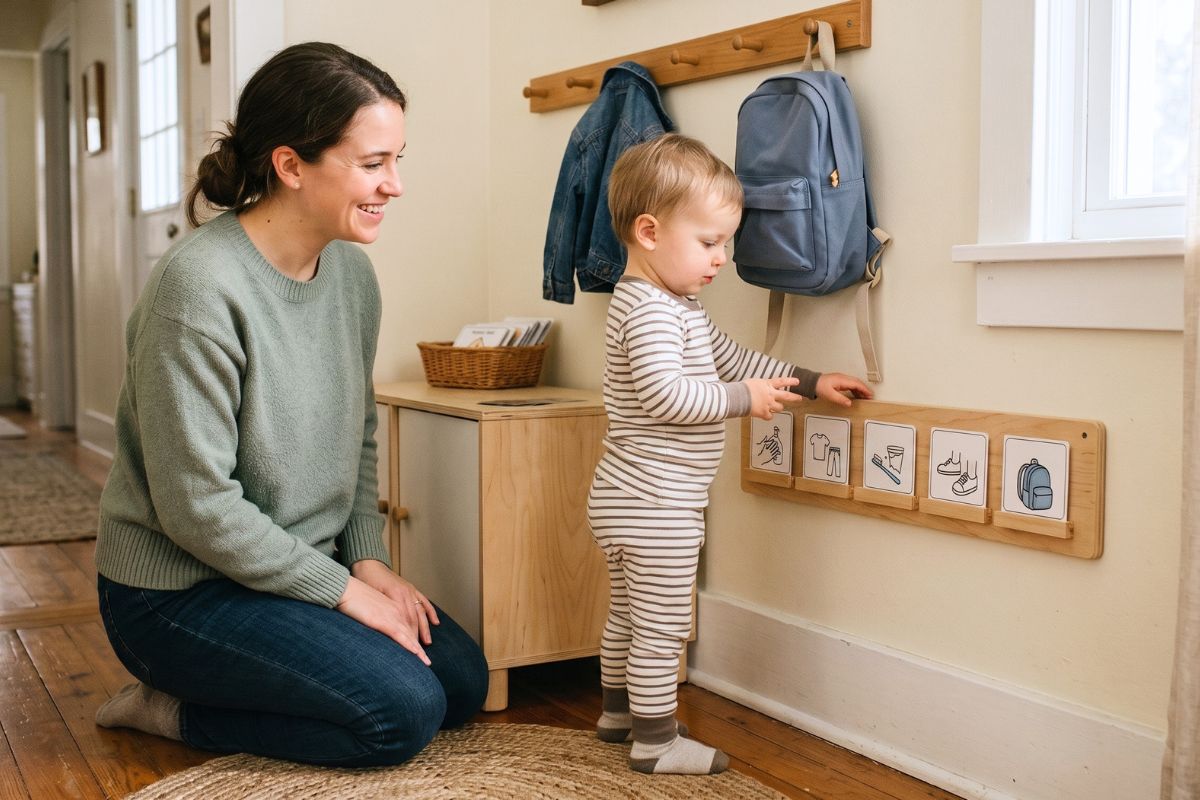
A visual schedule sounds simple. Take a few pictures, put them in order, and wait for your toddler to become independent. In real life, many routine charts become one more thing the parent has to point at, explain, update, and police.
The Montessori goal is not to make a toddler obey a prettier checklist. It is to make the sequence of daily life visible enough that the child can participate with less adult prompting. The schedule should reduce language, not add another layer of instructions.
What You Need to Know
- Best starting age: Around 18 months when the child recognizes familiar photographs and follows one-step routines
- Best format: Real photographs of the child’s own bathroom, clothes, shoes, and backpack
- Number of steps: Two or three for a young toddler, four to six for most preschoolers
- What to avoid: Reward stars, twelve-step charts, abstract clip art, and constant adult narration
- The real measure of success: Fewer reminders and more participation, not perfect completion
Why Most Toddler Routine Charts Stop Working
The problem is usually not the child. It is the design. Many printable schedules show generic cartoon children doing ten different tasks. A two-year-old may understand each picture individually but still struggle to connect those symbols with the exact bathroom, clothes, and shoes in front of them.
Long schedules also ask too much working memory from a young child. By the time the parent has explained every card, the schedule has become a verbal lesson. The child waits for the adult because the adult still holds the sequence.
Why it works: A useful visual schedule transfers one small piece of memory from the adult to the environment. The child can look again without asking what comes next.
Use Real Photos Before Illustrations
Photograph the exact objects involved in the routine. Take a picture of the child’s toothbrush in its cup, the two clothing choices on the low shelf, the shoes beside the door, and the backpack on its hook. Crop the image so one action is obvious. Avoid wide room photographs with too much visual information.
A Better Photograph
- Brushing teeth: Show the child’s toothbrush and cup, not a smiling stock-photo child
- Getting dressed: Show two folded outfits on the child’s actual shelf
- Putting on shoes: Show the child’s own shoes beside the low bench
- Leaving home: Show the backpack and coat on reachable hooks
Choose the Right Number of Steps
More cards do not create more independence. Start with the part of the morning that causes the most friction. If getting from pajamas to the front door is chaotic, begin with clothes, teeth, and shoes. Add breakfast or hair only when the first sequence has become familiar.
How to Introduce the Schedule
- Prepare it without fanfare. Place the cards at the child’s height near the place where the routine begins.
- Walk through it once. Say, “First clothes, then teeth, then shoes.” Keep the presentation under a minute.
- Complete the routine together. Let the child move or turn each card after the action.
- Reduce your language. On the next day, ask, “What comes next?” rather than repeating the full instruction.
- Wait longer than feels natural. A toddler often needs several seconds to look, remember, and begin.
The Montessori difference: The card is a cue, not a command. The adult remains available, but the environment holds the sequence.
What to Say When the Child Gets Stuck
A visual schedule does not remove every limit or every difficult morning. It simply gives the parent shorter, calmer language. Instead of repeating a command, name the point in the sequence.
Useful Phrases
- “You finished getting dressed. Check your pictures.”
- “The shoes are next. I will wait by the door.”
- “You want help with the zipper. You can start, and I will finish.”
- “The routine is not finished yet. Which picture is still showing?”
Why Rewards Usually Make the System Harder
A sticker can create fast cooperation, but it changes the purpose of the routine. Brushing teeth becomes a way to earn something rather than part of caring for the body. The child begins to ask what they receive for ordinary participation.
Use completion itself as the feedback. Turn the card over, place it in a finished pocket, or slide a small wooden marker along the sequence. This gives the child a clear ending without turning the routine into a prize system.
Troubleshooting Real Problems
The Child Moves Every Card at Once
Use only two cards and keep the finished pocket farther away. Model moving one card after the real action. Do not turn the cards into a matching game during the routine.
The Child Ignores the Schedule
Move it closer to the action and remove unnecessary cards. A schedule beside the kitchen is easy to ignore when the problem happens in the bathroom.
The Child Refuses the Next Step
The schedule cannot replace a boundary. Acknowledge the feeling, keep the sequence clear, and offer limited help. “You do not want shoes. We still need shoes to leave. You can sit on the bench or the floor.”
The Parent Still Gives Ten Reminders
Choose one phrase and use it consistently. “Check your pictures” is enough. Then pause. Repeating different explanations keeps the adult at the center of the routine.
A Simple Morning Schedule That Works
For many toddlers, the most useful first schedule contains only three images. Get dressed, brush teeth, put on shoes. Breakfast often happens naturally because hunger and family rhythm already cue it. The best schedule solves the missing links rather than documenting every minute of the morning.
The Goal Is Less Adult Management
A good visual schedule becomes almost boring. The child glances at it, completes a familiar step, and moves on. It does not need constant praise, decoration, or new printable cards.
Start with real photographs, very few steps, and one calm prompt. When the routine becomes automatic, remove the card. Independence is not following a chart forever. It is gradually no longer needing one.