
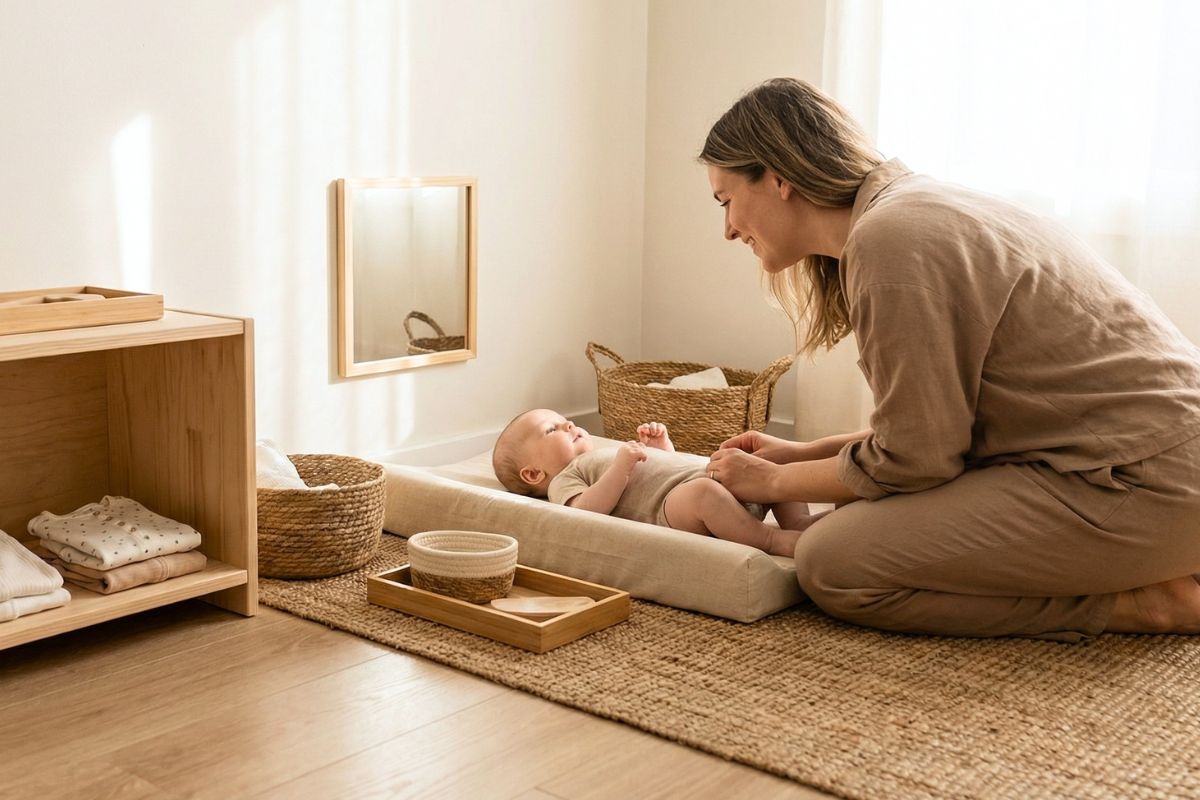
Changing a diaper can take thirty seconds or three minutes. The difference is not the task. The difference is whether the adult treats it as something to finish, or as a moment with a real person who deserves to know what is happening to their body.
The Montessori physical care area is built around this idea. Every diaper change, every dressing routine, every moment of care is also a moment of communication, cooperation, and the quiet building of trust between a child and the adults who care for them.
The Physical Care Area at a Glance
- What it is: The area where diapering, dressing, and grooming happen
- The Montessori difference: Physical care is cooperative, not done to the baby
- Changing setup: Low surface or floor mat, with the adult at the baby’s feet for eye contact
- Clothing storage: Open, accessible, at child height with 2-3 choices visible
- Mirror: A small mirror at the dressing area helps the child see themselves and participate
- Everything within reach: Supplies organized so attention stays on the baby, not on hunting for items
Why Physical Care Is Not Just Hygiene
In most conventional nursery setups, diapering is something adults do quickly and efficiently. The goal is clean and done. The baby is a passive participant, lifted, cleaned, dressed, set back down.
The Montessori and RIE (Resources for Infant Educarers) approach to physical care asks a different question: what is the baby experiencing during this? A baby who is lifted without warning, whose clothing is pulled off without narration, who has no idea what comes next, experiences each care moment as something being done to them. A baby who is told in calm, clear language what is coming, who is given a moment to respond, whose cues are read and respected, experiences the same moments as cooperative. The content is the same. The relationship it builds is not.
What Research Says: A 2021 study observing 144 diapering cycles across 74 infants found that caregiver responsiveness during diaper changes was significantly related to both child well-being and involvement. Babies whose caregivers were more responsive and encouraging showed greater engagement and well-being in the moment. The study concluded that caregiver behavior during caregiving routines, not just during play, is a critical proximal process in infant development.
Setting Up the Physical Care Area
The physical care area has two components, the changing setup and the clothing storage. Both need to be organized around ease of access and the ability to keep the adult’s full attention on the baby rather than on managing supplies.
The Changing Area
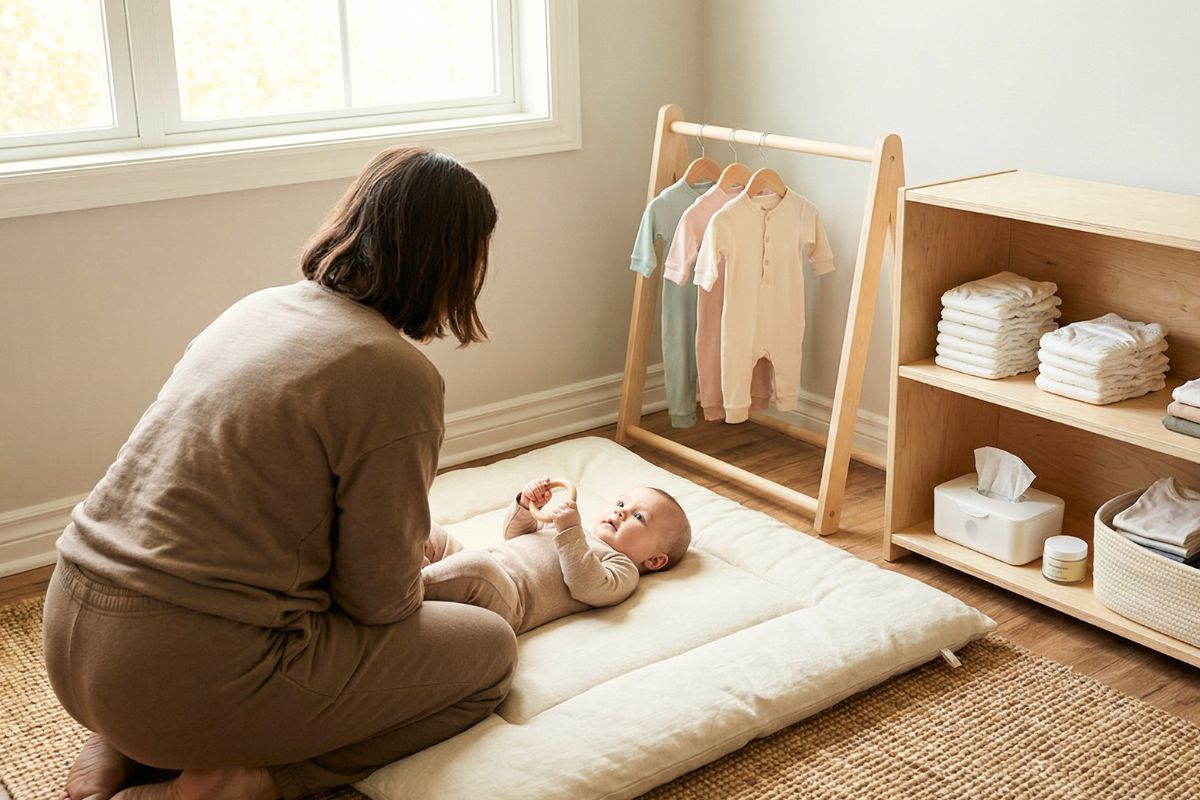
Placement: The Montessori ideal is a low surface where the adult kneels or crouches at the baby’s feet, facing them. This allows eye contact and easy communication during the change. A floor mat works well for young babies. A low changing table at the right height for the parent to crouch, not stand, works for families who prefer it.
The adult position: Being at the baby’s feet, not the head, keeps the adult’s face visible to the baby throughout the change. The baby can see who is caring for them and track the interaction. This is a small adjustment that changes the quality of the moment significantly.
All supplies within arm’s reach: Diapers, wipes, cream, a change of clothes. Everything should be stored at the changing area so the adult’s hands are the only things leaving the baby’s side. Reaching across the room for a diaper means leaving the baby alone on the changing surface and breaking the interaction.
A small object to hold: Some babies become very active on the changing mat from around 4 months. A small natural object (a wooden ring, a cloth) placed nearby gives them something to look at or hold while you work, which supports their focus without distracting from the caregiving interaction.
Effective setup
All supplies within arm’s reach
Low surface (floor or low table)
Small object to engage the baby
What to avoid
Looking away or reaching across the room
Handling the baby without narrating
Clothing Storage
Montessori clothing storage is low and open. Instead of a full wardrobe hung at adult height with everything inside, the physical care area has a small open section with 2 to 3 outfit choices visible and accessible at the child’s level.
In the early months, this matters mostly for the adult’s convenience: having a change of clothes already at the changing area means the adult never has to leave to get one. As the baby becomes a toddler, the low wardrobe starts serving a completely different purpose: the child can see their clothes, choose between two options, and begin participating in getting dressed. This is one of the first areas of genuine daily autonomy.
A small mirror at the clothing area, positioned so the child can see themselves during dressing, supports self-awareness and participation. From around 10 to 12 months, babies in front of a mirror during dressing begin to watch what is happening, anticipate the next step, and push their arm through a sleeve or pull a sock off. These small participations are not incidental. They are the beginning of the child’s relationship with their own care.
Practical setup
Open shelving or low wardrobe rail
Small mirror at dressing height
Change of clothes at the changing area
How to Do a Montessori Diaper Change
The Montessori approach to a diaper change is less a technique and more a mindset: slow down, narrate, wait, observe. In practice, it looks like this.
During The Change
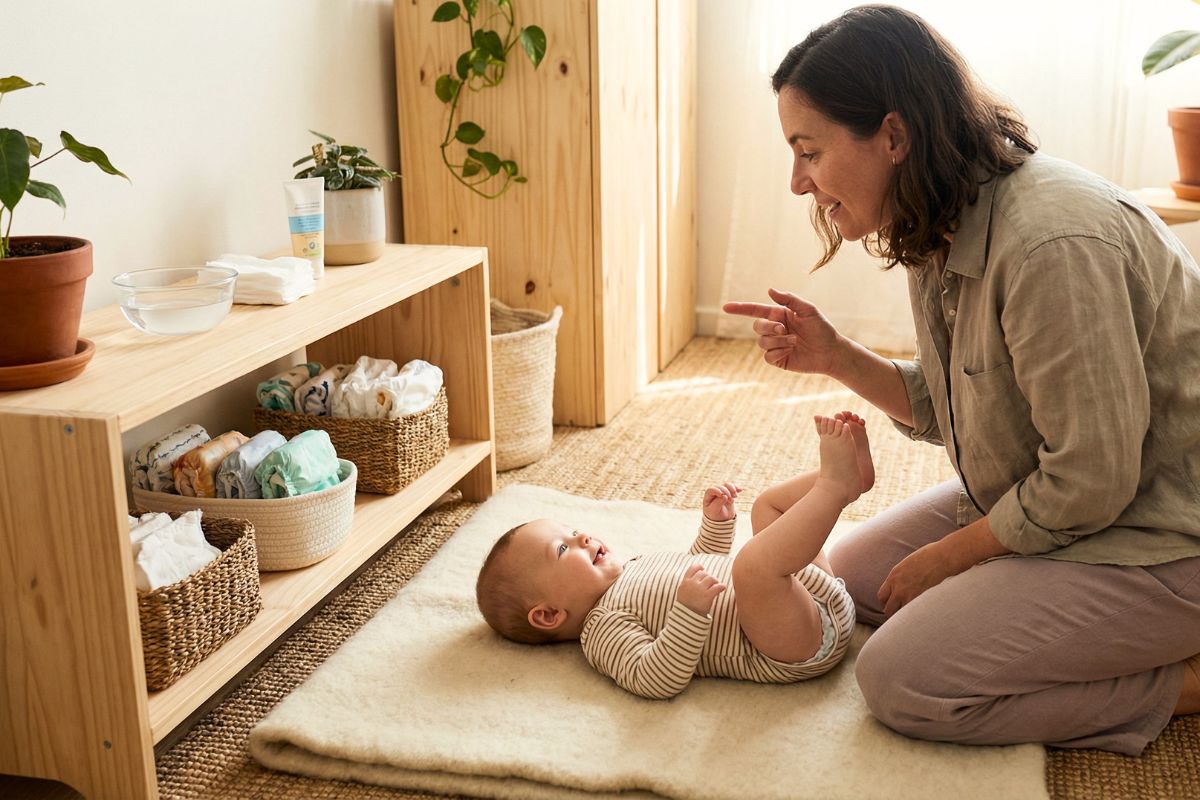
- Give notice before lifting: “I am going to pick you up now.” Then pause briefly. Even a newborn registers the tone and attention.
- Narrate each step calmly: “I am lifting your legs now. Here is a clean diaper. I am putting your socks back on.” Not a performance, just warm description.
- Ask for cooperation and wait: “Can you lift your bottom?” or “Give me your arm.” The baby will not cooperate from birth, but they will begin to from several months in, because they have been asked consistently.
- Name body parts: Every change is a language and body awareness lesson. Knees, ankles, tummy, back. Naming builds vocabulary and body schema simultaneously.
- Make eye contact: The baby’s face is the feedback. When they look away, they may be overstimulated. When they look toward you and vocalize, they are engaging.
This approach takes more time per change in the beginning. What it builds over months is a child who is an active participant in their own care: who lifts their legs before you ask, who pushes their arm through the sleeve, who cooperates with dressing because they have always been invited to. The time investment in the early months pays back in toddler-age routines that are genuinely collaborative rather than struggles.
How the Physical Care Area Evolves (0-12 Months)
Clothing Choices for a Montessori Baby
What the baby wears matters less than how they can move in it. Two principles guide Montessori clothing choices.
Freedom of movement: Clothing should not restrict the baby’s movement. Tight waistbands, stiff fabrics, complicated fastenings, or anything that makes it difficult for the baby to kick, roll, or crawl works against the movement development that the whole nursery setup is designed to support. Soft natural fabrics in simple cuts work best.
Easy to put on and take off: Clothing that can be managed quickly and cooperatively during changes is also clothing that the child will eventually be able to manage themselves. Large openings, snaps rather than fiddly buttons, elasticated waists. As the baby becomes a toddler and begins wanting to participate in dressing, the clothing that was easy to change becomes the clothing they can actually practice with.
Socks and bare feet: On non-slip floors, bare feet are better than socks for a baby who is beginning to pull up and cruise. The grip and sensory feedback of bare feet on the floor supports motor development. Socks with non-slip grips are the second option. Standard socks on a wooden floor are slippery and work against the pulling-up practice the baby needs to do.
Questions Parents Ask Most Often
What if I use a standard changing table?+
A standard changing table works fine as long as the adult is positioned at the baby’s feet and makes eye contact. The height issue is mostly about the natural adult tendency to stand above the baby and look down rather than toward them. With a conscious effort to position yourself at the baby’s feet and face level, a standard table provides the same care quality as a floor setup. The floor mat is simply a more accessible starting point for families who have not purchased a dedicated table yet.
My baby fights diaper changes. What do I do?+
This is very common from around 6 to 9 months when mobility increases. The baby wants to be on the floor doing things, not on their back being changed. Approaches that help: narrate clearly and quickly so the baby knows it is brief, offer an interesting object to hold, try standing diaper changes once they can pull up (some babies find lying flat much more frustrating than standing), and keep a consistent brief routine that signals start and end. The resistance is not defiance. It is a developmentally appropriate preference for floor time over being still.
How do I set up clothing storage in a small space?+
The low wardrobe does not need to hold everything. Most of the baby’s clothes can be stored in a drawer or cupboard at adult height. What matters is that 2 to 3 choices are visible and accessible at the baby’s level. An IKEA KALLAX cube with a fabric bin for today’s options works. A small tension rod at low height in a closet works. A simple wooden peg rail with 2 to 3 items hanging works. The point is the principle: some clothing is at the child’s level, giving them something to see and eventually to choose from.
When do babies start actually participating in dressing?+
Earlier than most parents expect. At around 9 to 10 months, babies who have been consistently invited to participate will begin to push their arm toward the sleeve or hold out a foot for a sock. This is not accidental. It comes from months of being told what is coming next and being asked for cooperation. By 12 to 14 months, many Montessori-raised babies are actively pulling off socks or hats and can be involved in the dressing sequence in small but genuine ways. Toddler dressing independence builds directly from infant dressing cooperation.
The Smallest Zone Does the Biggest Relationship Work
The physical care area does not need to be beautiful or expensive. A changing mat on the floor, supplies organized nearby, a small open shelf with 2 clean outfits, and a parent who pauses before each step to explain what is coming. That is the whole setup.
What it builds is something most parents do not realize they are building in those first months of changes: a child who expects to be told what is happening to their body, who trusts that the adult will wait for a moment, and who begins to understand from very early that their cooperation is wanted and valued.
That understanding is not a small thing. It carries forward into every haircut, every doctor’s visit, every piece of clothing the toddler insists on choosing themselves. It starts at the changing mat, in the first weeks.
Scientific References
Laurin, D.E., Guss, S.S. & Horm, D. (2021). Caregiver-infant and toddler interactions during diapering: Caregiver responsiveness and child well-being and involvement. Infant Mental Health Journal, 42(4), 546–559.
Davies, S. & Uzodike, J. (2021). Montessori Baby. Workman Publishing.
Gerber, M. & Johnson, A. (1998). Your Self-Confident Baby. Wiley. (RIE framework on cooperative caregiving)