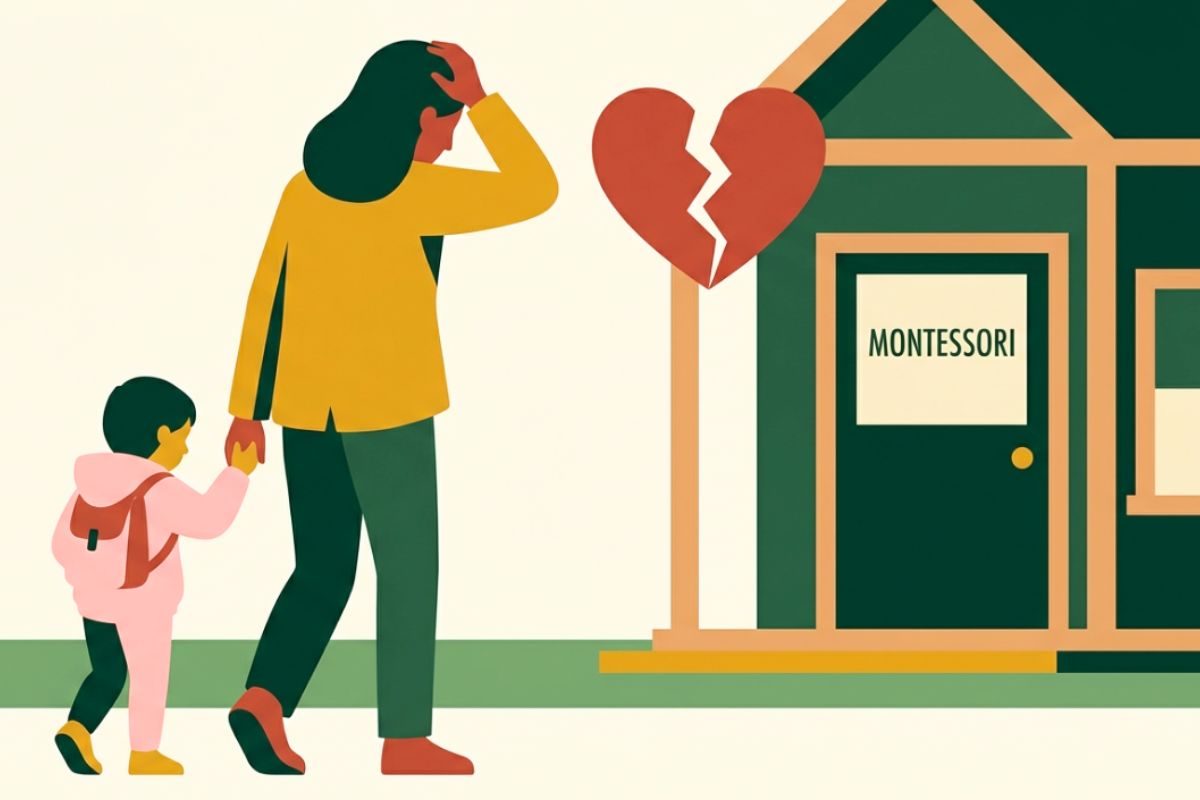
Search for parents leaving Montessori and you will quickly find dramatic claims about disappointed families abandoning an expensive educational illusion. The reality is usually less sensational and far more useful.
Most families do not leave because they suddenly discover that the entire philosophy is a mirage. They leave because tuition becomes unsustainable, the school does not deliver what it promised, their child needs different support, progress feels difficult to evaluate, or the family’s priorities change.
Other families face the same concerns and stay because their child feels safe, develops independence, enjoys learning, and receives the right balance of freedom, structure, and individual guidance.
What Parents Should Know First
Montessori is an educational philosophy, but families experience it through one particular school, classroom, teacher, and community. A poor experience at one school does not automatically disprove the method. At the same time, a respected philosophy does not excuse weak teaching, poor communication, inadequate support, or an unhappy child.
Reason 1: The Cost Is Real, Not a Conspiracy
Private Montessori tuition in most countries runs comparably to other independent schools, often between the cost of daycare and a private day school, depending on the region and the age group. That is a genuine barrier for many families, not a myth invented by critics.
What often gets left out of the cost conversation is that public and charter Montessori programmes exist in a number of countries and have grown steadily. They are not available everywhere, and where they are, waiting lists can be long. But the “private school for the wealthy” framing ignores a meaningful part of the actual landscape.
Families who leave over cost are usually making a straightforward financial decision, not rejecting the philosophy. Families who stay despite the cost are usually the ones who found a public programme, prioritised the expense deliberately, or decided the years they could afford were worth it even if they could not sustain it long-term.
Reason 2: Quality Varies Wildly Between Schools
“Montessori” is not a protected or regulated term in most places. Any school can put the word on its sign. This means the quality gap between a school with AMI or AMS certified teachers, authentic materials, and a genuine three-hour uninterrupted work cycle, and a school that has simply rearranged a conventional classroom and added a few wooden toys, can be enormous.
Parents who leave here are often not leaving Montessori. They are leaving a school that was never really practising it. The frustration is legitimate, but it is a quality control problem, not a flaw in the method itself.
The families who stay tend to be the ones who did the homework before enrolling: they visited during a working morning, asked about teacher certification, and watched whether the classroom actually ran on child choice or on a disguised conventional schedule.
Reason 3: The Self-Directed Model Does Not Fit Every Child
Montessori asks a child to generate their own motivation, choose their own work, and manage significant stretches of unstructured time. Most children rise to this. Some do not, at least not without more external structure and clearer expectations than a Montessori classroom typically provides.
Children who need explicit, step-by-step direction, who become anxious with too much ambiguity, or who have certain attention or sensory profiles, can find the open structure genuinely difficult rather than liberating. This is not a criticism of those children. It is a mismatch between a specific environment and a specific temperament, the same kind of mismatch that happens with any educational model.
Parents who move their child out for this reason are usually responding to real, observed distress, not giving up on independence as a value. Parents who stay through a rocky adjustment period often see the difficulty resolve once the child settles into the rhythm, which can take longer than it does for other children.
Reason 4: The Transition Back to Conventional School Takes Adjustment
Montessori children are used to choosing their own work, moving at their own pace, and being assessed through observation rather than grades or standardised tests. A child who moves from Montessori into a conventional school, particularly mid-primary, may need real adjustment time to sitting at an assigned desk, following a fixed schedule, and being tested on demand.
Families planning to switch systems partway through elementary school sometimes leave Montessori earlier than planned specifically to smooth this transition, moving their child while they are younger and the adjustment is less disruptive.
Families who stay through the full Montessori sequence, often through to age 12, tend to avoid this problem altogether or manage it once, at a natural transition point, rather than navigating an abrupt mid-year switch.
Reason 5: It Asks Something of the Parents Too
Montessori works best when the values carry over into the home. A child who spends their school day choosing purposeful work and dressing themselves independently, then goes home to a house where every choice is made for them and screens fill every gap, experiences a genuine disconnect between two very different environments.
This is not a requirement Montessori schools always state clearly at enrolment, and some parents discover only later how much home consistency the approach assumes. Families who find that mismatch too demanding sometimes decide the whole system is not worth the friction.
Families who stay usually make small adjustments at home rather than large ones: a lower shelf, fewer toy choices, a bit more independence at the dinner table. None of it requires becoming a different family. It requires being willing to adjust a few habits.
Why Families Stay Anyway
Given these five real friction points, it is worth asking what the families who stay are actually getting for the cost, the adjustment, and the home consistency the method assumes. The research base is more substantial than most Montessori articles let on, and more substantial than most competing methods can claim.
Montessori research holds up well. A 2023 review of 32 studies found real benefits over traditional schools, both academically and in independence and social skills, especially where schools followed the method closely.
One study stands out for good reason. It used a school lottery instead of letting parents self-select, making the comparison far more reliable. Montessori kids showed stronger focus, reading, math, and social skills, and the gap between lower and higher-income children actually shrank.
A follow-up study tracked these kids into adulthood. Those who attended Montessori reported greater happiness and fulfillment, and the effect grew with more years attended.
None of this cancels out the five reasons above. A family can read this research, find it genuinely compelling, and still leave over cost or fit. The research explains why so many families who can make it work choose to, not why every family should.
How to Decide Before You Are Two Years and a Deposit In
Visit during a real work cycle
Not a scheduled tour. Ask to observe an ordinary morning and watch whether children are genuinely choosing their own work.
Ask about teacher certification
AMI or AMS credentials are a reasonable proxy for whether the school is running an authentic implementation.
Be honest about your child’s temperament
A child who needs heavy external structure may need a longer settling period, or may simply be a better fit elsewhere.
Plan the exit point in advance
If you know you will switch systems eventually, decide roughly when, so the transition happens on your terms rather than mid-crisis.
Common Questions
Is Montessori really just for wealthy families?+
Not exclusively, though private Montessori tuition is a genuine cost barrier for many families. Public and charter Montessori programmes exist in a number of regions and, notably, the lottery-based research showing the strongest outcomes for lower-income children was conducted in public Montessori schools, not private ones. Availability varies significantly by location.
How do I know if a school is genuinely Montessori or just using the name?+
Ask about teacher training (AMI and AMS are the two major certifying bodies), observe whether children choose their own work during an extended uninterrupted period, and check for mixed-age classrooms with authentic Montessori materials rather than a conventional curriculum rebranded with Montessori language.
Will my child struggle if we switch to conventional school later?+
Most children adjust within a few weeks to a few months. The adjustment is more behavioural than academic: getting used to teacher-directed instruction and fixed schedules rather than catching up on content. Transitioning at a natural stage boundary, such as the end of Montessori primary, tends to be smoother than an abrupt mid-year move.
Does Montessori work for children with ADHD or autism?+
It depends heavily on the individual child. Some children with ADHD or autism thrive with the freedom of movement and self-paced structure. Others find the lack of explicit external direction genuinely difficult. There is no universal answer, and this is a case where visiting the specific classroom and speaking with the specific teachers matters more than general guidance.
The Reasons Are Real, and So Are the Reasons to Stay
Families leave Montessori for the same handful of reasons, over and over, cost, inconsistent quality between schools, a child who needs a different kind of structure, the adjustment of switching systems, and the home consistency the method quietly assumes. None of these are manufactured controversies. They are ordinary, practical trade-offs.
The families who stay are usually not ignoring these trade-offs. They have simply decided, with the same information, that the outcomes are worth it for their specific child, in their specific school, at their specific stage of life. That is the actual decision in front of you, not a referendum on whether Montessori is secretly a mirage.
Scientific References
Randolph, J.J. et al. (2023). Montessori education’s impact on academic and nonacademic outcomes: A systematic review. Campbell Systematic Reviews, 19(3), e1330.
32 studies, 132,249 data points. Meaningful positive impact on academic and nonacademic outcomes. Effects strongest in high-fidelity implementation.
Lillard, A.S., Heise, M.J., Richey, E.M., Tong, X., Hart, A. & Bray, P.M. (2017). Montessori preschool elevates and equalizes child outcomes: A longitudinal study. Frontiers in Psychology, 8, 1783.
Lottery-based RCT in public Montessori schools. Closed the achievement gap between lower- and higher-income children rather than widening it.
Lillard, A.S., Meyer, M.J., Vasc, D. & Fukuda, E. (2021). An association between Montessori education in childhood and adult wellbeing. Frontiers in Psychology, 12, 721943.
Adults who attended Montessori as children reported significantly higher wellbeing. Dose-response relationship with years of attendance.