

The most common parent concern about Montessori mixed-age classrooms is that the youngest child will get lost. The second most common is that the oldest will get bored. Understanding why both of these concerns usually invert into advantages, and what the research actually shows about what happens developmentally in these spaces, requires looking at what each child experiences differently.
This is not a list of benefits. It is a closer look at the mechanism, why mixed-age grouping changes the developmental experience for every child in the room, in ways that a same-age classroom structurally cannot replicate.
What This Article Covers
- What “mixed-age” actually means in Montessori: The three-year cycle and why the span matters
- The youngest child’s experience: Imitation, observation, and language acceleration
- The oldest child’s experience: The protégé effect, why teaching consolidates learning better than review
- What the research shows: Studies from 1997 to 2025 on social development, language, and academic outcomes
- The honest challenges: What can go wrong, and what makes it work
- For parents and teachers: Practical observations to make during a school visit

What “Mixed-Age” Actually Means in Montessori
In a conventional school, children are grouped by birth year. In Montessori, children are grouped in three-year spans: infants (birth to roughly 18 months), toddlers (18 months to 3 years), primary (3 to 6 years), and lower elementary (6 to 9 years). The spans are not arbitrary. Three years is wide enough to create genuine developmental diversity, a 3-year-old and a 6-year-old have profoundly different abilities, and narrow enough that children share common developmental ground.
Crucially, the same child stays in the same classroom group for all three years. A child who enters the primary classroom at 3 is the youngest in the room for their first year, a peer in their second, and the oldest in their third. This three-year arc is the design. Each role, observer, co-learner, mentor, is experienced sequentially by every child in the room.
The three-year cycle: Year one, the child is the youngest, watching, absorbing, imitating. Year two, they are a mid-point peer, consolidating their own skills alongside children both younger and older. Year three, they are the oldest, teaching, mentoring, reviewing through demonstration. No child is permanently the smallest or the biggest. The role rotates through every child in the classroom.
The Youngest Child’s Experience
The anxiety for parents of the youngest child is understandable, will they keep up? Will they be overwhelmed? In practice, the youngest child’s developmental experience in a mixed-age classroom is almost entirely positive, and for reasons that are well-documented.
Imitation as the primary learning mechanism
Young children are neurologically primed to learn through observation and imitation. When a 3-year-old watches a 5-year-old carefully carry a tray from the shelf to a table, set up a material, work through it, and then restore it, they are absorbing a complete sequence of purposeful, ordered action that no adult-led lesson could reproduce with the same authenticity. The older child is not performing for the younger one; they are simply working. The younger child watches anyway, and the watching is the lesson.
Vocabulary and language development
A 2014 study by Guo et al. found that 4-year-olds in mixed-age classrooms developed significantly larger vocabularies than peers in same-age groups, attributing this directly to daily exposure to the more complex language used by older children. A 2025 study in the journal Early Years (Liepina-Burenina and Burenina) observed the same pattern across a full academic year in a Montessori 3-to-5-year-old classroom: older peers consistently served as language models, supporting participation in conversation and reducing withdrawal behaviours among younger, less verbally confident children. The language the youngest child is surrounded by is simply richer and more varied than they would encounter in a same-age group.
Aspiration without pressure
In a same-age classroom, every child is being measured against a similar standard at roughly the same moment. In a mixed-age classroom, the youngest child is not expected to do what the 6-year-old is doing. They watch the 6-year-old work and find it interesting, even aspirational, but there is no pressure to match it. Developmental diversity across three years means no two children are competing at the same developmental moment. This structure, as AMI’s published research notes, specifically reduces the peer comparison and status anxiety that emerges in same-age groups from the earliest years.
The Oldest Child’s Experience: The Protégé Effect
If the youngest child benefits from observation, the oldest child benefits from something equally powerful: teaching. And this turns out to be the most significant academic benefit in the entire mixed-age model.
The protégé effect
Research in cognitive science consistently shows that teaching a concept to someone else produces deeper, more durable understanding than additional study alone. When an older Montessori child demonstrates how to use the golden beads, or shows a younger child how to care for a plant, they are not simply being helpful: they are reorganising their own knowledge, identifying gaps, and consolidating understanding in a way that passive review cannot achieve. This is the “protégé effect”, you learn most deeply when you know you will have to teach it. A 2024 study in Frontiers in Education confirmed that having more opportunities to interact with and instruct younger or less experienced peers specifically accelerated knowledge construction in older children, beyond what same-peer interaction produced.
Leadership without authority
Becoming the oldest child in the room is not a promotion handed to you by a teacher. It is something that happens as the younger children around you gradually catch up. This means the leadership role is earned developmentally, not assigned. The AMI notes that this creates a genuine sense of competence rather than the performance of competence, the oldest child knows they understand something, because a younger child successfully learned it from them.
Honest concern: do older children miss advanced challenge?
This is the most legitimate concern about mixed-age grouping, and research is honest about it. A 2004 study by Fosco et al. found mixed outcomes in mathematics for older children in multi-age settings, and a 2018 study by Ansari and Purtell noted that benefits depend substantially on teacher training and the quality of advanced material available. The honest answer: in a well-resourced, well-trained Montessori classroom with materials calibrated for the oldest children’s level, the concern dissolves. In a classroom where the oldest child has no more challenging work to reach for, it is a real risk. This is one reason teacher qualification matters so much when evaluating a nursery or school.
What the Research Shows Across the Full Age Range
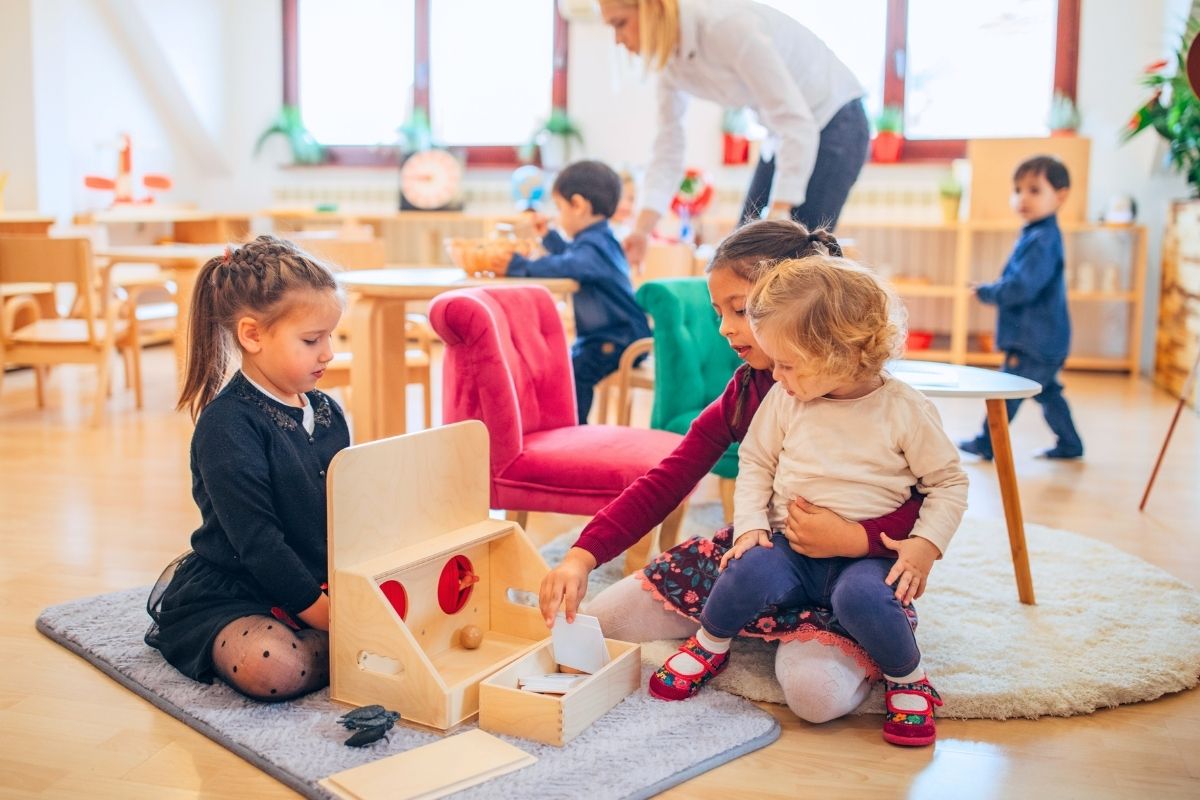
What Happens to Competition When You Remove Same-Age Grouping
One of the less-discussed but significant effects of mixed-age grouping is what it does to competition, specifically, the way it makes direct comparison structurally impossible.
In a same-age classroom, every child is working on approximately the same material at approximately the same time. A child who is slower can see it. A child who is faster can see it. Even in classrooms that do not explicitly rank children, children rank themselves. This is not a teacher failure, it is a structural consequence of gathering children of identical ages and giving them identical tasks.
In a mixed-age classroom, comparison is between children who are two or three years apart in development. The 3-year-old does not compare themselves unfavourably to the 6-year-old’s writing, any more than they would compare themselves unfavourably to an adult’s. The gap is simply too wide for that kind of status competition to form. Meanwhile, the 6-year-old looks at the 3-year-old’s work without condescension, because they remember, recently, doing the same thing. Montessori observed this directly: the class becomes, as she wrote, “a group cemented by affection.” The AMI notes that this environment specifically supports children with learning differences or developmental delays, who in a same-age group may be acutely aware of their divergence from the norm.
The Honest Challenges
What can go wrong, and what makes it work
- Teacher training is the non-negotiable variable. A 2018 study by Ansari and Purtell found that benefits of mixed-age grouping are highly dependent on teacher skill. An undertrained or overwhelmed teacher in a mixed-age classroom produces significantly worse outcomes than a good teacher in a same-age classroom. This is the strongest argument for checking teacher certification before choosing a Montessori school.
- The shelf must serve all three years. If the oldest children have outgrown every material on the shelf and there is nothing left to reach toward, the developmental logic of the model breaks down for them. A well-stocked Montessori primary classroom has materials extending to 6-year-old level work and beyond, the checkerboard for multiplication, the moveable alphabet, advanced cultural studies. Ask to see what the oldest children in the room are currently working on.
- The work period must be long enough. The benefits of mixed-age peer interaction, observation, imitation, informal peer teaching, require uninterrupted time to occur naturally. A classroom that transitions every 20 minutes does not give this dynamic time to develop. Montessori’s three-hour work period is not arbitrary: it is the minimum container for genuine self-directed work and natural peer interaction.
- Peer dynamics require guidance, not management. Mixed-age peer conflicts, a 4-year-old using a material a 6-year-old wants, for example, are genuinely more complex than same-age conflicts. A Montessori teacher handles this through grace and courtesy lessons, conflict resolution modelling, and careful observation. A teacher who simply assigns turns by age is missing the developmental opportunity the conflict provides.
What to Look for When You Visit a Mixed-Age Classroom
- Watch a younger child for 5 minutes. Are they engaged? Are they watching an older child work? Are they attempting something they observed? That sequence, watching, attempting, gradually succeeding, is the mixed-age model working.
- Watch an older child for 5 minutes. Do they have access to genuinely challenging material? Are they working independently on something complex? Are they interacting spontaneously with a younger child, and if so, is the interaction warm and purposeful?
- Watch the teacher. Are they spending most of their time with individual children or small groups, presenting specific materials? Or are they managing the room at large? A Montessori teacher in a functioning mixed-age classroom is mostly invisible because children do not constantly need them.
- Notice the noise level. A genuinely working mixed-age Montessori classroom is not silent, children talk, move, carry materials, but the ambient sound is purposeful and not chaotic. Loud, directive teacher voices or persistent child conflict signals that the environment needs adjustment.
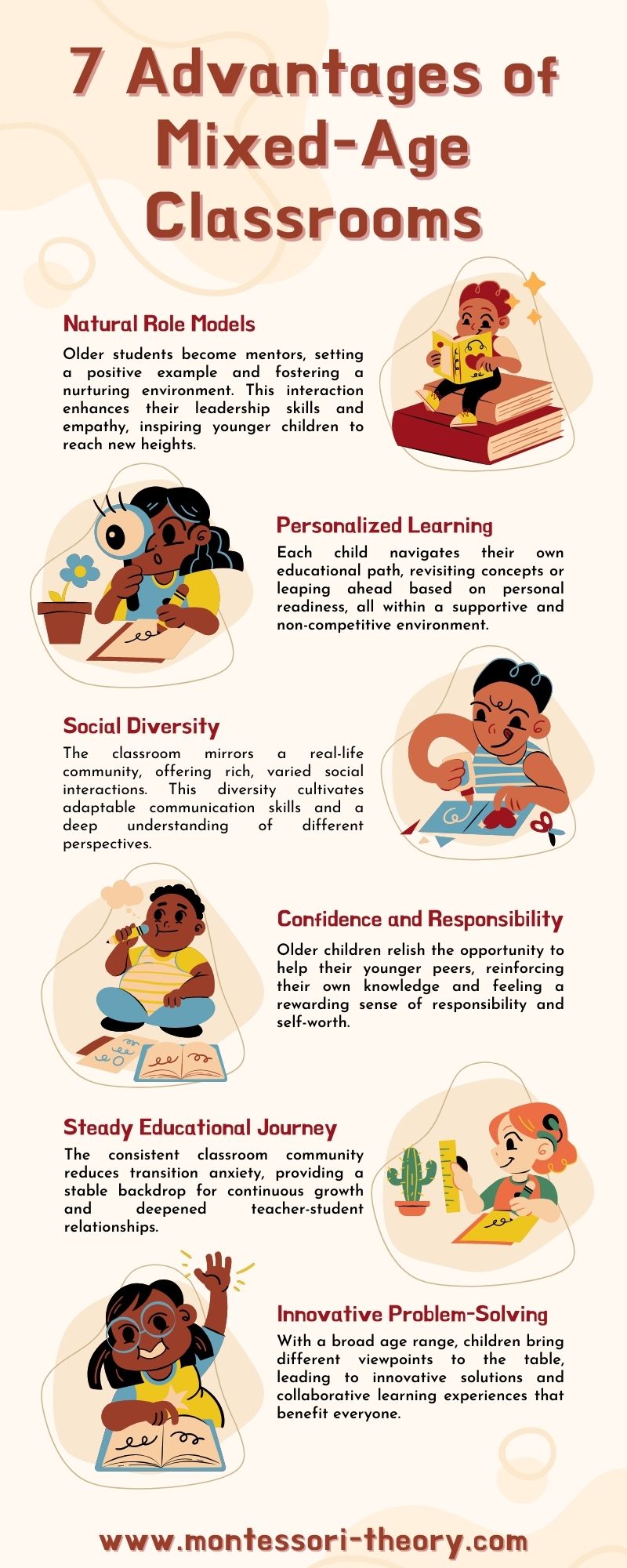
The Seven Advantages at a Glance
Questions Parents Ask Most Often
My child is shy. Will they get overlooked in a mixed-age room?+
The 2025 Early Years study found that mixed-age Montessori dynamics specifically reduced withdrawal behaviours among younger and less verbally active children over the course of an academic year. The combination of child-led routines, emotionally secure environments, and older peers who model participation without pressuring it appears to be particularly supportive for quieter children. That said, the quality of the teacher’s observation matters: a shy child in any setting needs an attentive adult who notices them. Ask during your visit how the setting tracks quieter children’s engagement and wellbeing.
Will my child have to share materials with much older children?+
Yes, and this is a feature, not a problem. Material sharing in a Montessori classroom is handled through the principle that whoever chose a material first has it for as long as they need it. Children learn to wait, to observe, and to ask politely. The conflict that arises around shared materials is handled by the teacher as a real-life conflict resolution lesson. The Frontiers in Education 2024 study specifically noted that mixed-age environments produce better conflict resolution skills, precisely because conflicts of this kind are handled purposefully rather than avoided.
What if my child is advanced? Will they be bored teaching the same things to younger children?+
A well-trained Montessori teacher does not direct older children to teach younger ones constantly, the peer teaching that occurs is largely spontaneous and limited. Older children who are genuinely advanced spend most of their time on their own challenging work. When peer teaching does happen, the protégé effect means it deepens their own understanding rather than slowing them down. The concern to investigate is whether the classroom has genuinely advanced materials available, not whether the mixed-age dynamic itself is a problem for capable children.
Three Years in One Room
The deepest argument for mixed-age grouping is not any single research finding. It is the developmental logic of the full three-year arc: entering small, watching, imitating, gradually joining; becoming a peer, a collaborator, a co-learner; becoming the largest, the most experienced, the one who teaches. Every child in a Montessori classroom lives through all three of these experiences. That progression, over three years with the same teacher and the same community, is something no one-year grade level can provide.
The question is not really “is mixed-age good or bad?” It is “is this specific mixed-age classroom well-run?”, and that is a question answered by visiting, watching, and asking the right questions.
Continue reading
|
School choice
How to Choose a Montessori Nursery
The 8-point visit checklist, 10 questions to ask, and red flags to walk away from.
|
At home
The Montessori Baby Room
Setting up the four zones of a Montessori home environment from birth to 12 months.
|
Scientific References
Liepina-Burenina, L. & Burenina, S. (2025). Peer interactions and communicative engagement in a Montessori preschool: a case study in a mixed-age classroom. Early Years.
Chen, Z. et al. (2024). Effects of peer interactions on young children’s knowledge construction in mixed-age groups. Frontiers in Education, 9, 1253782.
Randolph, J.J. et al. (2023). Montessori education’s impact on academic and nonacademic outcomes: A systematic review. Campbell Systematic Reviews, 19(3), e1330.
Ansari, A. & Purtell, K.M. (2018). Continuity and changes in classroom age composition and achievement in Head Start. Journal of Applied Developmental Psychology, 58, 86–95.
McClellan, D.E. & Kinsey, S. (1997). Children’s social behavior in relation to participation in mixed-age or same-age classrooms. ERIC, ED418771.