
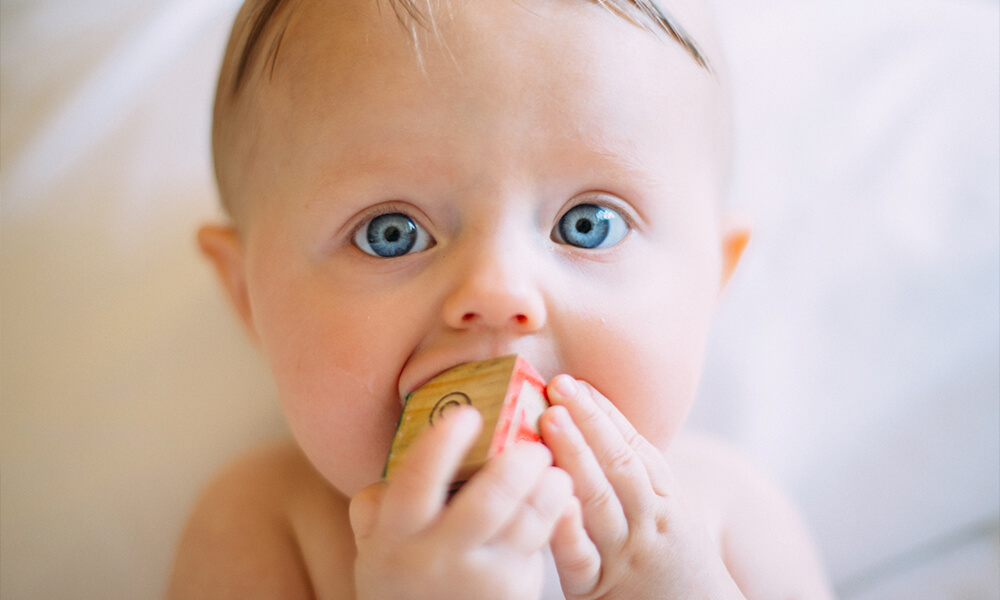
Almost every “best toys for 6-month-olds” list includes wooden shape sorters, stacking rings in size order, and puzzles with multiple pieces. None of those are appropriate for a 6-month-old. They are 12-to-18-month toys. A 6-month-old does not yet have the pincer grip to pick up puzzle knobs, the wrist control to sort shapes into holes, or the seriation concept to order rings by size.
This guide works backwards from what a 6-month-old can actually do, and picks toys that match those hands, that attention span, and the developmental milestones that are genuinely arriving at this stage.
Quick Picks
- Best overall: Object permanence box (tray version): the single most developmentally accurate toy for this exact stage
- Best for hands: Interlocking wooden rings or bell rattle: matches the palmar grasp and hand-to-hand transfer emerging at 5-7 months
- Best sensory: Textured sensory ball or ball with protrusions: easy to grip, easy to mouth, responds to movement
- Best for floor time: Scarf pull box: cause and effect at its simplest, endlessly repeatable
- Best to skip: Shape sorters, wooden knob puzzles, building block sets, stacking rings in order: all 12-18 months
What a 6-Month-Old Can Actually Do (The Developmental Reality)
Choosing the right toy starts with understanding what the hands, eyes, and brain are working on at this moment. Six months is a fascinating and specific developmental window, not early infancy anymore, not yet a toddler.

On the pincer grip: The pincer grip (thumb and index finger picking up small objects) does not develop until around 8-10 months. Any toy that requires this, knobbed puzzle pieces, shape sorter slots, small stacking rings, is simply not graspable yet. Offering them at 6 months does not accelerate development. It produces frustration. Wait.
The 8 Best Montessori Toys for 6-Month-Olds
Each pick below is matched to a specific developmental milestone arriving around 6 months. The rationale matters as much as the product.
1. Object Permanence Box (Tray Version)

The object permanence box is the most developmentally targeted toy for exactly this stage. Around 6 months, Piaget’s sensorimotor stage moves into a phase where the baby begins to grasp that objects continue to exist when they can no longer see them. The tray version is the simplest: a wooden ball is placed in a hole, rolls through, and reappears in a tray. The baby watches it disappear, then finds it again. This cycle, drop, disappear, reappear, is the entire developmental work of the material.
Start with the open tray version, not the drawer version. The drawer requires pulling a small knob, which is a 9-10 month fine motor skill. The tray keeps the ball fully visible when it reappears, which is exactly right for a baby just beginning to work through permanence. At 6 months, even placing the ball in the hole is a challenge. Let them work at it at their own pace.
Why it works at 6 months
Cause and effect: immediate feedback
Palmar grasp for the ball
Self-correcting, no adult needed
2. Wooden Bell Rattle or Rolling Bell Cylinder
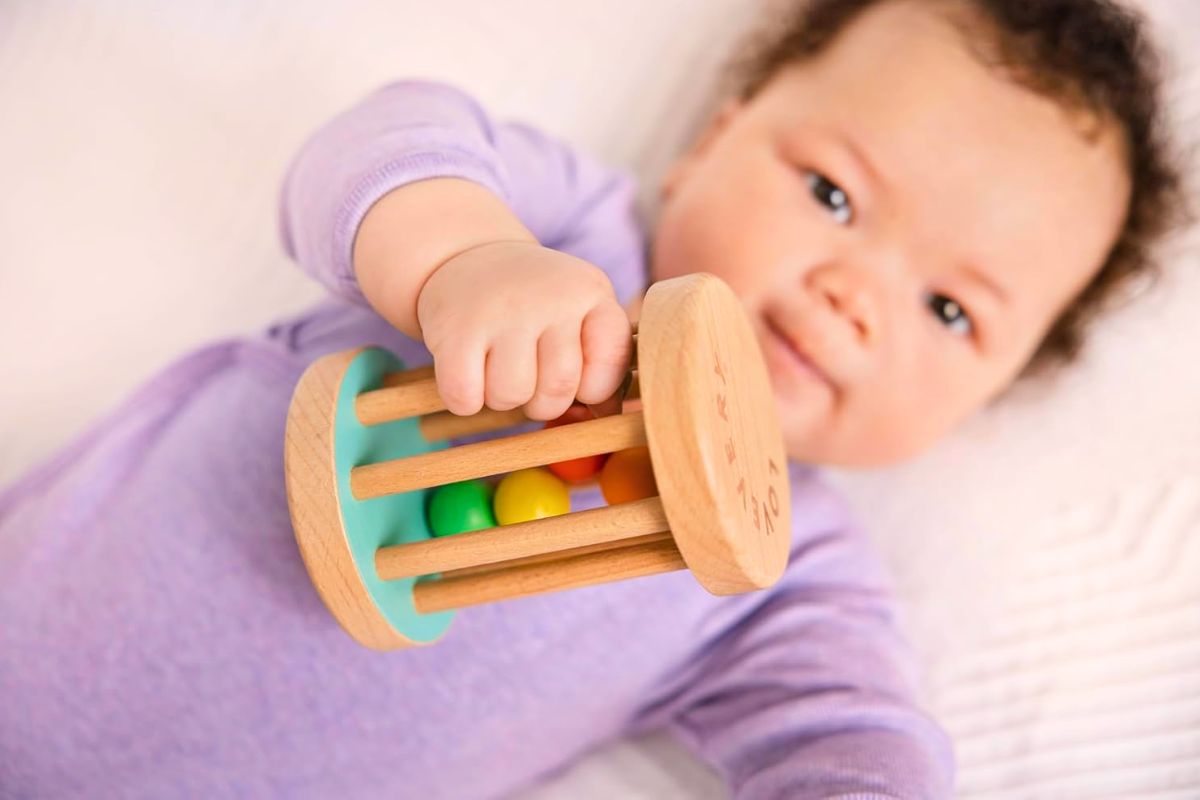
A simple wooden rattle where the source of the sound is visible is a Montessori classic for good reason. At 6 months, the baby is making the connection between their action and the resulting sound. The bell rattle, a small cylinder with a bell inside a wooden frame, responds to the gentlest movement, which is perfect for hands still developing grip strength. The rolling bell cylinder (a round wooden rattle on a curved base) rolls when touched and invites the baby to reach and grasp repeatedly.
The Montessori principle here: the source of the sound should always be visible. A sealed electronic toy that beeps is not the same. The baby needs to see and understand that shaking the wooden object causes the bell inside to move. Concrete, transparent cause and effect is the developmental work.
Hand-to-hand transfer practice
Auditory + tactile development
Visible cause and effect
3. Interlocking Wooden Rings
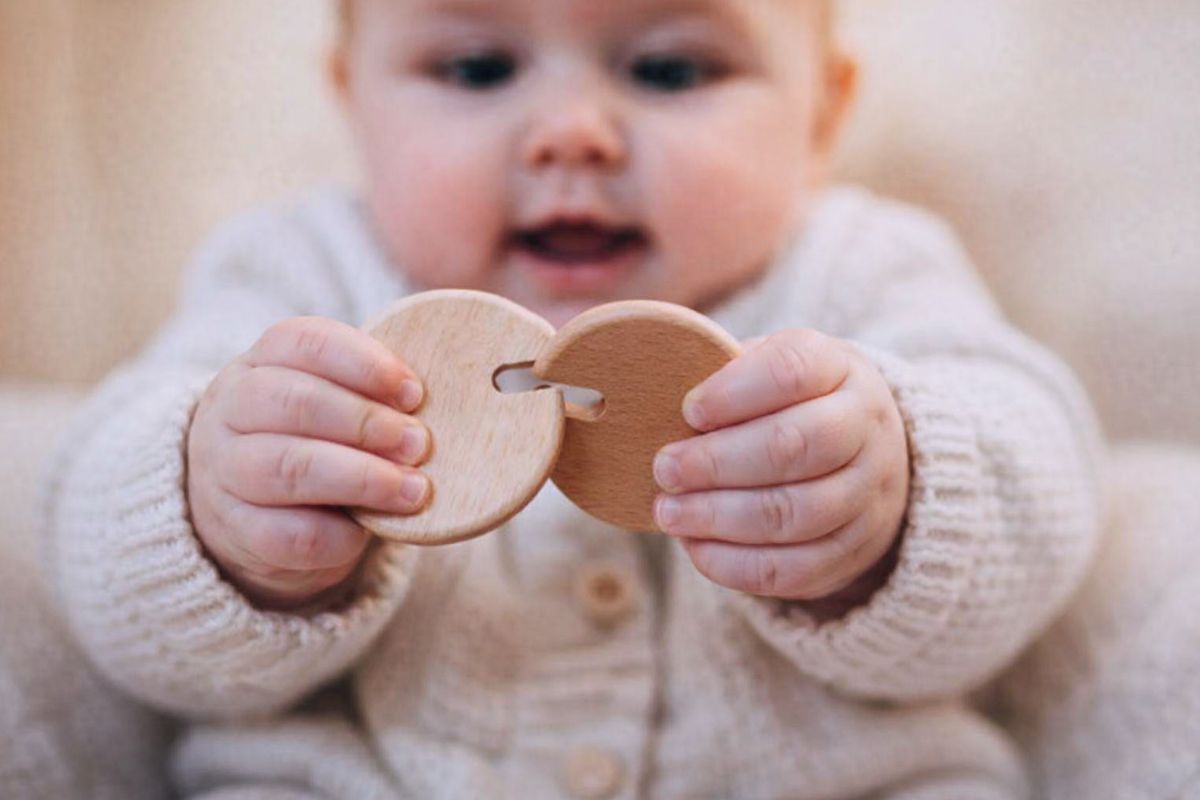
Two or three wooden rings linked together are one of the most useful grasping toys for 5-7 months. The rings are easy to grip from any angle, light enough for weak hands, and can be passed from hand to hand, shaken, banged, and mouthed without any concern. The fact that they are joined means the baby can manipulate the set without losing pieces, which matters when they are still working on coordinating two hands simultaneously.
Look for rings made from untreated or food-safe finished maple or beech wood. Avoid rings with paint or lacquer that chips. The simplest versions (two plain rings joined by a leather cord or directly interlocked) are better than decorated versions with many elements.
Easy grip from any angle
Safe to mouth
4. Sensory Ball with Protrusions (Grippy Ball)

A standard smooth ball is difficult for a 6-month-old to maintain grip on. A ball with rubber or silicone protrusions, bumps or spikes that the fingers can close around, is much easier to grab, hold, and transfer. The textures also provide genuine sensory information through the fingers and mouth, which is exactly the kind of multi-modal exploration the brain is seeking at this stage.
During tummy time, placing a grippy ball slightly in front of the baby and letting them push it gives immediate visual feedback as it rolls. This motivates the head lift and also begins to connect pushing movement with object movement, one of the earliest spatial concepts a baby develops.
Tactile exploration through fingers and mouth
Great tummy time motivator
5. Scarf Pull Box (Tissue Box Alternative)
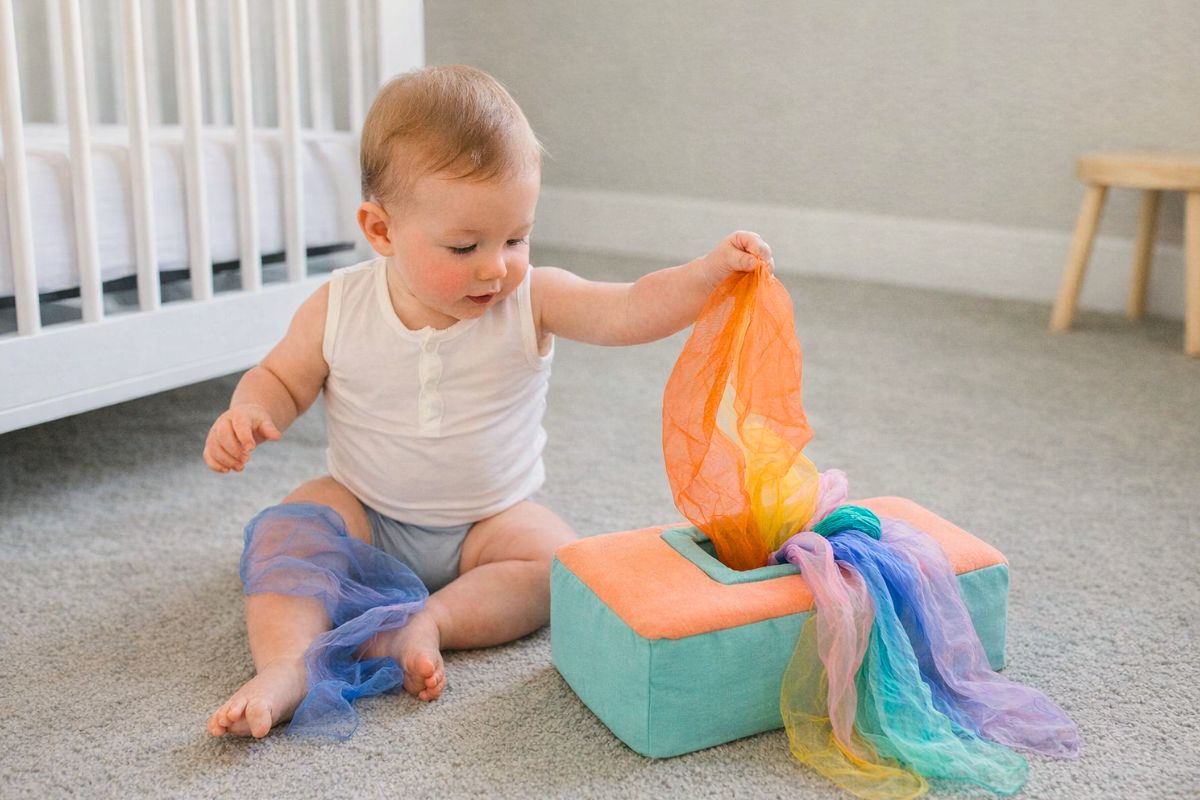
This is as simple as it sounds: a box with a hole in the top, stuffed with lightweight silk or cotton scarves that pull out one at a time. The action of grasping the scarf and pulling is perfectly suited to the palmar grip, and the immediate, continuous visual feedback as the scarf comes out is deeply satisfying for a 6-month-old exploring cause and effect. Many babies will repeat this for far longer than you expect.
You can make this at home with an empty wet wipe container and a few 30cm squares of lightweight fabric. The result is identical to commercial versions selling for $30-40. The scarves can also be used for peek-a-boo, which directly exercises the emerging object permanence understanding.
Pure cause and effect
Can be made at home for free
6. Soft Fabric Book (One Image Per Page)
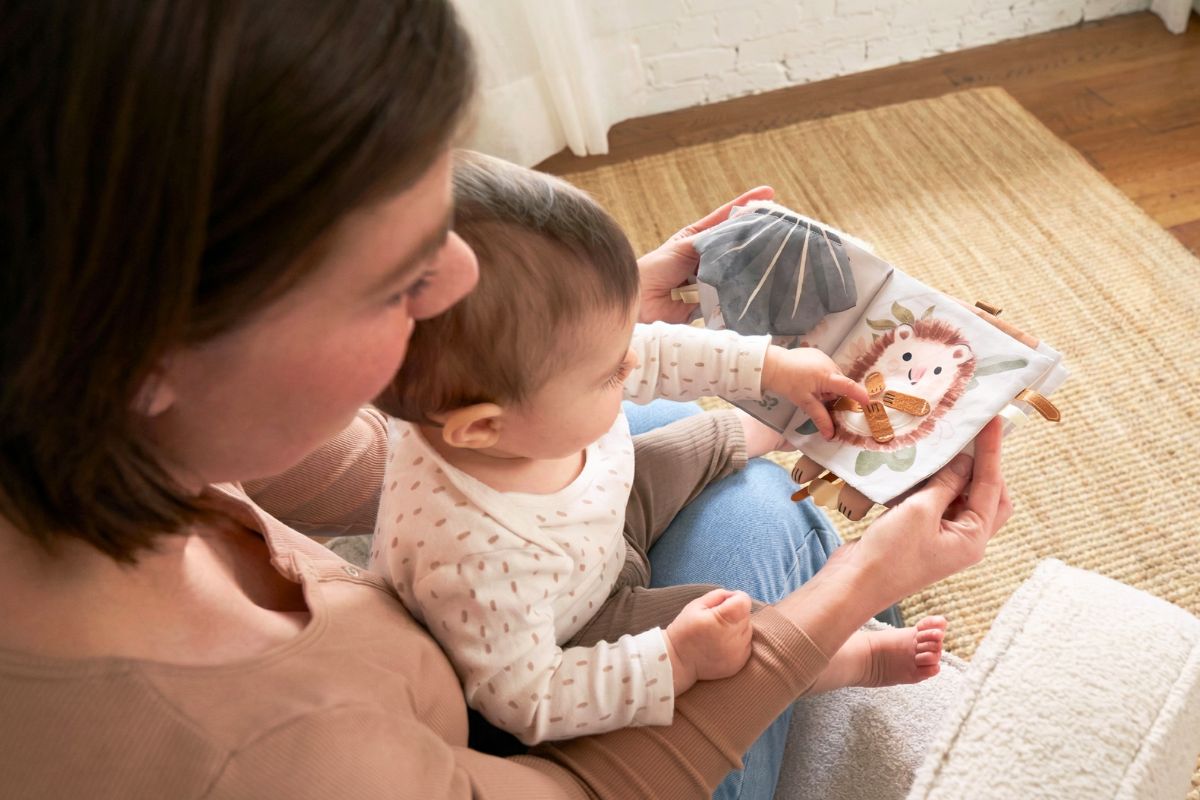
A soft fabric book with simple, realistic images, one clear object per page, serves two purposes at 6 months. It is a grasping and mouthing toy (the pages crinkle, different fabrics offer different textures), and it is also the beginning of language work: pointing to a real object, naming it clearly, and repeating. A dog on a page. A banana. A shoe. Simple, recognizable, real.
Avoid books with cartoon characters or abstract images at this age. Babies are working to make the connection between words and real-world objects. A stylized cartoon apple does not look like the apples in the fruit bowl, and the mismatch is genuinely confusing at this stage. Realistic photography or clean illustration of real objects is the Montessori standard for infant books.
Safe to mouth
Tactile page textures
Choose realistic images, not cartoons
7. Floor Mirror (Shatterproof Acrylic)
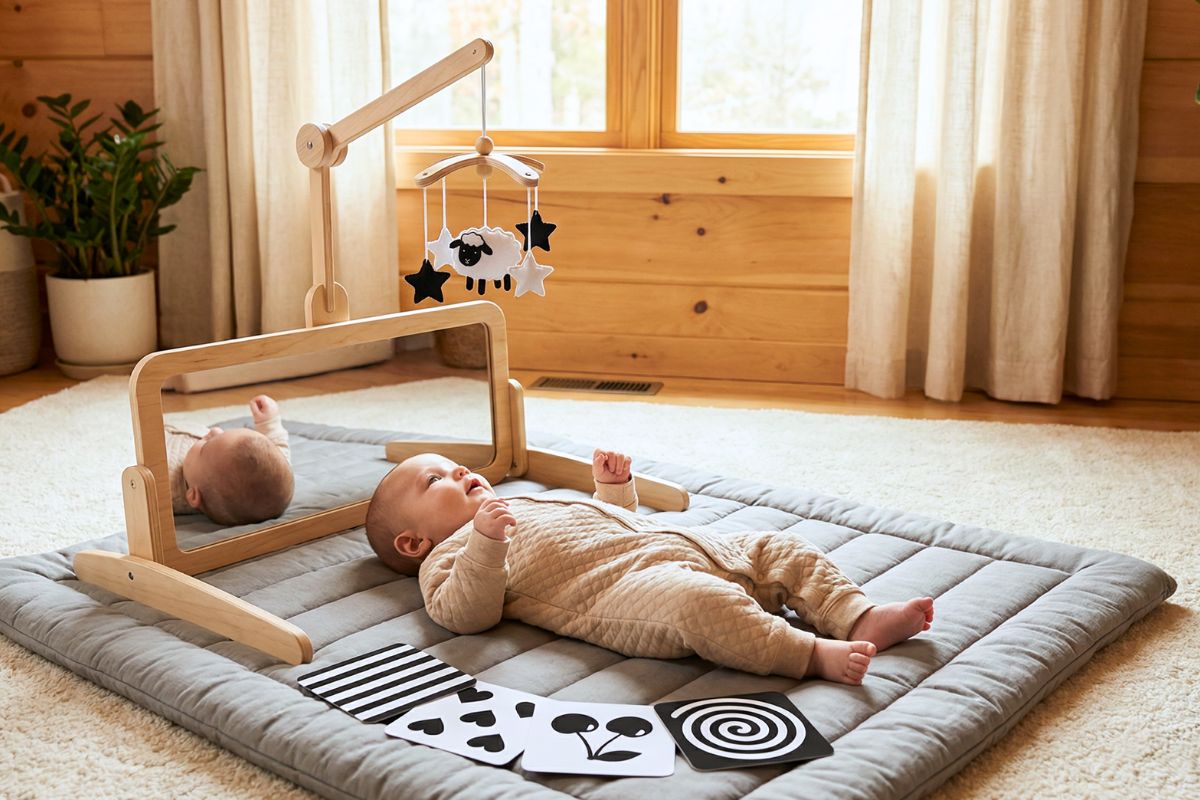
This is not technically a toy but it belongs on this list because nothing else does as much work. A horizontal shatterproof mirror at floor level gives the baby a face to interact with during tummy time (motivating the head lift), a reflection of their own body movements during floor exploration, and a source of fascination that does not require any adult intervention to be engaging.
At 6 months, babies do not yet recognize their own reflection as themselves, that comes around 18 months, but they are deeply attracted to the face they see, which motivates movement, reaching, and sustained attention. The mirror stays relevant from newborn through the first year and beyond.
Body awareness
Relevant from birth to 12 months+
8. Natural Rubber or Maple Wood Teether
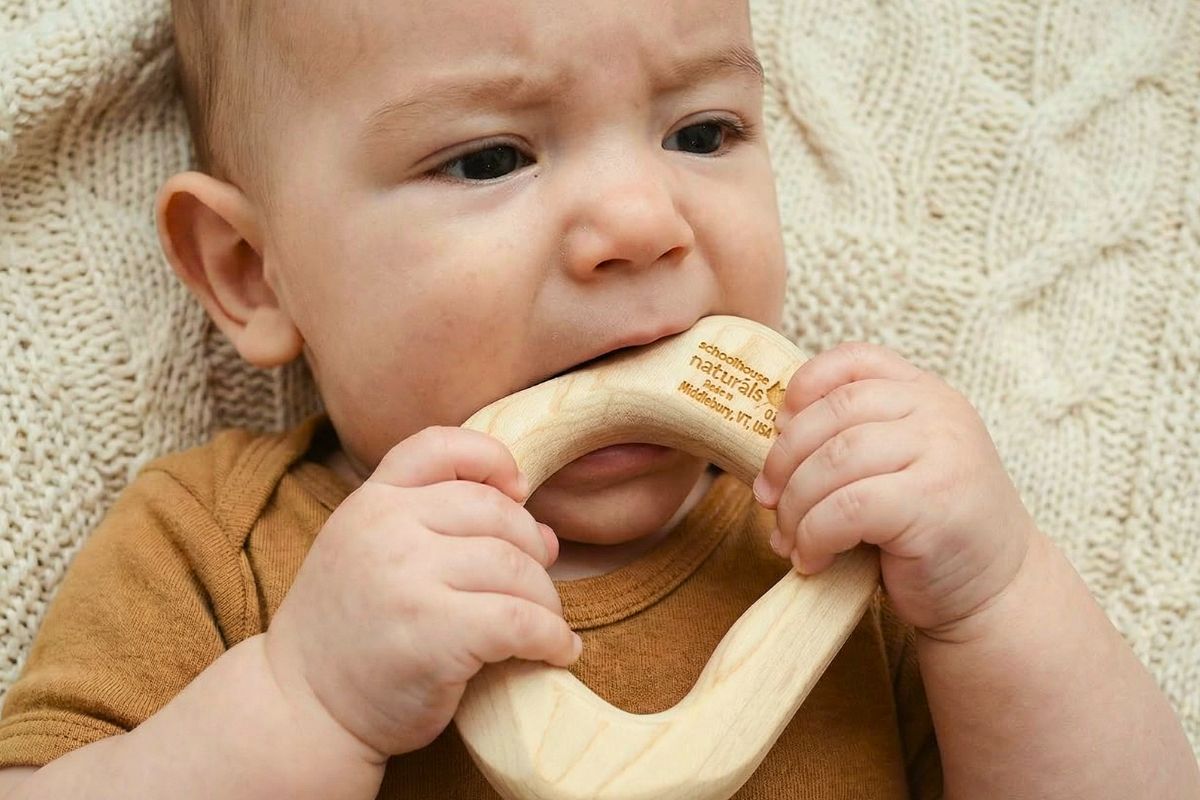
Teething typically intensifies from around 4-6 months and a purpose-made teether serves real developmental work at this stage, not just comfort. A maple wood teether or natural rubber teether provides genuine sensory feedback through the gums and lips that a plastic chew toy cannot match. The weight of maple wood (heavier than it looks) also gives the hand proprioceptive information that supports hand awareness.
For natural rubber options, look for 100% natural rubber certified free of nitrosamines, the common concern with rubber toys. For wood, look for food-safe finishes (olive oil, beeswax) or unfinished maple. Avoid painted wooden teethers.
What to look for
Materials & Safety
100% natural rubber, nitrosamine-free certification. Wood: untreated maple or beech, or food-safe oil/wax finish only. No paint, no lacquer, no BPA, no phthalates.
What to Skip at 6 Months (And When It Becomes Right)
A note on musical instruments: A simple xylophone or small drum can be introduced from around 6 months for the basic cause-and-effect experience of hitting and hearing a sound. Keep to instruments with large, easy-to-hit surfaces and no small detachable parts. What to avoid at this age is anything with multiple buttons, modes, or programmed songs that play regardless of what the baby does, the learning value of an instrument comes from the direct action-sound connection, not from passive listening to a pre-programmed tune.

Questions Parents Ask Most Often
How many toys should I have out for a 6-month-old?+
Two to four objects on the shelf at any one time is enough for this age. Research shows that fewer toys produce longer, richer play sessions at this stage. A mirror, one grasping toy, one rattle, and one cause-and-effect material is a complete and balanced selection. Rotate rather than accumulate, when one object stops generating interest, replace it, do not add to it.
Do Montessori toys have to be wooden?+
No. The material matters less than the properties: safe to mouth: not battery-operated, open-ended enough to explore in multiple ways, and scaled correctly to small hands. Natural rubber, untreated cotton fabric, and food-safe silicone are all consistent with Montessori principles. Plastic is not inherently incompatible, but most low-cost plastic toys fail the open-ended and durability tests. Wooden toys tend to pass more of the criteria more consistently, which is why they dominate the recommendation lists.
My 6-month-old just mouths everything. Is that okay?+
Completely normal and developmentally important. Mouthing is a primary way babies gather sensory information about an object: its temperature, texture, hardness, size relative to the mouth. It is not a problem to be corrected. It is the developmental work of this stage. This is exactly why every toy on this list must be safe to mouth. Rather than trying to stop mouthing, ensure every accessible object is genuinely safe for it.
When does a 6-month-old actually play independently?+
At 6 months, periods of genuinely independent play are short, 3 to 10 minutes is realistic, depending on the child and the material. This is normal and appropriate. The Montessori approach is not about leaving a 6-month-old alone with toys for extended periods; it is about giving them the conditions to explore without constant adult direction. You can be nearby, quietly present, without directing the play. Those short independent windows grow gradually throughout the first year as the shelf is well-matched to development.
Match the Toy to the Hands, Not the Age Range on the Box
The “6+” label on a toy tells you very little. A shape sorter marketed from 6 months will sit ignored for four months before a baby can actually use it. An object permanence box in the right hands at exactly 6 months will be used every single day until around 9 months, when the drawer version becomes the next step.
Watch the hands. Watch the attention. Start with objects that can be grasped palmarly, mouthed safely, and that produce immediate feedback from the simplest action. That is the whole brief at this stage. Everything else can wait.
Continue reading
|
Shelf management
Montessori Toy Rotation Guide
How many toys on the shelf, the 5 signals that tell you it is time to swap, and storage that takes 10 minutes.
|
Movement area
The Montessori Movement Area
The full floor-based setup: mat, mirror, mobiles, and how the shelf evolves from birth through first steps.
|