
The two Montessori globes look similar enough that it is easy to buy the brighter one first. The usual sequence goes the other way. The sandpaper globe introduces one simple contrast, rough land and smooth water. The colored globe comes next and separates that land into continents.
You do not need to teach countries, oceans, latitude, or flags in the first lesson. Five quiet minutes with the words land and water gives a young child a much clearer starting point.
Buy One or Both?
- First globe: Sandpaper land-and-water globe.
- Second globe: Colored continent globe.
- Typical starting window: Around age 3, guided by interest and the child’s ability to handle the globe carefully.
- If you can buy only one: Choose sandpaper for a true beginner, colored for a child who already knows land and water.
- First presentation: Globe, Earth, land, water. Stop there.
- Next material: Colored globe, world puzzle map, then continent work.
Transparency note: This article includes Amazon links. If you buy through one, I may earn a small commission at no extra cost to you. I only link to materials that fit the lesson described here.

Why the Sandpaper Globe Comes First
Montessori materials often isolate one idea before adding another. On the first globe, every rough area means land and every smooth blue area means water. Color, continent names, borders, and countries are held back.
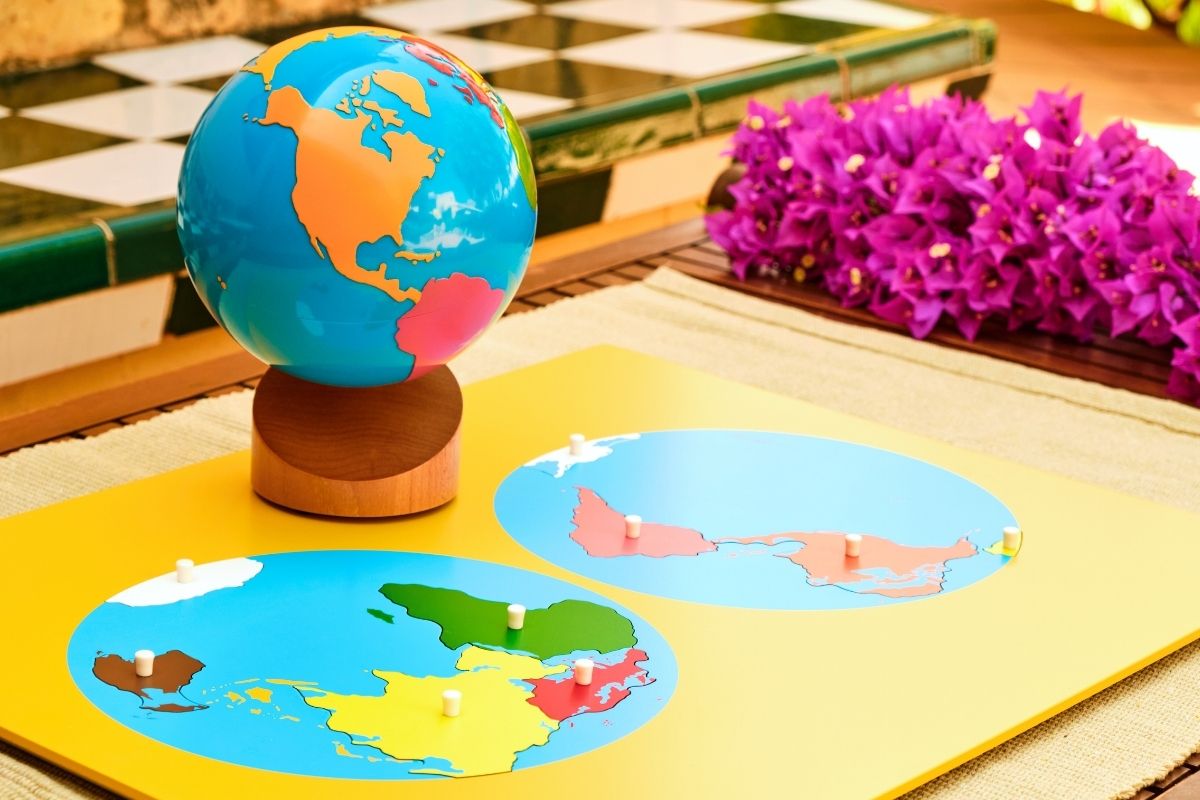
The colored globe keeps the same spherical model but adds a new distinction. The child can now see that the land is organized into separate continents. The American Montessori Society lists the Globe of Land and Water before the Globe of the Continents in its Early Childhood core-material sequence.
The old order is easy to reverse. The colored globe looks more informative, but more information is exactly why it comes later. A young child first needs the whole Earth and the basic land-water contrast.

Sandpaper or Colored Globe: A Clear Comparison
Both globes represent the same planet, but they answer different questions. Choosing by lesson purpose is more helpful than choosing by appearance.
The Five-Minute Sandpaper Globe Presentation
The presentation is quiet because the material already carries the contrast. Give only the words needed for what the child’s hands can feel.
1
Show how to carry the globe with two hands supporting the base.
2
Say, “This is a globe. It is a model of our Earth.” Rotate it once slowly and let the child look.
3
Touch one rough area gently. Say, “Land.” Invite the child to feel it.
4
Stroke one smooth blue area. Say, “Water.” Invite the child to feel it.
5
Ask two or three recognition questions. “Show me land.” “Can you find water?” Then let the child explore.
Stop before continent names. Naming Africa, Asia, oceans, and the child’s home country in the same sitting removes the isolation that makes the first globe so clear.
How to Present the Colored Continent Globe
Bring out the colored globe after the child can identify land and water comfortably. Begin by linking the new globe to the old one rather than presenting it as an unrelated object.
A simple bridge between the globes
“This is Earth again. The blue is water. The land has different colors because the land is divided into continents.”
Name two or three strongly contrasting continents through a three-period lesson. You may include the continent where your child lives because it gives the new vocabulary a personal anchor, but there is no need to quiz all seven in one day.
The Traditional Montessori Continent Colors
The same colors usually continue from the globe to the world puzzle map, continent cards, and folders. Matching the system helps the child recognize a continent across different materials.
Activities That Extend the Lesson Without Rushing It
A useful extension repeats the same idea in a new form. It does not pile country capitals, latitude, climates, and flags onto a preschool geography lesson.
1. Find land and water in real life
At a pond, beach, puddle, or garden, use the same simple vocabulary. The globe word now connects to a real place.
2. Match the globe to a world puzzle map
Place the globe beside the map and find the same continent by color. This helps the child move from a sphere to a flat representation.
3. Locate where your family lives
Move from Earth, to continent, to country, to town. Keep each scale clear rather than presenting every place name at once.
4. Make one continent basket
Choose a few real photographs, a book, a familiar object, and one animal figure. Avoid reducing a continent to costumes or stereotypes.
5. Follow a real journey
Trace a relative’s trip, a package route, or the setting of a story. Real connections usually hold more meaning than random quiz questions.
What Comes After the Globes
The globe gives the child the whole planet first. Later materials flatten, separate, and name parts of that whole in a controlled sequence.
The broader Montessori geography materials guide explains how the globes, maps, landforms, and three-part cards fit together. A home-made version is also possible if you prefer to begin with the DIY Montessori globe guide.
Common Mistakes That Make the Globe Less Clear
Most home mistakes come from enthusiasm. The adult has many interesting facts ready, while the child is still trying to work out what the model represents.
- Starting with the colored globe before the land-water contrast is clear.
- Teaching all seven continents in the first presentation.
- Using stickers or pins that damage the surface or turn the globe into a crowded display.
- Expecting preschoolers to learn latitude, longitude, or political boundaries from the first globe.
- Quizzing more than observing and naming.
- Using cultural objects without context, or presenting one object as if it represents an entire continent.
- Leaving the globe where it is likely to be spun roughly rather than carried and handled with care.
Questions Parents Ask Most Often
What age is a Montessori globe for?+
The first presentation is commonly offered in the 3-to-6 environment, often around age 3. Readiness includes interest in the world, enough language for the vocabulary, and the ability to carry and touch the material carefully.
Do I really need both globes?+
No. Both give the cleanest sequence, but a home does not need to reproduce a full classroom. Choose the sandpaper globe for the first concept, then use a continent map or DIY colored globe later if budget or space is limited.
Should I teach continent names in a fixed order?+
There is no need to recite them around the globe in a fixed order. Present two or three contrasting continents, often including the child’s home continent, then add others as recognition becomes secure.
Can we use an ordinary political globe instead?+
An ordinary globe is useful for later questions, but it contains many lines, labels, and colors. For a first preschool lesson, a simple land-water model isolates the concept more clearly. A DIY version can provide that simplicity.
Start With the Whole World, Then Add the Names
The first globe lesson is not small because young children are incapable of learning facts. It is small because a clear foundation lets every later fact find the right place.
Begin with Earth, land, and water. Add the colored continents when that contrast feels familiar. Then move slowly from globe to map, from whole planet to one continent, and from abstract color to real people and places.
Sources & References
- American Montessori Society. (2020). Early Childhood Core Materials and Activities. Retrieved from https://amshq.org
- Montessori Academy. Material Spotlight: The Montessori Sandpaper Globe. Retrieved from https://montessoriacademy.com.au
- Montessori, M. (1912). The Montessori Method. Frederick A. Stokes Company.
- Montessori, M. (1949). The Absorbent Mind. Theosophical Publishing House.
- Lillard, A. S. (2017). Montessori: The Science Behind the Genius (3rd ed.). Oxford University Press. DOI: 10.1093/acprof:oso/9780190613976.001.0001
- Daoust, C. J. (1994). A Comparison of the California Public School and Montessori Elementary Curricula. American Montessori Society.