
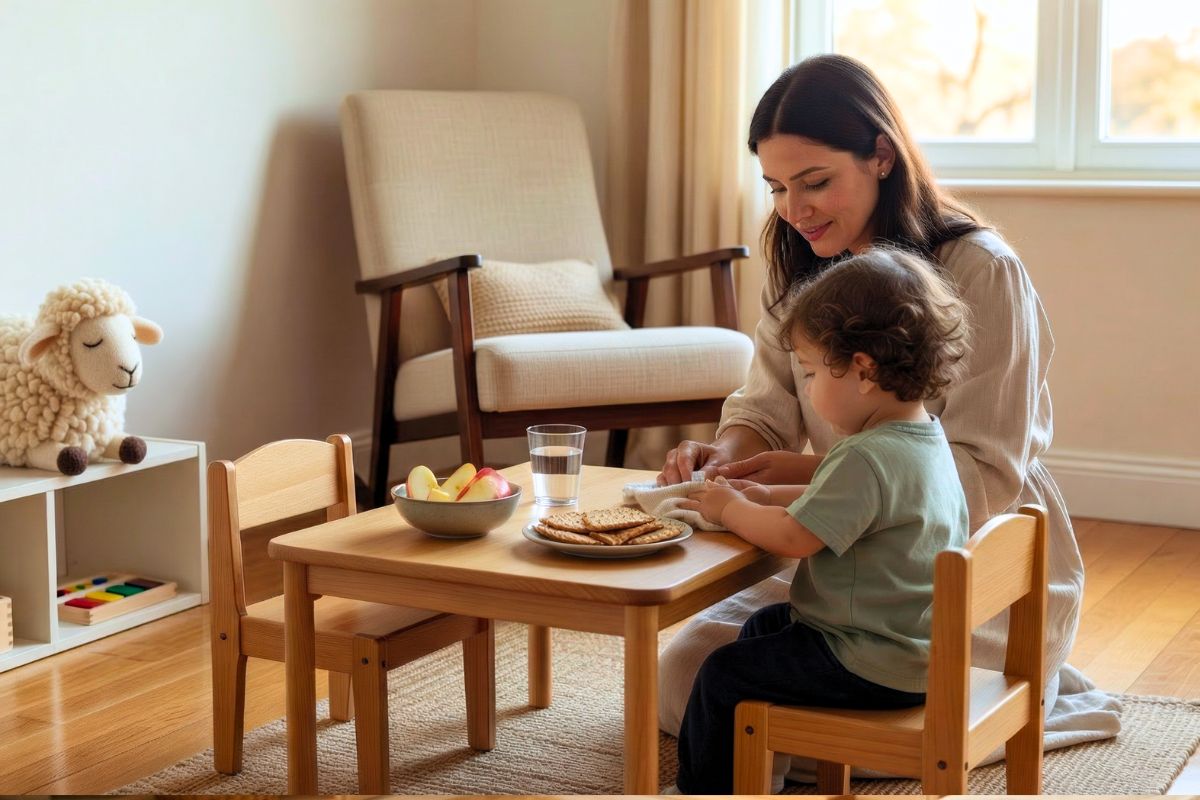
Every parent knows feeding a baby takes up an enormous portion of the early months. What most don’t realize is that how and where feeding happens shapes more than nutrition. It shapes the baby’s sense of order, their relationship with mealtimes, and eventually their capacity to regulate their own hunger.
The Montessori feeding area is built around two ideas, consistency creates security, and as soon as possible, the child eats like a person rather than being fed like a package. That shift, from passive recipient to active participant, starts earlier than most parents expect.
The Montessori Feeding Area at a Glance
- Phase 1 (0-5 months): One consistent nursing/feeding chair, same spot every time
- Phase 2 (5-8 months): Weaning table and low chair introduced for solid foods
- The core principle: Feeding happens in the same place, with full adult presence, every time
- What the nursing chair needs: Good back support, footrest, side table within reach
- Weaning table: Small, stable, child-height table and chair. Not a high chair.
- The Montessori approach to solids: Self-feeding, family mealtimes, minimal purees
Phase 1: The Nursing and Feeding Chair (0-5 Months)
In the early months, feeding happens entirely between you and your baby. The Montessori principle here is straightforward, do it in the same place every time.

This is not about rigidity. It is about the baby’s sense of order. A newborn who is fed in the same chair, in the same quiet corner, with the same adult nearby begins to recognize the cues that feeding is coming. The environment communicates before words do. That predictability is calming, and it sets up a clear routine that serves both the baby and the parent.
Setting Up The Nursing Chair Area
The chair itself: A comfortable armchair or rocking chair with genuine back support. Nursing creates physical strain over many months, and a chair with proper lumbar support and arms prevents long-term discomfort. A rocking motion is calming for both parent and baby and is the one piece of moving furniture that Montessori explicitly supports in the feeding area.
Footrest: Essential for nursing. A small ottoman or footstool allows the parent to keep their legs at a comfortable angle, which supports both posture and the baby’s latch.
Side table: Within arm’s reach, with everything the feeding adult needs: water, a cloth, a phone if necessary (though Montessori encourages full presence during feeding). The goal is that once sitting down to feed, the adult does not need to get up, which disrupts the feeding and signals to the baby that the activity is not the full priority.
Environment: Quiet, calm, no background TV or loud noise. The Montessori position on feeding is that it is a two-way interaction, not a task to complete while multitasking. Even a very young baby is communicating during feeding: slowing down, pausing, looking away, resuming. These cues teach hunger regulation if the parent is present enough to notice them.
What helps
Footrest
Everything within reach before sitting
Calm, consistent environment
Full presence with the baby
What disrupts it
Feeding in different spots each time
Getting up mid-feed frequently
Phase 2: The Weaning Table (From ~5-6 Months)
Around the time solid foods begin, usually between 5 and 6 months, the feeding area gains its most distinctive Montessori element: the weaning table.
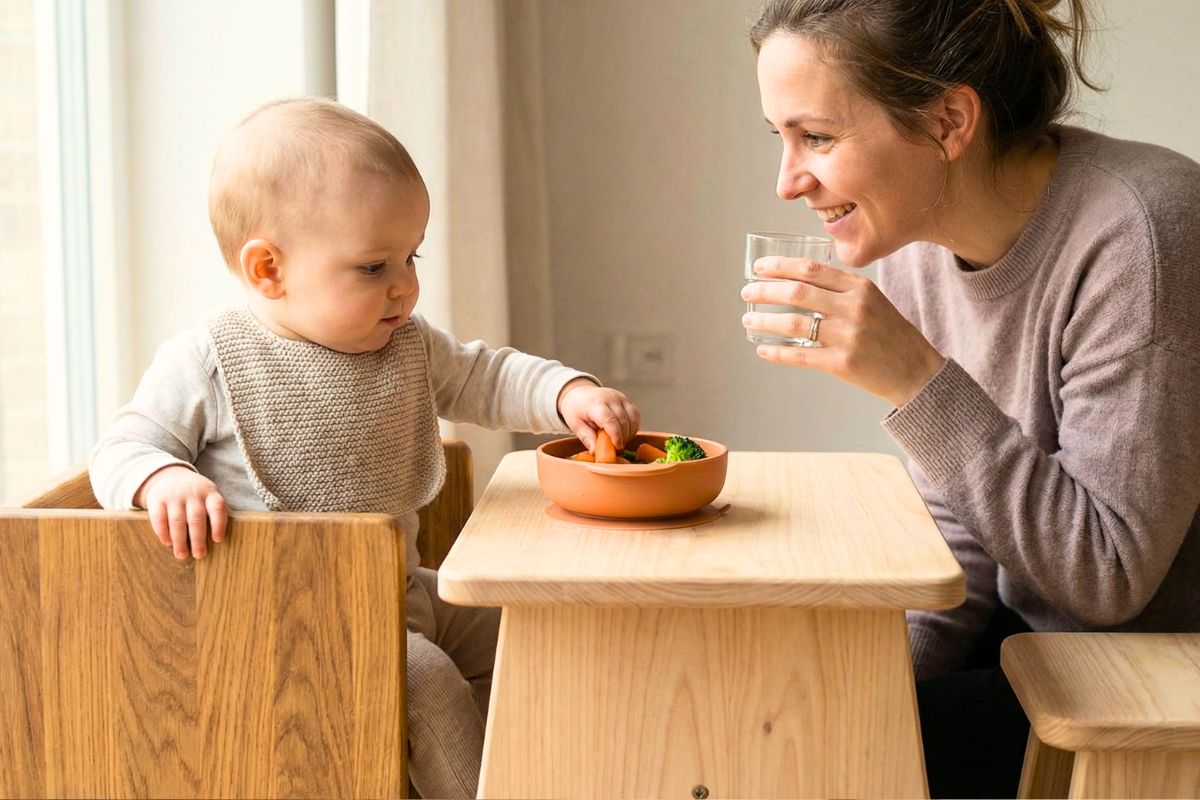
A weaning table is a small, very low wooden table, usually around 20 to 25 cm high, paired with a proportional chair. The baby sits at the table independently, at their own height, and engages with food as a person rather than being held or strapped into a high chair at adult table level.
This small piece of furniture carries a large philosophical point: eating is something the child does, not something that is done to them. From the first solid foods, the baby has agency over their mealtime. They explore the food with their hands. They decide how much to pick up. They choose what to eat next. This is not a mess to be tolerated; it is how appetite regulation, food curiosity, and independence at meals develop.
Research Note: A 2023 randomized study found that babies introduced to solids through self-feeding (baby-led weaning approach) showed significantly greater self-feeding ability and transition to solid foods compared to those receiving traditional spoon-feeding, with no increased risk of choking, obesity, or iron deficiency. A 2022 review by the French Society of Pediatrics confirmed that self-feeding promotes breastfeeding, respect for appetite, and use of unprocessed foods.
What The Weaning Setup Looks Like
The table: A very small, low wooden table. The height should allow the baby to sit with feet flat on the floor (or close) and arms comfortable on the table surface. Many Montessori furniture brands make these; the IKEA LATT table, while not perfectly proportioned, works as a budget alternative.
The chair: A small wooden chair at the same proportions. Sturdy, with four legs on the floor rather than a base that can tip. The baby sits without restraints.
The adult stool: The parent sits beside the child on a low stool, at the baby’s eye level, to model eating and offer support. The adult is present but not controlling the pace or quantity of food.
The tableware: Small, real crockery or silicone that the baby can handle. A small shallow bowl. A small cup for water, introduced early. Not plastic sippy cups as the first option, but a small open cup with very little water to practice sipping.
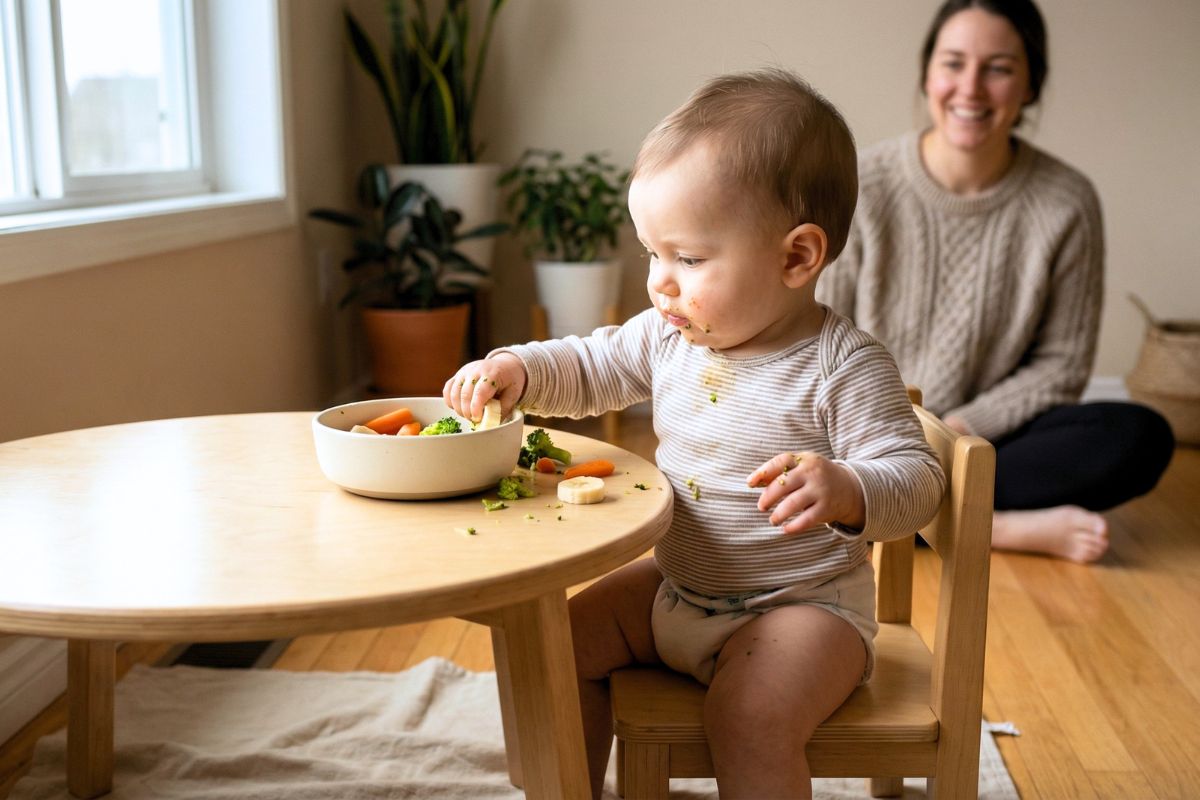
Underneath: A mat or newspaper under the chair and table catches the food that lands on the floor, which is a lot at first. This is not a problem. It is part of how babies learn to eat.
The weaning table supports
Fine motor development (pincer grip)
Food exploration and texture tolerance
Independence at mealtimes
Positive relationship with food
What to avoid
Pressuring or coaxing to eat
Distractions during mealtimes (screens, toys)
Strapping the baby into a high chair and managing the spoon
The Feeding Area Through the First Year
The Montessori Approach to Solid Foods
The Montessori philosophy on solid foods aligns closely with what is now widely called baby-led weaning: the baby leads the pace and process of discovering and eating solid foods, with the adult providing appropriate, safe options and full presence rather than control.
Montessori Principles For Solid Food Introduction
- Readiness, not age: Wait until the baby can sit unsupported, shows interest in food, and the tongue-thrust reflex has faded. This is usually around 6 months but varies.
- Real food, not products: Soft pieces of vegetables, fruit, grains, and protein in forms the baby can manage, not pouches, not flavored cereals.
- The baby controls quantity: Offer, don’t push. The amount a baby eats at any meal varies widely. This is normal. Hunger regulation is an internal process that works best when external pressure is absent.
- Family mealtimes: Eating together matters. The baby at the weaning table beside family members who are also eating learns about mealtimes as a social, pleasurable experience.
- Mess is the process: Food exploration is messy. The mat under the table handles it. The mess is not a problem to solve but a sign that learning is happening.
Questions Parents Ask Most Often
Do I really not need a high chair?+
Many Montessori families use both. The weaning table is for the child’s independent meals, where they are at their own level and have full control. A high chair adapted to the adult table (like the Tripp Trapp) can work well for shared family meals where the child eats at the same height as the adults. The principle is the same: the child sits without being strapped into a passive receiving position. They participate. The weaning table is often the more important investment for under-12 months; the adapted high chair matters more from toddlerhood on.
When should I introduce the weaning table?+
When the baby can sit unsupported well enough to stay in the chair without slumping. This is usually between 5 and 7 months. You do not need to wait for the weaning table before beginning solids, but ideally you are starting to use it around the same time. Set it up before you need it so it is part of the environment from the beginning of solid food introduction.
Is it safe for babies to self-feed? What about choking?+
Self-feeding when the baby is developmentally ready and the food is appropriately sized and textured is safe. The key is being present and watching, offering food in strips or pieces the baby can manage, and knowing the difference between gagging (normal, part of learning) and choking (rare, requires response). Multiple controlled studies, including a 2023 randomized trial (Arslan et al.), found no increased choking risk with self-feeding compared to spoon-feeding when implemented appropriately. Learning infant first aid for choking is always a worthwhile step regardless of feeding method.
What does the feeding area look like in a small apartment?+
The nursing chair can be in the bedroom or the living room. The weaning table is small enough to fit in any corner of the kitchen or living space. Neither element requires a dedicated room. The feeding area is not a physical room but a consistent setup: the same chair for nursing, the same small table for solids. Many families who live in small spaces find this setup works better than a high chair, which takes up more room and requires more equipment.
Feeding as Connection
When we talk about the Montessori feeding area, we are really talking about presence. Every feeding from the first days is an opportunity to be fully with the baby. No screen, no second task, no rush. Just the adult and the child, and what happens between them.
Set up the chair before the baby arrives. Order the weaning table alongside the other nursery furniture. When solids begin, the setup is already there. And then you sit down, put the food in front of them, and watch what they do with it. It will surprise you.
Scientific References
Arslan, N., Kurtuncu, M. & Turhan, P.M. (2023). The effect of baby-led weaning and traditional complementary feeding trainings on baby development. Journal of Pediatric Nursing, 73, 196–203.
Bocquet, A. et al. (2022). “Baby-led weaning”: Progress in infant feeding or risky trend? Archives de Pédiatrie, 29(7), 516–525.
Davies, S. & Uzodike, J. (2021). Montessori Baby. Workman Publishing.