
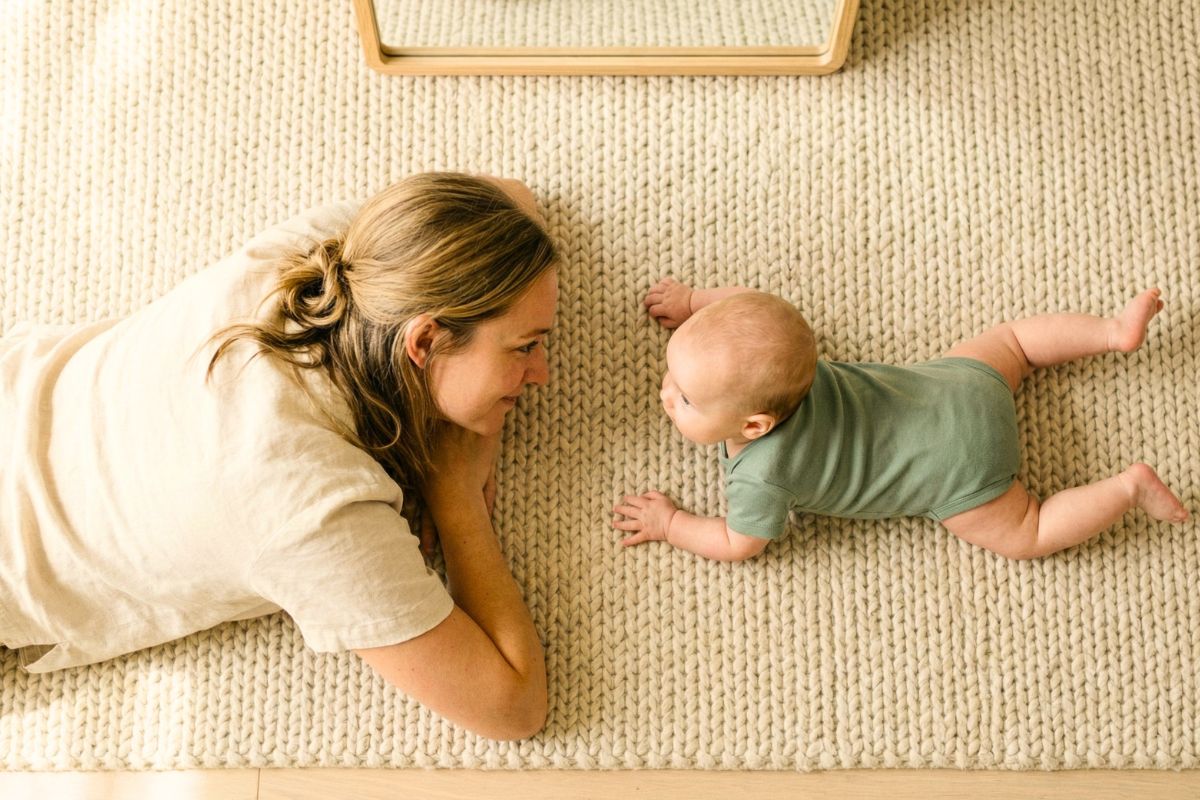
My daughter screamed every time I put her on her tummy for the first three weeks. I was doing it wrong, not the position, but the whole setup. Hard floor, no mirror, no context, no warning. Just: face down, good luck. The moment I understood what tummy time is actually trying to do, and how it fits into a baby’s entire waking life rather than being a separate chore, it stopped being a battle.
Here is everything that actually matters, when to start, how much by age, why Montessori babies often do it without parents even noticing, and how to make it work if your baby currently hates every second of it.
Quick Reference
- When to start: From birth, as soon as you are home from the hospital
- Newborn (0-4 weeks): 30-60 seconds, 2-3 times daily; on your chest counts
- By 2 months: 15-30 minutes total per day, broken into short sessions
- By 3-4 months: Build toward 60 minutes total across the day
- By 5-6 months: Natural floor play takes over, no more “scheduled” tummy time needed
- The setup that works: Firm surface, low mirror, you at eye level, short and frequent
- Montessori note: Time on your chest, over your lap, and on a movement mat all count
What Tummy Time Actually Does
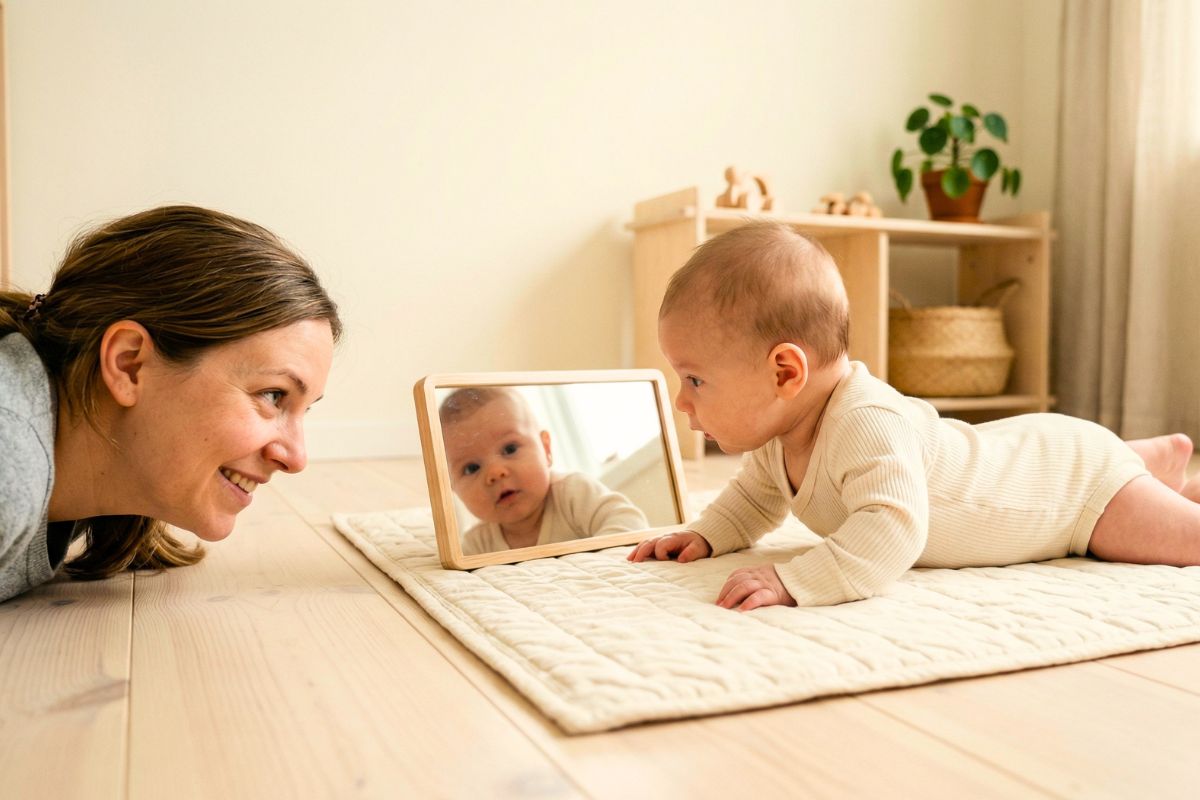
Tummy time is supervised awake time with your baby lying on their stomach. It became a specific recommendation after 1994, when the AAP launched the Back to Sleep campaign that dramatically reduced SIDS deaths by ensuring babies slept on their backs. The unintended consequence was that babies began spending almost all their time on their backs, including awake time, and motor delays started to increase as a result.
When a baby is on their tummy, they have to fight gravity to lift their head. That effort builds the neck, shoulder, and upper back muscles that make every subsequent motor milestone possible. Rolling, sitting, crawling, pulling to stand, walking. All of them depend on the strength built in prone position. There is no shortcut around it.
What the research shows: A systematic review published in Pediatrics (Hewitt et al., 2020) found that supervised tummy time during awake periods supports motor, visual, and sensory development and is recommended by the AAP, WHO, and most major pediatric bodies from birth. A 2022 longitudinal study following 411 infants (Carson et al., Int J Behav Nutr Phys Act) found that higher tummy time was associated with earlier achievement of all gross motor milestones: rolling, sitting, crawling, standing, and walking, while higher restrained time in bouncers and car seats was linked to delayed milestone achievement.
The AAP recommends starting tummy time as soon as your baby arrives home from the hospital. You can read their full guidance at HealthyChildren.org.
Beyond motor development, tummy time reduces the risk of positional plagiocephaly (flat head syndrome), which has increased significantly since the Back to Sleep campaign. Time in the prone position, including being held upright and doing supervised floor time, distributes the pressure across the baby’s skull more evenly than continuous time on the back.
Tummy Time Chart by Age
Every baby develops at their own pace, but these targets give you a useful framework. The goal is gradual accumulation across the day, not long forced sessions.
Important: These are cumulative daily totals across all sessions, not single-session targets. A newborn doing four 30-second sessions is meeting the recommendation. Three minutes of fussing followed by fifteen minutes of calm observation is not useful tummy time. Short and positive always beats long and stressful.
How to Do Tummy Time: 5 Positions That Actually Work
Most parents start with one position and give up when the baby protests. These five variations give you options. Different positions suit different babies at different ages, and rotating between them keeps things interesting.
1. Chest-To-Chest (Best For Newborns, 0-8 Weeks)
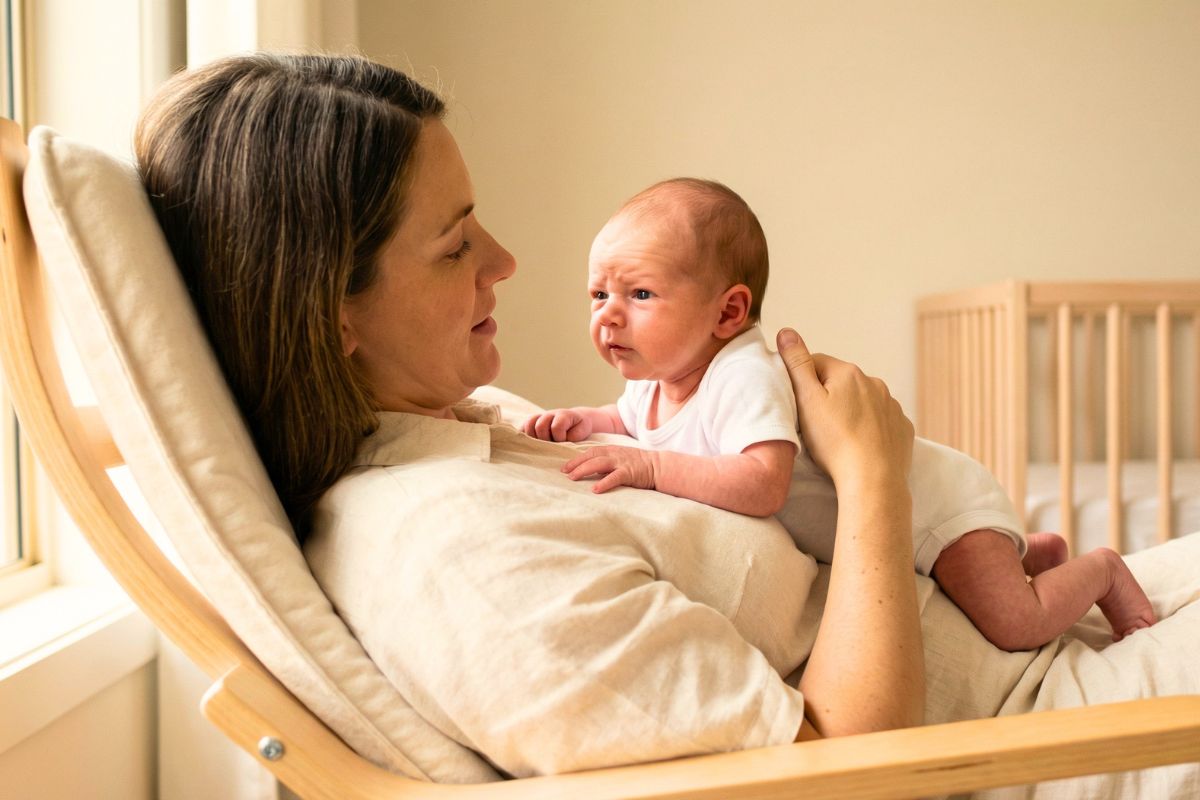
Recline on a chair or the floor at a 30-45 degree angle and lay the baby on their tummy on your chest. Your face is right there: the most compelling thing a newborn can look at. This position counts as supervised tummy time, builds the same neck and shoulder muscles, and is much more tolerable for babies who hate the flat floor. It is also the easiest way to begin in the first days home.
Counts toward daily total
Best for babies who resist the floor
2. Over The Lap (From Birth, Useful For Gas And Fussiness)
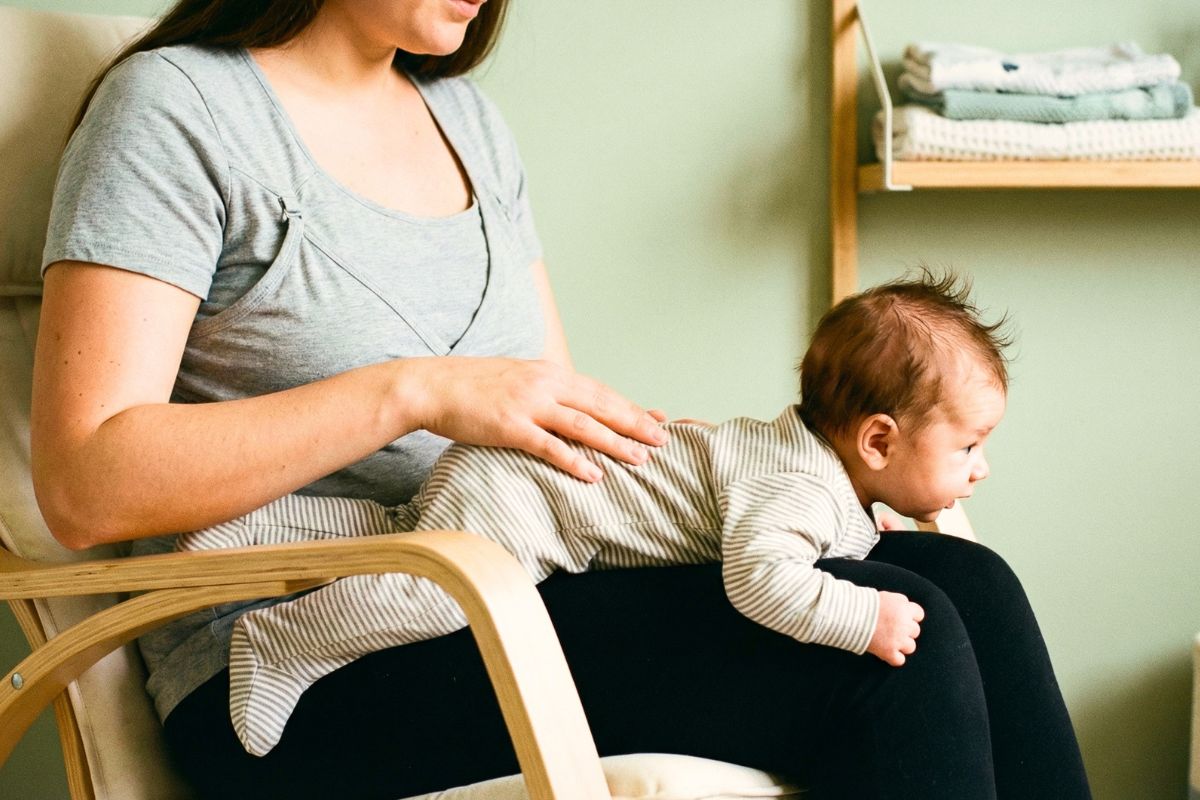
Sit on a chair and lay your baby tummy-down across your thighs, with their head slightly elevated. This position gently compresses the belly (helpful if the baby has wind) and gives them a new perspective on the room. You can gently rock your knees or rub their back. A good position for the early weeks before the baby has any meaningful floor tolerance.
Good for gassy babies
Counts toward daily total
3. Floor Tummy Time With Mirror (Main Montessori Setup, From 2-4 Weeks)
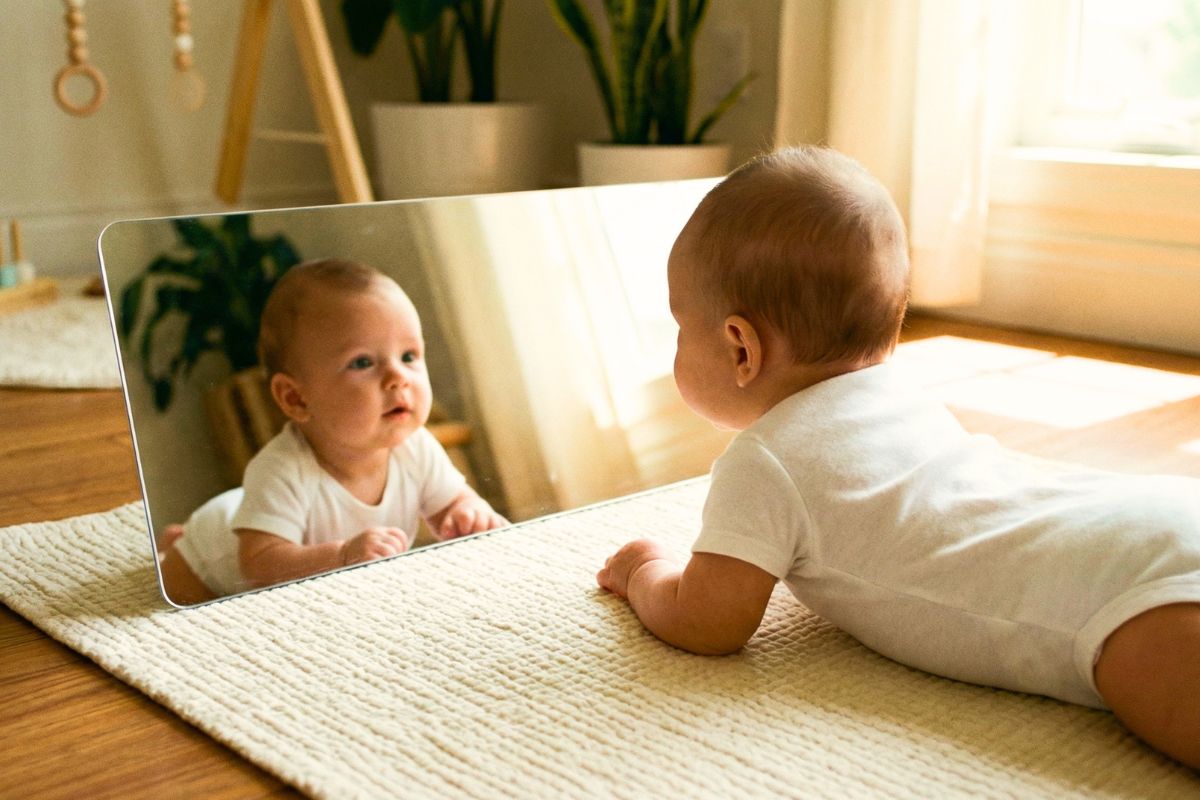
Place the baby on a firm surface (not a soft mat that lets them sink) with a low horizontal mirror at their eye level. The mirror is not decoration: it is the most powerful tummy time motivator there is. Babies are drawn to faces, and their own reflection is endlessly interesting. Seeing themselves move also begins to build body awareness and the connection between intention and action. You get down at their level too. Your face beside the mirror doubles the incentive to lift up and look.
The Montessori movement area setup
Main method from 1 month onward
4. Supported Tummy Time With A Rolled Towel (For Babies Struggling With Floor Time)
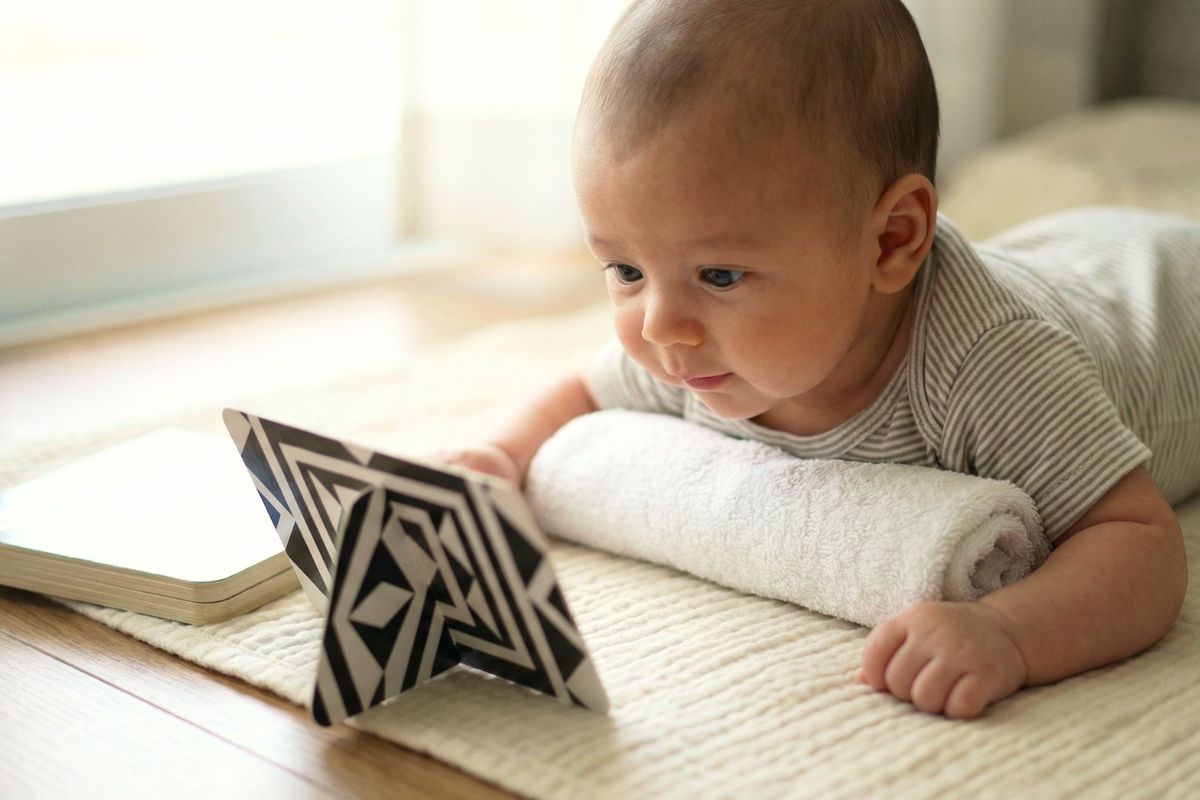
Place a tightly rolled hand towel or small receiving blanket under the baby’s chest, just below the armpits. The slight prop gives them a head start on the lift and makes the effort of tummy time feel less overwhelming. This is particularly useful in the first 4-6 weeks for babies born with less upper body strength, or babies who seem to panic when placed completely flat. Remove the roll as they gain confidence.
Transition tool, not permanent
Wean off as strength develops
5. Football Hold Carrying (Bonus: Counts As Strengthening Time)

Carry the baby face-down along your forearm, with their tummy resting on your arm, head toward your elbow, legs straddling your hand. Walking around in this position gives the neck and shoulder muscles exactly the kind of eccentric loading that tummy time on the floor provides. It is also extremely calming for colicky babies. Not a substitute for floor time, but a useful addition to the rotation, especially in the first 8 weeks.
Builds same muscle groups
Best for 0-3 months
The Montessori Angle: Why Your Baby May Already Be Doing It
One of the recurring conversations in Montessori parenting communities is the tension between the AAP recommendation to do deliberate tummy time and the Montessori principle of not placing a baby in a position they have not reached independently.
In practice, this tension is much smaller than it sounds. Montessori families who set up a genuine floor-based movement area with a mirror, firm mat, and mobiles end up doing substantial tummy time without scheduling it, because that is where the baby spends their awake time. On your chest during nursing. On your lap during a diaper change. On the floor mat during visual mobile time. These all count.
What Counts As Tummy Time
Any supervised awake time with your baby in a prone or face-down position. On your chest. Over your lap. On a firm floor mat. On a slightly elevated rolled towel. On your forearm in the football hold. The position matters, not the surface. The floor is best as the baby gets stronger because it provides the most challenge, but chest-to-chest and lap positions are genuine contributions in the early weeks.
From around 4 to 6 months, tummy time naturally becomes the baby’s preferred floor position during awake time. At that stage, with enough free floor time available, you stop thinking about tummy time as a scheduled activity: the baby chooses it because it is how they explore, push toward objects, and build toward crawling. This is why the movement area in a Montessori nursery matters so much: it provides the conditions under which all of this happens organically.
If Your Baby Hates Tummy Time
Most babies who resist tummy time are dealing with a setup problem, not a developmental one. Work through this checklist before concluding that your baby simply cannot tolerate it.
Troubleshooting Checklist
- Surface too soft: A plush mat that the baby’s face sinks into makes lifting almost impossible. Use a firm, flat surface.
- Session too long: 30 seconds of good effort is better than 3 minutes of distress. Start shorter.
- Nothing to look at: A blank floor is not motivating. A low mirror at eye level changes everything.
- Your face is missing: Get down to their level. Your face is the most compelling thing in their world right now.
- Wrong timing: After a feed is not ideal (pressure on a full stomach). After a nap, when the baby is alert and content, works much better.
- Never tried the other positions: If floor tummy time is not working yet, chest-to-chest and over-the-lap are real alternatives, not compromises.
- Possible torticollis: If your baby strongly prefers turning their head to one side and resists the other, mention it to your pediatrician. Tight neck muscles can make tummy time genuinely uncomfortable and a physiotherapist can help.
A baby who has never had much tummy time and is suddenly placed on the floor at 3 months will find it harder than a baby who has been doing brief daily sessions since birth. If you are starting late, go slowly and positively. A few pleasant seconds builds more than a long distressed session. It usually takes about two weeks of daily short sessions for babies to stop resisting and start engaging.
When to Talk to Your Pediatrician
Tummy time progression varies between babies, but a few signs are worth bringing up at your next visit.
Questions Parents Ask Most Often
Can I do tummy time if my baby still has their umbilical cord stump?+
Yes. The umbilical cord stump does not interfere with tummy time. The AAP recommends starting from the first days home regardless of the stump. Chest-to-chest tummy time is a comfortable way to start in those first days, as the baby is slightly elevated on your chest rather than pressing flat on their belly. Floor tummy time can begin as soon as you feel comfortable with it.
Can tummy time happen on a bed or sofa?+
Not recommended. Soft surfaces like mattresses and sofas are unsafe for tummy time because a baby’s face can sink into them, creating a suffocation risk. They also reduce the physical challenge: the baby needs to push against a firm surface to build strength. A blanket on the floor or a firm play mat is the right surface. Your chest while you are reclined (not lying flat) is also a safe surface for chest-to-chest tummy time.
My baby falls asleep during tummy time. Should I let them sleep like that?+
No. Tummy time is supervised awake time only. If your baby falls asleep on their tummy, move them to their back immediately. The AAP is clear that back sleeping is the only safe sleep position for babies. Tummy time and sleep are completely separate activities. Never leave a sleeping baby face-down, even briefly.
Does babywearing count as tummy time?+
Upright babywearing in a carrier supports head and neck control and reduces flat head risk, but it is not the same as prone tummy time on a flat surface. The specific muscles built by pushing against a firm horizontal surface are not replicated in a carrier. Babywearing is genuinely beneficial and worth doing, but it does not replace the daily floor tummy time target. Think of them as complementary, not interchangeable.
Start Small, Start Now
The most useful thing I can tell you about tummy time is this: one minute of calm, positive prone time is worth more than five minutes of distressed, struggling time. The session ends the moment it stops being useful, not after a timer goes off.
Put a mirror at floor level. Get your face down there. Start with 30 seconds after the next diaper change. Build from there. By three months, if you have been consistent, your baby will be lifting their head and chest and looking around like they own the room. Because by then, they kind of do.
If you are setting up a proper floor-based play space for your baby, our movement area guide covers the full setup: mat, mirror, mobiles, and how the space evolves across the first year.
Scientific References
Hewitt, L., Kerr, E., Stanley, R.M. & Okely, A.D. (2020). Tummy Time and Infant Health Outcomes: A Systematic Review. Pediatrics, 145(6), e20192168.
Carson, V., Zhang, Z., Predy, M., Pritchard, L. & Hesketh, K.D. (2022). Longitudinal associations between infant movement behaviours and development. International Journal of Behavioral Nutrition and Physical Activity, 19, 10.
Moon, R.Y. et al. (2022). Sleep-Related Infant Deaths: Updated 2022 Recommendations for Reducing Infant Deaths in the Sleep Environment. Pediatrics, 150(1), e2022057990. (AAP Back to Sleep/tummy time guidelines)
American Academy of Pediatrics. Back to Sleep, Tummy to Play. HealthyChildren.org →