
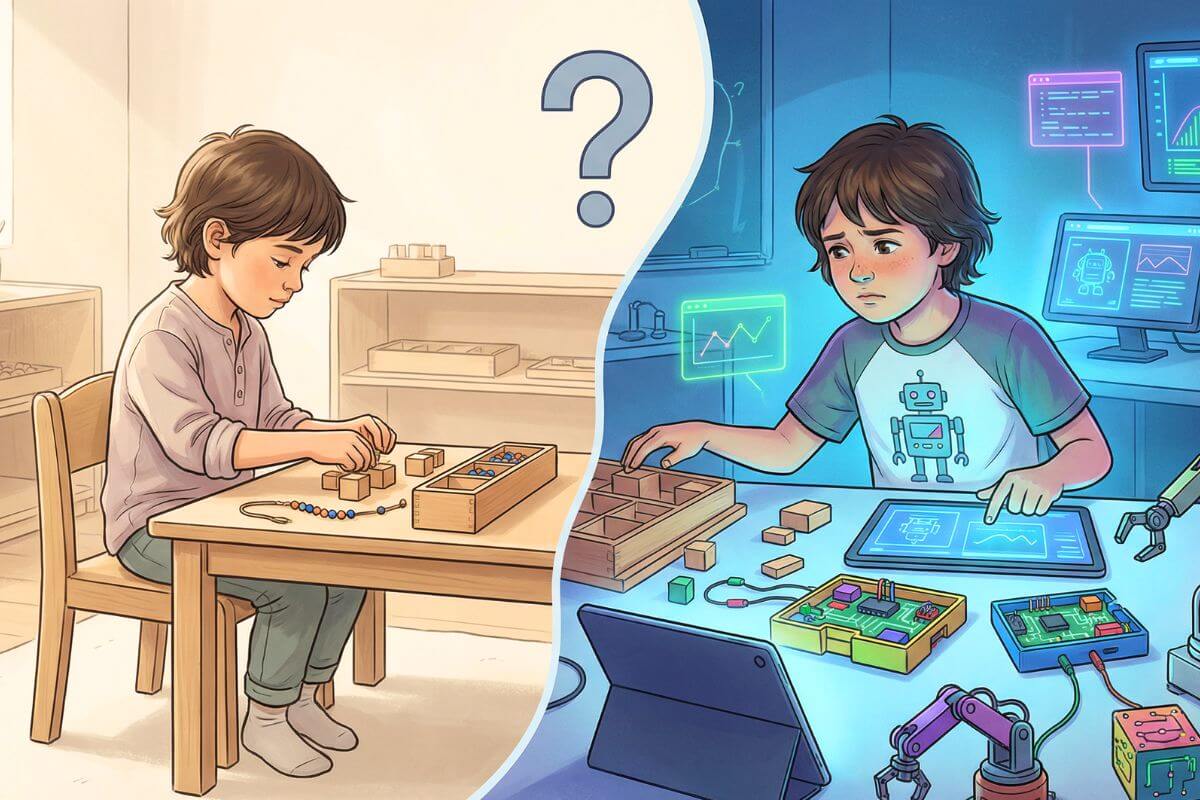
STEM education (Science, Technology, Engineering and Mathematics), is often presented as a modern reform of schooling: a response to the 21st-century economy, a corrective to passive, test-focused classrooms. What rarely gets said is that Maria Montessori built most of what STEM describes into her method in 1907, without the acronym and before any of us had thought to give it one.
This article explains the specific points of connection, the research evidence on Montessori outcomes in maths and science, and the one tension between the two approaches that most comparisons quietly skip.
Key points
- Montessori materials are STEM materials: The binomial cube, geometric cabinet, bead chains, and sensorial apparatus each teach specific scientific or mathematical concepts through direct physical interaction
- The process skills match: Both Montessori and STEM prioritize observation, hypothesis, testing, recording, and revision, Montessori builds these into every material through the control of error
- The research supports this: A longitudinal study found that attending Montessori programmes from ages 3 to 11 significantly predicted higher maths and science scores in high school. A systematic review found maths effect size g = 0.22 in favour of Montessori (high quality evidence)
- One honest nuance: Adding conventional STEM technology and engineering materials to a Montessori classroom can displace engagement with Montessori materials: integration requires care, not just addition
- STEM and Montessori differ on scope: STEM focuses on four subject domains; Montessori treats all subjects as interconnected and adds language, practical life, peace education, and physical development as equally central
What STEM Education Actually Means
STEM education is an interdisciplinary approach that emphasises science, technology, engineering, and mathematics not as separate subjects but as connected ways of thinking and solving problems. The goal is not to produce students who can recall scientific facts or execute mathematical procedures: it is to produce students who can observe a problem systematically, design a solution, test it, and revise it based on evidence.
The acronym is recent, but the underlying competencies it describes are not: curiosity, observation, systematic thinking, tolerance for failure in the service of learning, and the ability to work with evidence rather than assumptions. These are old ideas with a new label. What makes STEM a useful concept is the emphasis on connecting these four domains rather than siloing them: understanding that the mathematics you learn is the same tool you use to design the engineering solution, which requires the scientific understanding, which benefits from the technology.
How Montessori Materials Are STEM Materials
The most specific and useful thing to say about the Montessori-STEM connection is not that the two approaches “share values.” It is that specific Montessori materials teach specific STEM concepts, concretely and physically, to children who are nowhere near old enough to understand the same concept presented abstractly.
Sensorial materials: a physics laboratory for 3-year-olds
The Montessori sensorial area uses precisely designed materials to isolate specific physical qualities: weight (baric tablets), temperature (thermic bottles and cylinders), sound intensity (sound boxes), pitch (bells), texture (tactile boards and fabrics), and size relationships (the pink tower, the broad stair, the long rods). Each material allows the child to experience a single variable while all others remain constant, which is exactly the principle of controlled experimental design. A child working with the sound boxes is not playing with rattles. They are classifying stimuli by a single auditory property, building the capacity for systematic observation that underlies all scientific work.
Mathematics materials: from concrete arithmetic to early algebra
The Montessori mathematics sequence takes children from physical handling of quantities (golden beads representing units, tens, hundreds, thousands) through the four operations, fractions, geometry, and, in the elementary years: early algebraic concepts, all through materials rather than abstract notation. The binomial cube, which a 3-year-old can assemble as a three-dimensional puzzle without any algebraic knowledge, is the physical representation of (a+b)³. The trinomial cube is (a+b+c)³. Children who have assembled these materials dozens of times arrive at the algebraic formula with the physical intuition already built in.
The bead chains: color-coded strings of beads representing squares and cubes of numbers: introducing skip counting (the foundation of multiplication), squaring, and cubing through linear and spatial experience. A child who has laid the 1000 bead chain across the floor and marked every hundredth bead understands the relationship between 10, 100, and 1000 in a way that is physically embodied. This is not incidental to STEM competence: it is its foundation.
Cultural studies and science: classification as scientific thinking
Montessori’s cultural curriculum introduces botany, zoology, geography, and physical sciences through nomenclature cards, specimens, and classification activities. Children learn to identify, name, and classify the parts of a flower, the families of vertebrates, the layers of the Earth, and the types of landforms, always with three-dimensional or pictorial materials rather than textbook descriptions. Classification is not a school exercise. It is the fundamental cognitive operation of biology, chemistry, and earth science. A child who has classified dozens of leaves by shape, texture, and edge pattern has learned to observe with precision and to build a taxonomic mental model, exactly what systematic scientific observation requires.
Practical life: engineering principles through everyday work
The practical life area, which covers activities like pouring, sewing, food preparation, care of plants, basic woodworking, is often described as teaching independence and concentration. These are accurate descriptions. But practical life also teaches engineering principles: that materials have properties, that tools are designed to exploit those properties, that a process can be optimised, that errors have identifiable causes, and that outcomes can be predicted and then evaluated against the prediction. A child who pours water from a pitcher into a glass, spills it, and adjusts their grip and angle to succeed next time is running a physical feedback loop. This is design thinking before it has a name.
The Process Skill That Connects Everything: Control of Error
Every Montessori material is designed with what Montessori called a “control of error”: a feature of the material itself that allows the child to see when something is wrong, without requiring an adult to tell them. The pink tower has only one possible arrangement that produces a perfect tower from largest to smallest. The cylinder blocks only fit in their correct holes. The colour tablets only match correctly when sorted. The knobbed cylinders produce a visible gap or misalignment when placed incorrectly.
This is not a design feature for efficiency or adult convenience. It is the physical implementation of scientific feedback. A researcher who runs an experiment and gets an unexpected result is receiving the control of error of reality. They must revise their hypothesis, adjust their method, and try again. This is the core of scientific practice, and it is what Montessori children do with every material, every day, from age 3. By the time they encounter formal scientific method in secondary school, they have been practicing its structure for years.
What the Research Shows on Maths and Science Outcomes
The research evidence on Montessori outcomes in maths and science is more specific and more interesting than most summaries suggest.
The Milwaukee longitudinal study
A longitudinal study of Milwaukee high school graduates (Dohrmann et al., 2007) compared students who had attended Montessori programmes from approximately ages 3 to 11 with a peer control group matched for demographic variables. The Montessori group scored significantly higher on standardised maths and science tests in high school. Crucially, no significant differences were found for English or social studies. The researchers suggested that the maths advantage was likely driven by the Montessori materials themselves: the concrete-to-abstract sequence that is built into every mathematics material in the classroom.
The 2023 systematic review
A systematic review published in 2023 (Lillard et al., Campbell Systematic Reviews, PMC10406168) analysed 32 studies involving over 132,000 data points. For academic outcomes, maths showed an effect size of g = 0.22 in favour of Montessori, with the evidence quality rated as high. General academic ability showed g = 0.26. The review confirmed that the effects were stronger for preschool and elementary settings, exactly the years when children are working most intensively with Montessori mathematical and scientific materials, and for high-fidelity Montessori implementation compared to supplemented versions.
Why maths and science specifically?
The npj Science of Learning review (Marshall, 2017) noted that Montessori students’ advantages in maths and science but not English or social studies may reflect the specific nature of the Montessori materials. The mathematics sequence: from golden beads to the checkerboard to the geometry cabinet, gives children a multi-year, deeply concrete encounter with mathematical structure that conventional instruction simply does not replicate. The science advantage may reflect the same principle: children who have spent years classifying, naming, and physically exploring natural phenomena arrive at formal science instruction with a richer observational framework than peers who encountered the same content through textbooks and worksheets.
The Honest Tension: Adding STEM to Montessori Requires Care
The standard argument in most Montessori-STEM articles is that the two approaches align perfectly and should simply be combined. This is mostly true, but there is one research finding that deserves mention, because it complicates the simple narrative.
A small action research study conducted in a Montessori Children’s House classroom (University of Wisconsin, 2021) introduced technology and engineering materials: tablets, coding tools, building kits, alongside traditional Montessori materials over five weeks. The results showed that student engagement overall increased. But engagement with the Montessori-specific materials decreased. Once the new STEM materials were present, children gravitated toward them rather than continuing their work with the Montessori materials they had been using before.
This is a small study and its findings are preliminary. But it reflects a real tension: the Montessori prepared environment is carefully calibrated. Each material is present for a reason, at the right time, in the right quantity. Adding external STEM materials, particularly highly stimulating technology tools, into that environment does not automatically create a richer learning experience. It can disrupt the concentration and independent work that the Montessori environment is designed to foster.
The practical implication: Integrating STEM into a Montessori environment is not a matter of adding coding kits and robotics alongside the materials. It is a matter of understanding what the Montessori materials already do, identifying any genuine gaps in what they cover, and filling those gaps with materials that are consistent with Montessori principles: meaning they are open-ended, self-correcting, allow independent use, and do not create dependency on adult facilitation or external rewards.
Where the Two Approaches Genuinely Differ
The similarities between Montessori and STEM are real and meaningful. The differences are worth being honest about, because understanding them helps parents and educators make good decisions.
Supporting STEM Thinking at Home the Montessori Way
Whether your child attends a Montessori school or not, the principles that make Montessori effective for STEM competence can be applied at home. The key is in how you structure the experience, not which specific materials you use.
Let the child observe before you explain
Put a magnet near a pile of mixed objects (metal and non-metal). Say nothing. Watch what the child does. If they pick up the magnet and explore, let the discovery happen on its own timetable. If they do not engage after a few minutes, demonstrate once without commentary (“look what happens when I do this”) and step back. The observation that the magnet moves toward some objects and not others is more valuable when the child generates it than when an adult explains it.
Prioritise sorting and classification over labelling
Scientific thinking begins with classification. Give a child a collection of natural objects (leaves, stones, shells) and ask them to sort them into groups, any groups they choose. Ask them to explain their sorting criterion, then ask them to sort the same collection a different way. This single activity develops the habit of looking for properties, creating categories, and applying categories consistently. It is the cognitive foundation of biology, chemistry, and geology.
Build measurement into daily life
Cooking is a laboratory for early mathematics and science: measuring volumes and masses, observing physical and chemical changes (what happens when you heat water? when you mix vinegar and bicarbonate?), comparing quantities, scaling recipes. Do not simplify these experiences for the child. Let them weigh flour, pour liquids to a marked line, and observe what changes when a quantity is doubled. Real measurement with real tools is more valuable than any toy kitchen or plastic science set.
Ask “what do you notice?” not “do you know what that is?”
The question “what do you notice?” invites observation. The question “do you know what that is?” invites retrieval of existing knowledge. STEM competence depends on observation more than recall: on the habit of looking carefully and describing precisely before drawing a conclusion. This is a linguistic habit as much as a cognitive one, and it can be cultivated by consistently asking for observations rather than answers when a child encounters something unfamiliar.
Questions Parents Ask Most Often
Does Montessori teach coding or digital technology?+
Traditional Montessori does not include digital technology in the primary years (ages 3-6), and intentionally so. Montessori’s position was that the hand-mind connection: the physical manipulation of materials: the primary vehicle for learning in early childhood. Digital interfaces, which reduce physical interaction to tapping and swiping, are not consistent with this principle. Some Montessori schools introduce age-appropriate technology tools in the elementary years (6-12), particularly for research, documentation, and problem-solving. The absence of coding and digital technology in early Montessori is not a gap: it is a considered position about what young children need most.
Will a Montessori education prepare my child for STEM careers?+
The longitudinal research on Milwaukee students suggests yes, at least in terms of maths and science performance at school-leaving age. Anecdotally, several founders of major technology companies: including Google’s Larry Page and Sergei Brin and Amazon’s Jeff Bezos, have credited their Montessori education with developing the independent curiosity and self-directed learning habits that drove their later success. Anecdotes are not evidence, but the pattern is consistent with what the materials are designed to do. STEM careers require sustained focus on difficult problems, tolerance for failure, and the ability to learn independently, all of which the Montessori environment cultivates from the earliest years.
What about STEAM: should arts be included?+
STEAM adds arts to the four STEM domains, and there is a reasonable argument that creative and aesthetic thinking are as important for innovation as scientific and mathematical thinking. Montessori includes art, music, and movement as integral parts of the curriculum, not as enrichment or extras, but as core components of whole-child development. From the Montessori perspective, STEAM describes what good education looks like more completely than STEM does, but both are still partial descriptions of what the prepared environment provides. Montessori would add language, practical life, peace education, and physical development as equally non-negotiable.
My child’s school is not Montessori but emphasises STEM. Is there anything I can do at home?+
Yes. The most powerful thing you can do at home is protect open-ended, hands-on exploration time: time with no correct answer and no adult evaluation of the outcome. This is the condition Montessori materials create in the classroom. Give children materials that have physical properties (magnets, water, earth, sand, simple tools), stay present to observe and ask questions, and resist the urge to explain or correct. The process of generating a question and testing it matters more than reaching the right answer. See the home activities section above for specific ideas aligned with Montessori principles.
Montessori Was STEM Before STEM Was a Word
The connection between Montessori and STEM is not one of compatible philosophies that happen to share some values. It is structural. The materials are designed to develop the same process skills that STEM education names. The sequence builds the same cognitive capacities. The research shows the same outcomes in maths and science.
What STEM adds that Montessori does not explicitly address is technology, particularly digital technology, and formal coding and engineering design challenges. These are genuine additions that can be integrated into a Montessori environment at the right age and with care for the prepared environment principles. But the foundation that makes a child ready to use those tools productively? Montessori built it first.
Scientific References
Dohrmann, K.R., Nishida, T.K., Gartner, A., Lipsky, D.K. & Grimm, K.J. (2007). High school outcomes for students in a public Montessori program. Journal of Research in Childhood Education, 22(2), 205–217.
The Milwaukee longitudinal study. Montessori students (preschool to grade 5) showed significantly higher maths and science scores in high school versus matched controls. No significant differences for English or social studies.
Lillard, A.S. et al. (2023). Montessori education’s impact on academic and nonacademic outcomes: A systematic review. Campbell Systematic Reviews.
32 studies, 132,249 data points. Mathematics effect size g = 0.22 (high quality evidence). Strongest effects at preschool/elementary level and in high-fidelity Montessori implementation.
Marshall, C. (2017). Montessori education: a review of the evidence base. npj Science of Learning, 2, 11.
Comprehensive review of Montessori evidence. Notes the specific advantage in maths and science (but not English/social studies) and suggests the Montessori materials themselves may be driving the differential effect.
Jackson, C.M. (2021). STEM Integration in the Montessori Early Childhood Classroom. University of Wisconsin. Action research study, Montessori Children’s House, 5-week observation.
Found that introduction of technology and engineering STEM materials increased overall engagement but decreased engagement with Montessori-specific materials. Small-scale, preliminary finding.