
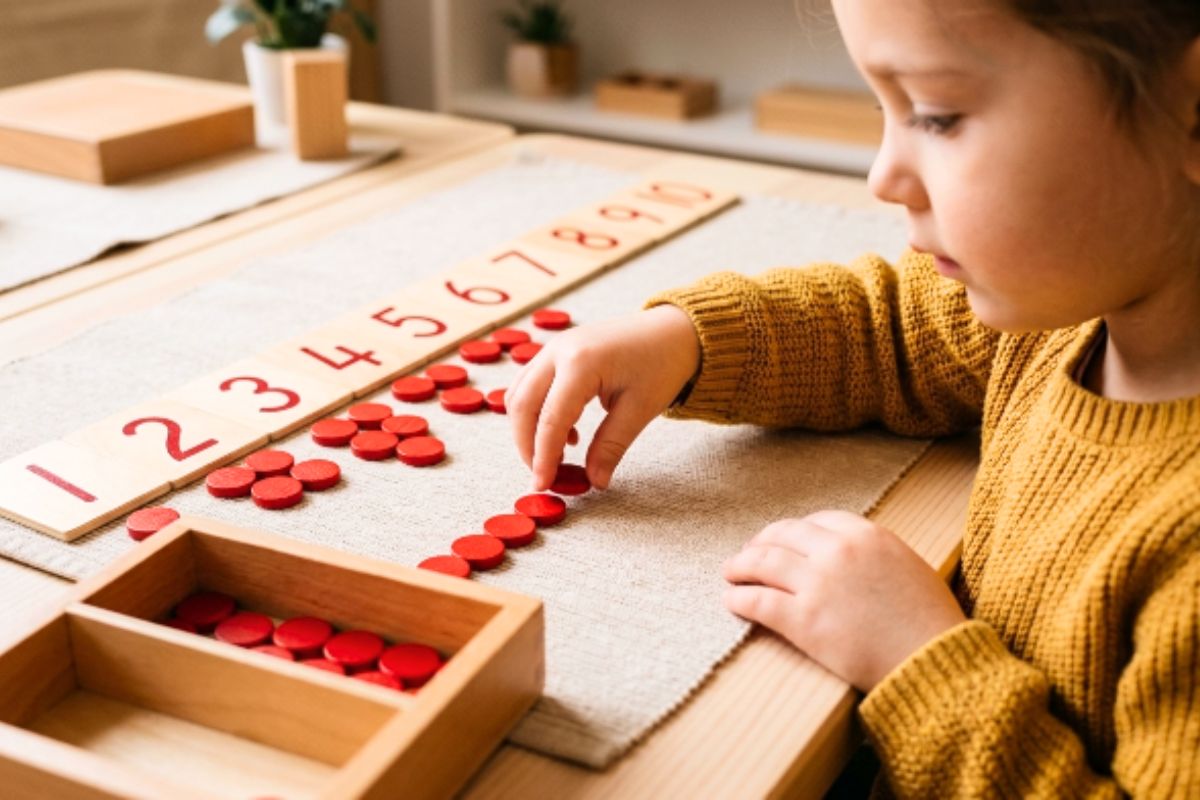
My daughter had been working with number rods for weeks. She could build them in order, name them, pair them with the sandpaper numerals. Then came the spindle box, where she filled compartments with loose spindles and discovered what zero actually meant. One morning she arrived at the shelf and chose the cards and counters for the first time. She arranged all ten number cards in a row, then began laying out the red counters one by one beneath each card. When she got to nine and placed that last counter alone in the center, slightly below the others, she stopped. Looked at it. Looked at seven. Looked at five. She had noticed something nobody had told her to notice.
That noticing is exactly what the material is designed for. Cards and counters is not about counting practice. It is about a discovery the child makes themselves.
What Are Montessori Cards and Counters?
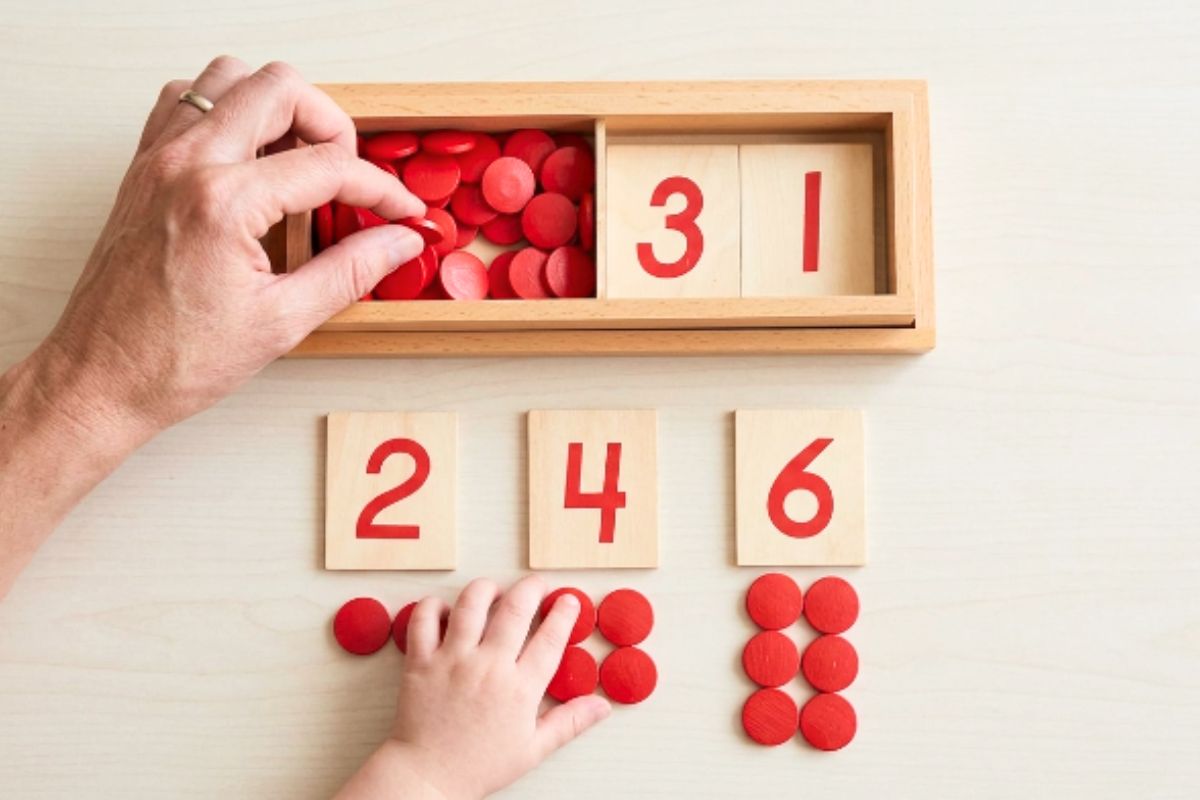
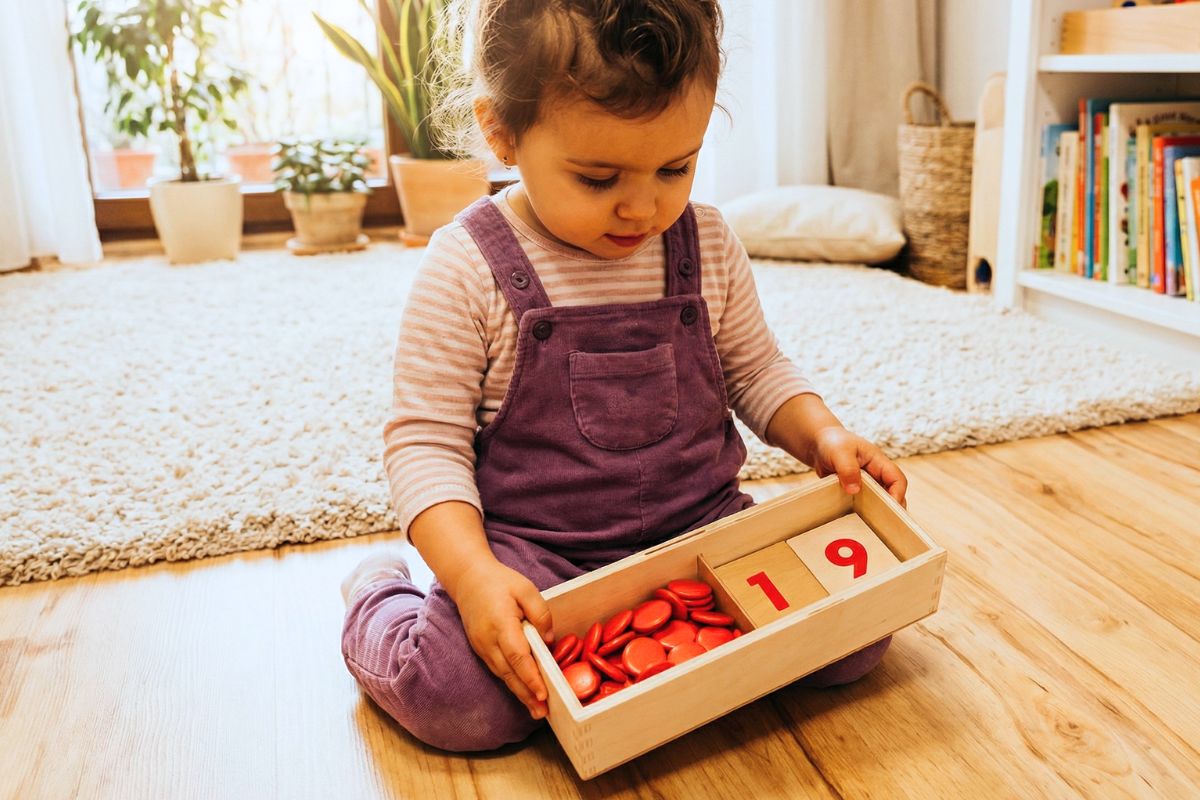
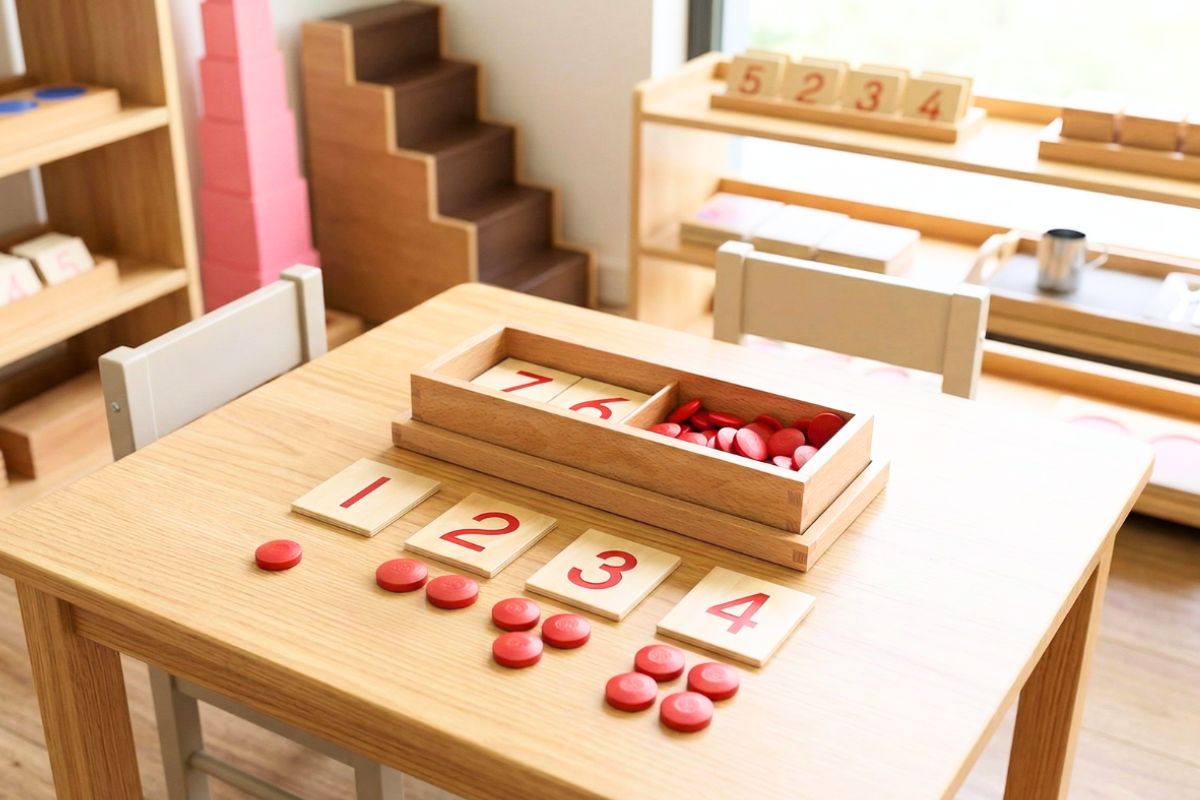
The material is simple: a set of wooden number cards from 1 to 10, and 55 small red circular counters kept in a separate compartment of the same box. The child lays the number cards in order across a mat, then places the corresponding number of counters beneath each card, arranged in pairs, with any remaining counter centered below the last pair.
That arrangement is not decorative. The pairing reveals something the child can see without being told: some numbers end with a counter that has a partner, and some end with a counter that stands alone. The ones with a lone counter are odd. The ones without are even. The child arrives at this through observation of their own work, not through a rule delivered by an adult.
Why exactly 55 counters? Because 1+2+3+4+5+6+7+8+9+10 = 55. The quantity is not arbitrary. It is the precise total needed to represent every number from 1 to 10 simultaneously. If a child finishes with counters left over, or runs out before reaching 10, they know immediately that something has gone wrong somewhere. The total itself is the control of error built directly into the material.
Cards and counters is the third material in the Montessori number sequence, and it represents a meaningful cognitive step. With the number rods, the quantities are fixed in wood. With the spindle box, the numerals are fixed and the quantities are loose. With cards and counters, both the numerals and the quantities are loose for the first time. Nothing guides the child except their own knowledge. This is where everything built in the previous two materials comes together and becomes genuinely independent.
When to Introduce It
Cards and counters is typically introduced in the middle of the primary year, usually around age 4, after the child has worked confidently with the spindle box. The material assumes that the child already understands that a number symbol represents a specific quantity. The question it poses is whether the child can demonstrate that understanding independently, without any fixed structure to lean on.
How to Present It
Cards and counters is presented on a floor mat, as the full layout of 10 cards and 55 counters requires significant space. Carry the box with two hands and invite the child to do the same. The presentation models both the physical setup and the pairing convention, everything else the child works out themselves.
The presentation, step by step
- Carry the box to the mat with two hands. Place it at the top edge. Invite the child to sit beside you.
- Remove the number cards and scatter them on the mat. Ask the child to find “1” and place it in the upper left corner. Ask what comes next. Continue until all ten cards are ordered in a row, spaced a hand-width apart.
- Point to the “1” card. Take one counter from the box and place it beneath the card, centered. Count aloud: “One.”
- Point to the “2” card. Place two counters side by side beneath it: one to the left, one to the right of an imaginary center line. Count as you place each one.
- Point to the “3” card. Place two counters side by side, then place the third counter centered below the pair and slightly lower. Count aloud as each counter goes down.
- Continue this pattern for all ten cards: always pairs first, with any remaining counter centered below the last pair.
- For 10, show the child how to combine the separate “1” and “0” figures if using the traditional loose numeral version. Place five pairs beneath, no remainder.
- Once a few numbers are placed, invite the child to continue independently. Step back and observe.
What not to do: Do not explain odd and even during the first presentation. Do not point to the lone counters and name them. Do not correct the child’s arrangement if they place counters in a non-standard way during early sessions. The pairing convention can be reinforced gently in a second presentation if needed. The visual discovery of odd and even must come from the child’s own observation, not from an adult explanation that arrives before the experience.
What to Observe
Once the child begins working independently, stay close but stay quiet. Cards and counters produces very specific behaviors that tell you both where the child is in their understanding and when they are ready for the odd/even extension.
Signs work is going well
- Child orders all 10 cards before placing any counters
- Counts aloud or under their breath as each counter goes down
- Pauses after placing a lone counter and looks back at the layout
- Spontaneously compares odd and even numbers visually without prompting
- Checks their own work by counting back through each group at the end
Signs to step back or revisit
- Runs out of counters before reaching 10 (miscounting in earlier groups)
- Has counters left over at the end (same cause)
- Places counters without the pairing convention (present the pairing again)
- Skips number cards in the sequence (return to number rod work first)
The 55-counter self-check in practice: Because the total number of counters equals the sum of 1 through 10 exactly, any counting error produces either leftover counters or a shortage before the child reaches 10. The child discovers their own mistake through the material itself, without any adult correction. This built-in control of error is what allows the child to work independently and builds both accuracy and confidence over time.
Extensions and What Comes Next
Once the child has worked with the basic layout across several sessions, the material opens into a sequence of extensions that deepen the odd/even concept and connect naturally to the next materials in the math curriculum.
The finger-slide: making odd and even visible
Once the layout is complete, show the child how to place one finger above the counters beneath each card and slide it slowly down the center. For even numbers, the finger passes between two paired counters all the way to the mat. For odd numbers, the lone counter blocks the finger before it reaches the bottom. The child experiences the difference through touch before they hear the words. Only after they have run the finger-slide themselves do you introduce the vocabulary: “Numbers where your finger slides all the way through are called even. Numbers where a counter is in the way are odd.”
Three Period Lesson: naming, recognizing, recalling
Once the child knows the words, use a Three Period Lesson to consolidate: first period names (“this is odd, this is even”), second period asks the child to recognize (“show me an even number”), third period asks them to recall (“what kind of number is this?”). The concrete experience with the finger-slide makes this lesson land: the child connects the abstract label to a physical memory.
Independent odd/even sorting
Write “Odd” and “Even” on two index cards and place one on each side of the mat. Scatter the number cards randomly and invite the child to sort them from memory, without placing any counters first. The child can then verify their sorting by placing the counters beneath each card and running the finger-slide. The verification itself is the control of error: the child discovers any mistake through the material.
Seasonal and natural counter variations
Any collection of exactly 55 identical objects works as counters: smooth pebbles, acorns, autumn leaves, dried beans, shells, glass nuggets. Children who have mastered the red wooden counters often return to the activity with renewed interest when the counters change. The concept stays the same; the materials shift with the season or the child’s current interest.
What comes after: Teen Boards and the Short Bead Stair
Cards and counters consolidates numbers 1 to 10 with both symbol and quantity free-moving. The next step extends that understanding into the teen numbers (11 to 19) using the Seguin Teen Boards, and then into the full decimal system through the golden bead materials. A child who has genuinely worked through cards and counters and its extensions arrives at those materials knowing exactly what each numeral means as a collection of separate units. That foundation is what the later work rests on.
Questions Parents Ask Most Often
Can I make my own cards and counters at home?+
Yes, and it is one of the easiest Montessori math materials to replicate at home. Write the numerals 1 to 10 clearly on sturdy card stock. For counters, gather exactly 55 identical objects: buttons, smooth pebbles, glass nuggets, dried beans, or coins all work well. The key is that the 55 counters are identical to each other so the child is not distracted by differences in color or shape. The material works exactly the same way regardless of what the counters are made of.
My child keeps miscounting and running out of counters. Is that a problem?+
It means the material has been introduced too early. The control of error built into the 55-counter total reveals the mismatch: the child runs out before reaching 10, or has counters left over. If this happens consistently, go back to the spindle box for another week or two. Cards and counters requires reliable one-to-one correspondence with loose objects up to 10. Introducing it before that readiness is in place turns it into frustration rather than the discovery it is designed to produce.
When do I introduce the words “odd” and “even”?+
Only after the child has done the finger-slide themselves and noticed that some numbers allow the finger through and some do not. The vocabulary must follow the experience, not precede it. If you name odd and even before the child has felt the difference physically, the words become a memorized rule rather than a label for something genuinely understood. Wait for the moment when the child pauses at a lone counter and looks at you with curiosity. That is the moment to introduce the language.
Where does this fit in the Montessori math sequence?+
Cards and counters is the third of the foundational number materials in the primary math sequence. It follows the number rods (fixed quantities paired with sandpaper numerals) and the spindle box (fixed numerals, loose quantities, introduction of zero). Cards and counters is where both symbols and quantities are loose for the first time. After this material, the child moves into the teen number sequence using the Seguin Teen Boards and eventually into the decimal system through the golden bead materials. Each step assumes the previous one is genuinely consolidated, not just completed once.
A Discovery, Not a Lesson
Odd and even is introduced in many classrooms as a rule: “numbers ending in 0, 2, 4, 6, 8 are even.” Children memorize the rule without understanding why it is true. With cards and counters, the child arrives at the same conclusion through their hands. They pair the counters. They run their finger through the center. They find some numbers stop the finger and some do not.
The rule is something they notice, not something they are told. That difference matters far beyond odd and even. It is how Montessori mathematics works at every level: the concept comes through experience first, and the name follows it. Cards and counters is one of the clearest examples of that principle in the whole curriculum.
Scientific References
Laski, E.V., Jor’dan, J.R., Daoust, C. & Murray, A.K. (2015). What Makes Mathematics Manipulatives Effective? Lessons From Cognitive Science and Montessori Education. SAGE Open, 5(2).
Pires, A.C., González Perilli, F., Bakała, E., Fleisher, B., Sansone, G. & Marichal, S. (2019). Building Blocks of Mathematical Learning: Virtual and Tangible Manipulatives Lead to Different Strategies in Number Composition. Frontiers in Education, 4, 81.
Continue Reading
Cards and counters sits in the middle of the Montessori number sequence. These guides cover the materials that come before and after it.