
You are in the waiting room of a therapy centre. Through a small window, you can see a darkened room. A child of about seven, who has autism, is lying on a beanbag surrounded by slowly shifting light. A bubble tube changes colour beside him. There is faint music. He is completely calm. His therapist sits nearby, not intervening, simply present.
This is Snoezelen. It looks passive. It is not.
What this guide covers
- What Snoezelen is and where it came from
- How a Snoezelen room works and what goes in it
- Who benefits and what the evidence actually shows
- How to create a basic Snoezelen-inspired space at home or in school
- How Snoezelen compares to the Montessori prepared environment
What Is Snoezelen?

Snoezelen (pronounced SNOOZ-uh-len) is a portmanteau of two Dutch words: snuffelen, meaning to sniff or explore, and doezelen, meaning to doze or relax. The name itself describes the dual character of the approach: it is both activating and calming, depending on what the person in the room needs.
Formally defined, Snoezelen is a non-directive, multi-sensory therapy that uses controlled combinations of visual, auditory, tactile, and olfactory stimulation to produce relaxation, reduce anxiety, and support cognitive and emotional function. It takes place in a purpose-designed room where every element: the lighting, the sound, the textures, the scent, can be adjusted to the specific needs of the individual at that moment.
Critically, it is not goal-oriented. There is no task to complete, no skill to demonstrate, no assessment at the end. The participant sets the pace. The therapist or caregiver follows. This non-directive character is one of Snoezelen’s defining features and one of the reasons it produces results in populations who resist more structured interventions.
A Brief History
Snoezelen was developed in the Netherlands in the late 1970s by two occupational therapists, Jan Hulsegge and Ad Verheul, who were working with adults with severe intellectual disabilities at De Hartenberg centre in Ede. Their original intention was practical: to create a leisure activity that could engage adults who did not respond to conventional recreational programmes.
They built a tent filled with sensory materials: coloured lights, scented elements, textured objects, soft music, and documented what happened when residents were left to explore it freely. What they observed was striking: participants who were routinely agitated or unresponsive became calm, engaged, and communicative within the space.
Hulsegge and Verheul published their findings in 1987. Within a decade, Snoezelen rooms had been installed across Europe, and the approach had begun to expand into new populations.
The first UK Snoezelen room opened in 1987. North American facilities followed in 1992, with early installations in Toronto and New York. Today, Snoezelen rooms are found in hospitals, care homes, special schools, psychiatric facilities, and increasingly in mainstream schools and private homes.
What Is Inside a Snoezelen Room

A Snoezelen room is not a single standard design. Each room is adapted to its users. What they share is a toolkit of sensory elements that can be combined and adjusted in different ways. The following are the core components found in most installations.
Visual elements
Fibre optic curtains, bubble tubes filled with coloured liquid, LED projectors that cast moving scenes (water, forest, stars), mirror balls. Lighting is always soft, never fluorescent. For those with dementia, flickering must be avoided as it can be perceived as insects or other disturbances.
Auditory elements
Ambient music, nature sounds (water, birdsong, rain), white noise. Volume is low and adjustable. In some rooms, vibro-acoustic elements allow sound to be felt through surfaces, particularly effective for people with hearing impairments.
Tactile elements
Textured wall panels, weighted blankets, soft cushions and beanbags, fidget objects, tactile boards with varied surfaces. The goal is to provide a range of touch experiences that the person can choose to engage with or avoid.
Olfactory elements
Aromatherapy diffusers with calming scents (lavender, vanilla, chamomile). Scent is the most direct route to emotional memory, particularly valuable in dementia care where a familiar scent can trigger positive associations when language no longer can.
The room is designed to be adaptable. Lighting can be brightened or dimmed. Music can be changed or switched off. Scent can be removed. The caregiver continuously observes the individual’s response and adjusts the environment accordingly. This responsiveness is what distinguishes Snoezelen from simply putting someone in a decorated room.
Who Benefits and What the Evidence Shows

Snoezelen has been used with a wide range of populations. The evidence base varies considerably by population, and it is worth being honest about what the research shows and what it does not.
| Population | Reported benefits | Evidence quality |
|---|---|---|
| Autism spectrum | Reduced anxiety, fewer stereotyped behaviours, improved communication with caregivers during sessions | Moderate. Some RCT evidence, but sample sizes small. Effects mainly within-session. |
| Dementia / Alzheimer’s | Reduced agitation, improved mood, decreased aggressive behaviour, better caregiver interaction | Moderate. Cochrane review (Chung et al.) found positive behavioural effects, limited long-term data. |
| Intellectual disabilities | Relaxation, engagement, improved quality of leisure experience | Moderate. The original population for which Snoezelen was designed; longest evidence history. |
| ADHD / Anxiety | Reduced hyperactivity during sessions, improved focus immediately after | Limited. Promising but understudied. Most evidence is observational. |
| Neurotypical children / adults | Stress reduction, relaxation, creative engagement | Weak. No clinical need, limited formal research. Anecdotal benefit. |
An honest note on the evidence: The research on Snoezelen is consistently positive in tone but limited in methodological rigour. Most studies have small samples, short follow-up periods, and difficulty controlling for the effect of the caregiver relationship (which is itself therapeutic).
The Cochrane review on Snoezelen for dementia (Chung et al., 2002) found beneficial behavioural effects during sessions but could not confirm lasting outcomes. This is not a reason to dismiss Snoezelen: it is a reason to use it as one tool among several rather than a primary intervention.
Creating a Snoezelen-Inspired Space at Home or in School
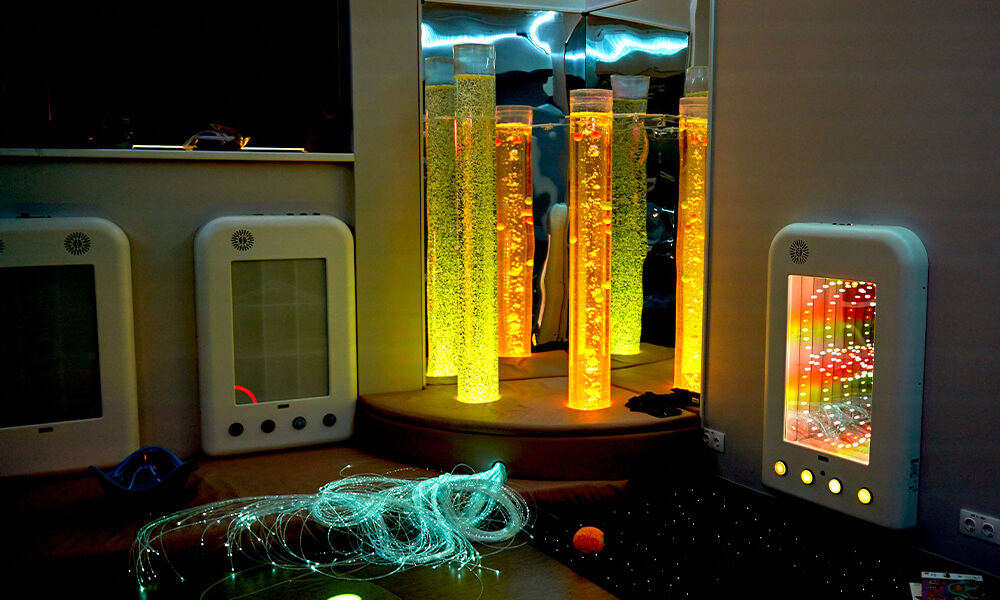
A fully equipped professional Snoezelen room costs between $5,000 and $50,000 depending on the equipment. This is neither accessible nor necessary for most families or small schools. A meaningful sensory space can be created for $150-500 using everyday materials. The principles matter more than the budget.
The principles for any budget
- Softness: Every surface should be softer and quieter than the rest of the house. Rugs, cushions, beanbags, curtains. Hard floors and bright overheads work against the goal.
- Controllable lighting: A dimmer switch costs $15. Fairy lights in a warm white or colour-changing version cost $10-20. These alone transform a corner.
- One focal point: Professional rooms use bubble tubes ($80-200). A cheaper equivalent: a lava lamp, a fibre optic light, or even a large fish tank. Something that moves slowly and holds attention without demanding it.
- Scent: A single aromatherapy diffuser with lavender oil. Subtle, consistent, calming.
- Texture options: A basket of objects with different textures: a smooth stone, a piece of velvet, a rough sponge, a warm wheat bag. Not toys. Objects to hold and explore.
- Sound: A small speaker playing nature sounds or soft ambient music. Volume at conversation level or lower.
- Enclosure: Corners work better than open rooms. A tent, a canopy, or simply a bookshelf creating a defined space increases the sense of safety and containment.
The most important element is not equipment: it is the attitude of the adult. A Snoezelen space used as a time-out location, or as a space where the child is sent rather than accompanied, loses its therapeutic character. The caregiver should enter with the child, follow their lead, and resist the urge to direct, teach, or comment unless the child invites interaction.
Snoezelen and the Montessori Prepared Environment: Two Different Tools
For parents with a background in Montessori, Snoezelen raises an obvious question: is this not just the prepared environment by another name? The two share enough common ground that the comparison is natural. But they are solving different problems.
| Montessori prepared environment | Snoezelen room | |
|---|---|---|
| Primary purpose | Independent learning and skill development | Relaxation, sensory regulation, emotional calm |
| Learning model | Child-directed but with sequenced curriculum | Non-directive, no curriculum, no progression |
| Role of adult | Observer and guide who prepares environment and offers lessons | Follower who adjusts environment to person’s real-time response |
| Materials | Self-correcting, developmentally sequenced, linked to curriculum areas | Sensory stimulation tools with no inherent sequence or self-correction |
| Primary population | Typically developing children, birth to 18 | Any population with sensory, cognitive, or emotional needs |
| What they share | Respect for the individual’s pace, sensory richness, calm and ordered atmosphere, belief that the environment shapes development | |
The most useful way to think about the relationship: the Montessori prepared environment is designed to do something. The Snoezelen room is designed to allow something. Both respect the child’s autonomy. But one is a workshop and the other is a decompression chamber.
A child who is dysregulated cannot engage productively with the Montessori curriculum. A Snoezelen-inspired calm space used alongside the prepared environment serves a complementary function, it enables the regulation that makes learning possible.
Some Montessori schools for children with additional needs have begun incorporating dedicated sensory areas alongside their prepared classrooms. This is not a contradiction of Montessori principles. It is an acknowledgment that children who cannot yet self-regulate need a different kind of support before they can access the classroom environment.
Contraindications and Cautions
Snoezelen is gentle and non-invasive, but it is not appropriate for everyone in every context. These considerations matter.
Epilepsy
Flashing lights and certain flickering patterns can trigger seizures. Any individual with a seizure history needs medical guidance before entering a Snoezelen room. Steady rather than strobe-effect lighting is standard practice in well-designed rooms.
Extreme sensory sensitivity
Some individuals with autism or sensory processing disorder may find even a low-stimulation Snoezelen room overwhelming. The space should always be introduced gradually, with the person able to leave at any time.
Behavioural challenges
Individuals who exhibit aggressive or self-injurious behaviours should be supervised carefully. The room should be free of objects that can be thrown or used harmfully.
Misuse as containment
Snoezelen is not a timeout room, a reward space, or a place to park someone who is difficult to manage. Used as a containment tool rather than a therapeutic one, it loses its value and can become aversive.
Questions Parents and Educators Ask Most Often
Can a typically developing child benefit from a Snoezelen space?
Yes, in the sense that any child benefits from having access to a calm, low-stimulation space where they can decompress without demands. The research on Snoezelen for neurotypical children is thin, but the principle is sound: all children experience periods of sensory overload or emotional dysregulation, and having a designated space for recovery is a practical support.
This is not the same as therapeutic Snoezelen: it is simply good environmental design, which aligns closely with Montessori principles about the role of the physical environment in supporting self-regulation.
How is a Snoezelen room different from a sensory room?
In practice, the terms are often used interchangeably. Technically, “Snoezelen” refers to the specific approach developed by Hulsegge and Verheul, which involves a non-directive therapeutic philosophy, not just a collection of sensory equipment. A sensory room in a school may be primarily designed to provide calming input for dysregulated children, with no therapeutic framework.
Both can be effective. The distinction matters if you are seeking reimbursement from a healthcare system (which may require a specific Snoezelen protocol) or if you are working with a clinician who uses a particular approach.
How long should a session last?
Clinical Snoezelen sessions typically run 30 to 60 minutes. For children with autism or intellectual disabilities, shorter initial sessions of 15 to 20 minutes allow the person to acclimatise before exposure is extended. The child or adult should be allowed to leave at any point.
Forcing someone to remain in a Snoezelen room beyond their tolerance defeats its purpose entirely. The session ends when the person signals they are done, not when a timer runs out.
What is the minimum to create a Snoezelen corner at home?
The absolute minimum that captures the Snoezelen principle: a corner with a beanbag or soft cushion, a string of warm fairy lights on a dimmer, and a small Bluetooth speaker with nature sounds or ambient music. This costs under $60 and creates a meaningfully different environment from the rest of the house.
Adding a lava lamp or a small fibre optic light increases the visual element significantly. The key is not the equipment: it is using the space consistently, calmly, and without adult direction. It only functions as a Snoezelen space if the adult who accompanies the child follows rather than leads.
A Room for Doing Nothing: Which Is Everything
The paradox of Snoezelen is that its value is most visible in what it does not ask. It does not ask the child with autism to perform communication. It does not ask the person with dementia to remember. It does not ask the dysregulated child to be regulated. It simply offers: light, sound, texture, scent, and the presence of another person who is not demanding anything.
For many of the populations it serves, this is a rare experience. It may also be precisely the one they need most. Whether you call it Snoezelen, a sensory room, or a calm corner, the principle is the same: some people need a place where the world asks less before they can give more.