Is your child struggling with traditional grammar lessons? Wondering why they seem bored or confused by abstract rules? You’re not alone. Thousands of parents watch their bright children lose confidence when faced with conventional grammar instruction that feels disconnected from real communication.
Traditional grammar teaching often fails because it asks children to memorize abstract concepts before they understand how language actually works. But Dr. Maria Montessori discovered a revolutionary approach over a century ago that transforms boring rules into colorful, tactile experiences children genuinely enjoy—grammar symbols that make language as engaging as building with blocks.
🎯 Key Takeaways
- Visual & Tactile Learning: Montessori grammar symbols use shapes and colors to make abstract language concepts concrete and memorable
- Scientifically Proven: Large-scale research shows children using these symbols consistently outperform peers in reading, writing, and language skills
- Perfect Timing: Ages 5-12 are when children naturally love exploring words and patterns—symbols tap into this curiosity beautifully
- Flexible Implementation: These symbols work wonderfully in any setting—Montessori schools, traditional classrooms, or homeschool environments
- Lasting Impact: Children develop confident writing, clearer thinking, and genuine excitement about language that stays with them for years
What Are Montessori Grammar Symbols and Why They’re Game-Changers
Montessori grammar symbols represent one of education’s most elegant solutions to a persistent problem. Instead of asking young children to memorize that “a noun is a person, place, or thing,” these colorful, three-dimensional symbols allow children to discover patterns and relationships through hands-on exploration.
Each symbol tells a story through its shape and color. The black triangle representing nouns isn’t random—it symbolizes the pyramid, one of humanity’s most enduring structures, painted black to represent carbon, the fundamental element of life. This thoughtful symbolism helps children form lasting mental connections that simple memorization can’t achieve.
Recent research examining thousands of children across multiple studies reveals that kids in Montessori programs consistently show stronger language development compared to their traditionally-educated peers. When you see your child confidently writing stories or explaining how sentences work, you’re witnessing these research findings come to life.
Why Your Child’s Brain Loves Symbol-Based Learning
Modern brain research confirms what Dr. Montessori observed through careful observation of children: kids learn best when they can see, touch, and move things around. When children trace the smooth surface of a red circle while saying “verb” and then acting out jumping or running, their brains create rich connections that help them remember.
Studies following children from preschool through elementary school found something remarkable: kids who learned grammar through hands-on materials like symbols retained information 40% better than those who only listened to explanations or read about rules. This explains why children who use Montessori grammar symbols often become enthusiastic, confident writers and speakers.
The hands-on element makes all the difference for young learners. Children who manipulate physical symbols while learning grammar develop stronger brain connections than those sitting still and memorizing rules. This finding explains why grammar symbols consistently create kids who actually enjoy working with language.
Complete Guide to Basic Grammar Symbols
The Foundation Nine
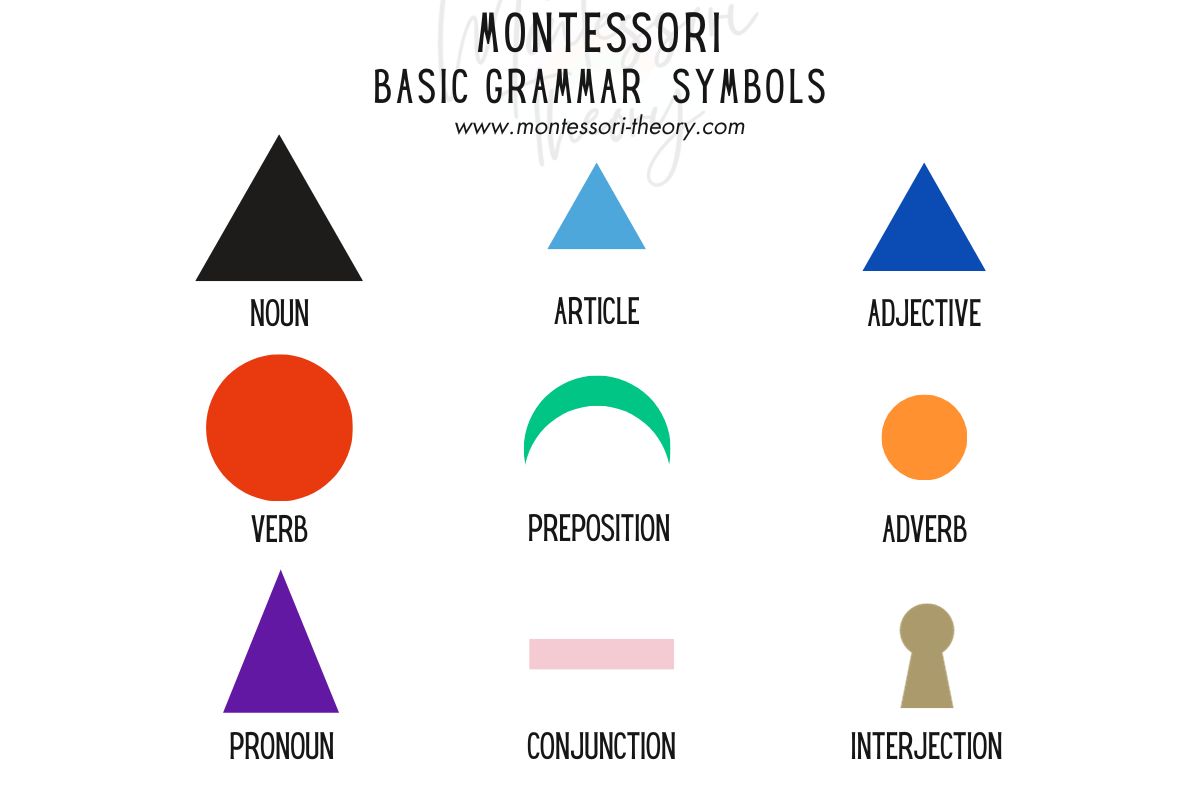
The nine basic symbols form the cornerstone of Montessori grammar instruction, typically introduced between ages 5 and 9 when children’s natural interest in language patterns peaks.
The Noun Family begins with the large black triangle, representing people, places, things, and ideas. Its substantial size and bold color immediately convey importance—nouns anchor our sentences and thoughts. Children quickly learn that everything they can name, see, think about, or imagine can be represented by this powerful symbol.
Articles appear as small light blue triangles, their diminutive size reflecting their supporting role in language. The pale blue represents the sky—always present but subtle, like articles themselves. When children place the tiny blue triangle before the large black one, they immediately understand the relationship between “the” and “book” or “a” and “friend.”
Adjectives take the form of medium dark blue triangles, their rich color representing the depth they add to communication. These symbols help children discover how descriptive words enhance and specify meaning. During lessons, children delight in collecting adjective cards and symbols, building towering piles of “beautiful,” “enormous,” “sparkly,” and “mysterious” that bring their nouns to life.
Verbs command attention as red circles, their shape suggesting continuous movement and energy. The circular form has no beginning or end, perfectly representing the ongoing nature of action and being. Children instinctively understand why “running,” “thinking,” and “becoming” all share this dynamic symbol.
The Supporting Cast includes:
- Adverbs (small orange circles that enhance actions)
- Prepositions (green crescents that bridge relationships)
- Pronouns (purple triangles that substitute gracefully)
- Conjunctions (pink rectangles that connect ideas)
- Interjections (golden ovals that burst with emotion)
Basic Grammar Symbols Chart
| Name | Symbol | Color | Description | Examples |
|---|---|---|---|---|
| Noun | Large Triangle | Black | Represents people, places, things, or ideas | tree, book, city, happiness |
| Article | Small Triangle | Light Blue | Provides context to nouns | a, an, the |
| Adjective | Medium Triangle | Dark Blue | Descriptive words that modify nouns | red, cold, beautiful, enormous |
| Verb | Circle | Red | Action words or words that describe states of being | run, jump, think, become |
| Preposition | Crescent | Green | Indicates direction, location, or time | in, on, under, beside |
| Adverb | Small Circle | Orange | Modifies verbs, adjectives, or other adverbs | slowly, beautifully, very |
| Pronoun | Small Triangle | Purple | Words that stand in for nouns | he, she, it, they |
| Conjunction | Rectangle | Pink | Connects words, phrases, or clauses | and, but, because |
| Interjection | Oval | Gold | Expressive words that convey strong emotions | wow, ouch, hooray |
Advanced Grammar Symbols for Growing Minds
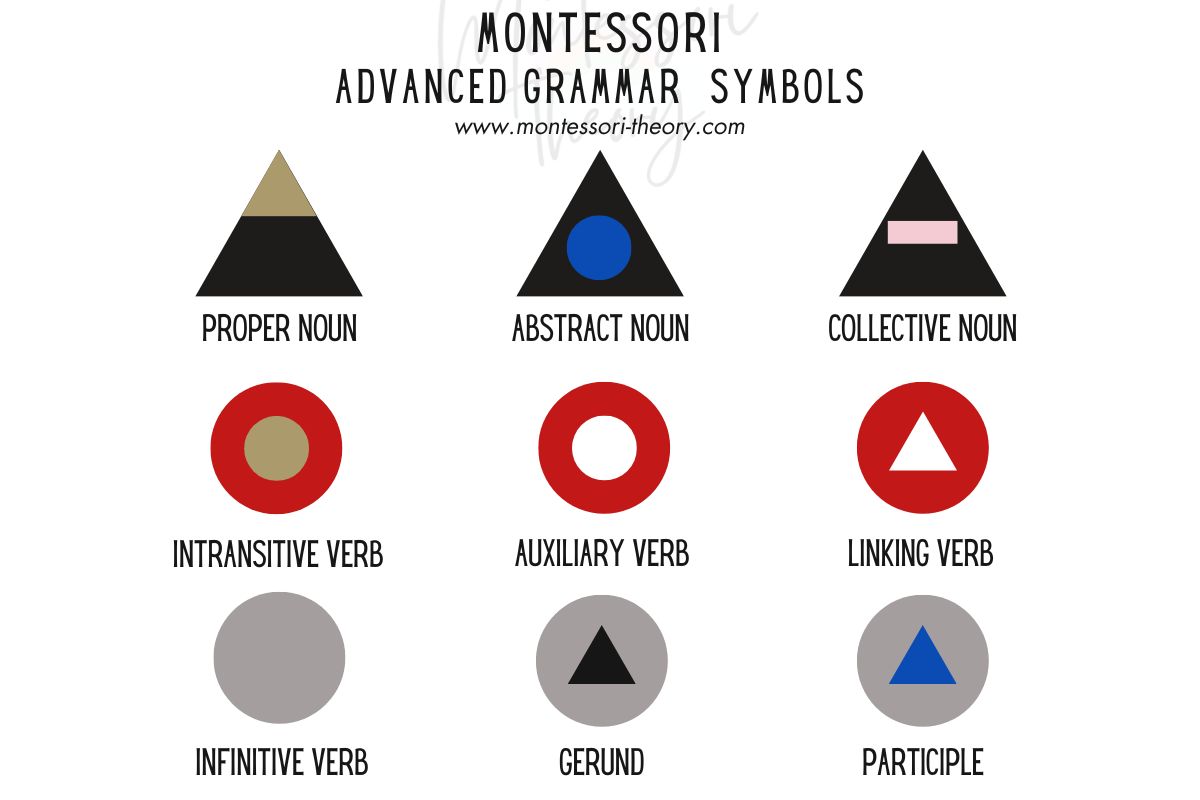
As children master the foundational symbols, usually around ages 9-12, they encounter more sophisticated grammatical concepts through expanded symbol families. These advanced symbols don’t replace the basics but build upon them, creating a comprehensive system for understanding complex language structures.
Advanced Grammar Symbols Chart
| Name | Symbol Variation | Description | Examples |
|---|---|---|---|
| Proper Noun | Black triangle with white line | Specific names or titles | Canada, Shakespeare, Amazon |
| Abstract Noun | Black triangle with gray triangle inside | Intangible concepts or ideas | love, freedom, justice |
| Collective Noun | Black triangle with smaller triangles | Names for groups or collections | herd, team, choir |
| Intransitive Verb | Red circle (specific marking) | Action words that don’t need an object | run, sleep, arrive |
| Auxiliary Verb | Pink circle attached to red circle | Helping verbs that modify main verbs | can, will, should, have |
| Gerund | Red circle with orange rim | Verb form ending in -ing used as noun | swimming, reading, running |
The beauty of this progressive system lies in its logical expansion. Children who thoroughly understand basic triangles and circles can readily grasp that a “collective noun” simply represents a special type of noun—one that gathers individual things into groups. The symbol modification makes intuitive sense, building confidence rather than confusion.
Grammar Symbols Activities That Captivate Young Minds
The Grammar Detective Game
One particularly engaging activity transforms children into grammar detectives, searching through familiar texts to identify different parts of speech. Armed with symbol cards and colored pencils, children might analyze a beloved picture book, placing symbols above words and color-coding their findings.
This detective work appeals to children’s natural curiosity while reinforcing symbol recognition. As children become more skilled detectives, they begin noticing patterns across different texts—how authors use multiple adjectives for emphasis, how varying sentence lengths creates rhythm, how different parts of speech work together to create meaning.
Living Grammar Theater
Physical movement amplifies symbol learning through what researchers call “embodied cognition.” In living grammar theater, children literally become different parts of speech, acting out their roles in sentence construction. Here’s how this magical activity unfolds:
- Verbs bounce energetically around the space, showing action and movement
- Nouns stand solid and strong, representing stability and substance
- Adjectives dance around nouns, adding flourishes and dramatic gestures
- Prepositions create bridges between other parts of speech with their bodies
- Conjunctions link hands to show how they connect different ideas
This kinesthetic approach particularly benefits children who struggle with traditional academic instruction. Research shows that physical movement during language learning creates stronger brain connections and dramatically improves retention compared to sitting-still instruction methods.
Creative Writing Through Symbol Planning
Advanced students use symbols to plan original writing projects, creating symbol patterns before writing actual sentences. A child might decide to write a story using the pattern: article-adjective-noun-verb-adverb-preposition-article-noun. This constraint-based writing, similar to poetic forms, often produces surprisingly creative and sophisticated results.
Symbol planning helps children understand that good writing requires intentional structure, not just creative ideas. Students who learn this principle early often become more confident and capable writers throughout their academic careers.
Using Grammar Symbols in Your Learning Environment

Starting Strong: First Week Foundations
Successful implementation begins with understanding that grammar symbols work best when introduced gradually and joyfully. Here’s how to create those magical first moments:
Week 1 – The Noun Adventure
- Gather children around a beautiful basket with miniature objects (tiny horse, smooth stone, delicate shell, small book)
- As children name each object, place a black triangle beside it
- Explain that this special symbol represents everything we can name
- Let children find more objects around the room to “label” with triangles
Week 2 – Articles Join the Party
- Play “treasure hunt” games where children find objects
- Practice saying “the pencil,” “a flower,” “an apple”
- Each time, place the small blue triangle before the large black one
- Children quickly see how articles and nouns work together
Weeks 3-4 – Adjectives Add Color
- Explore different textures: smooth silk, rough sandpaper, soft cotton
- Place dark blue triangles beside descriptive words
- Children love collecting “beautiful,” “enormous,” “sparkly” adjectives
- Watch them naturally start using more descriptive language
Building Complexity Through Guided Discovery
As children master individual symbols, they naturally progress to sentence construction activities. Rather than providing rigid templates, effective instruction encourages experimentation and discovery. Children might receive a collection of symbols and word cards, then explore different combinations to create meaningful sentences.
These exploration sessions often produce delightful surprises. Children discover that some word arrangements “sound funny” while others “make perfect sense.” Through this guided discovery, they develop intuitive understanding of syntax and grammar rules without pressure or failure.
Adapting Grammar Symbols for Different Learning Environments
Traditional Classroom Integration
Teachers in conventional schools can successfully integrate grammar symbols without completely overhauling their existing curriculum. Many educators begin by using symbols during editing and revision sessions, helping children identify and correct grammatical errors in their writing.
Symbol integration might start with weekly grammar centers where small groups work with symbols while other students complete different activities. As children become familiar with symbols, teachers can incorporate them into whole-class instruction, using large symbols on magnetic boards or interactive whiteboards.
Homeschool Implementation Strategies
Homeschooling families often find grammar symbols particularly valuable because they provide structured yet flexible language instruction. Parents need not be grammar experts to implement symbol-based learning effectively—the materials guide both parent and child through discovery-based exploration.
Many homeschool families create symbol storage systems using small boxes or containers, making the materials easily accessible for spontaneous learning moments. When children show interest in words or sentences during read-aloud time, parents can quickly gather symbols for impromptu explorations.
Supporting Students with Learning Differences
Grammar symbols prove especially beneficial for children with various learning differences. Students with dyslexia often find the visual-spatial aspects of symbols easier to process than traditional text-based instruction. Children with attention challenges frequently show improved focus when engaged with hands-on materials rather than abstract concepts.
Research in special education shows that hands-on approaches like grammar symbols can help students with learning differences achieve academic success that traditional methods might not support. The concrete nature of symbols provides scaffolding that helps struggling learners access grade-level content.
Troubleshooting Common Implementation Challenges
When Children Resist Symbol Work
Sometimes children push back against grammar symbol activities, especially if they’ve had frustrating experiences with traditional grammar instruction. Here are gentle strategies that usually turn reluctance into enthusiasm:
- Start with their interests: Use topics they love—dinosaurs, princesses, sports, favorite book characters
- Make it optional: Leave symbols available without pressure; curiosity naturally takes over
- Keep sessions super short: 5-10 minutes prevents overwhelm and maintains excitement
- Celebrate small wins: “Wow, you found three nouns!” builds confidence quickly
- Let them teach: Children love showing symbols to siblings, friends, or stuffed animals
The key is patience and following your child’s natural rhythm. Many children who initially avoid grammar work become the most enthusiastic symbol users once they discover how fun it can be.
Managing Mixed-Age Groups
Multi-age classrooms benefit from symbol flexibility. Advanced students can mentor beginners, while teachers create symbol challenges appropriate for different levels. The system naturally supports differentiated instruction—beginners work with basic symbols while advanced learners explore complex structures using the same foundational materials.
Real Results from Real Families
Research Shows Meaningful Improvements
Studies following children over several years found something wonderful: kids who learned grammar through symbols showed much stronger writing and speaking skills than their classmates using traditional methods. These children were more confident expressing themselves, wrote more creative stories, and actually enjoyed working with language.
What makes this even more exciting is that these benefits lasted for years. Even when children moved to schools with traditional teaching methods, they kept their advantages in communication skills and writing ability. Parents consistently report that their children who learned with symbols become more articulate and confident communicators.
Understanding Why Symbols Work Everywhere
Research conducted in schools across different countries and cultures provides additional proof that symbol-based grammar instruction works universally. Whether children speak English, French, Spanish, or other languages, the visual-spatial aspects of symbols support language learning effectively.
These international findings suggest that the benefits of symbol-based grammar instruction come from basic principles of how humans learn, rather than specific features of any particular language. The visual and hands-on nature of symbols appears to help children learn grammar regardless of their cultural background.
Free Resources to Get Started
DIY Materials You Can Make Today
Printable Symbol Sets
- Download templates for cardstock symbols
- Laminate for durability in classroom use
- Create storage boxes with compartments for organization
Interactive Games
- Symbol Memory matching games
- Grammar Symbol Bingo for whole-class activities
- Sentence Strip puzzles for independent work
Assessment Tools
- Symbol placement worksheets
- Progress tracking charts
- Self-evaluation rubrics for students
Digital Integration
Online Activities
- Interactive symbol placement games
- Digital sentence builders
- Virtual grammar box experiences
Your Child’s Grammar Journey Starts Here
Watching your child struggle with traditional grammar lessons breaks every parent’s heart. But here’s what thousands of families have discovered: when children can touch, move, and play with language through Montessori grammar symbols, everything changes. You don’t need to be a grammar expert or completely overhaul your child’s education—start small with a few colorful triangles and circles, a handful of word cards, and your child’s natural curiosity. Whether you’re homeschooling, supplementing traditional education, or simply looking for engaging weekend activities, these symbols open doors to confident communication that will serve your child for life, transforming language learning from a chore into an adventure.
References
- Lillard, A. S. (2017). Montessori education: a review of the evidence base. NPJ Science of Learning, 4(1), 10. https://www.nature.com/articles/s41539-017-0012-7
- Rathunde, K., & Csikszentmihalyi, M. (2005). The social context of middle school: Teachers, friends, and activities in Montessori and traditional school environments. Elementary School Journal, 106(1), 59-79. https://doi.org/10.1086/496907
- Gentaz, E., & Richard, S. (2022). The Behavioral Effects of Montessori Pedagogy on Children’s Psychological Development and School Learning. Children, 9(2), 133. https://www.ncbi.nlm.nih.gov/pmc/articles/PMC8870616/
- Courtier, P., et al. (2021). Effects of Montessori Education on the Academic, Cognitive, and Social Development of Disadvantaged Preschoolers: A Randomized Controlled Study. Developmental Psychology, 57(11), 1914-1928. https://doi.org/10.1037/dev0001232
- Lillard, A. S., & Else-Quest, N. (2006). Evaluating Montessori education. Science, 313(5795), 1893-1894. https://doi.org/10.1126/science.1132362
- Wang, X., Chen, Y., & Liu, Z. (2010). Effects of Montessori education on intellectual development in children aged 2-4 years. Chinese Journal of Child Health Care, 18(4), 298-300. https://pubmed.ncbi.nlm.nih.gov/20113610/
- Kuhl, P. K. (2011). Early language learning and literacy: neuroscience implications for education. Mind, Brain, and Education, 5(3), 128-142. https://doi.org/10.1111/j.1751-228X.2011.01128.x
- Denervaud, S., et al. (2019). Beyond executive functions, creativity skills benefit academic outcomes: Insights from Montessori education. PLoS One, 14(11), e0225319. https://journals.plos.org/plosone/article?id=10.1371/journal.pone.0225319
- Boehnlein, M. M. (1988). Montessori research: Analysis and critique. In Montessori education research. American Montessori Society.
- Dohrmann, M., et al. (2007). High school outcomes for students in a public Montessori program. Journal of Research in Childhood Education, 22(2), 205-217. https://doi.org/10.1080/02568540709594622