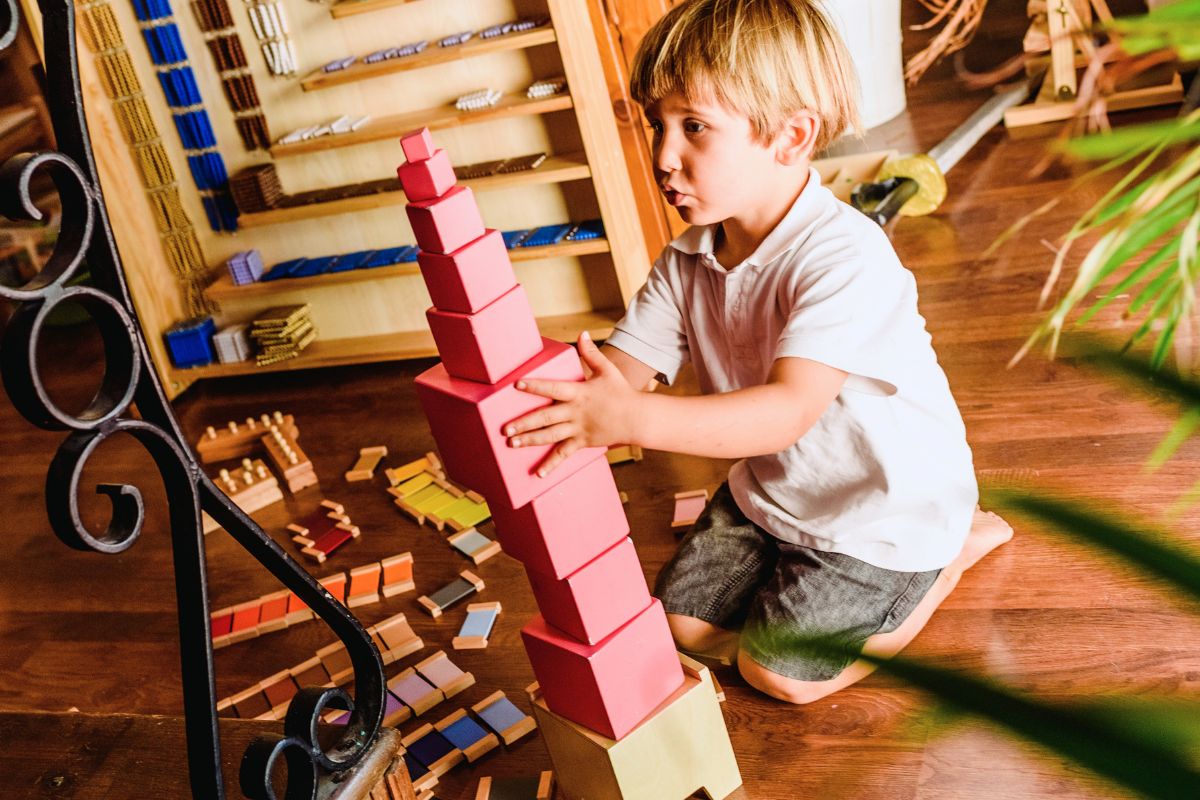
Ten pink cubes, stacked biggest to smallest. At first glance it looks like any wooden stacking toy you could find at a regular toy shop for a fraction of the price. It is not. Every cube’s size was chosen with a specific number in mind, and the whole tower is quietly setting your child up to understand the cubic function years before anyone says the word “math.”
Even the color was not a design choice. Maria Montessori tested several colors with real children before landing on pink, because it was the one they responded to most.
Quick Facts
- ●What it is: 10 solid wooden cubes, all pink, from 1cm³ to 10cm³
- ●Age: typically introduced between 2.5 and 3.5 years
- ●Category: Sensorial, part of the “visual sense” group of materials
- ●Main purpose: visual discrimination of size in three dimensions at once
- ●Self-correcting: yes, a wonky tower is visibly wonky, no adult needed to point it out
It Is Not Just a Stacking Toy
A regular set of stacking blocks usually grows in one dimension, taller or wider, and often uses different colors to make sorting obvious. The Pink Tower does the opposite on purpose. Every cube is the exact same pink, and every cube grows in all three dimensions at once, height, width, and depth together.
That single design choice, removing color as a clue, forces a child to judge size the hard way, by looking, comparing, and sometimes picking cubes up to feel the difference. Nothing else about the material is giving the answer away.
The math hiding in plain sight
The cubes are not just “bigger, a bit more.” Each one increases by the cube of its position in the sequence. The second cube contains exactly 8 copies of the smallest one. The third contains 27. The tenth contains 1,000. Long before your child hears the words “cubed” or “cube root,” their hands have already handled the concept.
What It Actually Develops
The Pink Tower is doing more than one job at once, which is typical of good sensorial materials.
Visual size discrimination
Judging which of two objects is genuinely larger, in three dimensions, not just guessing from height alone.
Fine motor control
Carrying, gripping, and precisely placing a heavy wooden object without knocking the tower over.
Order and sequence
Building a system, largest to smallest, and holding it in mind the whole time.
Early mathematical mind
A physical, hands-on encounter with volume and the base-ten system, years before formal arithmetic.
How to Actually Use It

The real Montessori presentation is slower and quieter than it looks in most photos. Here is the version that matches how it is actually taught.
1
Roll out a small rug or mat on the floor. This marks the workspace clearly.
2
Carry the cubes over one at a time, using two hands for the bigger ones, and scatter them randomly on one side of the mat. Do not line them up in order yet, that would give the answer away.
3
Find the largest cube together, and place it on the mat. Make a small show of “looking” for it, this is the part that teaches the actual skill.
4
Find the next largest, and center it carefully on top. Continue, one cube at a time, all the way down to the smallest.
5
Take it apart the same careful way, largest cube first, scattering the cubes again, then invite your child to build it themselves.
If they get it wrong
Say nothing. A cube placed out of order makes the tower visibly lopsided or unstable, and most children notice and fix it themselves within a few tries. This is the “self-correcting” part of the material at work. Pointing out the mistake yourself takes that discovery away from them.
Once Building It Is Easy: What Comes Next
A child who can build the tower without a second thought is ready for more, not a new toy, just a new way to use the same one.
- ●Build it flat. Lay the cubes out in a row on the floor instead of stacking, largest to smallest, which shifts the focus from balance to pure size judgment.
- ●Measure with the smallest cube. Use the 1cm cube as a ruler, sliding it along the edge of each larger cube to check exact alignment.
- ●Combine it with the Brown Stair. A related sensorial material of 10 prisms that vary in width and height, useful for comparing “tall” against “wide” directly.
- ●Guess before checking. Hold up two cubes and ask which is bigger before letting them test it by stacking, building genuine estimation skill.
Do You Need to Buy the Real One?
A genuine wooden Pink Tower, precisely cut to the cubic progression, is not cheap, and the exact millimeter accuracy is part of what makes the sensorial lesson work. That said, a rough DIY version can still introduce the idea before you invest in the real thing.
A rough substitute: stack of same-colored boxes, blocks, or even books in genuinely different sizes can teach the basic sequencing idea. What it will not replicate is the precision, the exact cubic relationship between each piece is what makes the material a real preparation for later math, not just a stacking game.
Frequently Asked Questions
Why is it pink specifically?+
Maria Montessori tested several colors with the children she worked with, and pink was the one that consistently drew the strongest response. It stuck, and the name followed. The color itself carries no symbolic meaning beyond that original observation.
What should my child know before starting the Pink Tower?+
Most classrooms introduce it after a child has worked with the Knobbed Cylinders, a simpler size-based material with built-in guides. Basic vocabulary around big and small, and comfort with careful grasping and releasing, are the other useful signs of readiness.
My child just wants to knock the tower over. Is that bad?+
Very common at first, and not a sign anything is wrong. It usually means the child is not developmentally ready to focus on the size-ordering task yet, or the material was introduced before genuine interest showed up. Put it away for a few weeks and reintroduce it later rather than repeating the same lesson while the interest is not there.
Is the Pink Tower the same as regular stacking blocks?+
No. Regular stacking sets usually vary in one dimension and use different colors as sorting cues. The Pink Tower deliberately removes color as a hint and grows in all three dimensions by an exact cubic ratio, which is what makes it a genuine preparation for later mathematical concepts rather than a simple stacking game.
A Simple Object Doing a Lot of Work
The Pink Tower looks deceptively simple, ten identical blocks in one color, stacked biggest to smallest. That simplicity is the design. By removing every clue except size itself, it hands a young child a genuine, hands-on encounter with volume, order, and the cubic function, long before any of those words mean anything to them.
Let them build it, take it apart, and build it again. The repetition is not filler. It is the whole point.
Sources
American Montessori Society. Revisiting the Pink Tower: A Pillar of Pedagogical Ingenuity. amshq.org →
Montessori Academy. Material Spotlight: Montessori Pink Tower. montessoriacademy.com.au →